


By my careful maternal estimate, Ezra has grown approximately six inches since last Sunday. I can’t confirm this because confirmation would require measuring him, and measuring him might reveal that my mister boy is becoming less of a baby. I prefer to conduct my research according to the ancient scientific principle of refusing data that could hurt my feelings.
He looks enormous, little curls have appeared along the back of his head, soft wisps that seem designed specifically to make it impossible for me to put him down. Every morning, he wakes me by throwing his bottle from his crib and yelling, “Mom,” which is both an effective communication strategy and an early demonstration of executive leadership. He’s a boy who knows what he wants and expects the relevant departments to respond promptly.
Still, I can already see the tenderness in him. When I lift him from his crib, he rests his head against my chest and gently rubs my shoulder while we snuggle. It is such a small gesture, but it tells me something about the person gathering inside him. He will be strong, certainly. He has already perfected the forceful disposal of unwanted objects. But I think he will also be soft in the places that matter.
My daughter is recovering. She has good stretches and difficult ones, and we are watching her closely, making sure she stays hydrated and gets some food into her tummy. There are few things more unsettling than watching the usual brightness leave a child’s face, even temporarily. We are taking each improvement as it comes and remaining nearby for everything else.
My oldest is now officially in the double digits, a development I find both thrilling and personally offensive. Ten years have somehow passed despite my having made no such authorization. He is delighted, and he should be. Every day, he moves a little closer to his goals, learning how to understand himself, manage the harder moments and keep going. I could not be prouder of the boy he has been or the person he is becoming.
Then, of course, there’s the husband. On Friday, he finally put his architectural genius to what I would call good use by designing a trellis for the cucamelons and cucumbers out of woodland sticks, then instructing me in its construction. I admit that “my husband taught me how to build a cucamelon trellis from forest debris” is not a sentence I imagined saying when I pictured my future. Sometimes the lives we never knew to ask for become the ones we are most grateful to inhabit.
For clarification, he uses his architectural genius for good quite regularly. He’s currently building a fairy garden bed from giant boulders and constructing a mystical river.
Technically, the mystical river is drainage infrastructure intended to prevent the driveway from flooding. He will never allow me to believe it is anything less than an enchanted waterway, because if there is one thing I can count on with that man, it is that he will carry me out of reality and into the magical whenever I ask. He’s my soul mate, there’s no more complicated explanation required.
The home front has its ups and downs. We worry, recover, build trellises, monitor small tummies and pretend babies haven’t grown six inches. Yet there is no doubt that I live among the most tenderhearted, fierce when necessary, deeply loving creatures I have ever had the pleasure of sharing a woodland cottage with. Perhaps that’s why this week’s stories found me so easily.
One is about a garden hidden beneath the ocean, alive in a place where scientists had expected to find only remains. The other is about giraffes returning to land that human violence once emptied. Both remind us that absence is not always permanent, and an obituary is sometimes only a failure of imagination.
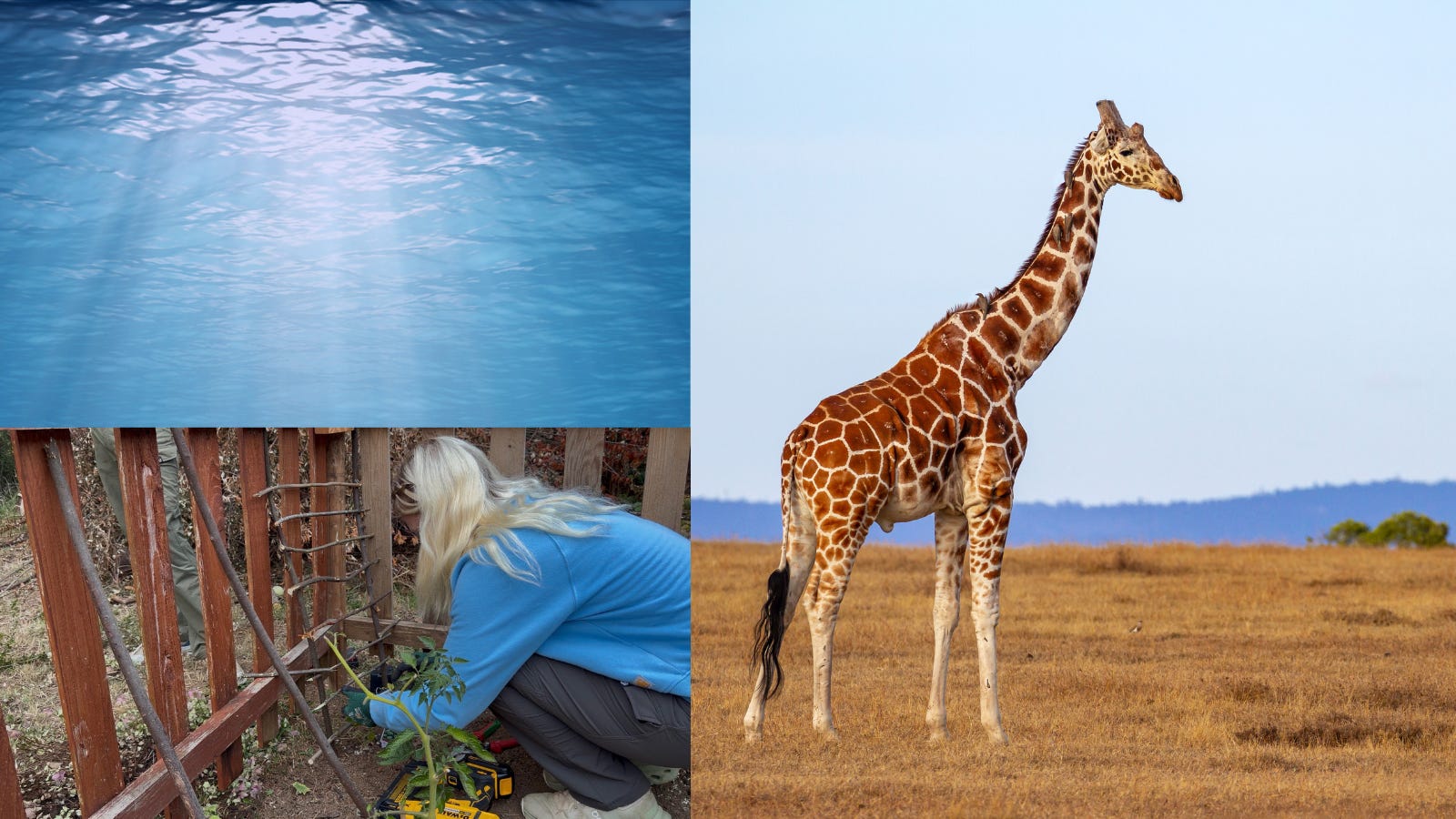
More than sixty years ago, researchers surveying the continental shelf off Benin in West Africa found evidence of coral structures roughly 170 feet beneath the surface. Without the technology to see the seafloor clearly, they presumed the corals were dead.
For decades, that was the accepted story; then scientists went looking again. Between April and December 2025, researchers returned to the Gulf of Guinea with side-scan sonar, underwater cameras and a remotely operated drone. At a depth of about 177 feet, their lights found not a marine graveyard but a living coral garden.
The newly documented ecosystem is dominated by octocorals, the soft corals that often grow into elaborate fans, feathers and branching forms. Researchers observed at least six octocoral varieties, two kinds of black coral and eight species of reef-associated fish sheltering and feeding among them.
It’s not the towering, framework-building reef we might picture from tropical postcards. It’s a mesophotic coral garden, growing in the ocean’s dim middle depths where little sunlight reaches and ordinary divers rarely go; that makes it no less astonishing. These deeper coral communities form a living bridge between shallow reefs and the deep sea, creating structure in places that might otherwise offer marine life little shelter.
Scientists don’t yet know whether the corals survived there all along or returned after an earlier decline. The original researchers may simply have lacked the tools to recognize the life beneath them. Either possibility is beautiful, for sixty years, humanity had written “dead” beside a place it could not properly see. Meanwhile, coral fans opened in the darkness, fish moved among the branches, and an unseen community continued its quiet work.
Coral ecosystems are among the great living architectures of the planet. Although coral reefs cover less than one percent of the seafloor, they support at least one quarter of marine species. They give fish places to feed, reproduce, hide and grow. They sustain fisheries and food webs, support the livelihoods of coastal communities and hold possibilities for medicines scientists have only begun to explore.
Shallow, framework-building reefs also soften the violence of the sea. Healthy reefs can absorb as much as 97 percent of a wave’s energy, reducing erosion and protecting coastlines from storms and flooding. They are nurseries, barriers, neighborhoods and living breakwaters, built one tiny coral animal at a time.
We’ve done terrible damage to them through warming waters, pollution, acidification and destructive fishing. Hope doesn’t require us to pretend otherwise, it simply asks us to recognize that life remains possible, then behave as though protecting it matters. Off Benin, scientists have now found a living ecosystem where the record held only a presumed death. Sometimes we mistake the limit of our vision for the limit of life.
Meanwhile, In Uganda, rangers have begun moving 12 endangered Nubian giraffes from Murchison Falls National Park to Ajai Wildlife Reserve, a journey of about 65 miles and several decades in the making.
Ajai once held abundant wildlife. In the early 1980s, poaching and political instability devastated the reserve, leaving a landscape that had known rhinos, buffaloes, antelopes and other animals unnaturally quiet. Now, people are filling that silence again.
Southern white rhinos, buffaloes, zebras and hundreds of Uganda kobs are being reintroduced. Rangers have been added, local communities are participating in conservation and sharing tourism revenue, and animals already returned to the reserve are spreading through the habitat, and many are pregnant.
Into this recovering landscape came the giraffes, transported in specially prepared trucks with branches mounted inside for them to eat along the way. Even during a major wildlife relocation, snacks remain essential. The move is partly intended to establish another population of Nubian giraffes and restore biodiversity at Ajai. It also places some distance between the animals and the intensifying oil development inside Murchison Falls, where heavy machinery now moves through habitat that wildlife can’t simply replace with a reasonably priced apartment in a quieter neighborhood.
The relocation doesn’t erase the danger. Oil extraction, habitat loss, climate change and human encroachment continue to pressure wildlife across the region. Moving 12 giraffes can’t repair everything people have damaged, but it can repair something.
There is profound humility in returning an animal to a place from which human actions drove it away. It is an acknowledgment that an empty landscape is not necessarily a natural one, and that restoration sometimes means carrying life back with our own hands.
The giraffes stepped from the trucks into a 64-square-mile reserve that had been waiting for them longer than they could know. They entered a place where other animals were already multiplying, where rangers stood ready and where people had decided that the silence left by destruction didn’t have to last forever.
A coral garden lived beneath the water while no one was watching, and a wildlife reserve is being rebuilt because people finally began watching closely enough. Perhaps that’s the hope these stories offer us.
Life is resilient, but resilience isn’t permission to keep injuring it. Tenderness requires attention and love isn’t merely believing that something will survive; it’s building the trellis, moving the giraffe, protecting the reef, offering the water and staying close through the difficult night.
Here in our woodland cottage, my husband is turning drainage into a mystical river. My daughter is healing. My oldest is moving bravely into his second decade. Ezra is growing curls and demanding morning bottle service before resting his sweet head against my chest. Around us, things are growing, returning and becoming.
The world is wounded, certainly, but it is not finished. Beneath the water and across the grasslands, life continues building places for itself. Sometimes it survives beyond our sigh, sometimes it needs us to carry it home, either way, the tenderhearted are still here.
P.S. Our subscription rates for new paid subscribers will increase on 08/15/2026. Upgrade before then to lock in our current price of $7/month or $70/year. Existing paid subscribers will keep their current rate. Learn more here:

Thank you again for the hopeful news about coral reefs, giraffes, and your precious family.
I have an update for your readers about something you wrote about a few weeks back. The campaign to raise money to "Save Moon Camp" in Big Bear Valley California has been closed. They received a 5.5 million dollar donation from Anna and Greg Brockman, (tech millionaires) which will be enough to purchase the land and make needed improvements. This is the good news. The bad news is that Jackie, the celebrity mama eagle, is at a raptor rehab center. She was found on the ground by caring humans who stayed with her for hours trying to find someone who could come and help. Finally the fire department was able to get ahold of an animal rescue group. Jackie is anemic and her kidney function is low. An eagle (named Spirit) at a nearby zoo donated blood for a transfusion. The raptor center will give another update tomorrow about her condition.
Hope..