


This is part three in “The Mirror We Refuse to Look Into” series, part one and two can be found at the links below:


The first danger of authoritarian politics is rhetorical. It is the lie repeated until it feels like weather, the enemy named often enough to seem real, the leader elevated until doubt itself feels disloyal. But rhetoric is only the beginning. The deeper danger begins when the language of fear stops being performance and starts becoming procedure, when grievance acquires an office, a budget, a badge, and the force of law.
That is where the real historical warning lives, because democracies do not usually collapse in a single cinematic moment. They are hollowed out in stages, as people are taught first to fear, then to obey, and finally to call obedience realism. By the time the machinery becomes obvious, it has often already been normalized.
People hear the word fascism and imagine uniforms, salutes, banners, a visual grammar so unmistakable that no one could possibly miss it. That fantasy is comforting because it allows us to believe we would recognize the danger on sight. History is less generous than that.
Fascism is better understood not as a costume but as a method, a political way of organizing fear, belonging, grievance, loyalty, and power. The research makes that plain. Fascism, in the comparative sense, is not a single doctrine frozen in interwar Europe. It is a family of movements organized around a myth of national rebirth, a leader who claims to embody the people, enemies cast as contaminants, the normalization of violence, and the conversion of state institutions from restraints into instruments. The historian Roger Griffin, one of the major scholars of fascism, identifies the myth of national rebirth as one of its defining features. The historian Robert Paxton focuses less on doctrine than on political behavior, showing how fascism grows through alliances, radicalization, violence, and the capture of institutions. Emilio Gentile, another leading historian of fascism, explains how fascist politics turns the nation and the leader into sacred objects of loyalty.
That matters because the useful question is not whether the United States has become a carbon copy of 1933. The useful question is whether recognizable fascist methods are finding a home inside an American democratic shell.
Every fascist politics begins with a wound story. The nation has been humiliated, corrupted, weakened, invaded, softened, betrayed, or made to kneel. Ordinary politics cannot heal such a wound because ordinary politics deals in compromise, and rebirth myths despise compromise. They demand purification, restoration, and a leader who will not merely govern but redeem. That is what makes this politics more dangerous than standard reaction. It does not simply promise order. It promises resurrection.
In Donald Trump’s 2025 inaugural address, he declared that “the golden age of America begins right now,” called January 20, 2025 “Liberation Day,” said his life was “saved by God” to make America great again, and described his return as the start of “the complete restoration of America.” That is not incidental flourish. It is the old grammar of rebirth politics, with the nation cast as fallen, the moment cast as redemptive, the leader cast as chosen, and the future cast as restoration rather than democratic argument.
In a functioning democracy, a leader is supposed to be temporary, bounded, and replaceable. In fascist politics, the leader becomes something much larger and much more dangerous, the symbolic body of the nation, the vessel through which the people imagine themselves unified, vindicated, and made strong. At that point criticism no longer feels like disagreement. It feels like desecration. Loyalty, once owed to law, is transferred to the person who claims to embody the people. This is why authoritarians spend so much time teaching people to confuse devotion with patriotism. The leader does not simply ask to govern the nation. He asks to stand in for it.
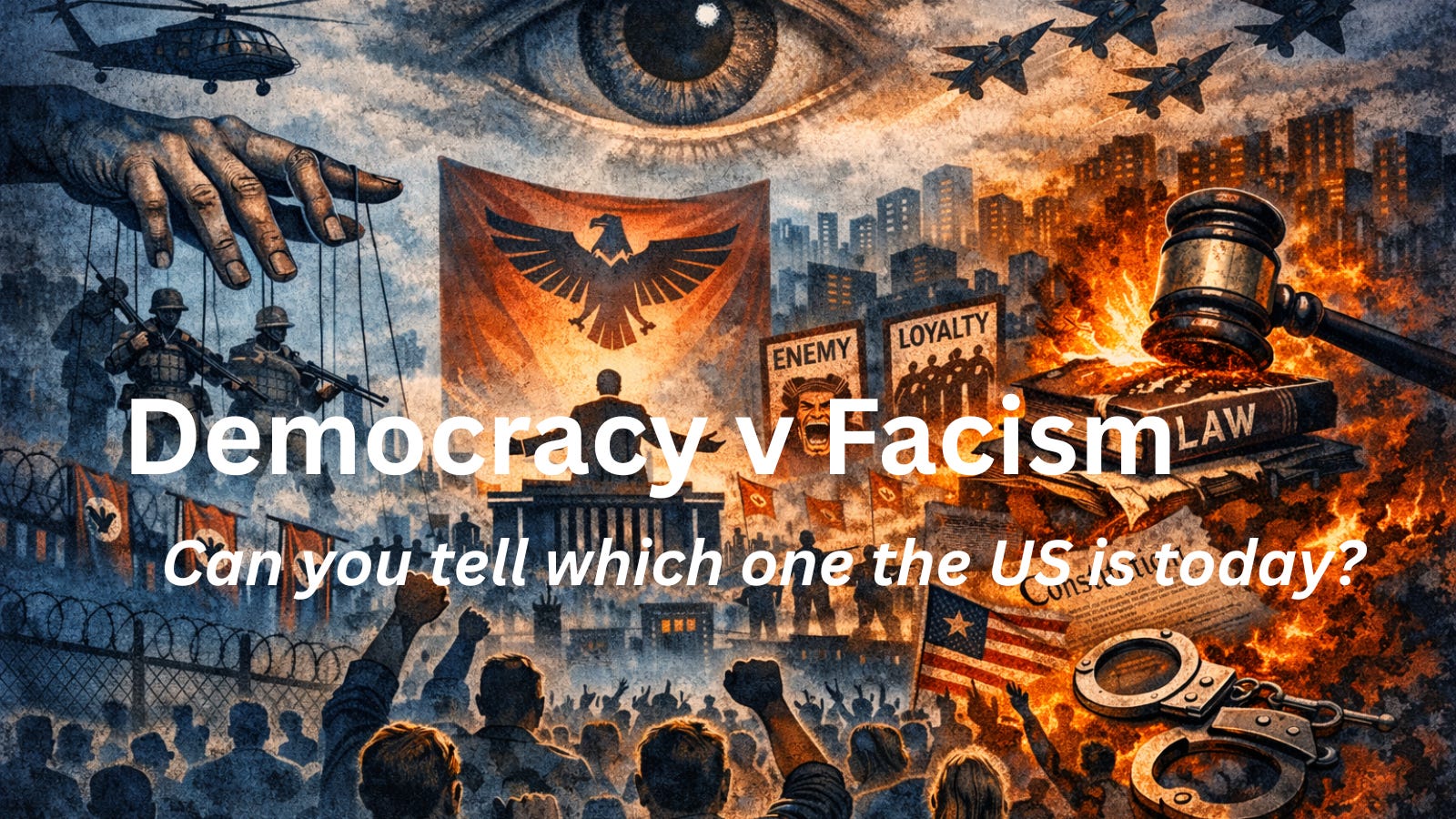
He also does not rise alone. One of history’s oldest elite delusions is the belief that the strongman can be borrowed, managed, fenced in, used for turnout, used for revenge, used for tax cuts, used for party discipline, and then quietly constrained once he has served his purpose. Fascist breakthroughs often depended not only on mass grievance but on elite decisions to co-opt rather than crush these movements, often because conservatives believed they could control fascist leaders once they became useful enough.
That pattern should terrify us more than open fanaticism because true believers are obvious while opportunists are not. The demagogue’s first enablers are often donors, media owners, legislators, consultants, and institutional conservatives who do not think of themselves as revolutionaries at all. They think they are practical. They think they are still in charge. They mistake proximity for control and access for leverage, and they are rarely prepared for the appetite of the thing they are feeding.
Emergency is one of authoritarianism’s favorite inventions because it does not merely frighten a public. It reorganizes what people believe is permissible. Once a country is said to be under siege, law becomes inconvenience, restraint becomes weakness, deliberation becomes luxury, and critics become irritants the moment can no longer afford. This is why authoritarian politics is so addicted to the language of invasion, war, betrayal, contamination, and collapse. Crisis is not just something it exploits. It is the atmosphere in which it breathes best.
Again, the contemporary example is not hidden. In January 2025 Trump declared a national emergency at the southern border, described the situation as an “invasion,” and directed the armed forces to support “complete operational control” of the border. The language matters as much as the policy because it turns migration into warfare, administration into militarization, and ordinary legal protections into obstacles to survival.
The old myth about authoritarian rule is that it arrives lawlessly, as though tyrants simply burst through the doors of legality and rule by naked force. History is more unsettling than that. Some of the most dangerous regimes of the twentieth century built their cruelty through decrees, citizenship rules, emergency provisions, administrative reclassification, and official definitions of who counted and who did not. Law did not vanish. It was repurposed. We can trace that pattern from the Reichstag Fire Decree and Enabling Act to the Nuremberg Laws and other legal architectures of exclusion.
That is one reason people miss the danger. Paperwork feels respectable, procedure feels calm, and bureaucracy does not look like a boot on a neck until long after it has become one. The authoritarian state prefers its violence notarized.
We are already living inside that lesson. In March 2025, the Supreme Court made clear that detainees subject to removal under the Alien Enemies Act must receive notice “within a reasonable time” and in a manner that allows them to seek habeas relief before removal. The fact that the Court had to say that at all tells its own story. Democratic systems can still produce resistance, and they can still slow or interrupt the machinery. But the machinery is there, with emergency language straining toward a broader and more punitive theory of state power.
Institutions, meanwhile, do not always die dramatically. The death of democracy is often imagined as spectacle, with tanks in the streets, constitutions shredded, and a single unforgettable announcement that the old order is over. More often it is a conversion process. The civil service is not abolished, but purified. Courts are not formally erased, but denounced whenever they refuse obedience. The press is not openly banned, but disciplined, mocked, excluded, and flooded. Elections remain, but their surrounding conditions are steadily poisoned. The shell survives while the meaning leaks out.
Trump’s January 2025 order on policy-influencing federal positions makes the logic unusually plain. It says career federal employees have been “resisting and undermining” executive leadership and declares that employees in the new Schedule Policy/Career positions are required to “faithfully implement administration policies,” with failure to do so becoming grounds for dismissal. That is not merely a staffing dispute. It is a theory of government in which neutrality is suspect and loyalty becomes the highest administrative virtue.
Authoritarian politics is never only about force. It is also about naming, about who gets to define reality, which words are legitimate, and which institutions must echo the vocabulary of power in order to retain access, safety, or permission to participate. These language battles are often dismissed as petty, but they are diagnostic because they reveal whether power is content to govern action or whether it also demands submission in speech.
The Associated Press confrontation this year was a clean example. AP said the White House told it that unless it aligned its editorial standards with Trump’s executive order renaming the Gulf of Mexico as the Gulf of America, it would be barred from access to an Oval Office event, and AP’s reporter was then blocked. A federal judge later ordered the White House to restore AP’s access, holding that the government cannot punish the organization for the content of its speech. The point is not that this dispute alone equals totalitarian censorship. The point is that it reveals the same underlying impulse, with language turned into a loyalty test and access turned into a reward for verbal obedience.
Violence, too, enters in stages. It does not begin only when blood is visible. It begins earlier, in classification, in permission, and in the widening circle of people whose suffering no longer counts as morally serious. First comes mockery, then tolerated intimidation, then selective impunity, then the legal narrowing of protection, and finally the discovery that a society can absorb far more cruelty than it once imagined, provided the target has been named often enough as a threat.
This is one of the reasons the January 6 pardons matter so much symbolically. Trump’s January 20, 2025 proclamation called the prosecutions a “grave national injustice” and granted “a full, complete and unconditional pardon” to all other individuals convicted of January 6-related offenses after commuting the sentences of several named defendants. A democracy should be chilled whenever movement-aligned violence is rewritten as martyrdom and then rewarded by the state. America may not have Blackshirts or Brownshirts in the classical form, but the moral rehabilitation of loyalist violence is one of the oldest warning signs in the book.
No fascist politics is ever only about enemies and institutions. It is also about the body, the family, sexuality, and the hierarchy of everyday life, because the fantasy of national rebirth is never purely political. It is moral, reproductive, and intimate.
The memo is useful here in a way most contemporary commentary is not. It stresses that fascist systems frequently fused hyper-masculinist politics with pronatalist ideals and a hierarchical family model, treating gender as central rather than incidental. Gender politics were not decorative features of fascism. They were among its organizing principles. Fascist order always reached into the home. It always tried to make domination feel natural, sacred, biological, and inevitable. That is why the modern mirror is not only rhetorical contempt for feminism or nostalgic talk about “traditional values.” It is also the attempt to make the state itself enforce a rigid moral biology. Trump’s January 2025 gender order directed the federal government to treat sex as a fixed binary, while a second order applied that logic to military service by casting transgender identity as incompatible with readiness and discipline. The point is larger than any single policy. It is that gender hierarchy is being translated into administrative doctrine, with the state deciding which bodies, identities, and forms of personhood count as legitimate.
That, finally, is the mirror we refuse to look into. Fascism is not only a spectacle from the past. It is a sequence by which fear is converted into hierarchy, grievance into obedience, myth into policy, and human beings into categories of belonging and disposal. That sequence does not require perfect historical repetition to become dangerous. It only requires enough people to accept that emergency is permanent, that loyalty is nobler than law, that cruelty is realism, and that the nation can be saved by narrowing who counts as part of it.
The wrong question is whether Donald Trump is Adolf Hitler in some total or metaphysical sense. That question flatters the lazy and exhausts everyone else. The real question is whether the methods history has already taught us to fear are reappearing in forms we are still too comfortable to recognize.
Democracies do not fail only when dictators declare themselves. They fail when ordinary people are taught to call obedience patriotism, retaliation justice, exclusion order, and fear common sense, because by the time the final form is visible, the ordinary steps have already done their work.
Fascist, from "fasces" (latin), an ancient legal symbol favoured by Mussolini: a bundle of twigs tied together with the axe used to cut them. Going back to the roots is instructive with this stuff. Also relevant is the other roman legal term, "suum cuique", loosely translated as "To Each His Own", meaning that justice should fit the circumstances of the accused. There is humility and mercy in that. It is instructive, because it was written on the gate to the Buchenwald Concentration Camp, where the meaning was twisted. Only inmates (Hitler's political opponents) could read the letters, from within the camp. From outside, it was a mirror world, with the letters backwards. The abuse was clear: if all those politicians wanted a democratic state, the post WWI Weimar Republic, they could have it, in this little doll house model of it, Buchenwald. They could look out to the beech forest (Buche=Beech; Wald=Wood, or Forest) and see the new German state, in part the people they had kept as criminals in their prisons, living freely, outside this doll house Weimar Republic, while the republic (the camp) was quite literally hell. One more detail: the camp was built around the oak tree under which the poet Goethe wrote his first draft of a scene from his play "Faust". Goethe's classical models (Greek and Roman, merged with humanism and revolutionary democracy) were picked by the Weimar Republic as a good foundation for a non-Imperial German State. The tree was used as a gallows. Effectively, it was the greatest prisoner of the camp. These two examples are very illustrative of the mid-20th century regimes you are referencing, in ways that allow many avenues for baring connections to present day versions of such distorted visions of justice. Adding to that one more, the child-molesting and sexually predatory anti-Santa Claus, the Krampus, who has a switch related to the fasces and has become a darling of the German and Austrian extreme right, makes a robust image of our time possible. US intellectual culture is adept at providing universal images, such as the solid and timely analysis given here about fascism. Respectfully, a dose of extra-US specificity would strengthen these arguments. Buchenwald was also the one camp with a strong, functioning resistance.
Chilling, and as Sarah Quinn says, terrifying. Thank you for setting it out so clearly