


Part one of “The Mirror We Refuse to Look Into” series can be found at the link below:

When people hear a comparison between Adolf Hitler and Donald Trump, they often reach for the quickest escape hatch, which is to assume the comparison is saying the two men are identical, or that history repeats with perfect photocopy fidelity, or that the only legitimate use of the past is a museum plaque that ends with “never again” and asks nothing further of us.
The argument worth making, is narrower and more unsettling than that, because it lives at the level where politics becomes permission. It is about how a public is taught to accept what it would have rejected a year earlier, and how leaders who hunger for dominance learn to convert confusion into loyalty, grievance into mandate, and violence into virtue, even when the uniforms, technologies, and centuries differ. War is the clearest place to see that alchemy, because war demands consent, or at least acquiescence, and consent is built from words before it is enforced by weapons.
Look at Trump’s statement announcing major combat operations in Iran, and look at Hitler’s Reichstag address on September 1, 1939, given after German forces had already crossed into Poland in the early hours of that morning.
The historical contexts are not the same, the states are not the same, and the consequences in scale and horror are not commensurate, but the rhetorical skeleton, the set of moves that turns aggression into necessity, is painfully familiar.
Trump begins by making violence sound like defense, and defense sound like mercy. “Our objective is to defend the American people by eliminating imminent threats from the Iranian regime,” he says, and with that single sentence he draws the moral map, in which he is the guardian, the other is the threat, and the act of striking first becomes a form of protection.
Hitler performs the same moral inversion, with a different trigger phrase, because his story requires a clock, a border incident, the sense that Germany is not beginning a war but merely answering one. “Since 5.45 A.M. we have been returning the fire,” he tells the Reichstag, placing Germany in the position of the restrained party that simply refuses to die quietly.
In both cases, the leader is offering a doorway out of moral discomfort, because people resist seeing themselves as aggressors, and they resist seeing their country as capable of cruelty without cause. The leader, if he is skilled at this, does not ask them to stop being decent; he asks them to redefine decency as force.
The second move follows quickly, because defense alone is not enough, and even a frightened public wants to believe it tried peace. Trump’s speech frames diplomacy as exhausted, as something the enemy squandered, as a door politely opened and then slammed in America’s face. In widely reprinted transcripts, he argues that Iran kept building toward nuclear capability and refused to renounce its course, and he presents military action as the only remaining tool that is not surrender.
Hitler does the same, and he does it with the chilly tone of a man presenting paperwork, as though he is not launching a cataclysm but balancing a ledger. “As always, I attempted… by the peaceful method… an alteration of this intolerable position,” he claims, setting up the conclusion that force is not desire but obligation, the last page in a file of rejected offers.
This “we tried peace” posture is not a mere flourish, because it is the mechanism by which a leader converts a violent decision into a reluctant duty. The leader does not say, “I want to do this,” because the people still remember that wanting war is ugly. He says, “I had no other choice,” because the people want to remain innocent even while they are being led into complicity.
Then comes the escalation that turns a specific act into a permanent condition, because a war that is genuinely limited would be less useful to a leader who feeds on dominance, and a war that is bounded by modest aims would not provide the same psychic reward that power always promises its followers.
Trump insists that the enemy’s very nature makes restraint unreasonable, calling the regime vicious, describing it as menacing, and expanding the circle of danger beyond the homeland to “our troops, our bases overseas, and our allies throughout the world,” so that the battlefield becomes everywhere that American identity stretches.
Hitler reaches for the same expansive logic, though his vocabulary is different and his goal is territorial, because he insists that German identity has been wounded, that Germans in contested areas suffer, that the settlement after Versailles is a torture that cannot be endured, and that normal diplomacy cannot correct what he frames as an existential injustice. “Danzig was and is a German city,” he declares, and by saying it twice, he attempts to make entitlement sound like fact, and inevitability sound like reason.
This is a crucial parallel, and it is one the public often misses, because it hides in plain sight. Both leaders take something complex and contested, and they restate it as simple and absolute, because absolutes are easier to obey. Trump’s absolute is a capability that “can never” be allowed, and his end state is promised in the language of completion, as in the claim made by Pete Hegseth that “we didn’t start this war, but under President Trump we will finish it,” and Hitler’s absolute is territory that “was and is” German, but the structure is identical, because the point is not precision; the point is closure.
Once closure is achieved, the leader can turn to the audience not as citizens who must deliberate, but as a crowd that must submit. Hitler’s speech is full of the intimate authoritarian promise, which is that he will carry the burden for you while you surrender the burden of doubt. He offers himself as the embodiment of sacrifice and unity, insisting that his “entire life belongs” to the German people, and that he has the right to demand sacrifice because he will share it, which is a classic way of laundering power into devotion.
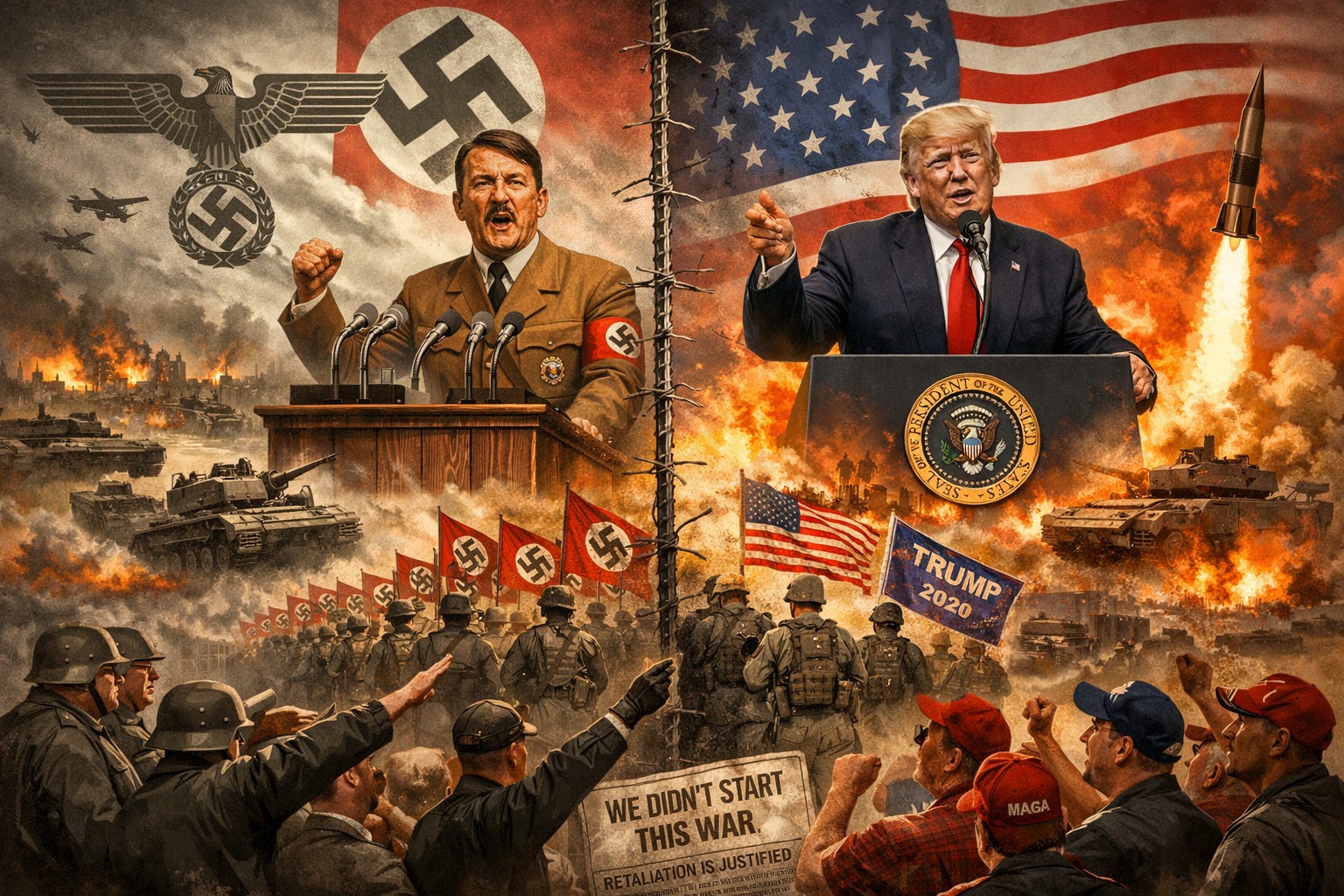
Trump’s performance is different in style, modern and media-shaped, but it leans into the same personalization, because he frames military action as what only he would do, what others were too weak to do, what proves strength, what proves that the story he tells about himself is real, and the medium is modern even when the script is antique. The leader becomes the instrument through which the nation acts, so that critique of the decision becomes critique of the nation, and dissent becomes betrayal. This is one of the deep similarities that survives the distance of generations: both men cultivate a politics in which the leader is not a temporary steward of institutions but a living symbol, and the symbol demands loyalty that cannot be checked by ordinary standards.
The next similarity is the way each leader uses language to shrink accountability while expanding permission. Hitler’s “returning the fire” line is doing more than claiming self-defense. It is an attempt to place Germany on the side of legality and order, so that the invasion becomes not a rupture but a restoration. His speech, as preserved in multiple archival sources, frames Germany as the party seeking a “peaceful settlement” that Poland refused, and this is the rhetorical equivalent of a forged receipt, the kind that allows a thief to insist he is only taking what is owed.
Trump’s “imminent threats” phrase performs the same function in a modern register, because imminence is a legal and moral keyword. It evokes self-defense while escaping the burden of proving that an attack has occurred, and it invites the public to treat uncertainty as sufficient cause, because fear loves a deadline and “imminent” provides one. And now the inversion is made explicit in Pete Hegseth’s formulation, “we didn’t start this war, but under President Trump we will finish it,” which functions as a modern cousin of “Since 5.45 A.M. we have been returning the fire,” because it relocates blame before it locates targets and offers the public innocence as the price of entry into violence.
When you lay these moves beside each other, what becomes visible is not that the facts are the same, but that the permission structure is the same: a leader offering moral cover, legal cover, and emotional cover, so the public can cross a line while still believing it has remained on the right side of itself.
At this point, many readers will want to object that Hitler’s war was conquest and Trump’s is framed as prevention, that Hitler’s regime became genocidal and Trump’s America still has elections and courts, that the analogy is therefore invalid, and that to even place their quotes in the same paragraph is to disrespect the dead, yet even prevention can be narrated in the grammar of righteous continuation when the leader’s camp insists that it did not start the conflict and will therefore finish it.
That objection sounds principled, and it is also the very posture that allows repetition to begin, because it treats comparison as an insult instead of a diagnostic tool. It is possible to be honest about difference and still insist that similarity matters, because similarity is how danger becomes legible before it reaches its final form.
Hitler did not begin by telling Germans, “I will destroy Europe and murder millions.” He began by telling them that Germany was humiliated, that Germans were mistreated, that treaties were unjust, that enemies were at the gate, and that force was the only language left.
Trump does not need to share Hitler’s ideology for the machinery to rhyme, because the machinery is older than either man, and it runs on the same fuel in every era: humiliation, resentment, a desire for purity, and the promise that violence will make life feel coherent again.
This is where the comparison becomes not only real but urgent, because modern democracies have a bad habit of treating war as an external event, as something that happens “over there,” while ignoring that war is often the most effective domestic propaganda a leader can buy, since it creates a story where dissent feels dangerous and obedience feels patriotic.
Hitler’s speech is explicit about the political uses of war, because it frames Germany as surrounded by enemies and betrayed by international arrangements, which helps justify internal consolidation, intensified repression, and the demand for sacrifice.
Trump’s war talk, in current transcripts, similarly invites the public into a world where fear and loyalty become intertwined, where the leader’s willingness to strike proves his virtue, where strength becomes a moral category, and where the enemy is described in ways that make negotiation feel like weakness.
Another generational similarity, often missed, is the shared contempt for constraint, the shared insistence that rules are for others. Hitler’s rhetoric is saturated with grievance about the Versailles “diktat,” a word chosen to make international law feel illegitimate and coercive, so that breaking it becomes an act of liberation rather than lawlessness.
Trump’s rhetoric, in its own way, plays the same game with modern constraints, because it suggests that caution is cowardice, that international norms are obstacles, that critics are not fellow citizens but enemies of resolve, and that the only true measure of legitimacy is whether the leader “wins.” The words differ, but the message is consistent: constraint is weakness, and strength is righteousness.
A further similarity is the emotional appeal to a wounded identity, because both leaders understand that people will tolerate cruelty when they believe they are reclaiming dignity. Hitler offers Germans a story in which pain is proof of virtue and retaliation is the restoration of honor, and the invasion becomes a catharsis for national humiliation, a ritual that rewrites shame into power.
Trump offers his supporters a related story, in which America has been mocked, taken advantage of, restrained, and embarrassed, and in which decisive military action becomes a kind of cleansing, a way of proving that America is feared again, and that fear is the definition of respect.
You can hear it in how both men talk about time. Hitler’s “since 5.45 A.M.” is not just a timestamp; it is a narrative switch that turns a planned invasion into a reaction. Trump’s “imminent threats” is not just a warning; it is a countdown that makes debate feel irresponsible, and it compresses the moral horizon until action seems like the only adult choice. In both cases, the public is pushed into a narrowed present where fear crowds out deliberation, and where the leader’s certainty becomes more comforting than the truth.
Authoritarian politics is often a training program in moral surrender, and war talk is one of its final exams. There’s the repeated pattern, and I must insist that the patterns matter because they reveal intention and trajectory. I also refuse the comforting myth that a society becomes dangerous only when it becomes unrecognizable, because history shows the opposite, which is that societies become dangerous precisely when cruelty is made to feel normal, when violence is made to feel logical, when the leader’s voice is treated as reality itself.
The warning is not that Trump is Hitler, as a person or as a metaphysical villain; the warning is that Trump uses recognizable authoritarian techniques, and that those techniques, when applied to war, do not merely kill people abroad, they remold the people at home, because a society that learns to accept violence by lying to itself about why it is happening is a society that can be led into darker rooms.
Hitler’s words, preserved in the cold clarity of transcripts, show how a leader can wrap invasion in the language of peace, and how easily an audience can be invited to feel righteous while crossing a border with tanks. Trump’s words, circulating through modern media as a video statement, show how quickly the language of imminent threat can be used to make war feel like a protective reflex, and how readily an audience can be guided toward the belief that violence is virtue if the leader’s story is told with enough confidence.
What separates eras is technology and costume; what links them is the human longing to feel safe and to feel proud, and the leader’s ability to promise both by offering an enemy. The reason to pay attention is not academic, and it is not an exercise in historical name-calling. It is because the story that justifies violence is the same story that justifies the silencing of critics, the weakening of institutions, the punishing of out-groups, and the slow conversion of politics into obedience, and because once a people accept the leader’s moral inversion, once they accept that aggression is defense and domination is dignity, they are already on the path where the next lie is easier to swallow than the last.
If a society wants to avoid repeating history, it cannot rely on the comforting idea that repetition arrives with a swastika and a goose-step, and it cannot wait for the final form before it objects. It has to listen to the beginning forms, the rhetorical forms, the permission-building forms, the way a leader says “defend” and means “strike,” the way a leader says “peace” and means “conquest,” the way a leader says “choice” and means “submission,” and it has to decide, before the story hardens into policy and the policy hardens into blood, that reality is not negotiable, that restraint is not weakness, and that war sold as virtue is still war.
Good for you and congratulations! This is first time I've encountered someone honest and brave enough to make such a forthright and in-depth comparison between Hitler's and Trump's words and actions.
As you point out so completely and so articulately, the fundamental manipulative demagoguery of each man is almost exactly the same, just some minor differences in style and technology. The fundamental manipulation is always the same--tap into people's ignorance and fear; drill down constantly until you reach their most primitive fears and desires; set fire to their houses then tell them you're the only one can put it out--
I really admire you for making the inevitable comparisons between these two maniacs--complete with a perfect illustration!
Keep on rockin' in the free world!