


We learn history the way we learn fire: first as story, then as scar, then as warning; we memorize the names, we recite the dates, we swear we would have done something different, and we promise ourselves that we would have seen it coming, because the alternative is unbearable, because it suggests that people like us, people who consider themselves decent, can watch a society step quietly toward the cliff, and still call it normal life.
Hitler is, for many, the ultimate symbol of evil, a singular monster sealed inside a singular era; he is black and white, a villain in a film we have already watched to the end, and we are comforted by that ending, because it implies inevitability, because it tempts us to believe that moral catastrophes only arrive wearing costumes that make them easy to recognize. Yet fascism rarely walks in with a dramatic flourish; it tends to arrive by the door we forget to lock, it speaks in familiar accents, it borrows old resentments and gives them new clothing, it offers relief from complexity and calls that relief “truth.”
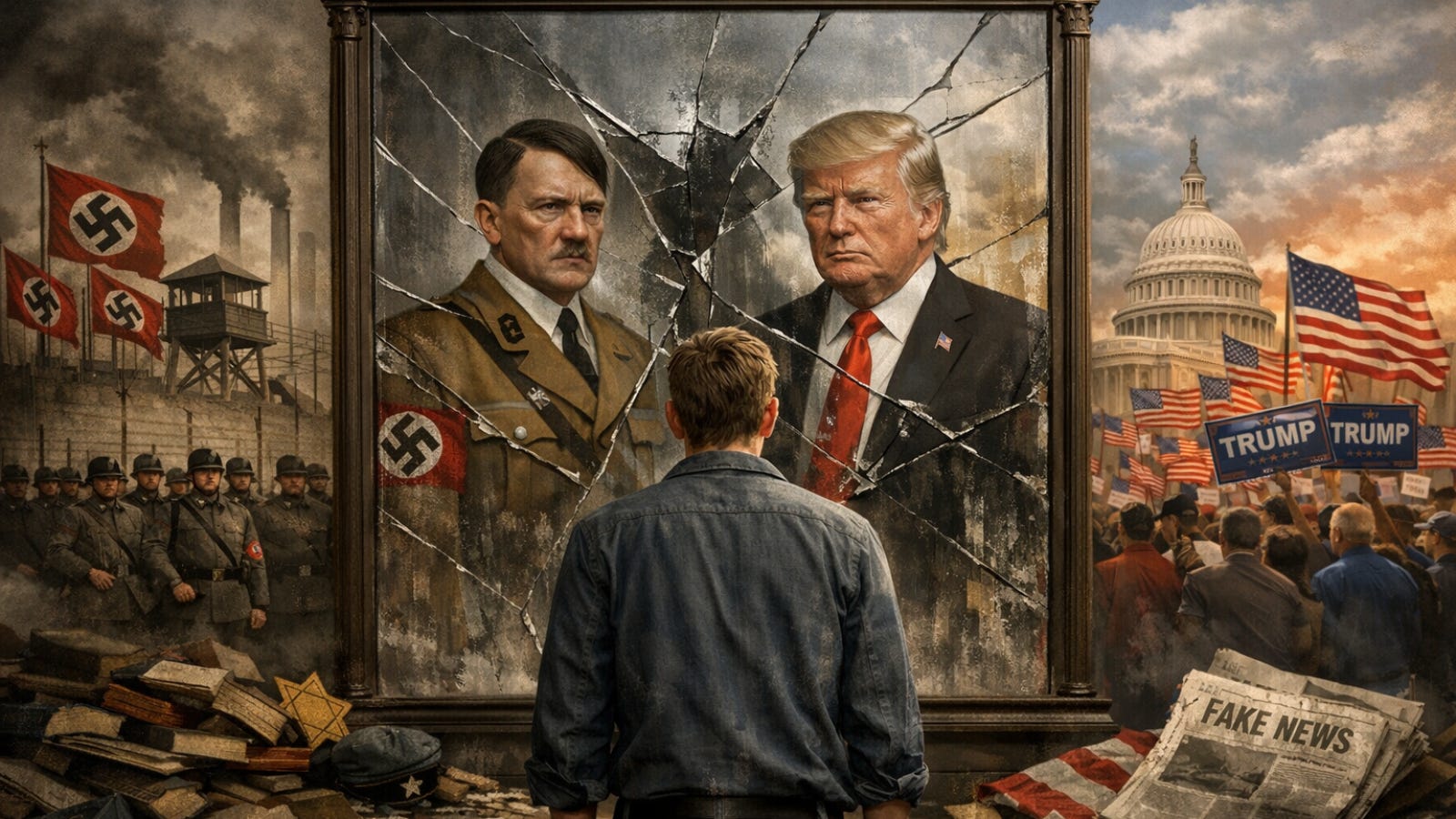
This is why comparisons between Donald Trump and Adolf Hitler provoke such fierce reactions, including from people who otherwise agree that Trump’s behavior is dangerous; the comparison feels too extreme, too sacred, too inflammatory, or too impolite for civil company. But a comparison is not a claim of identical outcomes, nor a claim that history repeats with perfect symmetry; it is a way of tracing patterns across time, a way of identifying how democracies can be hollowed out while their citizens insist the walls are still standing. If we want to keep our society from stumbling into a catastrophe that future generations will call obvious, we must learn to look at the mirror without flinching.
Hitler did not seize power by announcing, plainly, that he would become a dictator and commit atrocities; he rose through a politics of identity and humiliation, through the promise that one group’s pain could be healed by another group’s punishment. He offered a myth of national restoration, and then he attached that myth to an enemy: Jews first, and then many others, all framed as contaminants of the nation, all framed as threats to purity, and as obstacles to greatness.
This is not merely history’s horror; it is also history’s psychology. Human beings are tribal under stress; we are story driven when frightened; we seek simple explanations when our lives feel unstable; we cling to leaders who promise certainty, even if certainty is purchased with cruelty. The scapegoat is not a side effect of authoritarian politics, it is the fuel. You cannot maintain an emergency state without an enemy to justify it, and you cannot ask ordinary people to accept extraordinary violence without first persuading them that the target is less than fully human.
In our time, Trump’s movement has thrived on the same architecture:
The constant manufacture of an “us” that is righteous and besieged, and a “them” that is criminal, parasitic, or subversive; immigrants, political opponents, journalists, judges, “deep state” bureaucrats, professors, city dwellers, and anyone who refuses the script. The labels shift, the emotional machinery does not.
When a leader repeats claims that are lurid and unverified, when the claims are repeated until they feel like ambient reality, something changes in the mind of the listener; not because the listener is uniquely gullible, but because repetition is a kind of pressure, and pressure reshapes perception. The lie does not have to be airtight, it only has to be constant; it does not have to persuade everyone, it only has to exhaust the part of the population that still believes truth can be jointly held.
We are watching a political style that treats shared reality as an enemy, and that is not a small thing; democracy depends on disagreement, yes, but it also depends on a common world in which disagreements occur. Once the common world collapses, the strongest storyteller wins, and the strongest storyteller is often the least constrained by facts.
Hitler’s path to dictatorship was not only a story of crowds and charisma, it was a story of institutions; courts, civil service, police, media, all the referees who keep competition from becoming conquest. The authoritarian does not have to abolish every institution; he can capture them, intimidate them, discredit them, and then use them as props for legitimacy.
One of the most psychologically effective techniques of authoritarian movements is to persuade followers that neutral institutions are secretly partisan; that courts are rigged, that journalism is propaganda, that elections are fraudulent, that facts are “fake,” that expertise is “elitism,” and that accountability is persecution. Once the referee is suspected, the leader becomes the only trusted narrator; the leader becomes the only source of meaning, and loyalty becomes the highest virtue.
When Trump attacks judges, mocks the legitimacy of elections, frames prosecutors as enemies, and paints journalists as villains, he is not merely venting; he is conducting a long campaign to make objective constraints feel illegitimate. This is not unique to him; it is a global pattern among aspiring strongmen. But it is uniquely dangerous in the United States because so many citizens have been taught that American democracy is self-renewing by nature, as if the Constitution is a magical shield rather than a set of agreements that require active defense.
The tragedy is that many people can recognize the tactics in a history book, and still miss them in real life, because real life comes with noise, with fatigue, with bills and soccer practice and distractions; because real life arrives in increments, and moral alarms are easiest to ignore when the volume is turned up slowly.
It is tempting to imagine that Hitler’s followers were simply evil, and that we, being better people, would never have joined them; this temptation is not only comforting, it is dangerous, because it keeps us from recognizing what authoritarians offer that is emotionally intoxicating. They offer relief from shame. They offer a story in which your suffering is someone else’s fault. They offer permission to stop wrestling with complexity. They offer the pleasure of cruelty disguised as justice. They offer a stage where resentment can become righteousness.
Trump’s politics has repeatedly invited crowds to laugh at the vulnerable, to cheer humiliation as entertainment, to treat cruelty as “telling it like it is.” This matters, not because it shocks polite sensibilities, but because it trains a public to see empathy as weakness and domination as strength. When a society begins to enjoy punishment as a form of bonding, it is preparing itself for larger violences, even if it insists it would never support them.
The psychological trick is that people rarely experience themselves as villains; they experience themselves as victims reclaiming fairness. That is why the authoritarian must keep the emotional temperature high; the hotter the anger, the less room there is for reflection, and reflection is the enemy of obedience.
Hitler’s external aggression was not an accident; it was an extension of his internal political needs. Foreign enemies justify domestic control. International humiliation can be repackaged as national grievance. Aggressive posturing creates the image of decisive leadership, and decisive leadership is what an authoritarian sells when he cannot deliver competent governance.
We should be careful here, because history is not carbon copy; the geopolitical landscape of the 1930s is not the world of nuclear deterrence, global supply chains, and international institutions. Still, the psychology of the bully state has enduring features: the craving for submission, the contempt for alliances framed as “weakness,” the fascination with strongmen, the preference for intimidation over diplomacy, and the use of threats to generate spectacle.
When Trump treats international relationships as dominance games, when he frames allies as freeloaders and adversaries as partners in performance, when he elevates personal flattery over strategic consistency, he is not simply being unconventional; he is feeding a worldview in which power is measured by who can be coerced and who can be humiliated. That worldview, scaled up, is how wars become plausible; not always through formal declarations, but through cascading miscalculations, broken commitments, and the belief that someone else will blink first.
Hitler tested the world and discovered that hesitation could be exploited; each successful violation of norms made the next violation easier. The authoritarian learns from the international community the same lesson he seeks to teach his domestic opponents: consequences are negotiable, rules are optional, and morality is theater.
We do not need to claim that Trump will recreate the exact sequence of the 1930s to recognize a warning; a world in which powerful states normalize bullying, destabilize alliances, and treat truth as disposable is a world more vulnerable to conflict, and that vulnerability should terrify anyone who believes that the horrors of World War II were a one time exception rather than a recurring possibility.
Here is the most painful question, and perhaps the most important one: how can people hate Hitler, study Hitler, condemn Hitler, and still fail to recognize familiar patterns in the present? Because Hitler has been safely embalmed in moral certainty, while Trump is still contested terrain; because condemning Hitler costs nothing, while condemning Trump can cost friendships, community, and identity. Because Hitler is taught as “evil,” which invites emotional distance, while authoritarian tactics in real time are taught as “politics,” which invites rationalization.
And because propaganda does not always look like propaganda; it often looks like jokes, like memes, like “just asking questions,” or like a stream of claims so relentless that the exhausted mind stops sorting them. The modern media environment does not need a single Ministry of Truth; it can accomplish something similar through sheer volume, through the constant erosion of attention, and through the transformation of citizenship into entertainment.
People also miss the similarities because they confuse fascism with aesthetics; they look for the uniforms, the salutes, the unmistakable symbols, and they overlook the deeper substance: the division of society into “real people” and enemies, the demand for loyalty over law, the contempt for checks and balances, the celebration of violence, the attack on independent institutions, and the belief that only the leader can save the nation.
A democracy can die while still holding elections, if those elections are distorted by intimidation, disinformation, and institutional capture; a democracy can die while its citizens insist it is alive, because the rituals continue even as the meaning drains away.
Comparing Trump to Hitler is not a parlor game; it is serious, and it can be abused. If we use the analogy lazily, it becomes a gimmick; if we use it constantly without specificity, it becomes noise; if we use it as an insult rather than an analysis, it becomes a tribal signal that persuades no one outside the choir.
But if we use it carefully, it becomes a diagnostic tool, a way of naming warning signs before the patient collapses. The point is not to say “Trump equals Hitler” and stop thinking; the point is to say: here are patterns that have appeared before, here is what they did to societies that assumed they were immune, here is what happens when lies become a lifestyle, when cruelty becomes a bond, when institutions are treated as enemies, and when politics becomes a revenge cult. It is possible, and necessary, to hold two truths at once: that the United States is not Weimar Germany, and that the United States is not magically protected from the dynamics that destroyed democracies elsewhere.
When we say we must do something to stop him, we do not mean fantasies of violence; violence is the authoritarian’s native language, and meeting him there only strengthens his story. We mean the slow, stubborn work that authoritarians hate because it denies them drama and denies them inevitability: voting, organizing, supporting independent journalism, defending civil servants, funding legal challenges, protecting vulnerable communities, showing up at local meetings, and refusing to normalize what should never be normal. We mean refusing to let exhaustion become surrender.
The authoritarian counts on fatigue; he counts on people deciding that constant chaos is just the weather. He counts on the decent majority telling itself that politics is always ugly, that nothing can be done, that life must go on, that it is safer not to look too closely, because looking too closely might demand action.
But history’s verdict is rarely about what we believed in our hearts; it is about what we did with our bodies, with our voices, with our votes, with our money, and with our time.
World War II did not begin as a single explosive moment that everyone recognized; it was built through a sequence of choices, rationalizations, appeasements, and escalations, each step making the next step feel less shocking. The lesson of that era is not only that evil exists; the lesson is that evil often advances through ordinary pathways, through paperwork, through propaganda, through legal maneuvering, through the turning of neighbors against neighbors, through leaders who insist that only they can fix what they have taught us to fear.
If we do not want a future in which today’s children ask, incredulous, how adults could have missed what was happening, then we must stop treating authoritarianism as a historical genre and start treating it as a live threat; we must speak clearly, document relentlessly, persuade patiently, and we must refuse the seductive fatalism that says the arc of history bends on its own.
The mirror is here; it is not perfect, it is not identical, it is not a simplistic copy, but it is recognizable. The question is not whether Trump is Hitler; the question is whether we recognize the machinery of authoritarianism early enough to keep it from becoming our normal. We are writing that answer together, every day.
And if you are reading this and feeling the familiar mix of anger, fear, and disbelief, we want you with us, not only as a reader, but as a participant; share this, subscribe, send it to the friend who says “it can’t happen here,” send it to the family member who says “it’s not that serious,” because the first defense of freedom is attention, and attention, shared widely, is how a society remembers that it still has a say.
In a 1990 Vanity Fair article following the divorce of Donald and Ivana Trump, titled After the Gold Rush, journalist Marie Brenner reported:
"Last April, perhaps in a surge of Czech nationalism, Ivana Trump told her lawyer Michael Kennedy that from time to time her husband reads a book of Hitler's collected speeches, My New Order, which he keeps in a cabinet by his bed…. Hitler's speeches…reveal his extraordinary ability as a master propagandist.
"’Did your cousin John give you the Hitler speeches?' I asked Trump.
“Trump hesitated. ‘Who told you that?'
"'I don't remember,’ I said.
"’Actually, it was my friend Marty Davis from Paramount who gave me a copy of Mein Kampf, and he's a Jew.' (‘I did give him a book about Hitler,' Marty Davis said. 'But it was My New Order, Hitler's speeches, not Mein Kampf. I thought he would find it interesting. I am his friend, but I’m not Jewish.’)
"Later, Trump returned to this subject. 'If I had these speeches, and I am not saying that I do, I would never read them.'"
In the same article, Brenner quoted Trump’s lawyer: “Donald is a believer in the big-lie theory. If you say something again and again, people will believe you."
Comparing Trump’s playbook with Hitler’s is “not a parlor game”, as Shanley demonstrates. It’s a relevant warning.
Have used this article and others to point out the similarities and will use yours to assist in informing. Thank you.
History doesn’t repeat itself, but it often rhymes. It’s has the capacity and capabilities of paralleling events, not exactly the same but so very similar. And when we look closely at how fascism rose in 1930s Germany to what we are experiencing now the parallels are astonishingly similar. You don’t need to see the SS insignia on ICE vests but their similarities to the Gestapo are present. Just as so many other policies and practices to executive orders, the MAHA movement to even changing the name from the Dept. of Defense to the Dept. of War.
Here’s how John Rees used these six points.
1. The Cult of Personality
2. Nationalism and Nostalgia
3. Scapegoating and Dehumanisation
4. Attacks on Truth and the Press
5. Undermining Institutions
6. The War on Expertise and Independent Thought
Also even have pointed out that even in this article when John Rees even pointed out this
“….on 1st April, Texas Congressman Keith Self directly quoted Joseph Goebbels during a Senate hearing: “It is the absolute right of the state to supervise the formation of public opinion.” Whether it was ignorance or something darker, it was said without irony, apology, or correction.
And when tRump even quoted Mussolini.. “In 2016, Trump retweeted: “It is better to live one day as a lion than 100 years as a sheep.” When asked about quoting a fascist, he said, “What difference does it make whether it’s Mussolini or somebody else?”… Again parallels…
Carl Jung said, “The encounter with oneself belongs to those unpleasant things one avoids as long as one can... the mirror does not flatter, it shows accurately what is reflected in it"
For me it’s just “Growth is about looking in the mirror and saying: Yes, I did that. I was wrong. I need to do better. I need to learn and recognize the events around me because without growth you wither and die in ignorance”
https://medium.com/@john.rees/do-trump-and-maga-echo-1930s-germany-a-cautious-but-urgent-comparison-78c1447cc7d5