


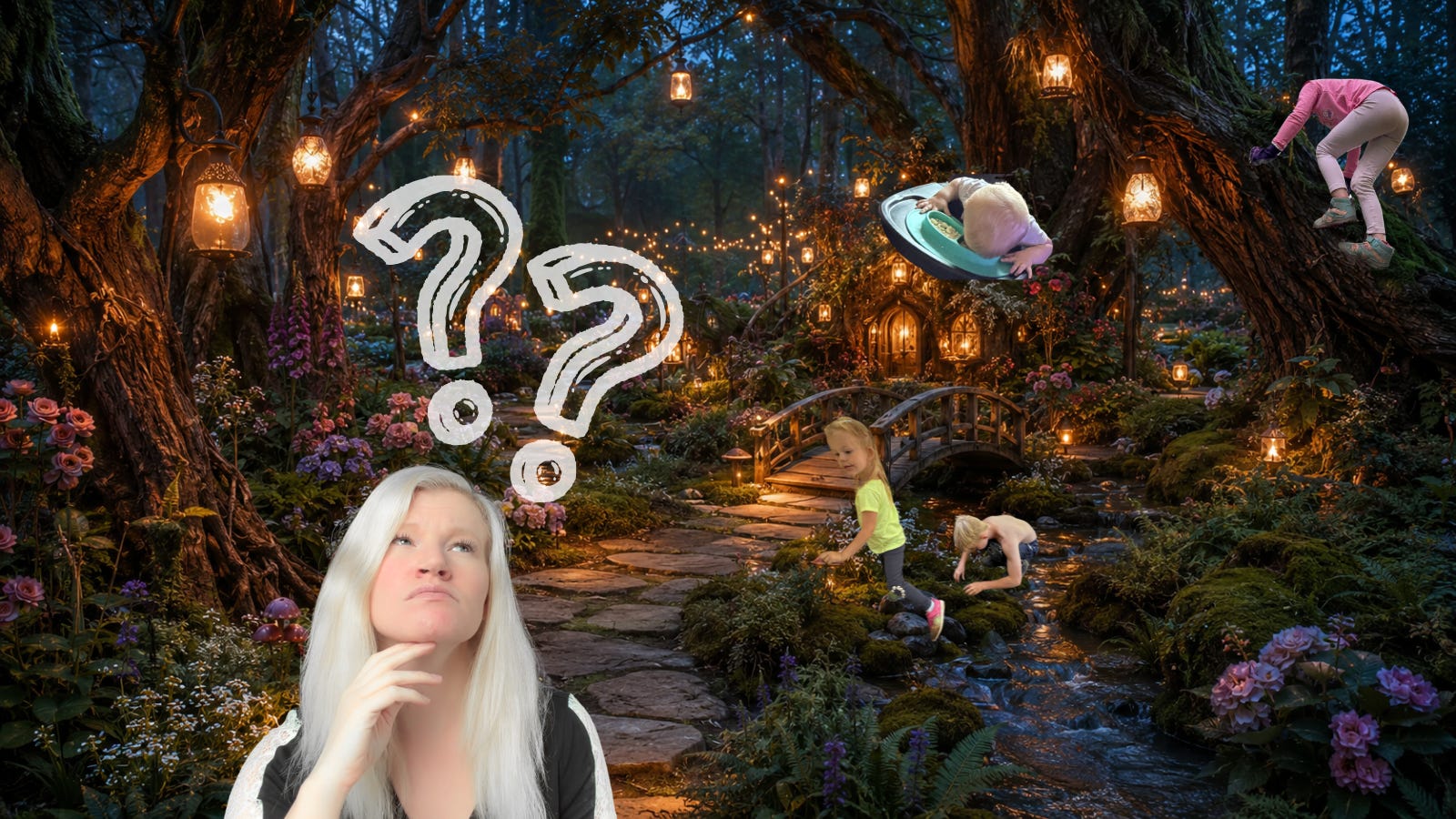
We are building a fairy garden while the country attempts to eat its young.
The plans have become elaborate. There will be paths winding through the trees, small houses tucked into roots, flowers planted where they might appear to have arrived by magic, and enough municipal infrastructure to support an entire civilization of creatures who have contributed nothing toward the property taxes. My husband is doing much of the daily labor, while our daughter follows closely behind as an uncompensated site inspector, offering the confident oversight traditionally associated with people who can’t yet read a blueprint.
Our youngest son is conducting an independent investigation into gravity by dropping every available object from his highchair, or really, from wherever he happens to be. Our oldest is learning the more complicated physics of being human, including what happens when a feeling becomes too heavy to hold and how to set it down without throwing it at someone else. Around them, trees are finding their places, strawberries and blueberries are multiplying, tomatoes are recovering from an unauthorized inspection by the deer, and the land we can finally call ours is slowly becoming the world we imagined when it still belonged to someone else.
Then I come inside and read the news, which is where the arrangement becomes psychologically questionable. I spend much of my working life studying what powerful adults are doing to the world, an occupation that’s not especially conducive to relaxed optimism. I read about democratic institutions being dismantled by people who speak of the Constitution with the reverence normally reserved for family heirlooms moments before listing them on Facebook Marketplace. I watch public protections stripped away, cruelty converted into policy, and the future treated like an asset our leaders intend to liquidate before the children are old enough to ask where it went.
Then I close the computer and walk back outside, where my daughter is waiting to show me where the fairies will live. I have begun to wonder what an informed mother is supposed to tell her children about the world. I know too much to promise that everything will be fine, but I love them too much to teach them that nothing can be.
Children are often given a softened version of reality in which adults are generally competent, good people eventually win, institutions exist for the reasons printed in the brochure, and someone responsible is paying attention. It’s an understandable arrangement. Childhood should contain some shelter from the full force of adult failure, particularly because children have limited political authority and are notoriously underrepresented in committee hearings.
Still, they eventually notice the smoke, even when we refuse to tell them what’s burning. They hear adults talking in the kitchen. They see fear move across a parent’s face before it is rearranged into something more reassuring. They notice that the weather is behaving strangely, that people are angry, that money is tight, that certain families are treated as threats, and that the grown-ups who claim to be in charge seem to have misplaced both the instructions and several essential parts.
My children may not understand every headline, but they understand me. They can hear when my voice changes and see when part of my attention remains trapped inside something I’ve read. If I tell them that everything is fine while behaving as though the horizon has caught fire, I’m not teaching reassurance. I’m teaching them that truth is something adults conceal with a pleasant expression.
Telling children that nothing is wrong doesn’t protect their trust; it teaches them to doubt their own perception. The answer, however, can’t be to empty the contents of our adult terror into their laps and congratulate ourselves for respecting their intelligence. Children deserve the truth, but they shouldn’t be expected to carry it at its full adult weight. They didn’t create these emergencies, and “the children will save us” is often a sentimental way of assigning them a cleanup job. There must be a way to tell them the world is wounded without teaching them that it’s lost.
What frightens me is not only the condition of the democracy my children may inherit. It’s what this democracy is teaching them while it dies. Children are always studying power, even when nobody has assigned it as a lesson. They notice who is allowed to lie without consequence, whose fear is treated as important, whose suffering is converted into entertainment, and which adults are expected to obey even after those adults have forfeited every reasonable claim to authority. They’re learning whether rules are shared agreements or merely restrictions imposed upon people without enough money or influence to escape them.
A dying democracy is still a classroom. It teaches children that citizenship means watching powerful people make decisions, that cruelty is evidence of strength, and that ordinary people exist somewhere beyond the velvet rope of history. It trains them to experience public life as spectators, endlessly informed and increasingly helpless, while the people dismantling their future appear on television to explain that the destruction is progress.
If we don’t interrupt that lesson, hopelessness won’t arrive as a dramatic surrender; it will settle into them as common sense. They will learn that corruption is permanent, resistance is ceremonial, and nothing they do can reach the rooms where the future is being decided.
Teaching hope, then, can’t mean teaching them to expect rescue. It must mean teaching them to recognize their own relationship to power. I think that begins with understanding that reassurance, optimism, and hope aren’t the same thing. Reassurance says nothing bad will happen, optimism predicts that things will probably work out, while hope makes no prediction at all. Hope says that what happens next has not been fully decided, which means what we do still matters.
That is a much harder thing to teach because it doesn’t come with a guarantee. It asks us to offer children something sturdier than confidence and more demanding than comfort. It asks us to show them that uncertainty isn’t only where fear lives; it’s also where possibility lives.
When we speak to children about a frightening world, I think we should try to name four things: what is happening, who made the choices that allowed it, who is working to stop it, and what remains within our reach.
Without the first, we give them denial. Without the second, we teach them that suffering falls from the sky, a naturally occurring weather pattern for which nobody can be held accountable. Without the third, we allow destruction to occupy the entire field of vision, and without the fourth, we leave them informed but helpless, which is precisely where authoritarian power prefers its citizens.
The truth must be given in proportions children can hold, but it should still resemble the truth. We can explain that a family is being treated unfairly without handing a child every brutal detail. We can say that a powerful person made a harmful choice rather than describing cruelty as one of those mysterious things that simply happens when government becomes restless. We can identify the people resisting, helping, documenting, organizing, and repairing, then show our children one honest point of contact between their lives and the larger world.
That point of contact doesn’t even have to be grand. Children can watch us vote, speak, question, plant, protect, help a neighbor, attend a meeting, write a letter, support a cause, or refuse to laugh when someone makes another human being smaller for sport. The lesson isn’t that every gesture changes history by itself, it’s that history is made from choices, including the ordinary ones that teach cruelty whether it will be welcomed, tolerated, or interrupted.
Despair frequently presents itself as the more intelligent response to a frightening world. It arrives wearing dark glasses and a graduate degree, explaining that it has reviewed the evidence and finds hope embarrassingly naïve. Yet despair makes a claim about the future that no human being is qualified to make. It insists that nothing can be changed, although the future has not happened and history has repeatedly been altered by people who were told their efforts were pointless. Despair isn’t always honesty; sometimes it’s certainty pretending to be wisdom.
Every week, I write a collection I call “Hope for Humanity.” I go looking for people rescuing strangers, protecting animals, restoring ecosystems, defending their communities, solving neglected problems, and generally behaving as though other lives matter. This is sometimes mistaken for an attempt to balance every terrible story with a cheerful one, as though reality were an accounting sheet and a rescued dog might offset the collapse of constitutional government.
That’s not what I’m doing; I’m simply trying to preserve a complete picture of humanity. Cruelty is real, but so are the people interrupting it. Corruption is real, but so are the people documenting it. Ecological destruction is real, but so are the people restoring wetlands, building wildlife crossings, planting forests, and returning endangered species to places from which they had nearly disappeared.
Destruction naturally attracts attention because it’s loud, fast, and usually accompanied by dramatic footage. A bridge collapsing becomes national news, while thousands of bridges remaining upright because ordinary people inspected, maintained, and repaired them are treated as the administrative background of existence. One powerful man behaving monstrously can dominate the headlines for a week, while millions of people feeding children, caring for neighbors, protecting vulnerable strangers, and keeping communities alive are classified as scenery.
When we count only the damage, we begin to mistake damage for the whole world. That distortion has political consequences; authoritarianism thrives on the belief that ordinary people are powerless, institutions are already dead, resistance is futile, and history belongs exclusively to whoever is cruel enough to seize it. A population convinced that nothing it does matters becomes much easier to rule.
Hope is dangerous to people who depend upon helplessness because hope restores the relationship between action and consequence. It reminds us that power isn’t magic, inevitability is often just propaganda, and even the largest systems are maintained by human beings who can choose whether to continue cooperating with them.
This doesn’t mean telling children that good people always win, because unfortunately they do not. It means teaching them that goodness is still worth practicing when victory is uncertain. The purpose of courage is not to predict the outcome, but to decide who we will be while the outcome remains unsettled.
We are already teaching our children versions of this lesson in smaller ways. When one of my children is overwhelmed by a feeling, I don’t tell them the feeling is imaginary or insist that everything is fine simply because I want them to feel fine. We are trying to teach them that an emotion can be real without becoming their ruler, that fear can deliver information without making every decision, and that anger can be acknowledged without being handed the keys to the house.
Perhaps collective fear should be treated similarly. We can acknowledge it without allowing it to govern us, we can listen to what it’s telling us, determine what requires our attention, and act before dread hardens into obedience.
This is the first instruction I want to leave behind, although I am still learning how to follow it myself. There will be others about citizenship, inheritance, attention, repair, usefulness, and the peculiar work of preparing children for conditions they didn’t create. They aren’t instructions for fixing everything adults have failed to; they’re instructions for remaining human inside an unfinished future.
This may be what the fairy garden is teaching me. We aren’t building it because we believe the world is safe; but because beauty remains worth making inside an unsafe world. We are planting trees whose shade will arrive later, laying paths before we know exactly where they will lead, and creating a home for impossible creatures because the future should find some evidence that we expected it to arrive.
My children don’t need me to promise that everything will be fine. I can’t make that promise honestly, and eventually they would discover that I had confused love with certainty. What I can tell them is that the story is not finished.
I can tell them that frightened people have changed history, wounded forests have recovered, endangered creatures have returned, ordinary citizens have stopped powerful men, and human beings have repeatedly built things they were told could never exist. None of those outcomes were guaranteed, which is precisely why the people who worked toward them mattered.
Perhaps this is how we teach a child hope in a dying democracy. We tell them the truth about what has been harmed, who is harming it, who is resisting, and where our own hands can enter the work of repair. We make a home for impossible creatures in a world not guaranteed, because surrender is also an instruction, and it’s not the one we intend to leave behind.
Next in Instructions for the Future: How to Repair What You Didn’t Break, about an injured salamander, inherited damage, and the difference between fault and responsibility.
P.S. Our subscription rates for new paid subscribers will increase on 08/15/2026. Upgrade before then to lock in our current price of $7/month or $70/year. Existing paid subscribers will keep their current rate. Learn more here:

That is some truly wonderful and inspiring writing. I feel so fortunate to have found this website. You guys are daily required reading.
Very important advice regarding questions I’ve often asked myself… what do we say to the children? My daughter is allowing - encouraging - her 4 year old to cry out his frustration. That’s a start. To acknowledge that his feelings are valid.