


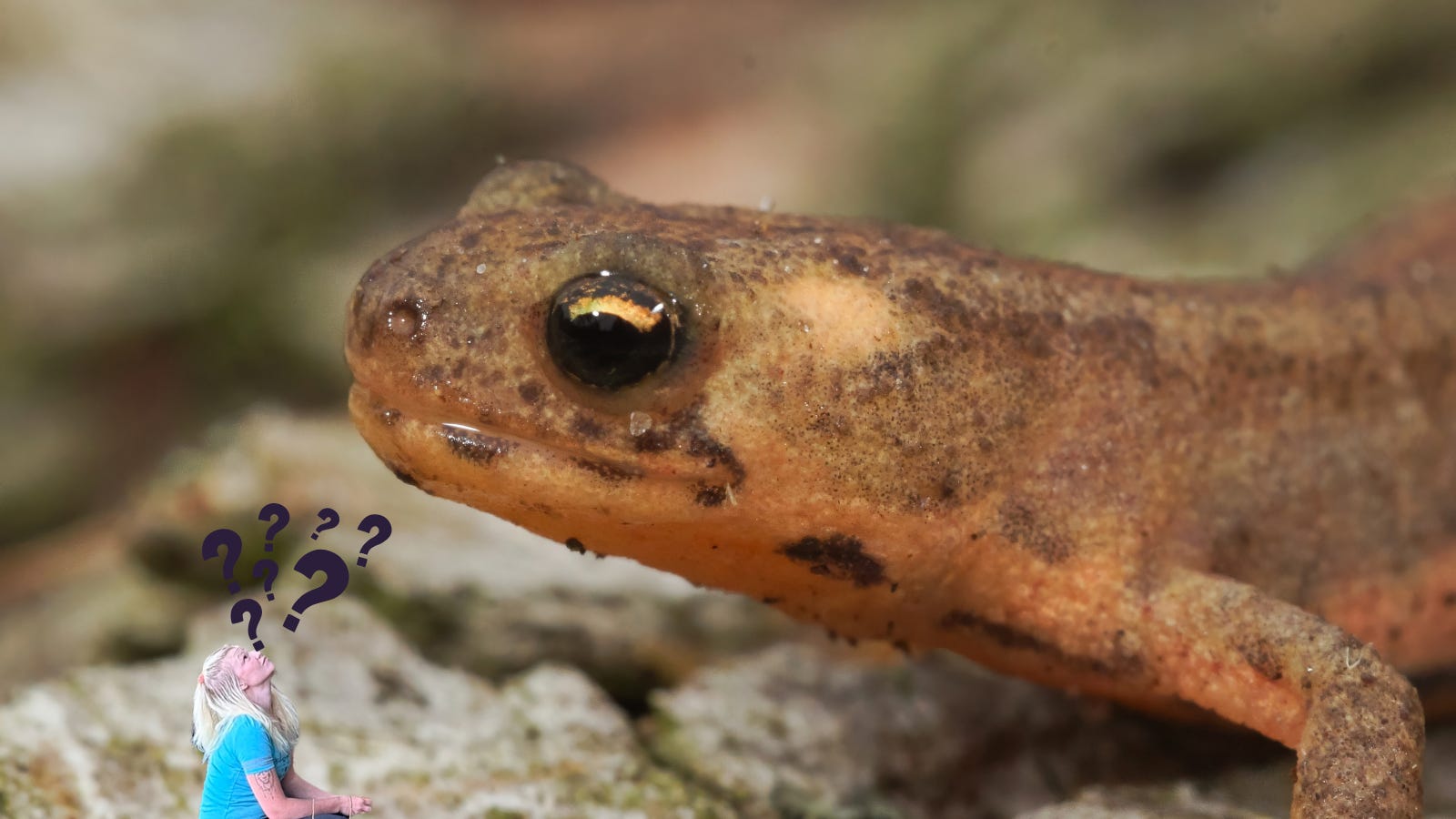
My husband found a salamander in the woods with its left front leg broken below the elbow and a scratch across its face. It was still crawling. More painfully, it was still trying to use the injured leg, rotating its shoulder and pressing the damaged lower limb toward the ground as though repetition might persuade the body to resume its ordinary arrangement. There is something especially difficult about watching a creature continue to trust a part of itself that has stopped working.
We didn’t know what had happened, the forest, unfortunately doesn’t maintain incident reports, and the salamander was in no position to provide a statement. Whatever injured it had already moved on, leaving behind a very small body with an immediate problem and no meaningful interest in whether the people who found it were technically at fault.
We made it a damp, sheltered place where it could hide and rest. I wanted to know what species it was, whether the leg could heal, and what we could do without making the injury worse. But certainty wasn’t the first thing it needed from us. It needed quiet, moisture, protection, and the best chance its small body could have at whatever came next. The wound had no interest in our innocence.
That is one of the more uncomfortable truths about living among other beings. We aren’t responsible for causing every injury we encounter, but our lack of guilt doesn’t make the injured thing need less from us. Once suffering enters our field of vision, the question changes. It’s no longer only about what happened before we arrived, but also about what we’ll do now that we’re here.
Any parent knows that children understand the defense of “I didn’t do it” almost immediately. A cup has spilled, a toy has broken, or an object has appeared in a location so improbable that several laws of physics may have been violated, but the first order of business isn’t repair. It’s the swift establishment of personal innocence. Adults retain this instinct, although we eventually acquire better vocabulary and access to legal counsel.
We didn’t write the law, poison the river, weaken the institution, cut the funding, build the system, approve the development, or create the conditions that made the damage inevitable. We weren’t alive when it began, we voted for someone else, or maybe we have documentation confirming that the mess was already present when we entered the room.
Sometimes all of that is true.
Fault matters because harm has authors, and people who cause damage shouldn’t be permitted to disappear into the soothing fog of collective responsibility. A society that speaks only of what “we” have done can make accountability strangely difficult to locate. The person holding the match becomes merely another concerned citizen standing beside the fire, graciously encouraging everyone else to find a bucket.
We should identify who caused the harm, who profited from it, who concealed it, and who continues it, justice requires that clarity. Repair requires something more. Fault tells us who caused the damage; responsibility determines whether the damage will continue. If we refuse to act until guilt has been perfectly assigned, we may eventually produce an excellent report explaining why nothing remains.
We live inside systems that have become remarkably skilled at socializing damage while privatizing repair. A corporation contaminates the water, and families are told to purchase filters. Employers pay wages that can’t support a household, and workers are offered seminars on responsible budgeting. Governments dismantle public services, and neighbors are encouraged to start fundraisers for the people abandoned by them. The people who caused the damage keep the profits, while those standing closest to the wreckage are handed a moral obligation to clean it up.
This is why responsibility must never be separated from power. Kindness can reduce suffering, but kindness without accountability can become the free labor that allows a harmful system to continue. We can carry water to the fire without losing sight of who is still holding the match. This is the world our children are entering.
Adults have begun treating youth as a line of credit against responsibility. We spend the future freely, then reassure ourselves that the children will be innovative enough to cover the balance. They will invent the technology, heal the divisions, restore the ecosystems, repay the debt, rescue democracy, and somehow develop a healthier relationship with the devices we placed in their hands before they could read. We produce sentimental advertisements about their limitless potential, which is apparently more affordable than leaving them functional institutions.
Most children can’t reliably locate both shoes at the same time, yet we speak of their generation as though a highly trained restoration crew is scheduled to arrive after we’ve completed the demolition. They deserve better than being called the future whenever the present doesn’t want to accept an assignment.
Children should be told clearly that they didn’t cause the conditions they inherited. They are entitled to anger about what was taken, grief for what was lost, and an honest accounting of who benefited. Repair should never become a polite word for requiring the injured to clean up after the people who injured them. They should also know that innocence and powerlessness are not the same thing.
There will be damage they didn’t cause but are capable of reducing. There will be people whose wounds began long before they met them, places harmed before they were born, and institutions weakened by decisions made in rooms they never entered. They will encounter problems that are unfair, exhausting, and offensively uninterested in whether repair fits comfortably into their plans.
The lesson can’t be that every broken thing becomes their personal obligation, that is simply not responsibility. No one person can rescue every wounded animal, restore every forest, correct every injustice, or become the unpaid emergency department for an entire civilization. Some people are taught so thoroughly to care for others that they begin treating their own destruction as evidence of moral seriousness. They need a different instruction: your life is not the material from which every repair must be made.
I am still learning where that boundary lives. Awareness can begin to feel like assignment, as though noticing suffering creates an immediate obligation to solve it. The salamander made that impulse almost comically literal. It was tiny, visibly injured, and entirely unable to tell me whether anything I was doing was helping.
Caring for it required action, but it also required humility. I could provide shelter, moisture, safety, and attention. I could try to learn what it needed and avoid causing further harm, I couldn’t command its body to heal, and destroying myself with worry would not improve its chances. Responsibility should be proportional to our power, proximity, knowledge, and capacity.
Power asks what we are actually capable of changing, proximity asks whether the damage has entered our reasonable sphere of responsibility. Knowledge asks whether we understand enough to help without causing further harm. Capacity asks what we can offer without turning ourselves into another casualty. These questions don’t provide an excuse to do nothing, they help distinguish responsibility from guilt, care from control, and sustainable repair from self-destruction.
Sometimes repair means direct action. Sometimes it means finding someone with the expertise we lack. It may mean giving money, making space, telling the truth, changing a habit, joining an organized effort, or refusing to cooperate with the people causing the damage. At other times, it means protecting something from further harm when restoring it completely is beyond our reach.
Repair is not always a return to what existed before. A broken bone may heal differently, a damaged forest may never resemble the one that was cleared, a family may not recover by recreating the arrangement in which the original wound occurred, a democracy cannot be repaired merely by returning to an earlier version of itself and pretending that version served everyone equally.
Sometimes the old structure contained the conditions for its own failure. Repair may require something stronger, fairer, and more honest than what was lost.
This is particularly difficult for a culture that prefers rescue stories with clean endings. We like the wounded creature to recover, the forest to regrow, the family to reconcile, and the corrupt official to be escorted from the building before the final commercial break. We want care to produce a visible result because otherwise we are forced to confront the possibility that doing the right thing does not guarantee the ending we want.
The salamander may not heal. We may provide moisture, shelter, and safety, only to discover that the injury is too severe or that the animal needs care we can’t provide. Our effort cannot purchase an outcome from its body. That doesn’t make the effort meaningless.
Care isn’t valuable only when it succeeds in restoring everything. A creature that can’t be saved can still be treated gently. A person whose suffering can’t be erased can still be accompanied. A public institution that can’t be returned to its former condition can still teach us what must be built in its place. Repair begins with refusing to let uncertainty become an excuse for abandonment.
Perhaps that’s what children most need to understand about responsibility. They don’t have to be guilty before they’re allowed to become useful, and they don’t need proof of success before choosing to care.
There is dignity in finding a damaged thing and declining to make its condition worse. There is courage in attempting a repair without pretending to possess every necessary skill. There is wisdom in recognizing when the work belongs to a community rather than an individual, and justice in insisting that those who caused the damage contribute more than inspirational remarks.
The world will place many broken things in our children’s hands. Some will be small enough to shelter in a damp enclosure. Others will be systems so large that no individual can touch more than one exposed edge. They shouldn’t be told that all of it is theirs to fix, but neither should they inherit our habit of mistaking blamelessness for exemption.
We didn’t break the salamander’s leg. That settled the question of our guilt, but it didn’t answer the more urgent question of what should happen next. What mattered next was that we had found it. We had seen the damaged leg dragging beneath a living creature that was still trying to move. We had enough knowledge to recognize suffering and enough power to offer shelter. Perhaps this is the next instruction for the future: when you find something wounded, begin by asking what it needs, not whether you can prove the wound belongs to you.
You can’t repair everything, and anyone who tells you otherwise is likely trying to hand you their tools and leave. Still, there will be moments when a damaged life, community, institution, forest, or future is placed within your reach. You may not be responsible for the breaking, but from the moment you recognize the wound, your choices become part of what happens next.
P.S. Our subscription rates for new paid subscribers will increase on 08/15/2026. Upgrade before then to lock in our current price of $7/month or $70/year. Existing paid subscribers will keep their current rate. Learn more here:

Your wisdom and insight is sorely needed as the brokenness is often overwhelming. There is no check big enough that we can write to help heal the family of Johan Guerrero, 26, killed by ICE in Maine with his 3 year old daughter in the car. But we can vote. For a representative who will go to Congress and propose a bill to curb the authority of those goons with guns. I hope your salamander heals and finds her way back to her underground burrow by the creek. That would be hope full.
Heartbreaking, yet beautiful♥️