


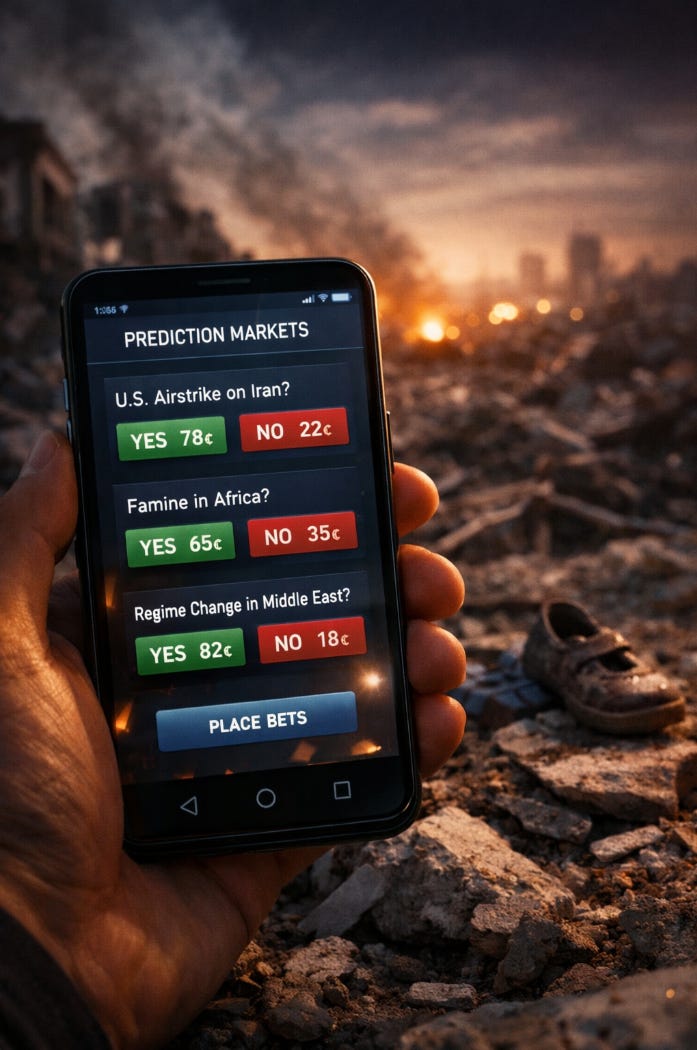
Some stories are so grotesque they feel like dystopian fiction until you realize they are not. A handful of years ago, the idea that Americans could scroll through their phones and place wagers on war, famine, political speeches, regime change, and humanitarian catastrophe would have sounded like a rejected Hunger Games subplot. Now it is a business model.
A growing class of so-called prediction markets has spent the last few years wrapping itself in the language of innovation, forecasting, and information efficiency. The pitch is sleek and bloodless: these are not casinos, they say, but sophisticated tools for aggregating public knowledge. They are not gambling products but financial instruments. They are not tawdry, but smart, not moral hazards, just mirrors of public expectation.
Once you strip away the glossy language, what remains is something darker and much more familiar: a system that allows politically connected insiders, wealthy operators, and opportunists hovering near power to turn public events into private extraction. A system that does not merely reflect corruption, but invites it. A system in which war becomes a trade, suffering becomes a signal, and access becomes an asset class.
That is the heart of the argument now emerging from lawmakers, regulators, journalists, and an increasingly alarmed public. And the more you look at the details, the harder it becomes to dismiss that argument as overheated rhetoric.
Senator Chris Murphy and Representative Greg Casar recently laid out the case with unusual bluntness. Their legislation, the BETS OFF Act, would prohibit prediction markets from offering wagers on sensitive government actions and on events where one person or a small circle can know or control the outcome. In their framing, the problem is not simply that these markets are distasteful or weird, which they most definitely are. It is that they are structurally corrupt.
Murphy and Casar are not saying only that bad people might misuse an otherwise neutral product. They are saying the product itself is built around asymmetry, insider access, and distorted incentives. The examples they cite make the point. If people can place bets on whether the United States will launch a military strike tomorrow, then the people closest to that decision have an obvious edge over everyone else. If users can bet on what words a president will use in a speech, or on who will perform at the Super Bowl halftime show, then the people inside those rooms already know the answer while the public is being invited to play a game that may have been decided before they even open the app.
No one would sit at a poker table if one player had already seen every hand. No one would roll dice if another player got to decide how they landed. Yet that is exactly the logic of these markets when the outcome is knowable in advance by the powerful. The only reason they function at all is because ordinary people are encouraged to believe they are participating in a fair and open market rather than a rigged one.
Murphy and Casar pushed the point further with a chart showing unusual betting activity before the U.S. strike on Iran. They did not name individuals, or prove that specific White House officials placed those bets, or present a criminal case. But the implication was unmistakable. They wanted people to consider the possibility that when war became tradable, someone near power may have treated it as an opportunity.
That is not even the deepest problem. Some events should never be objects of wager. Some questions should never be reduced to a contract price, a spread, or a yes-no market flashing on a phone screen between sports bets and meme coins. War should not be a betting category. Human suffering should not be a trading opportunity. Famine should not be a speculative instrument. Regime change should not become a digital parlay for people with too much money and too little conscience. Strip away the fintech jargon and the sleek app design, and it starts to look a lot like The Hunger Games: the pain of other human beings transformed into spectacle, suspense, and amusement for people safely removed from the blast radius.
Murphy touched that nerve directly when he asked what happens to us spiritually when every moral question becomes a market. He was right to ask it. What happens to a country when the prospect of bombs falling overseas is no longer first understood as a matter of death, trauma, and irreversible human cost, but as a chance to make money before the market closes? What happens when the suffering of Palestinians in Gaza, or the possibility of another war in the Middle East, or a political crackdown somewhere abroad, appears not first as a tragedy but as a line item in someone’s portfolio?
This is why the corruption angle has started to resonate so widely. It is not because people suddenly became experts in derivatives law or federal commodities regulation. It is because people recognize the smell of a grift. They know what it looks like when elites invent a more complicated vocabulary for an old scam. They know what it sounds like when a rigged system is presented as innovation. And they know that in Trump-era America, the odds are overwhelming that if a new marketplace appears promising easy money through access, spectacle, and deregulation, someone in the president’s orbit is already figuring out how to get a cut.
Donald Trump Jr. has documented ties to major players in the prediction-market world. He has been publicly linked to Kalshi as a strategic adviser. He has also been linked to Polymarket through advisory and investment relationships. Trump Media is preparing its own prediction-market venture, Truth Predict, extending the family’s existing politics-media-crypto ecosystem further into speculative event trading. Even where no law has yet been broken, the appearance of impropriety is glaring. The president’s family and business network are not passive observers of this industry; they are players.
That participation changes the way every regulatory fight must be understood. This is no longer just a debate over novel financial products. It is a fight over whether politically connected actors can build new extraction mechanisms around public events while demanding immunity from the rules that govern ordinary gambling businesses. The companies insist they are not sportsbooks. They prefer the language of exchanges, contracts, swaps, and federally supervised event markets. But that distinction grows thinner every day, especially when the overwhelming bulk of their activity looks and feels less like sober price discovery than like sports betting, entertainment betting, election betting, or catastrophe betting with a better tailor.
Arizona’s criminal case against Kalshi brings that conflict into sharp relief. The state has accused the company of operating an illegal gambling business and of accepting prohibited wagers on political outcomes, college sports, and player performance. Kalshi insists it is a federally regulated marketplace that answers to the Commodity Futures Trading Commission, not to state gambling authorities. The legal question is important. The cultural one may be even bigger. What exactly are we looking at here? A financial exchange? A sportsbook with a law degree? A casino in fintech drag?
Whatever label prevails in court, the public is starting to see what these platforms are doing. They are normalizing the idea that every sphere of collective life can be monetized. They are flattening the distinction between information and exploitation. They are taking the ugliest incentives of gambling culture and grafting them onto politics, governance, and global crisis. And because they operate in the glow of tech-world branding and federal ambiguity, they have enjoyed a degree of prestige and indulgence that an ordinary betting parlor never would.
Recent reporting has shown how these markets can create real pressure on the information environment itself. In one especially telling example, reporting around a high-stakes prediction market linked to military developments prompted online abuse and threats toward a journalist whose coverage affected how the event was understood and therefore how the market resolved. That is the logical endpoint of turning world events into wagers. The market does not passively await reality. It exerts pressure on the people trying to describe reality. Once money is tied to an outcome, everyone involved in documenting the truth becomes a target. That should terrify anyone who still imagines these products are just harmless internet curiosities.
Even this does not exhaust the danger because the most corrosive feature of all may be the way prediction markets train the public to accept a new moral posture toward catastrophe. They encourage spectatorship where there should be solidarity, and reward detachment where there should be grief or outrage. They transform horror into content, then into odds, then into profit. A bombing is no longer simply a bombing. It is a contract resolution. A famine is not just mass suffering; it is a volatility event. A speech is not democratic communication; it is an exploitable line movement for whoever already got the draft.
At its most decadent, commodification does more than sell goods and services. It sells a worldview. One that treats other people’s danger as entertainment and other people’s pain as opportunity. One that converts human vulnerability into a market category and then presents the whole arrangement as something sleek, clever, and worthy of admiration.
Some lines should still exist. There is a reason so many people are responding to this story with visceral disgust rather than abstract policy curiosity. The reaction is not prudishness or ignorance. It is moral recognition. People can feel that something essential is being violated when the machinery of speculation sinks its teeth into war, suffering, and state violence. They can feel that a civilization already drowning in corruption becomes still more degraded when it starts offering side bets on the collapse.
Maybe that is one of capitalism’s most decadent late-stage habits, turning every human reality into something that can be priced, packaged, and sold. That larger argument deserves its own essay. But you can see the outline of it here. Once monetization becomes the highest value, even catastrophe/kakistrophe starts looking like a market opportunity.
If this were happening in a healthier political culture, the response would be immediate. The line would be obvious. People with insider access would be barred from wagering on government action. War would be understood as a human catastrophe, not a monetized product. Markets controlled by a small circle of insiders would be recognized as rigged. And an economy that treats every tragedy as a possible payday would be seen not as innovative, but as morally diseased.
But this is not a healthy political culture. This is a political economy that has spent decades training itself to worship monetization, excuse grift, and call corruption by more respectable names. So we get the whole familiar performance: innovation, disruption, liquidity, information aggregation, federal preemption, market efficiency. A blizzard of respectable-sounding language meant to obscure an indecently simple reality: people with power, access, and money are building new ways to profit from public life while everyone else is told to clap for the technology.
The strongest case against these markets is not that every participant is a criminal or that every suspicious trade can already be proven in court. It is that the basic structure is indefensible. Even before the evidence catches up, even before investigators name names, even before judges settle the jurisdictional fights, the moral and political logic is already visible. A system that lets war be wagered on by those near power is a corrupt system. A system that turns human suffering into a contract is a depraved one. Any government entangled with the families, investors, and media machines trying to profit from that system has forfeited any claim to neutrality.
Prediction markets want to be seen as smart, modern, inevitable. They are none of those things. They are just one more expression of a political culture that has lost the ability to distinguish price from value, access from legitimacy, and speculation from governance.
"Prediction Markets" are as close, historically, to the late stages of the Roman Empire (Christians to lions, gladiators killing each other for sport) as anything I've read about or seen in my lifetime... When the immorality and corruption (for which, read: "The Trump Family") penetrates this deep into the bone-marrow of our political and cultural system, it's probably way too late to pull it back from the brink.
The fact that this country has sunk so far that it needs to outlaw such deeply
immoral behavior in the first place; that such betting on death and disaster is even considered a valid business model is a sure sign of incurable decay...
One question that seems impossible not to ask: Who are the hapless saps, the extreme fools who don't understand the completely rigged nature of these bets?"
There really is a sucker born every minute--and such fools and their money are soon parted.
Who are the idiots who don't understand that success in Prediction Markets is based ENTIRELY on insider information- Probably they're the same poor fools who buy all of Trump's bullshit merch and swallow his constant stream of self-serving lies...
This essay took it from unbelievable to unforgivable.