


Breaking news today brought with it that old lump in my throat again, the kind that never fully leaves you once you’ve waited for a phone call from the battlefield. There is a specific weight to that dread, a gravity that presses into your ribcage and makes even breathing feel treasonous. You know the feeling before the headlines reach you. You can sense it in the static of the morning air. Something is about to go wrong in the world, and the government is smiling as it does it.
When Donald Trump casually announced that the United States had seized a “very large” oil tanker off the coast of Venezuela, the largest ever, he said, as if bragging about a new resort tower, my stomach turned in a way I wish were unfamiliar. But I’ve lived long enough, and through enough wars that were never supposed to be wars, to know what comes next. You can always tell when a country is preparing its citizens for escalation; the euphemisms start multiplying, the facts get thinner, and the official tone takes on that too-bright cheerfulness, as though the whole state apparatus is trying to hide a tremor in its hands.
The reporting confirms the worst contours of this moment. The tanker appears to be the Skipper, a sanctioned ship with a history of carrying Iranian oil under a different name. U.S. officials refuse to specify where exactly they captured it or under which flag it sailed. They’ve cloaked the whole thing in the sterile technicality of a “judicial enforcement action on a stateless vessel,” as if that phrase somehow cleans the blood from the deck or makes the surrounding waters any less combustible. But what makes me truly ill is the broader shape coming into focus: months of U.S. military buildup in the Caribbean, tens of thousands of troops, airstrikes on alleged drug boats that never seem to produce evidence of drugs, and now the first direct interference with Venezuela’s oil flow, the country’s last artery of economic survival.
I know that artery metaphor too well. I know what it looks like when a government puts its hand around the neck of another nation and begins to squeeze, insisting all the while that this is diplomacy, that this is justice, that the people will thank us later. I know what it sounds like when military action is dressed up as law enforcement, when the president speaks not in the language of peace but of spectacle, largest this, biggest that, more to come. I know what happens to children, ours and theirs, when men in suits begin talking about the “Western Hemisphere” as something to dominate instead of a home shared by millions of families.
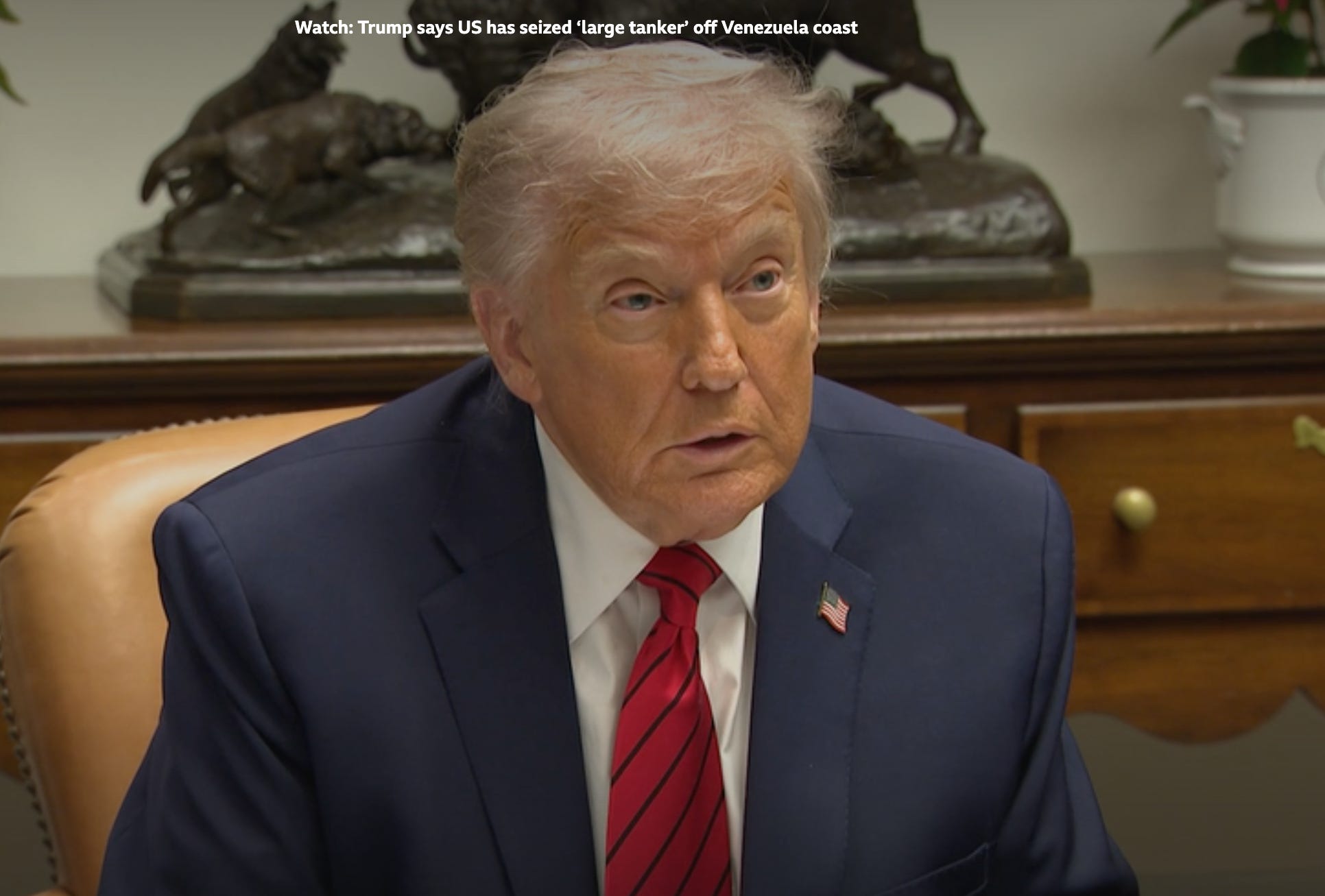
Venezuela’s government, for all its cruelty and corruption, is not the one that scares me tonight. What keeps me awake is the way my own country is moving, the way it seems to be slipping toward a confrontation that no one voted for, no one debated, and no one is being meaningfully informed about. You can feel the inertia building, the quiet acceptance among officials that force, once set in motion, rarely stops where you intended. The ghosts of Iraq, Libya, Grenada, and every forgotten intervention hover at the edge of this story, whispering warnings we keep refusing to hear.
The White House insists that everything is under control, that this is merely a maritime enforcement action, that no one should use the word blockade because that would imply something irreversible. But Reuters is already noting that Venezuela exported more than 900,000 barrels a day last month, and experts are openly saying that going after oil shipments marks a fundamentally new phase. Seize a tanker once and the markets twitch; seize another and the region recalibrates; seize a third and the world wakes up one morning to discover that a naval blockade has begun without a single vote in Congress or a single honest briefing to the American public. Blockades are acts of war, even when no one wants to say the word. Sometimes especially then.
Trump has spent months flooding the waters around Venezuela with U.S. firepower, an aircraft carrier, fighter jets, guided-missile destroyers, and the biggest naval deployment in the region since the Cuban Missile Crisis. More than twenty airstrikes have been carried out on so-called drug boats, killing over eighty people, many of them in murky, contested circumstances that human rights experts warn may already constitute war crimes. And now, with this tanker seizure, the pattern completes itself like the final click of a long-set trap. The administration is no longer merely rattling sabers at Nicolás Maduro; it is testing how far it can go, how violently it can squeeze Venezuela’s economy, before anyone stops it.
I wish I could say this feels unfamiliar, that I’m being irrational or drifting toward paranoia, but my body remembers too much. I remember watching officials minimize and euphemize right up until the bombing began. I remember hearing the word “enforcement action” the same week my child was returned home with psychic and moral injuries that would reshape his entire life. I remember being told everything was under control, all necessary precautions taken, nothing to worry about. I remember the quiet, sickening moment when I realized how easily a government can lie simply by refusing to call a thing what it is.
What we are witnessing now feels like a prelude, the overture to something darker that has not yet been acknowledged aloud. A president obsessed with oil, with dominance, with theatrics, and with punitive spectacle has now opened the door to a conflict that could swallow tens of thousands of lives. And I sit here, at my desk, reading the statements and the careful denials and the evasions, and all I can feel is that old familiar tightening in my throat. I am a mother who has already brushed the edge of losing a child to war; I know what it means when a nation pretends it can play with fire without burning its own children in the process.
Tonight, I am sick to my stomach not because I fear what Venezuela might do, but because I fear what my own country already has done and plans to keep doing. A tanker seized here, a strike justified there, a doctrine of hemispheric dominance spelled out in bureaucratic prose. The distance between “enforcement action” and invasion is far smaller than the government wants you to believe. And once the machinery of war begins to move, it rarely remembers how to stop for the sake of someone else’s children, or our own.
We can pretend nothing is happening but like the ostrich whose head is in the sand, we will find ourselves looking up to find another war, another grind of death, another reason to exploit our young men and women in uniform - not because their country needs them but because the oligarchs want their hands on the oil. Shame Shame Shame.
I'm sick too. A war abroad distracts from problems at home.