


Good morning! Before we wade into the fresh rubble of another news cycle, we begin with a clarification, because unlike certain presidents, we do not fear the concept of “a fact.” Yesterday I suggested that Trump’s bizarre Christmas-reception jungle monologue, the one where he effortlessly fused Sasha and Malia Obama, a dying White House doctor, a venomous snake, Secret Service agents sprinting through the canopy, and an emergency airlift of anti-venom, may have been triggered by his obsession with that corny “snake poem” he cited during his campaign rallies. The factual debris floating around inside his head did come from somewhere: a White House physician’s assistant named Dr. James Jones really was bitten by a venomous snake in Peru on a medical mission, and Malia Obama really did travel to Peru in 2016 on a supervised educational trek. Based on reporting, those two events, however, shared no timeline, no location, no overlap, and certainly no collapsing doctor in Malia’s hiking party.
They were two unrelated episodes until Trump retold them. And in Trump’s recounting, they didn’t just blur; they fused into one cinematic hallucination, complete with details that existed nowhere in either original story. He confidently declared this Peruvian viper kills 28,000 people a year, added dramatic flourishes about Secret Service chaos, and sprinkled in assorted crisis-movie embellishments that seem to have drifted in from the ether. The boundaries between memory, imagination, and idle fabrication have melted into a single gooey mass he now ladles out to donors for entertainment.
The clarification is mine; the cognitive decline is still his. And if anything, this clarification only strengthens the underlying point: Trump is no longer able, or perhaps no longer willing, to maintain the distinction between what happened, what sorta happened, and what he wishes had happened in the exciting action-adventure film playing exclusively in his head.
With that clarified, we turn to what is rapidly becoming the American governing model: the consequences of empowering a kakistocracy, those cheerful folks who believe government is the problem and then set out, quite efficiently, to prove themselves right. Over the weekend, as Australia reeled from its deadliest mass shooting in almost three decades, fifteen people killed at a Hanukkah celebration on Bondi Beach, its leaders did something unfamiliar to American ears: they governed. Prime Minister Anthony Albanese convened national leadership within twenty-four hours and announced a coordinated plan to strengthen gun laws across the country. In Australia, the idea that people should be able to attend a religious festival without being mowed down by long-barrel rifles is not controversial. It is not a partisan wedge issue, or a constitutional koan. It is simply obvious.
At about 4:20 p.m. on a cold Rhode Island Saturday, Brown University students were jolted by an emergency alert flashing across their phones: Active shooter on campus. Run. Hide. Take cover. Within minutes, an economics classroom had become a scene of chaos and carnage. Two students were dead. Nine others were wounded. Finals week transformed into a nightmare of barricaded doors, overturned desks, and parents frantically refreshing news feeds from across the country.
Hours later, before Providence had even begun to process what had happened, horror erupted again on the opposite side of the globe. As more than a thousand people gathered along Sydney’s iconic Bondi Beach to mark the first night of Hanukkah, two gunmen opened fire into the crowd from a raised boardwalk. At least fifteen people were killed, including a child, a Holocaust survivor, and a rabbi. More than three dozen remain in the hospital.
The scenes were separated by continents and seasons, a frigid December afternoon in Rhode Island, a sweltering summer evening in Australia, but united by the now-familiar rhythm of sudden violence, shattered communities, and lives upended without warning.
The aftermath in Australia was heartbreaking: families mourning, communities shaken, beaches strewn with abandoned shoes, blankets, half-finished picnics. But the civic response was immediate and functional. They lowered flags, comforted survivors, and asked hard questions about how the attackers obtained their weapons. Then, because Australia still remembers how to govern, they moved, together, toward reform. Show us how it is done, Australia!
In the United States, we responded in our customary fashion: offering our “deepest regards,” musing vaguely about the nature of evil, and waiting politely for the next mass shooting scheduled, statistically speaking, sometime later this afternoon.
Right on cue, America delivered. At Brown, as investigators scrambled to piece together events, students huddled in dorms under shelter-in-place orders, and Providence inhaled and held its breath, our federal law enforcement apparatus, now run by Kash Patel and a rotating cast of Trump-loyalist appointees, including a 22-year-old former gardener somehow in charge of counterterrorism, sprang into action by… delivering the wrong suspect.
The FBI insisted they had identified their man on surveillance footage. Providence police dutifully detained the individual, searched him, interrogated him, and even drafted search warrants. Regrettably, his name leaked, and his reputation was shredded. Then, with a level of public mortification rarely witnessed on live television, authorities were forced to announce he was innocent. The shooter remains at large, likely benefitting from the Bureau’s catastrophic head start in the wrong direction.
This is what “law and order” looks like under a kakistocracy: reflexive chest-thumping, incompetent execution, and a fugitive killer still roaming free because Trump’s FBI forgot how to FBI.
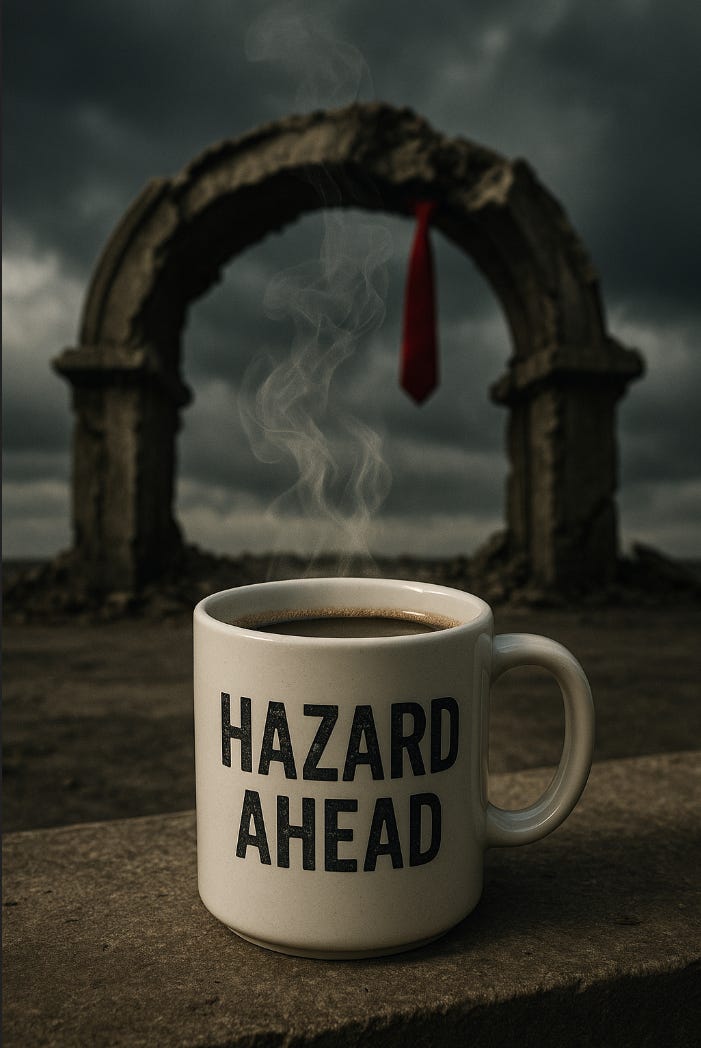
This is what happens when you staff national security with people whose primary qualification is loyalty to Trump’s feudal court, not experience. When the work of counterterrorism is handed to people who think “analysis” means checking Charlie Kirk’s feed. The United States is not simply enduring a crime wave, it is enduring the slow, grinding collapse of the very systems designed to prevent and investigate violent crime, a collapse engineered by the man now wandering around the White House taking selfies and telling donors he’s building his very own Arc de Triomphe by Arlington Cemetery because, and this is a direct quote, it will “blow away” the one in Paris.
While Australia tightens its gun laws and Providence searches for a killer, Trump was busy rhapsodizing about giant stone monuments celebrating himself, hawking Trump Gold Cards to oligarchs for only $5 million per citizenship, and posting glamour shots from the White House lobby like he’s auditioning for dictator Pinterest. Asked about the Brown massacre, he offered the full depth of his statesmanship: “Things can happen.” He said it with the casual tone of a man explaining a spilled smoothie, not the murder of students studying for exams.
If the domestic collapse weren’t enough, the rest of the world has begun saying the quiet part out loud: they see what too many American voters still refuse to acknowledge. Trump is not merely unstable, incompetent, or corrupt, he is a geopolitical hazard. And Europe, after decades of relying on the United States as the anchor of the democratic world, is finally, publicly, unmistakably done.
In Germany, Chancellor Friedrich Merz delivered a speech so blunt it should have come with a diplomatic seatbelt warning. The Pax Americana, the postwar era in which Europe and the United States operated as a unified democratic force against authoritarianism, is over, he said. Not “strained,” not “challenged.” Over. Finito. Packed up and placed gently in the museum next to the Cold War archives and the Berlin Wall fragments.
Merz told his country that nostalgia won’t save them, that America under Trump is acting entirely in its own narrow interests, and that Europe must now defend itself. It was the kind of speech a European leader gives when they have realized they no longer have a partner across the Atlantic, just a property developer in a spray tan, hawking Trump Gold Cards while dismantling NATO.
Europe isn’t drawing these conclusions in a vacuum. Merz gave that speech right before intervening directly in a diplomatic meeting between Ukraine and the hostile American delegation sent by Trump, a group consisting of the usual suspects: Steve Witkoff, a Putin adjutant in business casual; Jared Kushner, emissary of the Saudi-Russia influence pipeline; and a coterie of Trump envoys whose combined foreign policy experience could fit on the back of a cocktail napkin.
Ukraine came seeking a ceasefire and peace. Trump’s team arrived to pressure them into surrender, not a peace plan, not a negotiation, but capitulation. And Merz, understanding exactly what Putin and Trump are orchestrating together, literally sat himself at the center of the Ukrainian delegation, shoulder to shoulder with Zelensky, staring directly across the table at the Americans like a parent arriving at a middle-school fistfight to say: Absolutely f—-ing not.
His warnings echoed through Europe: Putin is not stopping at Ukraine. Putin’s ambitions mirror the logic of 1938. Ukraine’s fall would become Europe’s fall. And yet here is Trump, the ostensible leader of the free world, sending envoys to help Putin find Ukraine’s “soft spots,” while Russian officials publicly declare that they expect nothing short of total Ukrainian surrender.
European leaders have had enough. They see what’s happening even through the fog of Trump’s incoherent rambling about triumphal arches and imaginary “truckloads” of proof he won the 2020 election. Europe sees a United States that, under Trump, is not simply unreliable but actively aligned with the Kremlin’s goalls and Trump’s State Department officials meeting with far-right, pro-Putin German politicians, figures literally described in leaked Kremlin documents as being under “absolute control” of Moscow, and praising them for their “free speech” values while undermining Germany’s governing coalition. They see American diplomats amplifying Putin’s shock troops while Trump’s White House sabotages Ukraine behind closed doors.
And all of it is happening out in the open. For Europe, the mask is off. For too many Americans, it somehow still isn’t. While the world contends with rising ISIS attacks, sham peace plans, Russian disinformation pipelines, and authoritarian infiltration of Western institutions, Trump is wandering the White House lobby taking filtered selfies like a teenage TikToker and dreaming of a knockoff Arc de Triomphe by Arlington Cemetery, a mausoleum for the Pax Americana he is gleefully demolishing.
Hovering above all of it is the unmistakable sense that we are being governed by a man whose mind is slipping gears in public, and by an administration stacked with people unfit to run a lemonade stand, let alone the national security apparatus of a superpower. The cognitive collapse at the top meets the administrative collapse beneath it, and what fills the gap is tragedy, preventable tragedy, playing out from Providence to Bondi Beach, from Syria to the halls of our own universities.
The world this weekend offered a brutal trifecta of crises: mass murder in Australia, a deadly campus shooting in Rhode Island, and American service members killed in Syria amid rising ISIS activity. And in each case, the contrast between a functioning democracy and the United States under Trump was impossible to miss. Other nations respond swiftly, soberly, collectively. America responds with a shrug, a sales pitch, a misidentified suspect, and a president who seems more animated by imaginary French monuments than by the actual lives of the people he governs.
None of this is random. This is what happens when lies replace truth, when loyalty replaces competence, when nostalgia replaces policy, and when the leader of a nation begins to drift so far from reality that his memories merge into myths and his administration follows suit. This is what it looks like when the most powerful country on earth loses both its tether to truth and its capacity for self-protection. It is what happens when we lose our moral character.
When reading and digesting news commentary by Mary Geddry I find I need to first sit down and have a big mug of black coffee on hand.
The contrast between the responses of our country and Australia to the horrible shootings is bone chilling. Australia’s leader took rapid, intelligent and meaningful steps to address more gun control versus “Things happen…” uttered by President Trump.
I am deeply ashamed about how we are “negotiating” peace between Ukraine and Russia. The demands of the invader shouldn’t even enter the equation. The reputation of our country is swirling down the drain of history. The Arche de Trump idea is a monstrosity.
(insert screaming, prolonged)
Nothing, absolutely nothing is being done in this country that does not benefit Twump and then trickling down to his loyalists. This essay today is an unbelievable mishmosh of America's dying days and I wonder about future elections.
Focusing on one likely Republican candidate for president: After reading Propublica's report on South Sudan's health crises accelerating since the demise of USAID, I wonder how Marco Rubio will hold his head up when the huge numbers in the death count bubble up in his 2028 campaign. Right now, babies, children, moms and dads are dying from Cholera in an epidemic that the United States was helping to squash, but resurged like a tidal wave after Rubio's orders to stop aid. Those precious souls, their grieving parents - already have so many marks against them: being born into poverty, never-ending wars, shitty climate change conditions and diseases ravaging their already tenuous living conditions. And now, the agency that was created under JFK, is gone. And with it, America's boots on the ground. Those boots belonged to doctors, not soldiers.