


The fairy garden is finally beginning to look less like a large and financially irresponsible excavation project and more like the place I’ve been carrying around in my imagination.
We’ve created a mystical rock garden from the giant columnar boulders we brought home, each one shaped by this land millions of years before we arrived with a tractor and several ambitious opinions. The drainage river is also well on its way to becoming beautiful, although I continue to reject the suggestion that it exists for anything as ordinary as water management. It is a river of enchantment. If it also prevents the garden from washing down the hill during the Oregon rain, that is merely a fortunate side effect of the magic.
Of course, creating enchantment requires an extraordinary amount of dirt, machinery, physical labor, problem solving, and occasionally standing in the yard disagreeing about whether the water will obey my vision or the established laws of gravity.
Ezra spends his afternoons beneath the trees in his pack and play, watching the rest of us roam through the summer. He looks out at the yard with the quiet longing of a very small man unfairly confined by a deeply unreasonable government. He dreams of the day he can run through the grass, climb over the rocks, and experience the full splendor of childhood freedom. I have explained that he must first demonstrate an ability to resist eating driveway gravel; he doesn’t believe this requirement is relevant to the position.
My daughter, meanwhile, has expanded her natural intelligence into the emerging field of Nutella smuggling. She recently attempted to sneak an entire jar into her bedroom without my noticing. Her operation was nearly flawless, provided we overlook the Nutella on her face, her clothes, her bed, her hands, and the outside of the jar. She remains confused about how I solved the case, and I have decided not to reveal my investigative methods until she’s old enough to understand forensic chocolate analysis.
She’s also learning how to recognize and protect her own boundaries. She wants to love everyone, play with everyone, and remain involved in every available adventure until suddenly she has had enough of the entire human population. We’re teaching her that it’s okay to need quiet, to step away, and to tell people when she wants to be alone.
We’re still ironing out the finer points, including the distinction between creating space for yourself and occupying the entire living room while yelling at your siblings to get away from you. Boundaries matter, but so does kindness, and that’s a lesson I am still learning alongside her. Which perhaps is the best way to teach a child, with them, through our own failures.
The other day, she came to give me a hug for no reason beyond the fact that she loves me and felt like showing it. I was overstimulated, detached, and trying to manage too many competing sounds and thoughts at once, so instead of receiving that sweetness, I told her to go find something to do. The moment passed quickly for her, but it stayed with me.
ADHD can make me retreat inside myself when everything becomes too loud, including the people I love most. That explains what happened, but it doesn’t make the hurt disappear. My daughter offered me affection, and I responded as though her love were one more demand being placed upon me. I felt awful; she deserved a mother who stopped and held her.
The hopeful part isn’t that I always get these moments right, because I simply don’t. The hopeful part is that I can recognize when I’ve failed her, return to her, and try again. I can apologize, remind her that she was never the problem, and practice noticing when my mind is reaching its limit before the people around me are made to feel like they’re the reason.
Then there’s my husband, the architect of my imagination. I bring him ideas in their natural form, which is usually a beautiful, chaotic heap with no measurements, no structural plan, and only a passing respect for gravity. He listens, sorts through the pieces, and finds a way to build them into the world. He can take the wildness in my mind and translate it into lumber, stone, drainage, walls, and rooms where our children will grow. That’s beautiful, but it doesn’t lack effort.
He’s trying to do nearly everything himself, and there’s an enormous amount to do. He’s building gardens, solving drainage problems, removing an eighty-year-old chimney, repairing the roof, designing bedrooms inside a pitched attic, and carrying the daily weight of being the person everyone looks toward when something needs to make sense. He has more patience than I do, but he has limits because he’s a human being, not just a particularly handsome municipal works department.
There are times when he’s tired, frustrated, or more direct than my nervous system would prefer, and I take it personally. I hear exhaustion as rejection or interpret a practical disagreement as evidence that I’m the problem, which isn’t his fault, but it’s true. We work beautifully together in so many ways, and we also have hard moments when neither of us has enough patience left to translate ourselves perfectly.
Designing the attic bedrooms has offered several opportunities for growth because I remain unwavering in my position that peaked ceilings should have no effect on usable floor space and that physics has surely been inaccurate before. He continues presenting me with measurements, rooflines, and facts, while I process the betrayal at my own pace.
Sometimes we laugh about it, and sometimes we don’t. Sometimes one of us needs to walk away, calm down, and come back with better words. We love each other deeply, but love doesn’t turn two imperfect people into a flawless system. It does, however, give them a reason to keep repairing the system when it breaks down.
That is the less picturesque truth behind the fairy garden. The stones are beautiful, but they’re heavy, the river is becoming magical, but someone has to dig it, the rooms will hold our children, but first we have to agree about the walls, and there is imagination here, but there’s also strain, miscommunication, overstimulation, and the daily decision to return to the people we love after we haven’t loved them as well as we wanted to.
Perhaps that’s why the story of one humpback whale in Monterey Bay has stayed with me. The whale, known as the Duchess of Anchovy, had been tangled in commercial Dungeness crab gear for more than a month. Ropes remained wrapped tightly around her tail and flukes, cutting deeply into her body and threatening her life. Whale-watching crews first photographed her in late May, but poor weather made an immediate rescue too dangerous. When she was spotted again in late June, new photographs confirmed that it was the same whale and allowed experts to track the changes in her health.
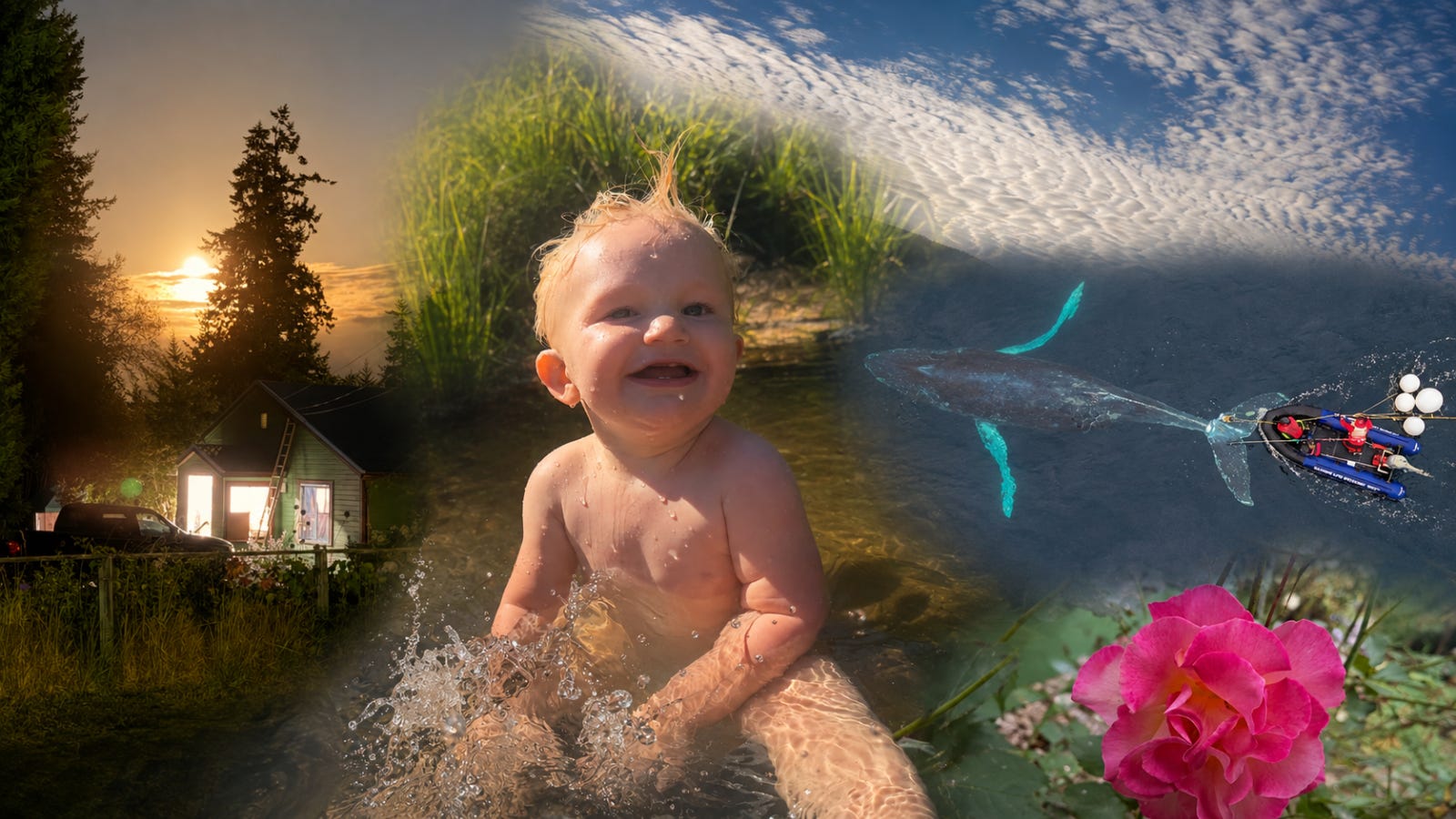
The rescue didn’t happen because one heroic person appeared at precisely the right moment. It happened because an entire network of people kept paying attention. Whale-watch captains and naturalists had attended training and knew what information responders needed. Crews shared photographs quickly enough for scientists to assess the entanglement and identify the whale. When she appeared again near Moss Landing in July, watchers stayed with her and guided an authorized response team to her location.
Responders attached a satellite-tracked buoy so they wouldn’t lose her when fog and poor weather moved in. The next morning, a drone helped them confirm that the ropes hadn’t shifted overnight. Experts developed a plan, and trained rescuers followed the whale as she sped up and dove to escape the boat, reacting as she might have reacted to a predator.
The team gradually attached five large floats to the trailing line, slowing her enough to approach without injuring her or themselves. By then, she had pulled them roughly fourteen miles from Moss Landing. Using underwater cameras, they studied exactly how the ropes were wound around her body, then used a knife mounted on a long pole to make three carefully placed cuts.
At first, nothing happened. The weather was worsening, and the responders believed they would have to leave and try again another day. As they began removing the floats, there was a small pop, and the remaining gear finally fell away.
The Duchess sped off, apparently having reached her lifetime limit for human interaction. The following evening, whale watchers found her feeding with other humpbacks near Moss Landing. They continued photographing her wounds and behavior so scientists could follow her recovery. NOAA Fisheries documented the rescue and the many people who made it possible.
There’s real hope for humanity in that story, but it’s not the comforting kind that asks us to pretend everything turned out fine. The whale was tangled in human fishing gear, and the ropes had already cut into her flesh. The first attempt to help was delayed by dangerous weather, and even when trained responders finally reached her, there was no guarantee that their plan would work.
Hope lived in what happened next. People had built relationships before the emergency, they had trained members of the community to recognize what mattered, they shared information instead of guarding it, admitted when conditions were unsafe, asked others for their expertise, and returned when they had the right tools. No single person could have saved her alone, so no one insisted on trying.
That last part feels especially important to me. We are often taught to admire the person who carries everything without help, as though exhaustion were evidence of devotion and reaching a breaking point were a personal failure. My husband tries to do too much because he loves us. I sometimes disappear inside my own mind because I’m overwhelmed. My daughter declares the living room an independent nation because she hasn’t yet learned that boundaries require diplomacy. None of us can manage every burden perfectly, and none of us should have to.
The whale wasn’t freed by perfection. She was freed through attention, preparation, cooperation, patience, and the willingness to keep trying after the first conditions were wrong and the first cuts appeared to accomplish nothing.
That’s the kind of hope I believe in because it leaves room for reality. It doesn’t require a perfect marriage, a mother who never becomes overstimulated, a husband with endless patience, or a childhood without hurt feelings. It asks us to notice what’s happening, tell the truth about it, accept help, make repairs, and come back with better tools.
Our fairy garden is becoming beautiful, but our life is not a fairy tale. We become tired, we misunderstand one another, we say the wrong thing, take things personally, and sometimes turn away from tenderness when it arrives at an inconvenient moment. Then we notice, apologize, and reach for one another again.
Hope isn’t the promise that love will keep us from causing harm or feeling pain; it’s the faith that we can learn, repair what we can, and refuse to abandon one another inside the ropes. Sometimes freedom begins with nothing more dramatic than a small pop in the line and the weight finally beginning to fall away.
P.S. Our subscription rates for new paid subscribers will increase on 08/15/2026. Upgrade before then to lock in our current price of $7/month or $70/year. Existing paid subscribers will keep their current rate. Learn more here:

Beautifully written! Thank you.
Well written and thought provoking.
Eleanor Roosevelt viewed hope as a pragmatic, intelligent choice over fear and a driving force tied directly to action, dreams, and human progress. Much like Michelle Obama, she rejected passivity, believing that hope requires active cultivation, courage, and a refusal to give in to defeatism. She argued that historical progress proves optimism is a more rational and productive strategy than paralysis.
“Surely, in the light of history, it is more intelligent to hope rather than to fear, to try rather than not to try,” she wrote in her book, You Learn by Living. She firmly drew a line between passive wishing and active, hopeful planning, reminding people that “It takes as much energy to wish as it does to plan.” She also noted that “Nothing has ever been achieved by the person who says, 'It can't be done.'”
https://www.goodreads.com/author/quotes/44566.Eleanor_Roosevelt