


Good morning! Power and control are not the same thing. Power is the ability to do something. Control is the ability to determine what happens after you do it.
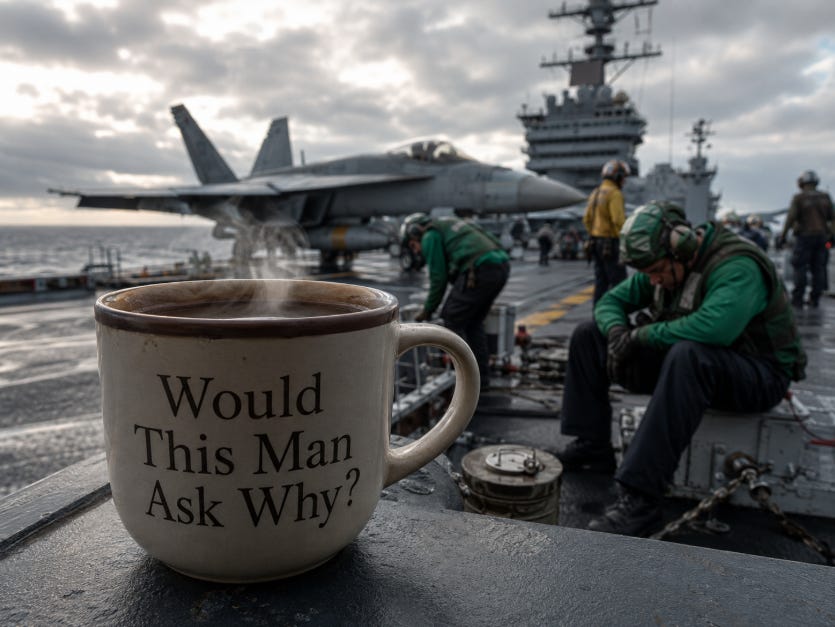
The Trump administration is being haunted by these distinctions across an extraordinary range of fronts. At home, old constitutional and civil-rights protections are being challenged, narrowed or dismantled in the name of executive authority and local control. Abroad, the United States is trying to reshape Gaza while fighting a widening war with Iran. On an American aircraft carrier, sailors and Marines are reportedly exhausted after months at sea with no clearly articulated end state. Back home, the economy is showing signs of strain from tariffs, war-driven energy costs and weakening employment. The accumulating evidence looks increasingly like enormous power being exercised without anything resembling mastery over the consequences.
Yesterday we spent considerable time on birthright citizenship, so there is little reason to reconstruct that argument here. The important thing this morning is that the fight belongs to a much larger question we are going to keep encountering: what happens when protections Americans have long treated as settled become dependent upon the willingness of institutions to defend them?
In Louisiana, Bossier Parish Schools and the federal government have agreed to end 61 years of court-supervised desegregation monitoring. Attorney General Liz Murrill hailed the move as an overdue restoration of local authority, arguing that decades-old consent decrees are costly, ineffective and intrusive. But the decision also belongs to a subject we have returned to repeatedly: fundamental rights, and the institutions required to make them real.
There is nothing inherently wrong with ending a decades-old federal decree once its work is genuinely complete. But “local control” carries some historical baggage when the subject is school segregation in Louisiana. The harder question is the familiar one: when may government safely remove a safeguard created because ordinary political processes once failed to protect a fundamental right?
That deserves its own essay. So does Yasmin’s detention.
According to her fiancé, ICE agents detained her at the Houston airport without initially explaining why, despite her having no criminal record and, he says, following the legal process in her pending immigration case. The interview turns heartbreaking when he describes both his ability to fight for her, lawyers, money, congressional help, and the families around him who have none of those advantages.
“They don’t have the means,” he says. “And that’s sad.”
That statement takes us directly back to one of our recurring questions about fundamental rights: a right that exists on paper but requires money, access, and extraordinary persistence to enforce is a very different thing from a right that ordinary people can actually exercise.
We will come back to both stories.
Now, Gaza. Donald Trump created something called the Board of Peace to oversee the reconstruction of Gaza, which sounds reassuring in much the same way that naming a subdivision “Whispering Pines” reassures you that somebody, somewhere, once saw a tree.
The Guardian reports that the board’s first prospective construction contract in Gaza is for a 150-person military outpost intended to house Moroccan troops taking part in an international stabilization force.
Not apartments, sewer systems, schools, or hospitals. Not permanent housing for people who have spent months living in makeshift camps. A military base.
To be precise, the contract reportedly has not yet been finalized, and supporters of the plan have a reasonable argument: if an international force is going to provide security during a transition, those troops need somewhere to operate. But sequencing communicates priorities.
And after months of grandiose talk about rebuilding Gaza, complete with futuristic renderings of waterfront towers and a gleaming “New Gaza” the first physical expression of that vision appears to be accommodations for foreign soldiers.
The penthouse comes later. The governing framework is being shaped by an international board chaired by Trump and involving Jared Kushner and Steve Witkoff.
The Palestinians themselves remain curiously peripheral to the grand exercise in restoring Palestine. It reminds me of the great rural-development pitch familiar to places like Coos County. Outside investors arrive with diagrams and consultants and announce that prosperity is imminent. There will be jobs. There will be infrastructure. Your streets will someday be paved with gold. Your children will attend schools constructed entirely of Italian marble. Please disregard the tax abatements and sign here.
At least that sales pitch traditionally contains a promise to the people who already live there. The Palestinians are not even getting much of that.
They are being shown visions of a rebuilt homeland while other people decide its security structure, political administration, reconstruction priorities and physical layout. It is difficult to discuss that honestly without eventually arriving at the word sovereignty.
Who governs Gaza? There is something grimly appropriate about erecting barracks before answering who actually owns the house.
Trump continues insisting the Iran war will end soon. On Friday he told reporters he expected it to conclude “pretty soon,” adding that he did not believe Iran could “go much longer.”
Perhaps.
But “pretty soon” has become one of those wonderfully elastic units of geopolitical measurement, somewhere between “two weeks” and “infrastructure week.”
The actual picture is considerably messier, and considerably more expensive than advertised.
The Washington Post reported this week that Trump’s frustration boiled over at Camp David, where he confronted Defense Secretary Pete Hegseth over missile shortages so severe they’re now constraining US options against Iran. Trump had believed the problem was fixed. It was not. Hegseth’s response was to blame his own deputy, Stephen Feinberg, for failing to keep the president informed — an answer that manages to be both an admission and an evasion in the same sentence. This is also the same Hegseth who, five months ago, was among the loudest voices assuring Trump the war would be quick and relatively easy.
The numbers explain the temper. In the war’s first month alone, US forces fired more than 850 Tomahawk cruise missiles, over 1,000 Patriot and THAAD interceptors, and more than 1,300 Army tactical ballistic missiles. ATACMS reserves — the same munitions Ukraine has spent three years begging allies for — are now reportedly exhausted. CNN separately reported this week that the US has burned through roughly 80 percent of its THAAD interceptor stock and half its Patriot interceptors. Replacement hardware takes up to two years to manufacture. There is no near-term fix, only a queue.
This is where the phrase “losing the war” needs some precision, because it is doing at least two different jobs at once.
Strategically, the verdict is arriving from surprising quarters. The New York Times reported that America’s own allies now describe the war as headed toward “strategic defeat” not because Iran won any particular battle, but because six months of military superiority have not produced a nuclear rollback, a changed government, or a secured Strait of Hormuz. The IAEA’s own assessment is that the strikes delayed Iran’s weapons-grade uranium capability by months, not years. Iran, battered but unbroken, is now the party effectively dictating Hormuz terms to Oman, terms Washington will likely have little choice but to accept and later describe as its own idea.
Tactically, the honest answer is not “the US keeps losing engagements.” It’s that engagement-by-engagement success has stopped being the meaningful measure. A military can win every individual exchange and still be losing the war of attrition underneath it, spending million-dollar interceptors against threats that cost a fraction as much to launch, the same mismatch that has ground down Ukraine’s air defenses for three years, except Ukraine didn’t choose its war. Somebody in the Pentagon appears to have understood this distinction going in: the expensive precision munitions were reportedly meant to open a corridor for cheaper follow-on strikes, not to carry the entire campaign. Instead they carried the entire campaign, and now the campaign is running out of inventory to spend.
A war does not have to be lost on the battlefield to be lost. Sometimes it is lost in the supply depot, one exhausted stockpile at a time, while the man who ordered it keeps promising reporters that it will be over “pretty soon.”
That exhaustion is not confined to budget spreadsheets. It has reached the families of American service members.
The USS Abraham Lincoln left San Diego in November, stopped briefly in Guam in December, and did not see another port until Oman in early July. Nine months at sea. Five of them in continuous combat operations. Sailors and Marines are reportedly working 12- to 14-hour days with few or no days off, describing food shortages, broken toilets, no hot water, and weeks without laundry. Lines an hour or two long at the ship store often end in discovering there’s no toothpaste, deodorant, or soap left to buy.
None of this means sailors expected a cruise. They know what they signed up for. What worries their families is narrower and more specific: fatigue on a flight deck is not an abstraction. Aircraft launch and land beside moving bombs and fuel lines in a space with no margin for a tired hand or a slow reaction. Logistics becomes operations. Operations become tactics. Tactics become an accident report.
One military mother put the entire war in a single question: “What are we completing? What have we completed?”
That is not pacifism. It’s strategy, asked plainly by someone with more standing to ask it than anyone in the Pentagon.
Representative Jason Crow, a veteran of Iraq and Afghanistan, argues the administration went to war without a real plan for rotating carriers and crews through the region. Whatever one makes of Crow as a messenger, the operational facts are hard to dismiss: a carrier nine months deployed, extended twice, is not a war plan working as intended.
A military doesn’t have to run out of aircraft to become less effective. Sometimes it just runs out of rested people.
And while America is paying those costs abroad, the bill is beginning to arrive at home.
Friday’s employment report was ugly.
Employers cut 23,000 jobs in July, and the government revised May and June downward by a combined 103,000; the labor market had already been weaker than Americans were told at the time. Wage growth slowed. The labor force shrank by more than a quarter-million people. One month doesn’t make a recession, and there are real signs of resilience: unemployment holds at 4.1 percent, private employers still added 30,000 jobs, and construction grew. Markets, with their customary enthusiasm for bad news that might delay a rate hike, actually rose.
But the direction is getting harder to wave away, and the causes are not mysterious. The New York Times reports businesses are absorbing renewed tariff costs alongside higher expenses tied to the war in the Middle East. Gasoline is roughly 35 percent more expensive than before the Iran war began. The 10-year Treasury yield has climbed sharply as investors price in inflation risk.
Which leaves the Federal Reserve facing the one combination central bankers dread most, weakening employment and persistent inflation, with no clean tool for either. Raise rates and hiring weakens further. Hold rates and inflation embeds deeper. There is no button labeled MAKE ECONOMY GOOD, whatever presidential candidates of both parties seem to believe.
Some of this inflation was a choice. Tariffs raise costs. War disrupts energy supplies. Energy costs ripple through everything else. Then the Fed is handed the job of taming the resulting inflation by making borrowing more expensive, roughly the logic of setting the kitchen on fire and then complaining the fire department got the carpet wet.
Trump recently called this “the greatest economy we’ve ever had, by far.” History has been known to enjoy a surprise. But a month of vanishing jobs, downgraded prior gains, elevated energy costs, and a central bank cornered between inflation and a weakening labor market is an odd moment to hang the MISSION ACCOMPLISHED banner.
This brings us back to the larger story connecting all of this.
The administration’s political vocabulary is saturated with the language of strength: taking control, restoring sovereignty, securing the border, ending federal interference, crushing Iran, rebuilding Gaza, bringing peace and making America wealthy again. These are all, in one form or another, statements about power, assertions that sufficient force, authority or will can bend events toward the desired result.
Politics eventually has to answer a second question:
Then what happened?
Birthright citizenship tests whether executive power can redefine a constitutional guarantee.
Louisiana tests whether removing federal oversight means an old injustice has been permanently corrected or merely that the referee has left the field.
Yasmin’s detention tests what due process means when the government can move faster than an individual’s ability to challenge it.
Gaza tests whether reconstruction without meaningful Palestinian political agency can honestly be called self-determination.
Iran tests whether overwhelming military capability can produce a desired political outcome.
The Abraham Lincoln tests how long that capability can be sustained when the human beings operating it are exhausted.
And the jobs report tests how long Americans will accept the domestic costs of tariffs and war while being told those policies are making them richer and safer.
None of these stories proves that catastrophe is inevitable. But taken together, they share a single, unfashionable lesson: power can compel, punish, and destroy, but it cannot guarantee that the world responds the way its wielder intended. That requires something power alone has never supplied. Judgment. The willingness to know, before you spend a life, what you are spending it for.
W.H. Auden wrote an epitaph once, for the tomb of an unknown soldier, that has outlived every war it was written about:
To save your world, you asked this man to die.
Would this man, could he see you now, ask why?
Families with sons and daughters on the USS Abraham Lincoln are asking that question now, while their loved ones are still alive to hear the answer, if anyone in Washington ever gives one.
Washington has yet to offer one.
Regarding the stressed and overworked military: it’s not just the Navy. My son is an Army National Guard sergeant responsible for contracting to sustain local missions. He has been working 13-14 hour days, 7 days a week, since April, with no end in sight until his deployment ends on October. We are very concerned for his mental wellbeing.
Very perceptive comments.
And about the Gaza Board of Peace: countries paid billions to join - where is the money? Nobody knows.
Maybe it's in the same place as the billions that have been paid for the Venezuelan oil that the US has diverted and sold - also completely unaccounted for. (And that's when Venezuela is desperate for aid following its horrible earthquake. Trump does not seem to be in a hurry to give the country its own money back to help rebuild.)
So power and no control, but unceasing corruption.