


Today, Thursday, February 12, 2026, the Trump administration did something that sounds like a bureaucratic footnote and lands like a gut punch. It moved to revoke the Environmental Protection Agency’s 2009 “endangerment finding,” the formal scientific and legal determination that greenhouse gases endanger public health and welfare. If you do not live in the weeds of federal regulation, you could be forgiven for thinking this is a bureaucratic footnote. It is not, it is closer to pulling a load bearing beam from the house and calling it renovation.
Because the endangerment finding is not just paperwork. It is the moment the federal government looked at the world we live in and said, out loud, in law, what people already knew in their bodies. Carbon pollution harms us, it is not an abstract “externality.” It is a threat that enters the air, the blood, the lungs, the weather, and the daily routines of families. It shapes whether a kid can run at soccer practice in August without heat sickness, whether a grandmother can breathe on smoke days, whether a coastal town can keep its schools open after the next storm. Revoking it is an attempt to make that threat legally unseeable.
The administration’s message came with the swagger of a sports trade or a corporate merger. It claimed the EPA has “terminated” the endangerment finding and eliminated greenhouse gas emissions standards that followed from it, especially for vehicles. The argument is cast as freedom. No longer will automakers be “pressured” toward electric vehicles. No longer will Washington “force” a transition.
But there is a trick embedded in the packaging. When you call a seatbelt requirement “pressure,” you can sell its removal as liberation. When you call a fire code a “burden,” you can frame demolition as deregulation. When you call the scientific basis of climate policy “so called,” you can make the future sound optional. This is the American climate story in miniature. Take a hard, shared physical reality, translate it into legal language, then pretend the legal language is the reality. If you can break the words, you can break the obligation. If you can unwrite “endangerment,” you can unwrite responsibility.
Here is the hinge that matters. In 2007, the Supreme Court held that greenhouse gases can be treated as pollutants under the Clean Air Act and that the EPA had to answer a direct question: do these emissions endanger public health and welfare? In 2009, after reviewing the scientific record, the EPA said yes. That “yes” became the legal foundation for federal greenhouse gas regulation, particularly tailpipe standards for cars and trucks, and later rules reaching other parts of the economy. It did not solve climate change. It did not even come close. But it established a principle that mattered: climate pollution is a public harm, and the government has the authority and therefore the duty to treat it like one.
That duty has been attacked for years because it is powerful. It creates obligation. It compels rules. It gives states, advocates, and industries a baseline of certainty. It says there is no pretending this is just a lifestyle debate or a cultural signal. Greenhouse gases are a problem, and government must respond.
The move to revoke the endangerment finding is a move to sever the federal government’s own legal nerve endings. If greenhouse gases do not “endanger” us in the eyes of the law, then rules designed to limit them become vulnerable. If the foundational finding goes, the architecture built on top of it can be weakened or dismantled. The administration is advertising exactly that. It wants to unwind standards for light, medium, and heavy-duty vehicles and dull the teeth of climate regulation across the board.
Even if the courts ultimately reverse this, and that fight will be fierce, there is damage in the attempt itself. Climate policy is not only statutes and rules. It is a social signal about what is real and what matters. When the federal government announces it is “terminating” an endangerment finding, it is not only talking to judges. It is talking to companies deciding what to build, to investors deciding what to fund, to governors deciding what to prioritize, and to parents deciding whether their worry is overreacting or simply accurate. It is telling the country to stop believing their own senses.
What makes this moment so disorienting is that it arrives at a time when reality is already screaming. This is not 2009, when climate change still lived for many Americans somewhere between documentary narration and distant polar bears. Now it is a calendar. It is the smell of smoke seeping into the car. It is the surreal orange daylight at three in the afternoon. It is heat advisories that read like a permanent fixture, not an exception. It is insurance premiums climbing like a living thing. It is the small, intimate bargaining of modern parenting. “Should we cancel the playdate? Is it safe to let them run outside? Do we have an air purifier? What if the power goes out?”
A sustainability story, told honestly, is never just about carbon. It is about continuity. It is about whether childhood can remain a place where the world is stable enough to take for granted. It is about whether seasons stay a comforting rhythm or become a roulette wheel. And if you have children, or you have nephews, students, godchildren, or neighbors’ kids you care about, you already feel the shift. You feel it when they ask why the sky looks wrong. You feel it when they learn words like “evacuation” too early. You feel it when adults start speaking in contingency plans as casually as weekend plans.
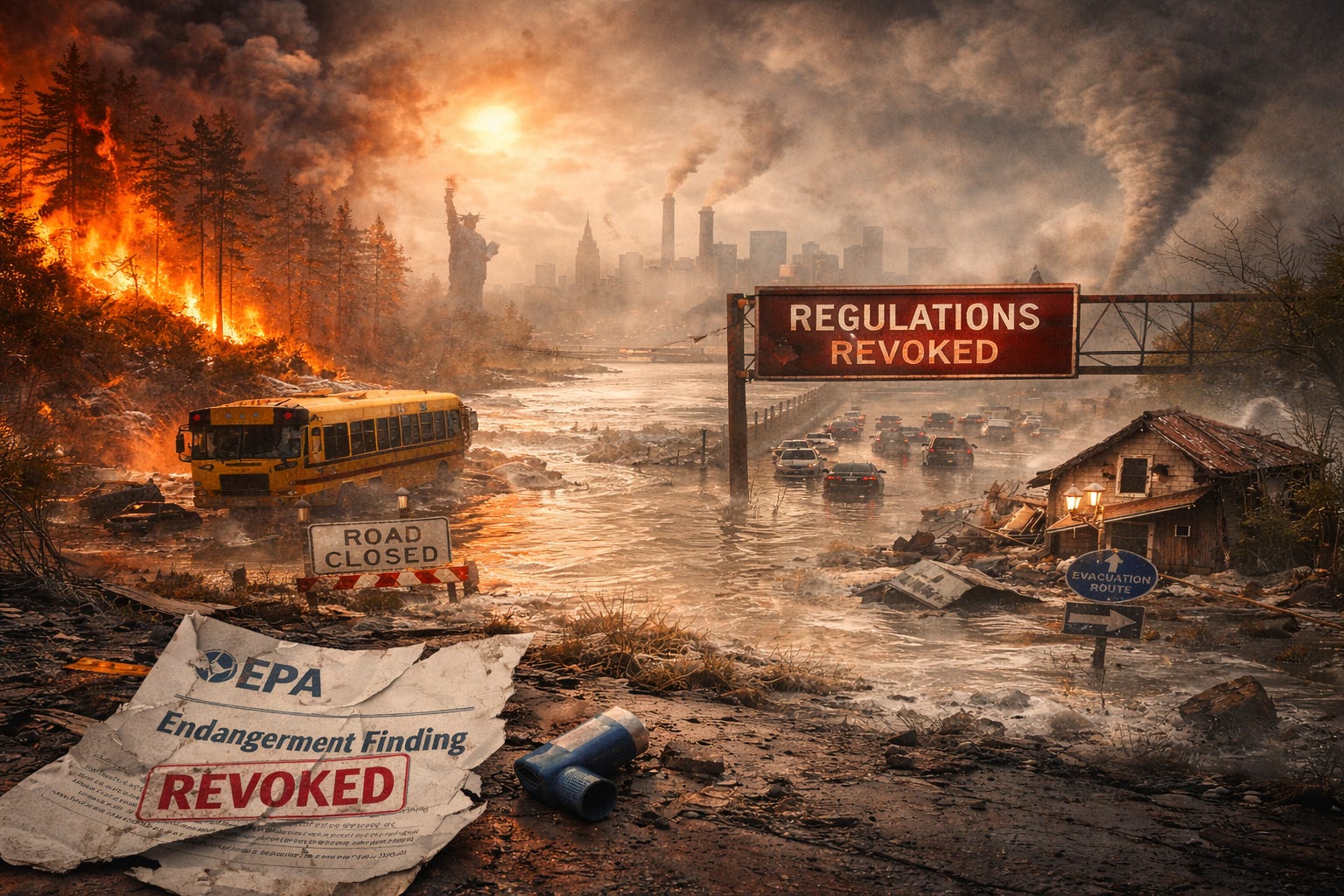
The administration is not subtle about whom it wants to protect instead. Unleash fossil fuel production, kill the transition, repeal subsidies, and withdraw from global agreements. These are verbs of acceleration in the wrong direction, dressed up as a return to common sense. The emotional trick is to present climate policy as elite indulgence, like boutique recycling, rather than what it is. A set of guardrails meant to keep the future from sliding off a cliff.
There is also a grim irony in the promise that ending standards means ending “pressure” on automakers. The pressure is not primarily regulatory. It is global and physical. Automakers face pressure from Europe and China’s industrial strategies, from supply chains, from consumer expectations, and from the reality that internal combustion platforms have diminishing long term certainty. Federal rollbacks can slow parts of the transition in the United States. They can inject chaos and delay. But the rest of the world is moving, and the atmosphere does not pause for our politics.
And delay is not neutral. Emissions are cumulative. We live with what we put in the air. Weakening rules for cars and trucks does not just change a line in the Code of Federal Regulations. It changes the fleet people will drive for the next fifteen years. It changes the air around highways and ports. It changes what manufacturers optimize for. It changes the direction of billions of dollars of research and development. It changes the political story about what is possible, and what is worth doing.
If you are looking for the emotional center of this, it is betrayal. Not betrayal as partisan melodrama, but betrayal as a moral failure. Adults in charge choosing a short-term victory over the long-term livability of the world children will inherit. There is something uniquely nauseating about climate rollbacks because they are, by definition, intergenerational. You do not get the full consequences during the term of office. You get them in your child’s adulthood, when the fires are worse, the storms are stronger, and the cost of fixing what we broke has compounded.
This is why the language of “deregulation” feels almost obscene. When a government deregulates greenhouse gases, it deregulates heat. It deregulates smoke. It deregulates whether a home remains insurable in a place people have lived for generations. It is not removing rules. It is removing the idea that we owe one another protection.
Yes, this will be fought in court. The endangerment finding did not appear by accident, and reversing it is not as simple as holding a press event. There will be lawsuits. There will be arguments about statutory authority and administrative procedure. There will be judges parsing the record. But the emotional truth does not need a ruling to be true. A government can do harm by trying to deny harm.
So, what should we do with the feeling of this? Refuse the numbness, the comforting fantasy that it will all work out without our involvement. Take the anger and the grief and turn them into something sturdier: insistence.
Insistence that the air our children breathe is not a bargaining chip, that the science is enough to justify action and the reality we are living is enough to demand it. Insistence that sustainability is not a lifestyle brand but a moral commitment to continuity, so that the story of childhood can still be, at least in part, about wonder rather than emergency.
If “insistence” sounds too small for a problem this large, remember what it looks like in practice. It looks like showing up where the rules are made. It looks like paying attention to state standards and local resilience funding and utility commissions and school district air filtration. It looks like supporting organizations that litigate, that organize, that vote, that build. It looks like calling this what it is: an attempt to strip legal recognition from a physical crisis, and refusing to let euphemisms do the work of erasing harm.
Mostly, though, it means something simpler and harder. Let yourself feel the stakes without turning away. Because sustainability is not a spreadsheet. It is the hope that the people we love will have a future not defined by escape routes. It is the belief that government can still be a tool for protection instead of a weapon for denial. It is the promise we make, implicitly, every time we care for a child, that we will not knowingly hand them a world on fire and call it freedom.
Today’s move is a warning flare. Not just about policy, but about the story we are being asked to accept. The story says climate danger is debatable, it says protection is tyranny. The story says we can unwind recognition and keep the benefits of a stable planet, but we can reject that story.
We can demand a government that treats reality as binding. And we can say, as plainly as possible, what should never have needed to be said. Greenhouse gases endanger us, and our children deserve adults who act like it.
Thank you for sharing this information, which is easy to miss or disregard with all the other horrendous actions of this administration. They also stopped renewable energy projects initiated by the Biden administration and private sector businesses.
This administration doesn't give a #@$% about people. They only care about making money 💰 That's what this is all about! Giving BIG COAL free reign, gas and oil baboons more $$$$$. As though any of these entities need more!
They don't care about our children, especially after they've taken their first breath! They're quick to condemn abortion and birth control, "it kills our babies " but once that child is born, they wash their hands!!!
Isn't it RUMP who screams "whatever happened to global warming " whenever this country experiences a cold spell!!! WHAT AN IDIOT! We're just shitting in our own nest!!!!
Thank you again, Mary for another great post.