


Trump’s latest kakistrophic war is a tragedy for everyone, that is the approved haze. Everyone is hurting, everyone is anxious, everyone is bristling at the pump, everyone is watching the price of shipping lurch upward like the global economy just wandered into a ditch drunk. The whole world, we are told, is suffering together.
So severe, in fact, that the G7 and the International Energy Agency have been forced into emergency talks over strategic oil reserves, while governments scramble through whatever other stopgap measures they can find to keep this war of choice from tipping the global economy into outright seizure. Oil spiked above $100 a barrel, the G7 said it stood ready to take “necessary measures,” and emergency stock releases were under active consideration as officials tried to contain the shock.
Some are watching the same chaos that is squeezing households and rattling markets and treating it like a dividend announcement. While everyone else gets inflation, uncertainty, and another round of geopolitical whiplash, a familiar class of opportunists is standing off to the side with a bucket under the cash leak.
One of the biggest beneficiaries, unsurprisingly, is Russia. That is the part that gets lost when the coverage turns into one big fog bank of generalized suffering. Yes, markets get twitchy and every talking head on television starts using the phrase “regional instability” like they are being paid by the syllable. But not everyone is merely enduring the fallout. Some players are converting it directly into money, leverage, and strategic advantage. They are not victims of the fire. They are roasting marshmallows over it.
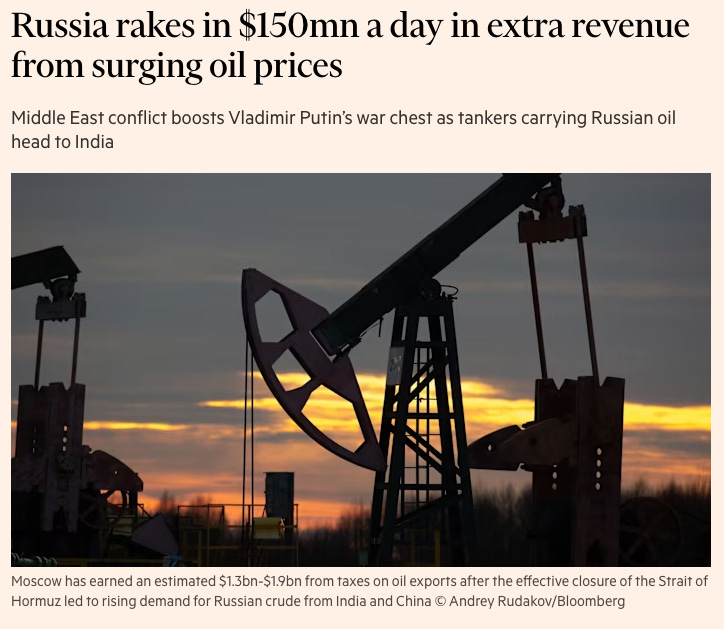
Russia, in particular, has once again stumbled into the sort of good fortune that only seems to arrive when the rest of the world is losing its mind. As oil prices rise and supply routes convulse, Russian crude becomes more valuable. Buyers who were supposed to be under pressure to diversify suddenly rediscover the charms of convenience. Sanctions start looking less like moral commitments and more like awkward obstacles to be worked around. Just like that, the Kremlin gets a fresh stream of revenue while Ukraine gets another reminder that in modern geopolitics, someone else’s “market adjustment” is usually a missile budget.
This is the grotesque “genius” of Trump-era chaos. He manages to turn every crisis into a two-for-one special for autocrats. The public gets told to accept higher prices as the unfortunate cost of decisive leadership, while strongmen and petro-states quietly head to the cashier with their winnings. It is like watching a man set his own garage on fire, call it a bold new heating strategy, and then somehow send the bill to his neighbors while the arsonist down the block sells propane at a markup.
Trump, because he is apparently incapable of touching any international crisis without making it somehow stupider and more profitable for Vladimir Putin, has once again created the ideal conditions for Moscow to cash in. He does not have to sit in the Kremlin war room twirling his tie and muttering in Russian. He just has to approach world events with the strategic discipline of a raccoon on Adderall, forever lunging at the nearest shiny domestic talking point and knocking over everything in the process.
The result is that while American families pay more to fill their tanks and businesses absorb the cost of higher shipping, Russia gets to enjoy something much nicer: renewed fiscal oxygen. And not in some vague, theoretical sense. According to the reporting, Moscow is pulling in an estimated $110 million to $160 million a day in extra budget revenue from the oil shock, with a total windfall of roughly $1.3 billion to $1.9 billion in just the first 12 days. If prices stay elevated, that could rise to something like $3.3 billion to $5 billion over the month. This is not a neat little economics sidebar for Bloomberg addicts and terminally online policy nerds. Oil revenue is war revenue. Every extra dollar flowing into Russian state coffers helps cushion the pressure that sanctions were supposed to create. Every spike in crude prices gives Moscow more room to fund its military machine, patch budget holes, and pretend the costs of its war of annihilation are manageable after all.
Which is why Ukraine should be at the center of this story, even when it is not on the front page. Because Ukraine does not experience these price surges as a matter of consumer inconvenience. Ukraine experiences them as a strategic setback. When Russia’s revenues rise by another hundred-million-plus dollars a day, the Kremlin’s capacity to continue slaughter and occupation rises with them. When sanctions enforcement gets blurrier because Washington suddenly wants to soothe energy markets, Ukraine is the one that pays the real bill. Not in dollars. In civilians, cities, infrastructure, and time.
That is what makes the usual hand-wringing coverage so maddeningly incomplete. It treats the crisis like some kind of universal misery weather system drifting over the globe, as though we are all simply getting rained on together. It is a wealth transfer wrapped in a security crisis. It is pain redistributed downward, profits redistributed upward, and advantage redistributed toward the very regimes that should be under the most pressure.
It’s no wonder Russia is sharing intelligence with Iran. Trump’s kakistrophic foreign policy does not simply fail to contain bad actors; it keeps rearranging the board so they come out richer, bolder, and harder to dislodge. It does not merely neglect allies; it leaves them exposed while handing fresh leverage to the regimes and strongmen trying to crush them. And it does not distribute pain evenly, despite the usual pious talk about shared sacrifice. It creates a rigged hierarchy of consequence in which ordinary people get hit with higher prices and deeper instability, vulnerable nations absorb the bloodshed and destruction, and opportunists at the top scoop up the cash, the market share, and the strategic advantage. That is the real obscenity here: Trump turns global disorder into a profit center for predators, then calls the wreckage leadership.
I guarantee that this twist is totally whispered into Trump's ear from Putin. You can't make this stuff up. It's really remarkable. Trump is a puppet if not an actual agent of Russia. If it walks like a duck..... you know the rest.
More evidence, if any is needed, that Putin’s hold over Trump is that of a handler over an intelligence operative - or a man with videos that would bring his BFF down. No doubt Putin is also advising Trump how to steal the midterms with Russia’s help.
Meanwhile, our mainstream media, elected representatives and courts stand by as if what’s plainly before our eyes and in countless evidentiary records is TDS or imagination gone wild.
After the Epstein files, the notion of a global network of ruthless, corrupt elites transacting for their own interests, we peasants be damned, doesn’t seem crazy.