


Good morning! The world’s largest economy is now being steered by a man who seems to think geopolitics works like a casino comp: bark loudly, threaten everyone in sight, stiff the dealer, and assume the house will eventually hand you the keys. Let’s begin in the Strait of Hormuz, where Trump’s unforced war with Iran has graduated from reckless military adventure to global cost-of-living event. The blockade he announced with all the subtlety of a man throwing a “hamberder” through a cathedral window is already being tested in public, with multiple reports of vessels transiting Hormuz after the blockade took effect, including ships tied to Iranian trade and Chinese-linked shipping. The blockade is being probed almost immediately, and every ship that gets through further erodes the credibility of a policy that was likely assembled somewhere between a Truth Social tantrum and a Fox chyron.
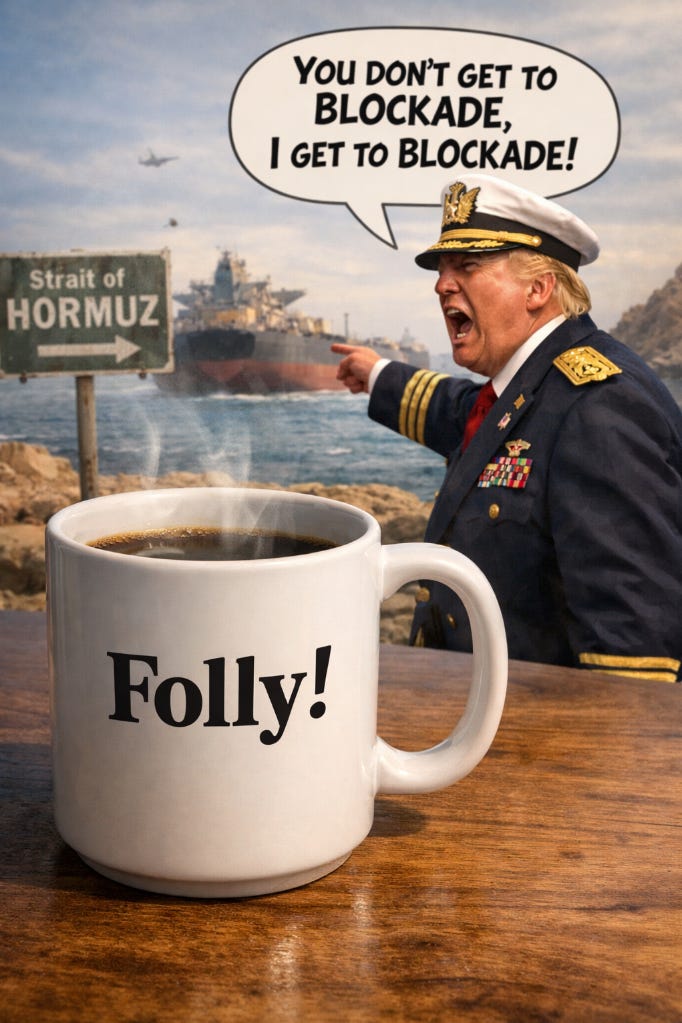
A blockade only works if people believe it is real. The moment tankers start slipping through, everyone recalculates: traders, insurers, shipping firms, allies, rivals, and Tehran itself. As one analyst put it, the shadow-fleet tanker Elpis, a vessel that took on cargo in Iran and then transited Hormuz, was “the guinea pig” because “Iran needs to gauge how seriously the US intends to enforce it.” Trump now sits in the worst possible position for any bluff artist: publicly tested, visibly porous, and one bad enforcement decision away from a much larger crisis. He can ignore the breaches and look weak, or tighten enforcement and risk a standoff with Chinese-linked shipping. Or he can continue issuing grand threats while the world watches to see whether there is any operational coherence beneath the chest-thumping. So far, the answer appears to be not especially. Reports now describe not one clean blockade but a grotesque little duet: Iran restricting transit through its own coercive system while the United States tries to interdict traffic farther out, creating what can only be described as a geopolitical “Who’s on first?” routine with warships, tankers, and insurance markets. Trump has, in a remarkable feat of self-sabotage, blockaded his own blockade.
The deeper problem is that this is no longer just a war story. It is an oil story, an inflation story, and a recession story. As one energy analyst warned in commentary cited this week, $100 or even $110 oil may be just the beginning; the real danger is not a temporary spike but a new floor. That is the phrase to keep in mind: a new floor. A structural reset in energy costs that works its way into everything else. More expensive food, higher shipping costs, pricier airline tickets, rising utility bills, fertilizer shocks, transport surcharges. The slow, grinding realization that once you rattle the world’s most important energy chokepoint, you are not just playing with oil futures; you are playing with the cost of daily life. Now the IMF has stepped in to confirm what the spin doctors keep trying to bury: this is no longer just a war story. It is an inflation story, a recession story, and a cost-of-living story for millions of people who had no say in Trump’s latest act of vanity and destruction. The fund is warning that the war could slow global growth, reignite inflation, and even raise the possibility of a global recession, with downside scenarios dragging growth sharply lower while energy and commodity prices continue to surge. Leave it to Trump to bankrupt casinos and the world.
That is the part the administration either does not understand or does not care to understand. The White House keeps behaving as if this is a made-for-TV pressure campaign, a temporary test of manhood in which Trump squints at the camera, says something about “all the cards,” and reality politely rearranges itself around his ego. Reality, however, is proving stubborn. The last prewar cargoes are reaching refineries. Asian buyers are vacuuming up replacement barrels from everywhere they can find them. Europe is worrying about jet fuel. Governments are moving into contingency mode. Markets are not reading this as a clean, overwhelming display of strategic mastery. They are reading it as a messy bargaining tool with fuzzy edges and rapidly spreading fallout. Even if the strait were magically reopened tomorrow, there is no fast-forward button for tanker logistics, inventories, damaged infrastructure, and repricing risk. A choke point does not simply unclench because Donald Trump declares himself a genius before lunch.
There is also the farce within the farce: diplomacy. After the marathon talks in Islamabad failed, JD Vance was still signaling that negotiations could continue. Pakistani mediators were still working the phones, and U.S. officials were still discussing another round. Then Trump responded by announcing a blockade, an act of economic warfare with a maritime costume on. Trump’s knee-jerk blockade undercut whatever diplomatic credibility Vance had left. One lane said keep talking; the other lane said we are escalating right now. That is before we even get to the spectacle of Trump telling reporters the Iranians are supposedly begging for a deal while tankers test his blockade in broad daylight.
Jeffrey Sachs, never exactly a man who pads the corners, put it bluntly: “This no longer looks like rational statecraft.” It looks like the foreign policy of an individualized, chaotic presidency, one in which Trump seems to believe he can bluff, bomb, and bully his way to total capitulation, even as every contradiction in the war suggests the opposite. The result is delusion operationalized: a blockade after failed talks, a ceasefire no one can define, allies drifting away, rivals exploiting the vacuum, and the global economy paying for one man’s fantasies of omnipotence. Instead of a functioning policy process with deliberation, discipline, and clear objectives, we have one aging narcissist, a shrinking coterie of hacks, and a global system forced to absorb the consequences of their improvisation.
America’s allies are reacting to this strategic masterclass by backing away like dinner guests who just watched the host sneeze over the soup. Trump keeps implying others will help enforce the blockade. They will not. Britain has explicitly said, “we are not getting dragged into the war,” while Germany, Spain, Italy, Poland, and Greece have all ruled out naval support. Macron and Starmer are instead working on a separate multinational plan to restore freedom of navigation later, once the conflict stabilizes, with Macron stressing that any future effort would be “strictly defensive” and “distinct from the belligerents,” diplomatic code for: we are not touching your weird little naval stunt, but we may eventually send adults to clean up the glass. Even Rachel Reeves, Britain’s chancellor, is calling the war “folly,” warning that “to start a conflict without being clear what the objectives are and not being clear about how you are going to get out of it” is exactly the kind of reckless stupidity now ricocheting through allied capitals.
While America’s allies edge toward the exits, China is doing what competent rivals do when the hegemon decides to cosplay as a bathtub Caesar: exploiting the moment. Beijing is publicly condemning the blockade as dangerous and irresponsible while simultaneously deepening ties with Arab partners, hosting the UAE’s crown prince, welcoming Spain’s Pedro Sánchez, and presenting itself as a more useful interlocutor than Washington. That is the story Trump never considered, because it would require him to understand that war rearranges trust as well as troop positions. His unforced war with Iran is not just roiling oil markets, it is quietly redrawing the map of global alignment, pushing allies into hedging behavior, inviting rivals like China to pose as the adults in the room, and shifting trade and diplomatic ties in ways this administration was too arrogant or too incompetent to foresee. What Trump sold as strength is increasingly looking like a geopolitical own goal.
Trump’s grotesque spat with Pope Leo only sharpened that same theme on a more cultural and diplomatic register. Blowing up a region, destabilizing the global economy, and toying with Chinese maritime escalation were not enough for one week, so Trump also found time to insult the head of the Catholic Church and post an AI-generated image of himself in Christ-like imagery before insisting, with all the oily confidence of a man trying to explain away lipstick on the collar, that he was merely depicting himself as “a doctor.” Italy, predictably, did not receive this as a charming bit of presidential whimsy. Reporting from Europe suggests political and church leaders condemned the attack across the board, major Italian papers treated it as outrageous and unprecedented, and even Giorgia Meloni, usually not allergic to Trumpism, was forced into a rare rebuke. The contrast could not be starker: Pope Leo is out preaching peace, dialogue, and bridge-building on a historic visit to Algeria, while Trump is abusing religious imagery and hurling insults at the leader of 1.4 billion Catholics. Another perfect snapshot of kakistocracy in action: vulgar, self-absorbed, diplomatically corrosive, and incapable of leaving any institution untouched by its own stupidity.
If the first half of this rundown is about the collapse of competent statecraft abroad, the second half is about the same rot consuming institutions at home. The Trump administration has now fired two immigration judges who earlier dismissed deportation cases against student advocates for Palestinian rights, including cases involving Rumeysa Ozturk and Mohsen Mahdawi. DOJ has not openly admitted retaliation because authoritarian systems generally prefer euphemism to confession, but the message is hard to miss: if you are not willing to rubber-stamp the regime’s political deportation agenda, your job may be next. These two firings come amid a broader purge of immigration judges, with more than a hundred already removed since Trump took office. The purge has reached the bench. Due process is still permitted in theory, right up until it inconveniences Trump’s preferred spectacle of cruelty.
Because every authoritarian project eventually requires a dungeon aesthetic, we also got further reporting out of Arizona on the ICE detention facility in Mesa. Local reporting from the Arizona Mirror suggested the site, rated for 157 people, had averaged 274 detainees a day over the past year, then suddenly dropped to unusually low numbers just in time for a scheduled congressional inspection before climbing again almost immediately afterward. That reporting prompted lawmakers to go back the same day for “not an announced” visit, and what they found was exactly what you would expect from a system that only behaves when it knows someone is watching: detainees packed into cells “like sardines,” people on the floor without blankets, and desperate pleas for help inside a facility designed for stays of less than 12 hours. Rep. Adelita Grijalva said, “It was frightening in there” and, more bluntly, “It is disgusting.” The overcrowding is bad enough, but the apparent staging for oversight is even more damning, because it suggests not only cruelty but consciousness of guilt. This administration is not merely warehousing human beings in degrading conditions; it appears to be curating Potemkin tours for Congress when it thinks anyone important might be watching.
The same kakistocracy staffed by sycophants and hacks is not just embarrassing the United States; it is degrading military judgment, damaging trade relationships, alienating allies, insulting global institutions, and burning through the trust and competence that real power depends on. Iran didn’t put a weekend Fox host in charge of its military. America did, and now the world gets to watch a cable-news fantasy collide with the realities of naval warfare, oil markets, and international law. The IMF has now done us the favor of translating all that stupidity into plain economics: this is an inflation story, a recession story, and a cost-of-living story for millions of people who had no say in Trump’s latest act of vanity and destruction.
The "blockade" was always a ludicrous idea. What was the US navy going to do? Sink a French or British tanker when they refused to stop? What a joke of an administration.
It is important to get into the mind of a stable genius. If a blockade is a good thing, then a blockade of a blockade is better. On a more serious note it looks like the military is working hard to take the Trump/Hegseth lunacy and modify it to reduce the risk of major power confrontation and risk to our ships and personnel. I know from having served with the State Department in Dhahran, that the U.S. Navy has always been leery about bottling up warships in the Strait. We (the public) don't know what weapons the Chinese and Russians are providing Iran, but suffice it to say i would not want my loved ones (or any US service personnel for that matter) on a naval vessel in the Strait (or near it) particularly given Trump's insanity.