


Good morning! A miserable morning, however, to the man who starts a war of choice, threatens NATO if nobody helps him finish it, and then acts personally betrayed that the rest of the world is not sprinting toward his flaming mess with a minesweeper, a body bag, and a thank-you card.
Donald Trump’s latest gaggle was basically Trump doing what Trump does best: declaring total victory, threatening more war, contradicting himself every six minutes, and blaming AI, the media, and reality itself when anything fails to flatter him.
He opened by bragging that Iran had been militarily crushed to dust, declaring that the United States had “essentially defeated Iran” and boasting, “We’ve taken out their air forces … their navy … their air defense. There’s no air defense whatsoever.” He also claimed the U.S. had taken out Iran’s leadership “times two or three,” as if he were narrating a mob movie instead of a war. At the same time, he insisted Iran now “want[s] to negotiate badly,” only to immediately muddy that with, “I don’t think they’re ready,” before veering into “I don’t know that I want to make a deal.” So the official doctrine appears to be: they want a deal, he wants no deal, there may be a deal, and no one knows who is still alive enough to sign it.
He then pivoted to the Strait of Hormuz and started selling the same old grievance in a new war wrapper: why should America guard shipping lanes for countries that rely on Gulf oil more than we do? “It’s almost like we do it for habit,” he said, before insisting, “I’m demanding that these countries come in and protect their own territory.” So the pitch was not strategy so much as a geopolitical protection racket: Trump starts the fire, declares the danger mostly over, and then bills everyone else for hose duty. According to him, Iran now has “very little firepower left,” which made his parting threat all the more thuggish: countries that refuse to help should remember that “we will remember.”
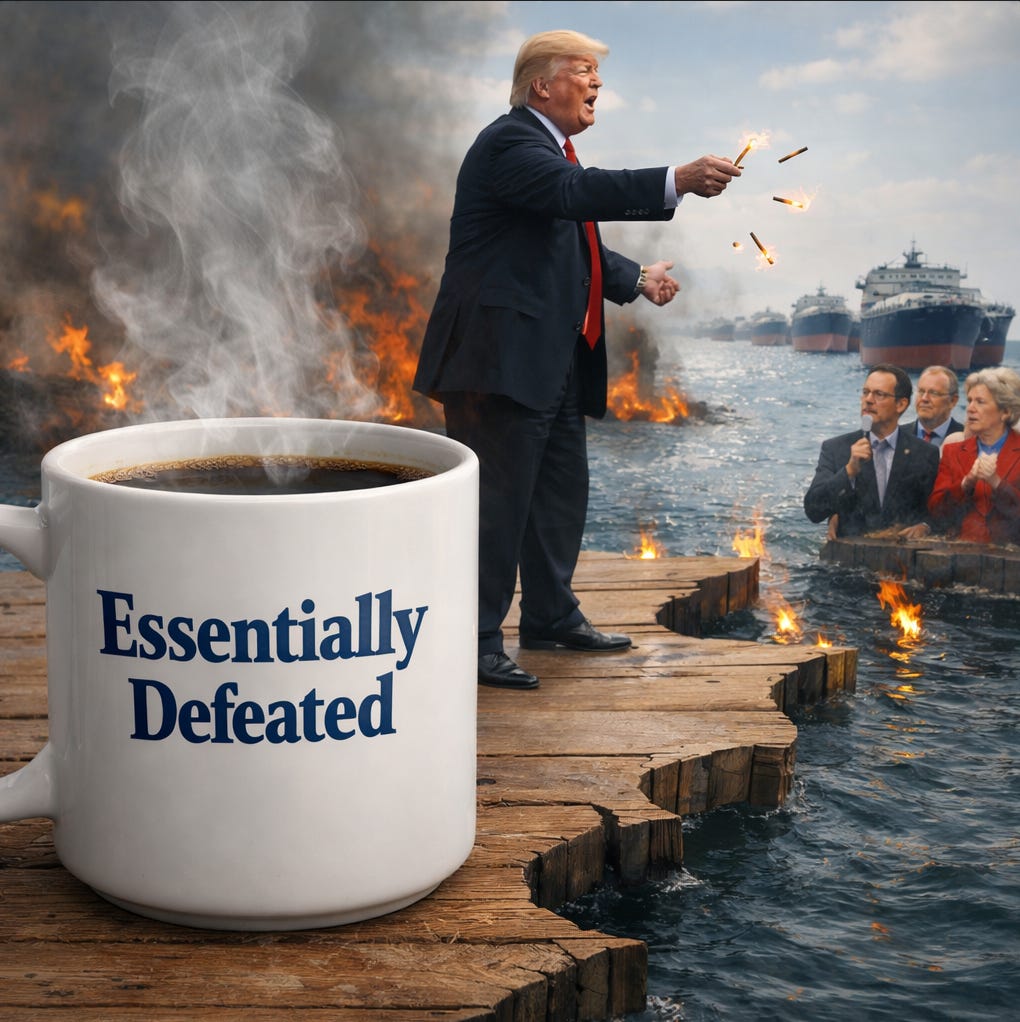
A good chunk of the rant was devoted to Trump insisting that nearly every inconvenient report out of Iran was fake, AI-generated, dishonest, criminal, or all four. He claimed Iran had circulated fabricated images of attacks on U.S. forces, saying they showed the USS Abraham Lincoln “burning” even though “it was never attacked. It was never burning.” He also dismissed reports of Iranian support rallies, insisting the supposed crowd of “250,000 people in a square” was “totally AI generated” and “never took place.” Even the “kamikaze boats,” he said, “don’t exist. They’re fake.” So the new doctrine appears to be: if a story makes Trump look even slightly less invincible than Alexander the Great in bronzer, then it must be AI and the American media are criminal for noticing it.
When reporters pressed him on criticism of a fundraising email that apparently used official White House imagery and teased access to “secrets,” he mostly brushed it aside and retreated into his favorite emotional support blanket: the claim that nobody has ever been more beloved by the military than he is. “There’s nobody that’s better to the military than me,” he insisted, before padding the case with the usual fog of unnamed “poll numbers” and election results. Not one of, or just very popular, but the most in history by the military. Obviously! The evidence, as always, appears to consist of vibes, self-mythology, and the election, which he drags into every subject the way your weird uncle drags up his high school football injury at every Thanksgiving.
He also used the opportunity to attack ABC, because of course he did. When a reporter from the network tried to ask a question, Trump snapped, “ABC News, one of the worst, most fake, most corrupt,” then escalated it into, “I think it may be the most corrupt news organization on the planet.” So, as usual, the press availability briefly stopped being about war, diplomacy, or reality and turned into Trump’s favorite improv exercise: Why Are You Making Me Lie In Front of These Microphones?
On Iran’s internal politics, Trump claimed the regime had already shot and killed “32,000 protesters” and suggested “the number is much higher than that,” using those figures to explain why Iranians were not rising up despite his calls for them to do so. “They put out statements that if you protest, you’re going to be shot and killed,” he said, adding, “The protesters have no guns,” as if that settled the matter. Whether one agrees with the broader point or not, the delivery was the usual Trump cocktail of authoritarian chest-thumping, unverifiable numbers, and the emotional subtlety of a yard sale garden gnome.
He also refused to officially declare victory, but only after spending most of the event describing a level of destruction that sounded very much like victory just with extra adjectives. “We’ve essentially defeated Iran,” he had already boasted, and later claimed that if the U.S. “left right now, it would take them 10 years and more to rebuild.” Yet when asked directly if he was ready to declare victory, he answered, “No, I don’t want to do that,” because apparently he wants all the glory of saying he won without the inconvenience of being pinned down to the word itself.
Then came the self-mythologizing. He insisted that ending the Obama Iran deal and sending B-2 bombers “obliterated” Iran’s nuclear ambitions and prevented nuclear war across the Middle East. In his telling, he alone prevented Israel and half the region from being nuked into oblivion. The man cannot describe a military operation like a president; he has to describe it like a guy at a casino explaining how he single-handedly saved civilization by hitting on 16.
Because no Trump ramble is complete without opening an entirely new geopolitical tab in his own brain, he wandered into Cuba at the end, declaring flatly, “Cuba is a failed nation.” He then claimed, “Cuba also wants to make a deal,” and promised that “something will happen with Cuba pretty quickly,” as if casually teeing up a second international crisis were just another item on the brunch menu. No unhinged war brag is complete without launching a bonus subplot before the first one has stopped burning.
That was the gaggle. But the Financial Times interview he gave beforehand made the whole thing even uglier, because it showed this was not just free-range babbling. The gaggle was the frothing public version of a cleaner, more deliberate message he had already delivered privately: help me with my war in Iran or NATO can have a “very bad future.”
That was the actual threat. Trump told the Financial Times that if allies failed to help, it would be “very bad for the future of Nato,” adding, “It’s only appropriate that people who are the beneficiaries of the Strait will help to make sure that nothing bad happens there.” Because of course this man cannot simply start a war and own it. He has to turn it into a loyalty test. He has to light the fire, then turn to America’s allies and snarl, why aren’t you helping me hold the hose? It is the same sleazy protection-racket worldview he brings to everything else. Every alliance is transactional. Every crisis is an invoice. Every partner who hesitates is disloyal.
His grievance parade in both appearances was especially revealing. He whined that Europe and China benefit from Gulf oil more than the United States does, asking in effect why America should keep footing the bill for everyone else’s shipping lanes. “It’s only appropriate that people who are the beneficiaries of the Strait will help,” he told the Financial Times, while insisting that “Europe and China are heavily dependent on oil from the Gulf, unlike the US.” He complained that Britain only offered help after he believed the hard part was already done, grumbling, “We need these ships before we win, not after we win.” And he even hinted that China’s failure to play along could affect his summit with Xi, saying of the trip, “We may delay.” So now we have arrived at the stage of empire where a U.S. president launches a war, threatens NATO’s future, shakes down allies for naval help, and tries to use a great-power summit like a mob boss holding a car dealership hostage. It is “America First” translated into its truest form: America starts the catastrophe, everyone else gets handed the cleanup bill.
France 24, to its credit, said the quiet part in polished broadcast English: Trump is trying to pressure allies into helping him out of an “unforced error.” That phrase deserves to be bronzed. Because that is exactly what this is. This was not some unavoidable act of history. This was not a bolt from the blue. It was a reckless choice, and now America’s allies are being told they owe their loyalty by risking their own troops and ships to help clean up the maritime and geopolitical chaos that choice unleashed. France is keeping its mission defensive. Japan and Australia have no plans to send warships. Everyone seems keenly aware that while Trump can apparently absorb any number of disasters so long as cameras are rolling, other leaders might prefer not to sacrifice sailors for his ego project and then explain the body bags to their voters later.
Costs are no longer theoretical. The Associated Press reports that the war is now hammering the global economy in exactly the way everyone with a functioning brain feared it would. Oil prices have surged. Brent crude is hovering above $100 a barrel. Iran has effectively strangled shipping in the Strait of Hormuz, through which roughly a fifth of the world’s oil passes. A drone strike temporarily shut Dubai International Airport, one of the busiest travel hubs on the planet, because apparently this war now needed to disrupt international aviation just to complete the catastrophe starter pack. Saudi Arabia is intercepting Iranian drones. The UAE is dealing with attacks on energy-related targets. Civilian infrastructure is under strain. Food and fertilizer markets are feeling the pressure. The entire global economy is being dragged into the undertow of Trump’s war of choice, and his answer is to warn that he will “remember” which allies decline to help him mop up the damage.
That little phrase really says it all, does it not? “We will remember.” He sounds like a thin-skinned nightclub owner threatening to ban patrons who refused to help him put out the kitchen fire after he himself threw the lit match into the fryer. This is the psychology of the whole administration in miniature: create danger, pretend danger proves your strength, then use the danger you created to extort obedience from everyone else.
While he is busy extorting allies abroad, he is also snarling at the judiciary at home. The Guardian reports that after the Supreme Court ruled many of his tariffs illegal, Trump took to social media to declare that he has “the absolute right” to impose new tariffs anyway. Not “I disagree with the ruling.” Not “we are reviewing lawful alternatives.” No, he just asserted an absolute right, because in his mind every institution exists to ratify his impulses, and any branch of government that fails to do so is corrupt, disloyal, or both. The Court had ruled in February that the 1977 emergency law he relied on did not authorize many of his 2025 tariffs. So naturally Trump responded by attacking the Court, claiming it had “ransacked” the country, and announcing that he was already finding another way to do the same thing.
There is a pattern here so obvious even a concussed goose could spot it. Abroad, Trump says he has the right to bully allies into joining his war. At home, he says he has the right to slap tariffs on the world despite an adverse ruling from the Supreme Court. In both cases, the assumption is the same: if Trump wants a thing, law and alliances are merely decorative obstacles for lesser people. He does not believe in institutions. He believes in instruments. NATO is an instrument, so is Congress. Courts are instruments, tariffs are instruments, and so it appears even war is an instrument. All of it exists, in his imagination, to amplify his will. If reality or the Constitution or international law intrudes, then reality and the Constitution and international law are the problem.
The view from abroad is always enlightening. Al Jazeera coverage adds another wonderfully humiliating dimension by looking at Trump’s attempt to pressure China over Hormuz. Trump claims China gets 90 percent of its oil through the strait. The report says it is closer to 40 percent. Still substantial, but not nearly the cinematic level of dependence he keeps inventing to make his latest threat sound plausible. More important, Beijing does not seem inclined to leap when Trump snaps his fingers. China has condemned the war, pushed de-escalation, and appears far more interested in watching Washington stew in the consequences of its own choices than in sending material support to save Trump from his regional blunder. One analyst opined with brutal elegance: never interrupt your opponent when he is making a mistake. That may be the cleanest description yet of China’s posture toward this whole debacle. Trump is out there threatening to delay his summit with Xi as though that is some masterstroke, while Beijing may be looking at the mess and thinking, by all means, sir, continue.
Trump is not merely endangering lives and destabilizing the global economy. He is also bleeding American prestige all over the carpet. Washington looks impulsive, coercive, and strategically incoherent. China gets to stand back, preach stability, and let the United States do the work of discrediting itself. Gulf states are watching America turn their region into a pressure cooker while demanding applause. European allies are being threatened with a “very bad future” if they do not help clean up a crisis they did not choose. And somewhere in the middle of all of that, Trump still finds time to scream about fake news, AI-generated boats, AI-generated rallies, and media organizations that allegedly are too dishonest to appreciate his magnificence.
This morning’s picture is grim and absurd in equal measure. Trump is trying to sell military escalation as victory, economic disruption as leverage, alliance blackmail as leadership, and legal defiance as executive strength. What he wants is the prestige of unilateral action with the convenience of shared liability. He wants to swagger through the rubble like a conquering emperor while handing everyone else the invoice for the fire damage, demanding that NATO prove loyalty by joining a war he chose, that China help stabilize an oil route he helped destabilize, and that the Supreme Court sit quietly while he rewrites tariff law with a Sharpie and a tantrum. Through all of it, he still expects the world to look at this carnival of aggression, confusion, and ego and call it strategy.
In news from the home front, Marz has apparently decided that enough is enough and is escorting me to a checkup this morning because he is tired of waiting for me to catch up with him on our romps. Frankly, I am tired of trailing behind him myself, so at least we are united on that front. It is nice to know that in a world full of collapsing norms, extortionate alliances, and presidents who think global chaos is a branding exercise, there remains one honest creature willing to look me dead in the eye and say, with love, that I need to get it together. So that is the mission for today: fewer draggy human moments, more keeping pace with the dog, and perhaps a little less being outperformed by a four-legged domestic tyrant with better cardio.
Thank you for doing all of the research, and then summarizing and putting it into context, so that we don't have to. That alone is worth the price of admission (oh, and there's also your insight and erudition, which is priceless).
Marz is right. Get help. Feel better. We need your sharp brain (which by the way does NOT seem to be affected by your overall recent decline - Phew).