


Good morning! Fresh off hijacking the nation’s 250th birthday celebration for his own personal aggrandizement, Trump has now managed to taint the World Cup before Team USA even takes the field against Belgium. The flags go up, the bunting comes out, the cameras roll, and then somewhere behind the curtain the phone calls begin.
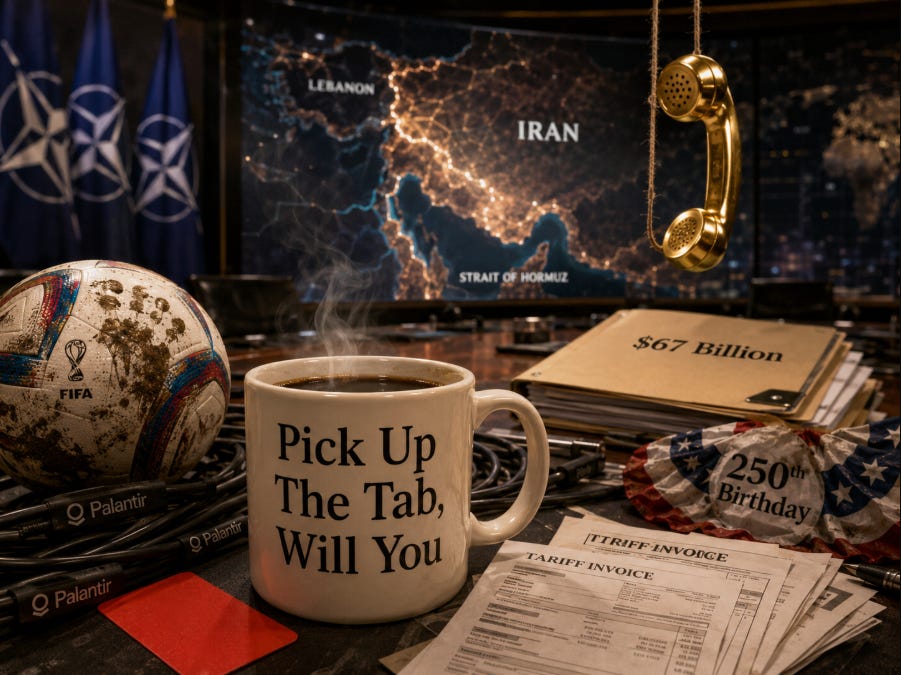
The latest object to pass through the Trump favor machine is Folarin Balogun, the U.S. striker who received a red card against Bosnia and Herzegovina and should have served the automatic one-match suspension that comes with it. There were legitimate soccer questions here before Trump got involved. Was the red card too harsh? Did the video officials rely too much on slow motion? Was the contact intentional or reckless or simply unfortunate? Those are the kinds of arguments soccer fans can have for days with the kind of righteous certainty usually reserved for theologians and parking disputes.
According to multiple reports, Trump personally pressed FIFA president Gianni Infantino to review Balogun’s suspension. FIFA then abruptly suspended the suspension, allowing Balogun to play against Belgium. The explanation was a thin little Article 27 fig leaf, offered with all the transparency of a nightclub bouncer saying, “He’s with us.” UEFA was not amused. European football’s governing body accused FIFA of crossing a red line and warned that the integrity of the game itself was at stake. Belgium was furious. Its federation said it was appealing, though apparently without even receiving the full reasoning behind FIFA’s decision, which is a neat little innovation in due process: please object to the ruling without being allowed to know what the ruling means.
This is the problem with Trump’s involvement. Maybe Balogun should not have been sent off. Maybe FIFA could have reviewed the case and produced a defensible explanation. Perhaps there was a way to correct a harsh call without setting the tournament on fire. But once the president of the host country starts working the phones with the head of FIFA, the outcome becomes tainted no matter how many lawyers are sent in afterward to staple procedure over the hole.
For the record, I was rooting for Cabo Verde. A tiny island nation punching its way into the World Cup imagination is the good stuff. That is the soccer story you want: underdog joy, improbable runs, people screaming in kitchens across Praia and Mindelo. Instead, we get Trump and Infantino turning the tournament into another velvet-rope favor exchange. Cabo Verde lost to Argentina last week, but at least they lost cleanly, which is apparently becoming an endangered concept.
What Trump has done here is unfair to Belgium. It is unfair to the tournament. It is unfair to Balogun, who now has to play inside a controversy he did not create. And it is unfair to the rest of Team USA.
One of my sons was an excellent soccer player in his day, and in open amateur leagues his presence alone could win games. Anyone who has watched local soccer knows how that works. One gifted player can walk onto a field and tilt the entire afternoon. But this is the World Cup. These are elite professionals. The U.S. roster is not a pickup squad waiting for one miracle striker to arrive with cleats and a presidential permission slip.
To interfere this dramatically to retain one player is almost an insult to the rest of the team. It says, in effect, that the United States does not trust its own players to beat Belgium unless Trump can first secure a special dispensation from his friend at FIFA. It shows a lack of confidence disguised as patriotism.
If U.S. Soccer wanted to save face in the global soccer community, it would voluntarily bench Balogun. Not because Balogun is the villain by any stretch, but because the team should not have to carry Trump’s thumbprint onto the field. Bench him and say: we respect the competition, we respect our opponent, and we believe the players eligible under the ordinary rules are good enough to win.
This is Trump’s America, sadly, where every shared space eventually becomes a private transaction. A national birthday becomes a campaign stage, a soccer match becomes a favor call, and a rulebook becomes a suggestion. A beloved global tournament becomes one more venue for the old familiar sequence: grievance, access, pressure, reversal, victory lap.
Having dragged the World Cup into the White House favors office, Trump is off to meet with NATO leaders. What could possibly go wrong, other than the alliance, the postwar order, Ukraine policy, European defense planning, and the remaining shreds of America’s reputation?
The official agenda is serious: defense spending, defense production, and continued support for Ukraine. NATO leaders are supposed to be discussing how to turn commitments into actual capabilities, factories, weapons, coordination, and resilience. In normal times, this would be a difficult but manageable alliance negotiation. In Trump times, it is a hostage situation with flags.
Trump arrives after years of treating NATO like a delinquent country club. He wants dues, deference, applause, and preferably some large purchase orders he can wave around like oversized novelty checks. He has complained that the alliance is one-sided, scolded Europe for failing to properly join his Iran adventure, and repeatedly signaled that American commitments may depend less on treaties than on his mood at breakfast.
That should be reassuring to allies planning for Russia, Ukraine, Iran, energy disruption, cyber threats, and the terrifying possibility that the United States now comes with terms and conditions written in ketchup.
NATO needs coordination. Trump brings grievance. NATO needs trust. Trump brings invoices. NATO needs strategy. Trump brings a mood swing and possibly a commemorative coin.
The timing could hardly be more revealing, because American voters are starting to look at Trump’s strongman production and ask a very basic question: how much is this costing us?
The Financial Times has new polling showing most registered voters do not believe Trump’s Iran war was worth the cost. The White House is reportedly asking Congress for $67 billion in new spending to cover the war so far. Voters are not exactly sending thank-you notes. A majority says the war was not worth it, more voters think the United States is now weaker with Iran than stronger, and Trump’s approval has slid to 36 percent. Among independents, it is even worse. Democrats now lead Republicans on the generic congressional ballot.
The strongman act is not playing as strength. It is playing as expense, instability, and exhaustion.
The bill is starting to come due in ways that are no longer just metaphorical, and the cleanest place to read it is the war itself. The White House has asked Congress for $87.6 billion in supplemental spending, roughly $67 billion of it for the Pentagon to replenish what Operation Epic Fury, the name for the U.S.-led war on Iran, consumed: $21 billion for munitions, $17.3 billion for operational costs, $12.1 billion for classified programs. That figure is the forward-looking ask, not the sunk cost. The money already spent is smaller and contested: Pentagon comptroller Jay Hurst put total war costs at about $29 billion in congressional testimony, while the Center for Strategic and International Studies independently estimated $34 billion to $42 billion, attributing the gap to equipment losses and base damage not captured in the initial accounting. Two different numbers measuring two different things, what has been spent, and what is now being requested to rebuild.
The request is where the favor machine shows its fingerprints again, because the war bill did not arrive alone. Stapled to the defense money is $10 billion for farmers who have struggled in part because of Trump’s own trade policies, $500 million for construction projects in and around Washington, and $1 billion to renovate Penn Station in New York. There are policy riders too: year-round E-15 gasoline sales, hemp regulation changes. A war supplemental doubles as a Christmas tree of district sweeteners and pet regulations: the same move as always. Make the mess, then itemize the bill so the parts nobody can vote against carry the parts they might.
None of this captures the costs that resist a line item: higher health premiums after the enhanced ACA subsidies were allowed to lapse, environmental and climate damage from regulatory rollback, corporate tax breaks paid for in forgone revenue, supply-chain distortion, delayed investment, damaged alliances, and the future cost of rebuilding institutions after they have been used as personal tools of presidential vanity. Those belong to a longer accounting than any single roundup can hold. But the direction is not in dispute.
Trump sells dominance. Americans get invoices.
If the FT poll shows the political cost at home, Al Jazeera’s live updates show it on the ground. Iran is in the middle of a multi-day state funeral for Supreme Leader Ali Khamenei, killed with members of his family in the February 28 U.S.-Israeli strike on his compound. Millions reportedly attended in Tehran, mourners carrying red flags of vengeance as chants of “Death to America” and “Death to Israel” rang out. Trump, meanwhile, offered that “neither side will shoot the other during the funeral proceedings” — quite a sentence to find oneself saying after helping ignite a regional war and then managing the etiquette of the funeral calendar.
Inside Iran the funeral is staged as national unity, but unity is not peace. Mojtaba Khamenei, reported to be the new supreme leader, still has not appeared publicly, reportedly over security fears and Israeli threats to kill him. The deal is fragile, the transition opaque, the region balanced on the edge of another explosion.
While Washington riffs about ceasefires, Israel is still striking, drone attacks in Gaza City, fire in the occupied West Bank, the death of a four-month-old Palestinian boy after forces allegedly blocked his medical transfer near Ramallah, and strikes on the outskirts of Nabatieh in a southern Lebanon Israel still partly occupies. Netanyahu even claimed some Lebanese Christian villages had asked to be annexed for protection; the mayor of Rmeish flatly called it false, insisting his town is not a borderland awaiting absorption but part of the heart of Lebanon. The annexation paperwork, it seems, arrives before the facts.
There is an economic tremor too: OPEC+ approved another output increase as Hormuz exports recover, even as analysts warn about shipping risks in the Strait. And the U.S. Navy suspended its search for a sailor lost after a Seahawk went down in the Arabian Sea. That is the buried cost of the whole adventure, not just the supplemental request or the gas prices, but the bodies, the checkpoints, the displaced families, and the widening map of places where “ceasefire” now means “temporary branding exercise.” Voters are right to ask whether this was worth it. The answer coming out of the region sounds a lot like no.
The allies are taking notes, which is what makes the Palantir news so revealing. Spain has reportedly instructed the public companies and state-controlled enterprises managed by SEPI, the holding company for its strategic assets, to avoid new contracts with Palantir. That would sweep in firms like Telefónica, Indra, and Navantia: telecommunications backbone, defense electronics and military command systems, warship construction. The reporting traces to the Spanish investigative outlet El Confidencial, and it follows France and Germany, both of which moved away from Palantir in their domestic intelligence services earlier this year. Three of Europe’s largest economies, in a matter of weeks, quietly showing the same American company toward the door.
I’d flag that some of the louder framing around this circulates through YouTube explainers that can sound like they’re narrating the fall of Rome from a gaming chair, so the sweeping “Europe is expelling Palantir” version deserves a raised eyebrow until more of it is on the record. But the underlying trend is solid, and its logic is not mysterious. Europe is increasingly treating data infrastructure as sovereignty infrastructure. Sensitive government data, defense systems, telecom networks, identity platforms, intelligence tools, none of these are being understood anymore as neutral software choices. They are strategic dependencies, and a dependency is only as safe as the government on the other end of it.
Which surfaces the question Washington never wanted asked out loud: if Chinese technology is dangerous because Beijing can reach through it, why is American security-state technology automatically benign? The honest answer, from a European capital’s chair, is that it isn’t, it is only benign as long as you trust the hand on the switch.
Palantir’s problem is not merely that it is American. It is American in exactly the wrong way for this moment: defense-linked, intelligence-adjacent, and publicly triumphant about hard power at precisely the moment its foreign customers are getting nervous about hard power. Its CEO, Alex Karp, spent the war telling anyone who would listen that “what makes America special right now is our lethal capabilities, our ability to fight war,” and that the AI revolution is “uniquely American.” Asked directly whether Palantir’s Project Maven system was used to target and kill Khamenei, he declined to confirm it, but allowed that he had read Maven described as the “core backbone” of U.S. operations in the region, the kind of non-denial that functions as a brag. You do not need to build a complicated sovereignty argument for leaving a vendor when that vendor’s chief executive is narrating American military dominance on television and winking at his product’s role in an assassination. He makes the argument for you.
The tools of American power now come with American conditions attached, and the allies have noticed that the conditions can change with the mood in the Oval Office.
That is the connective tissue between Palantir, NATO, FIFA, Iran, and the birthday spectacle. Trumpism has taught allies that American power is not merely unreliable. American power now arrives with hooks in it: a tariff, a threat, a phone call, a database, a weapons invoice, a red-card reversal, or a demand to applaud while the president turns a shared institution into a mirror.
This is the pattern now. Every public thing becomes his. The nation’s birthday is reduced to a stage set, the World Cup to a favor call, war to an invoice, a ceasefire to a funeral pause, and NATO to a collection agency. Even Europe’s data infrastructure has become a warning flare, as allies quietly plan for a world in which American power is not just unstable, but sticky.
Trump does not merely break institutions. He personalizes them first. He makes them answer to him, bend for him, flatter him, rescue him, enrich him, or perform for him. Once that happens, the thing itself is never quite clean again.
It is the cost no supplemental bill will itemize.
If global public outpourings are any indicator, most people see this as corruption at the highest levels. A dubious ref call should not be open to FIFA's nullification days after the game because one crook pulls strings with another.
The U.S. team effort is now tainted despite no fault of the players or coach. It’s a dilemma for the coach: if he benches the affected player to make a principled point, and the team loses, he’ll be vilified for choosing a “high road” when he didn’t need to. If the player saves the day, the team and coach will be booed as if they took advantage of insider corruption.
Trump is disgusting and ruinous - again.
AND NOW, EVEN THE WONDERFUL, BEAUTIFUL GAME IS SPOILED BY TRUMP DEMANDING AND RECEIVING A FAVOUR, THAT PHONE CALL SHOULD NEVER HAVE HAPPENED AND FIFA AGREEING TO ALTER A GAME CALL IS NOTHING BUT SHAMEFUL, SHAME ON THE ASKER AND SHAME ON THE GIVER. I WON'T SEE THE GAME AS ANYTHING BUT CORRUPTIBLE FROM THIS TIME ON. MUST YOU RUIN EVERYTHING, YOU WORTHLESS POS.