


Good morning! Welcome to Saturday, where the coffee is hot, the world is on fire, and the Trump administration has discovered that the easiest way to win an argument with reality is to slap a disclaimer on it and pretend reality has been placed on administrative leave.
The most accidentally honest sentence of the week came not from a rambling Trump press gaggle, not from a Fox News host discovering international fast food like Magellan in a quarter-zip, and not even Pete Hegseth accidentally revolutionizing classified military communications by treating a group chat like a Venmo notification. It came from a government webpage.
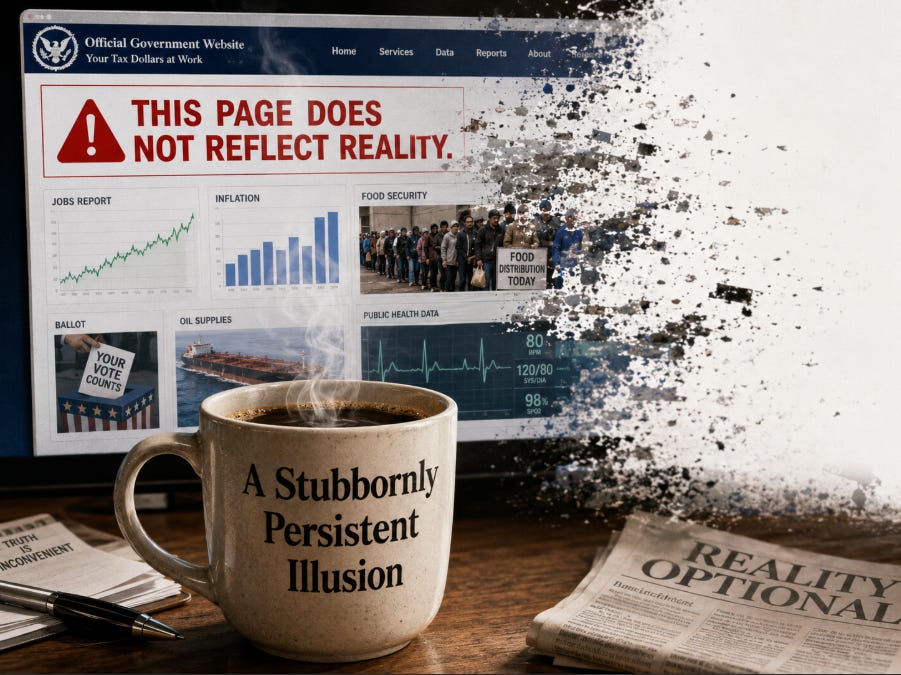
“This page does not reflect reality, and therefore, the administration and this department reject it.”
That line appeared on the page for the Pregnancy Risk Assessment Monitoring System, a public health data program created in the 1980s to help scientists understand why the United States had one of the highest infant mortality rates among developed countries. The data helped shape policies and practices that cut infant mortality nearly in half. Then the Trump administration ended new data collection, suspended access to historic data, put the program staff on leave, and left behind a disclaimer that sounds like it was drafted by the Ministry of Truth after a three-day Heritage Foundation retreat and a bad edible.
“This page does not reflect reality” may be the governing philosophy of Trump’s second term. If the data says babies are dying, reject the data. If the jobs report disappoints, fire the statistician. If Federal Reserve researchers find that American firms and consumers are paying nearly 90 percent of the cost of Trump’s tariffs, threaten the researchers. If the election numbers say you lost, demand someone find 11,780 votes.
The authoritarian trick in its purest form: first lie about reality, then delete the data that proves you are lying. Trump claims millions have been lifted off food stamps while scrapping the hunger report that would show whether those people are thriving or simply hungrier. He says prices are down while Americans stare at grocery receipts like they are reading ransom notes. And when the numbers refuse to behave, he does not change the policy. He attacks the numbers. Think of it as epistemic vandalism with a government letterhead.
While Trump’s government was busy rejecting reality at home, the rest of the world spent the week conducting what can only be described as a live-fire stress test of American credibility.
The main event was Trump’s trip to Beijing, where the reviews from abroad were less “historic triumph” and more “oh no, they sent the mark into the casino again.”
Simon Marks, watching from across the pond, was merciless. China offered Trump exactly what he craves: pomp, ceremony, flag-waving children, enthusiastic pageantry, and the full authoritarian Disney treatment. Trump lapped it up. He arrived with an entourage that included cabinet officials, tech royalty, Wall Street power, Nvidia’s Jensen Huang, Apple’s Tim Cook, Elon Musk, and, because we apparently now do foreign policy as a bring-your-oligarch-to-work day, Musk’s six-year-old son. What the delegation did not include, according to Marks, was a single American official steeped in Chinese history or policy. Not one.
So, to recap: the United States showed up to one of the most consequential meetings on Earth with billionaires, CEOs, and a child wandering through the Great Hall of the People, while China showed up with a strategy.
President Xi opened with the kind of sweeping geopolitical language that signals a state thinking in centuries. He spoke of global transformation, turbulence, and a “new crossroads,” invoking the Thucydides trap — the danger of conflict between a rising power and the established power it seeks to supplant. Marks dryly suggested Trump may have wondered whether the Thucydides trap was “a new kind of mouse catcher” China hoped to export to the American market. Cruel, yes. Unfair? I refer you to the entire transcript of the Trump presidency.
Then Trump responded in the only dialect he truly speaks: flattery of strongmen and flattery of himself for flattering strongmen. Xi was a “great leader.” Their relationship was “fantastic.” It was an “honor” to be Xi’s friend. People were supposedly saying this might be “the biggest summit ever.” America, according to Trump, was talking about nothing else, which must have come as a surprise to the millions of Americans mostly talking about gas prices, groceries, war, layoffs, and whether the government still measures infant mortality or has decided that too is woke.
Marks’ read of Xi’s reaction was devastating: the Chinese leader appeared to realize that Trump had come not to negotiate from strength, but to prostrate himself before the Chinese leadership and beg for business deals. That is when Xi moved in on the real issue: Taiwan.
This is where the foreign autopsies all converged.
Marks said China saw Trump coming and forced him onto the subject he least wanted to talk about. In previous meetings, U.S. officials had claimed Taiwan did not come up, which always sounded a bit like saying you met with the Pope and nobody mentioned Catholicism. This time, Taiwan not only came up; Trump’s own evolving account suggested it may have been the central issue. The Chinese readout emphasized Taiwan. The American readout tried to pretend it was not the flashing red light on the dashboard.
Bill Hayton of Chatham House reached the same grim conclusion from another angle. Trump declared the trip a “great success,” and Hayton agreed — with one small clarification: it was a great success for China. Beijing got Trump to frame Taiwan in precisely the way China wants it framed: Taiwan is very close to China, very far from America, and perhaps not worth the trouble. Hayton noted that Trump came home describing himself as neutral on additional arms sales to Taiwan, even though a $14 billion package had already been greenlit by Congress. Meanwhile, the supposed Boeing wins Trump touted can be canceled at any moment. In other words, Trump got talking points. Xi got leverage.
Professor Scott Lucas was even more direct. “China played Trump like a fiddle,” he said, and honestly, that may be the cleanest headline of the whole diplomatic catastrophe. Lucas framed the summit as a clash between Trump the transactional politician and China the strategic one. Trump got the things Trump likes: a photo-op, flattery, military ceremony, children singing, and the emotional experience of feeling like “the big man in town.” Xi got the thing Xi wanted: control of the narrative.
Lucas’ most important point was the asymmetry. China made its position unmistakable. Beijing put Taiwan at the center of the relationship and then reinforced that message through its foreign ministry and state-controlled media. The Americans, meanwhile, produced fog. Trump avoided saying Taiwan’s name. Scott Bessent suggested Trump would “re-evaluate” things when he got home. Marco Rubio insisted nothing had changed. So China left with clarity, and Washington left with a group project where every student wrote a different answer and nobody studied.
This is the problem with sending a transactional politician into a room with a strategic one. Trump thinks the win is being praised. Xi knows the win is changing the terms.
Taiwan heard the wobble. Asked aboard Air Force One whether the United States would defend Taiwan if it came to that, Trump refused to say. Asked about arms sales, he said he would be “making decisions.” Then came the sentence that probably landed in Taipei like a brick through a window: In a clear case of strategic indigestion, Trump said the last thing America needs is a war “9,500 miles away.”
The whole purpose of deterrence is that the other side believes you might act. Trump, in one airborne interview, seemed to invite Beijing to wonder whether the United States would rather sell jets, preserve the photo-op, and let Taiwan become another item in the “we’ll see what happens” drawer. When American commitments start sounding like they depend on who complimented Trump most recently, the world notices.
China certainly noticed. Hayton pointed out that Beijing had years to prepare for a second Trump administration. It stockpiled minerals and oil. It mapped out U.S. vulnerabilities, and it weaponized rare earths and processing capacity. Trump brought tariffs; China brought counterpressure. Trump brought CEOs; China brought choke points.
Reality has been busy elsewhere. In the Persian Gulf, the Strait of Hormuz crisis is no longer a hypothetical. Al Jazeera reported from Bandar Abbas, Iran’s key port city near the Strait, where maritime traffic maps showed oil tankers stalled in the water. Before Trump’s Iran war, nearly one-fifth of the world’s oil and gas moved through the Strait, with up to 140 commercial ships and tankers crossing its lanes each day. Now only a fraction are getting through.
Iran is trying to impose what it calls a new management regime over the Strait. Tehran’s message is not exactly that Hormuz is open, and not exactly that it is closed. It is open to friends and neutral countries, closed to enemies, subject to coordination with the IRGC, potentially subject to transit charges, and apparently off-limits to military vessels. So, terrific news: one of the world’s most important energy chokepoints is now operating on a vibes-based permission system run by the Revolutionary Guard.
Trump has turned Hormuz into a toll booth with missiles. The U.S. and Iran remain deadlocked not only over the Strait, but over the nuclear file, highly enriched uranium stockpiles, war reparations, Iran’s regional relationships, ballistic missiles, and security assurances. Iran says it wants guarantees that any settlement will not simply become a loop of war, ceasefire, temporary peace, and renewed confrontation. Trump has refused to rule out resuming the war. Families around the world are already paying the price in higher fuel costs, shipping disruption, and the lovely little global economic migraine that comes when a president treats war like a branding exercise.
And China? According to Hayton and Lucas, China does not appear to be rushing to bail Trump out. Hayton said Beijing does not want the Iranian regime to collapse, does not want America to prevail, and is content to watch the United States get bogged down, waste energy, and feel the economic pain first. Lucas punctured Trump’s claim that China had agreed not to provide military weapons to Iran, noting that this is not how China operates; Chinese companies can provide support while Beijing preserves deniability. Trump also claimed China wants to help reopen Hormuz. Lucas’ translation was essentially: no, it does not. China is not coming to rescue Trump from the mess he helped create.
Never interrupt your enemy while he is making a mistake. China appears to have read that memo. Trump seems to have laminated it and used it as a coaster.
Then there is Belarus. Volodymyr Zelensky warned that Russia is trying to draw Belarus deeper into the war and may be considering operations either toward Ukraine’s northern Chernihiv-Kyiv direction or directly against a NATO country from Belarusian territory. Belarus borders Ukraine, but it also borders NATO members Poland, Lithuania, and Latvia. It already served as a launchpad for Russia’s February 2022 invasion, and Minsk has since agreed to host Russian tactical nuclear weapons and Oreshnik hypersonic missiles.
Xi is testing Taiwan. Iran is testing Hormuz. Putin may be testing NATO’s flank through Belarus. Everywhere, the same question is being asked in different languages: does American deterrence still mean anything?
Colorado Governor Jared Polis commuted the sentence of Tina Peters, the former Mesa County clerk convicted in a scheme to copy her county’s election computer system after becoming a hero of the election-denial movement. Peters had been sentenced to nine years. Trump could not pardon her because she was convicted of state crimes, not federal ones. So he did what he could do: turned her into a MAGA martyr, screamed “FREE TINA!,” attacked Colorado officials, called Polis a “scumbag governor,” and applied political pressure until the system bent.
Peters was no innocent bystander who accidentally tripped over a Dominion server and landed in a MyPillow symposium. She may have been a willing victim of Douglas Frank, the self-styled election fraud expert whose phony algorithm claims convinced true believers across the country that their local election results had been mathematically manipulated. Frank’s roadshow reached into communities everywhere, including, full disclosure, Coos County, Oregon, where a local commissioner once brought him in to make his case, and where the antidote required importing an actual Stanford political scientist to explain why the math was nonsense. Peters absorbed Frank’s worldview and then acted on it, which is where sympathy for the deceived runs into accountability for the deeds. She snuck in an outside computer expert associated with Mike Lindell to make a copy of Mesa County’s Dominion Voting Systems election server during a state software update, after which video and photos of the upgrade, including passwords, were posted online. Colorado Secretary of State Jena Griswold called the commutation “a dark day for democracy” and said it sent a clear message to those willing to break the law and attack democracy for Trump: they may not face consequences after all. Matt Crane, executive director of the Colorado County Clerks Association, warned that the commutation signals open season on elections and election officials.
Polis argued that Peters’ sentence was unusually harsh for a first-time nonviolent offender. That may be a defensible argument in a vacuum, but politics does not happen in a vacuum; it happens in the middle of a pressure campaign by a president who has made election sabotage part of his loyalty program.
That is the whole Saturday morning picture.
At home, Trump rejects the data when it proves him wrong. Abroad, authoritarians test the lines when they sense he is weak. In Beijing, Xi gave Trump flattery and walked away with leverage. In Hormuz, Iran is trying to turn a global shipping lane into an IRGC checkpoint. In Belarus, Zelensky warns Putin may be probing the NATO frontier. And in Colorado, a woman convicted in an election-system breach gets her sentence commuted after Trump turns her into a cause.
The page does not reflect reality, says the administration.
The sentence does not reflect the crime, says the governor.
The election does not reflect the votes, says Trump.
And little by little, the institutions start bending around the lie.
The governor of Colorado, Jared Polis, needs to hear from everyone how he royally screwed up especially as elections are right around the corner. He let an unrepentant, treasonous, traitor who was convicted on 7 counts and sentenced to 9 years in prison FREE after only a year or so!! He caved to this regime and that sends a detrimental signal and we, all the rest of us will pay!!! Front desk gov. office: 1-303-866-2471; Gov. Jared Polis, 200 E. Colfax Ave. RM. 136, Denver, CO. 80203. She is to be let free June 1st.
A brilliant summary. Thank you.