


Good morning! The United States is preparing to celebrate its 250th birthday by turning the National Mall into a carnival-fortress, the Strait of Hormuz into nautical Minesweeper, and Watergate into a conservative martyrdom seminar. Historians may eventually give this era a dignified name. For now, “constitutional crisis with powdered sugar” will have to do.
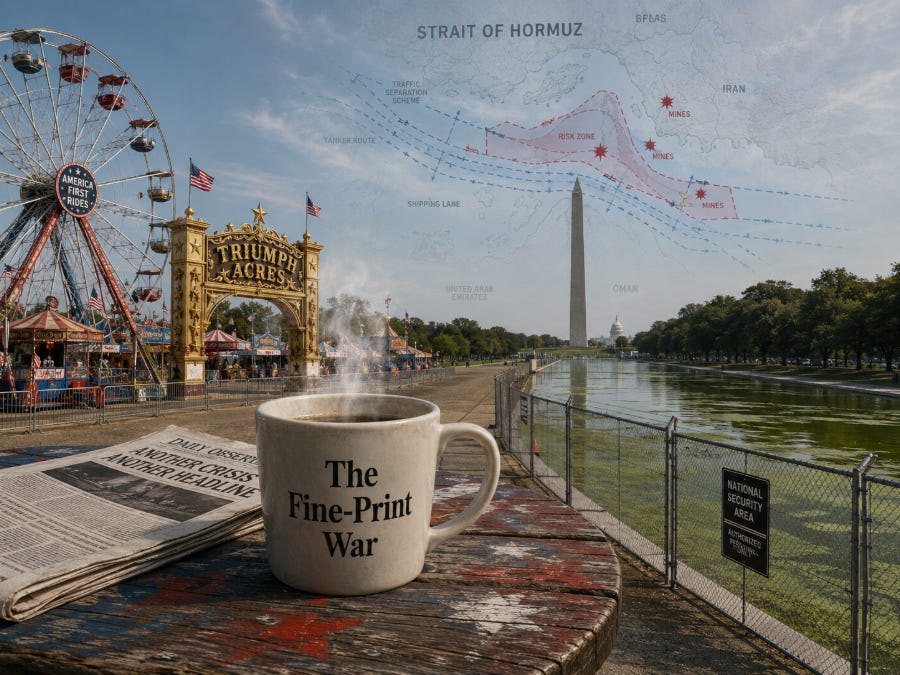
The Associated Press has helpfully offered a brisk little tour of Washington’s semi-quincentennial glow-up, and it sounds less like a national celebration than a theme park designed by a man who thinks subtlety is a zoning violation. The Great American State Fair is taking shape on the National Mall, complete with a towering replica of Trump’s proposed triumphal arch. Government buildings are wearing Trump banners. Armed National Guard troops patrol the streets under his emergency crime order. The UFC octagon has disappeared from the White House lawn, but the East Wing remains wrapped in ballroom construction, the Rose Garden has reportedly been paved into a patio, and security fencing now surrounds the Reflecting Pool after algae blooms and vandalism arrests turned the nation’s most symbolic puddle into a crime scene with chlorophyll.
Just past the Lincoln Memorial, scaffolding cloaks the Arts of War and Arts of Peace horse statues as workers resurface them in gold, because apparently the one thing American democracy lacked was more visual overlap with a casino lobby. Black Lives Matter Plaza has vanished from the pavement. The Kennedy Center has been renamed away from Trump. The monuments still stand, but the gift shop appears to have seized control.
This is the domestic version of the governing theory. When the institution does not perform correctly, brand over it. When the water turns green, fence it off. When the garden becomes inconvenient, pave it. When the capital does not sufficiently resemble one man’s imagination, erect banners, arches, troops, and gold. America at 250 is being staged as a fairground, a fortress, and a vanity project. There is probably a funnel cake stand somewhere selling “constitutional crisis” with powdered sugar.
While Washington is being dressed up as imperial cosplay, the Middle East “peace deal” is doing what poorly built Trump structures tend to do when exposed to weather: failing the load test.
The U.S.-Iran ceasefire has now reached the stage where both sides are accusing each other of violating the agreement while actively testing how much war can fit inside it. The U.S. bombed Iranian coastal targets for a second day, hitting Qeshm Island and the cities of Sirik and Bandar-e Lengeh after attacks on commercial vessels near the Strait of Hormuz. Iran says it launched retaliatory strikes on U.S. forces in Bahrain and Kuwait. Gulf states are lining up to condemn Iran’s attacks as violations of sovereignty. Iran, meanwhile, says those same states are allowing U.S. forces to use their territory as platforms for attacks. It is a regional argument over who gets to call their escalation defensive.
Trump, naturally, brought his famous diplomatic touch to the moment by threatening that the United States may be forced to “militarily complete the job” and that, if that happens, “the Islamic Republic of Iran will no longer exist.” Not the kind of language one traditionally associates with fragile ceasefire management, unless the ceasefire is being managed by a loose power cord in a fireworks warehouse.
Iran’s foreign minister Abbas Araghchi is now saying the Strait of Hormuz remains under Iran’s “total oversight and management” for the next 30 days. Hormuz is no longer just a waterway in this deal. It is leverage. Iran is treating the strait as the physical instrument of its bargaining power. Washington is treating Iran’s efforts to control or threaten traffic through the strait as a violation of the ceasefire and a threat to commercial shipping. Both sides are pointing to the same memorandum of understanding and saying the other side is the one breaking it. Congratulations to the lawyers: the war has entered the interpretive phase.
The New York Times identified the poison clause at the center of the mess. The agreement required Iran to make “arrangements using its best efforts” for the safe passage of commercial vessels through Hormuz, but it did not define “arrangements” or “best efforts.” That is the kind of diplomatic fog that may help negotiators get a document over the finish line and then, 10 days later, becomes the reason tankers are dodging drones. Iran reads the language as permission to determine routes through the strait. The United States reads attacks on ships using alternate routes as ceasefire violations. So the peace agreement now functions like an oil-soaked Rorschach test: insert your own definition, then launch accordingly.
Then there are the mines, because the maritime section of this crisis needed a supervillain upgrade. The Financial Times reports that shipping executives are warning Hormuz may remain below half of prewar traffic levels for months because available routes are narrow, constrained, and possibly mined. Iran is estimated to have laid dozens of mines in the main shipping lanes, and if many are seabed mines, clearing them will be far more difficult than plucking a few cartoon cannonballs out of the water. The agreement promises a return to prewar traffic volumes within 30 days after mine neutralization, but physics, insurance, and unexploded ordnance would like a word.
This is where the White House fantasy collides with the shipping industry’s hazard map. You can declare victory in a press post, announce that the strait is open, and claim a historic deal. But shipping companies have insurers, crews, hulls, cargo, and shareholders. They do not have to participate in a Trump victory lap through a mined choke point carrying a fifth of global energy exports.
Lebanon is the other fuse burning through the same document. The U.S.-brokered Israel-Lebanon framework is being sold as a path to end hostilities, but the mechanism is already splitting apart. Israel bombed southern Lebanon after the agreement was announced. Netanyahu is presenting the deal as recognition of Israel’s right to remain in southern Lebanon until Hezbollah is disarmed. Hezbollah, which was not part of the negotiations, has called the agreement humiliating, shameful, and void. A Hezbollah lawmaker is warning that the framework could lead to internal conflict. The Lebanese army is supposed to restore sovereign authority while nonstate armed groups are disarmed, but the most powerful nonstate armed group in the country is already rejecting the premise.
Less a peace plan and more a civil-conflict starter kit with a Washington letterhead.
The Lebanon track also matters because Iran wants it treated as part of the broader regional bargain, while Washington insists it is separate. Israel benefits from that separation because it can keep acting in Lebanon while the United States tries to keep Tehran locked into the Hormuz deal. So now Hormuz depends on Lebanon, Lebanon depends on Hezbollah disarmament, Hezbollah rejects the deal, Israel keeps bombing, Iran claims the U.S. is violating the MoU, Trump threatens to “complete the job,” and commercial shipping is asked to please proceed through the narrow mined corridor in an orderly fashion. It is a Jenga tower built on sea mines.
And Gaza remains the permanent horror beneath the headlines. Al Jazeera reports that Israel has expanded its military zone in Gaza so restrictions now apply to about 64 percent of the enclave, leaving just 36 percent for more than two million Palestinians. Gaza’s Health Ministry says at least 73,054 Palestinians have been killed and 173,480 injured since Israel’s war began in October 2023, including more than 1,000 people killed since the October 2025 U.S.-brokered ceasefire. The ceasefire era, apparently, is when the paperwork improves and the killing continues.
If this were merely a story about one bad agreement, that would be grim enough. But it is also a story about a governing movement that is learning to rename every failure as persecution, every constraint as sabotage, and every fact as an enemy action.
Which brings us to JD Vance at the Nixon Library. Vance stood at the shrine of the president brought down by Watergate and offered the movement’s new historical theology. Watergate, he joked, would be “a 12-hour news story” today. Then he went further. He described Nixon not primarily as a president who abused power, obstructed justice, and was cornered by evidence, but as a victim of the “deep state.” The same groups, the same institutions, he said, tried to do to Donald Trump what they did to Nixon.
Vance is teaching the movement how to remember accountability as sabotage. Watergate becomes a coup. Prosecution becomes election interference. Journalism becomes conspiracy. Civil service becomes “deep state.” Protest becomes “antifa.” The past is not being studied; it is being weaponized. If Nixon was the victim, then Trump can never be the perpetrator. If institutions exposed Nixon, then institutions themselves become the enemy. That is the enemy-manufacture machine with a presidential library backdrop.
The foreign view of Vance’s remarks was especially useful because from abroad the trick looks almost embarrassingly plain. The point was not really Nixon. It was Trump. It was Vance. It was the next scandal and the one after that. If Watergate can be reduced to media overreach and deep-state sabotage, then any investigation into Trump becomes part of the same martyrdom story. The crime disappears into the persecution narrative, and the people who expose it become the villains.
The next step after reframing history is pre-excusing the next abuse. If every check on presidential power is secretly a coup, then the people refusing to check Trump can pretend they are defending democracy by abandoning it. If the “deep state” took down Nixon, then the lesson is not “do not commit crimes in office.” The lesson is “purge the institutions before they can hold you accountable.”
Trump spent the evening demonstrating the point in real time. In one Truth Social eruption, he attacked Maggie Haberman’s new book, insisted she was wrong about him on everything, re-litigated the election in all caps, and then swerved into “And Iran will never have a Nuclear Weapon!!!” with all the grace of a shopping cart rolling into traffic. The tell was his line that “they don’t have the audio tapes that they imply they have,” which is a remarkably Watergate-adjacent sentence to post during the same news cycle in which Vance is trying to rehabilitate Nixon as a deep-state martyr. Nixon had tapes. Trump is yelling that there are no tapes. Somewhere, the ghost of Watergate just reached for a highlighter.
Elsewhere, Trump amplified headlines about prosecuting “leftist nonprofits,” seizing assets, fighting “gun grabbers,” guarding the border, defeating socialists, and riding an alleged Iran-deal energy boom. The machine is not subtle. When facts are bad, manufacture enemies. When the deal is collapsing, declare a boom. When the tapes come up, shout that there are no tapes. When accountability appears, call it sabotage. When dissent appears, call it antifa. When institutions resist, call them the deep state.
You do not need a diagnosis to see the pattern, and you should be wary of anyone offering one from a distance. Watch the behavior instead, all of it on the public record. Trump says regime change is the goal, then says it was not, then suggests it somehow happened automatically. He sells a peace deal, then threatens to annihilate the country he supposedly made peace with. He is asked about Iran and drifts into arches, monuments, and the Reflecting Pool. He answers a challenge not with explanation but with insult, digression, or threat. Dr. John Gartner, who has spent the administration in alarm-bell mode, put it more bluntly than most: you can’t BS your way out of Iran.
He is right about that much. Trump’s lifelong method, declare victory, insult the questioner, invent the numbers, gild the lobby, move on, runs into a wall when the subject is a mined shipping lane and a regional war. The more important fact is that someone with the power to do something about it already tried.
In June, a Republican-controlled Congress did the thing this whole movement insists is impossible: it told the president no. The House voted 215 to 208 to direct him to remove U.S. forces from hostilities with Iran absent a declaration of war or specific authorization. The Senate followed, 50 to 48, with Republicans Rand Paul, Susan Collins, Lisa Murkowski, and Bill Cassidy joining Democrats. In the House, Republican Brian Fitzpatrick put the issue plainly: “You either follow the law or you change the law. You can’t violate the law. That’s not an option.”
Then Congress went home for recess, and the president bombed Iran for a second day anyway, and threatened to make the country “no longer exist.” A resolution that took months and bipartisan nerve to pass was treated, within days, as decorative.
This is the part the movement would rather you not connect. The same Republicans who not long ago called a president’s cognitive fitness a national scandal, who subpoenaed a White House physician over it, who said a president who isn’t fit “isn’t fit for office,” have decided the standard does not apply when the president is theirs. They built the principle. They are now declining to use it. It is a choice, made daily, by people who can see exactly what everyone else can see.
Mines do not care about your branding. A tanker does not respond to all caps. Hezbollah does not disarm because the White House says “framework.” The Strait of Hormuz does not become safe because Trump has declared the vibes tremendous.
This is the point where the spectacle becomes the coping mechanism.
Abroad, the administration sells a ceasefire while tankers dodge mines and missiles. At home, it sells a birthday party while Washington is turned into a branded occupation zone with carnival tents, gold statues, troops in the streets, and a fenced-off green Reflecting Pool. In the historical imagination of the vice president, Watergate is no longer a warning about executive criminality but a tale of victimhood at the hands of institutions. In Trump’s own feed, enemies multiply as facts deteriorate.
But this cannot end at mockery, or even alarm. Why is every Republican with constitutional power pretending not to see that Trump is unraveling in public?
They see the threats, the contradictions, the fixation on monuments while the region burns. They see the president threatening to erase Iran while his own administration tries to preserve an agreement with Tehran. They see the capital remade as a vanity set while the Strait of Hormuz becomes a mined lawsuit with tankers. They see Vance rewriting Watergate into a deep-state myth. They see the enemy-manufacture machine turning prosecutors, journalists, civil servants, judges, protesters, nonprofits, and inconvenient facts into targets.
They do not get to say later that they didn’t know. They know.
This is where public pressure has to go. Not toward Trump, who will not become less Trump because someone sends him a sternly worded letter. Toward the Republicans who keep looking at their shoes while he threatens war, purges institutions, militarizes the capital, and turns the country’s 250th birthday into a loyalty pageant. Call them. Write them. Show up at their offices. Ask one question, over and over: what are you doing, today, to restrain an unstable president with command of the military?
Not what are you privately worried about. Not what are you leaking anonymously. Not what you plan to say in your memoir after the damage is done. What are you doing now?
History is not going to grade them on vibes. It is going to ask whether they used the power they had while there was still time to use it. If they refuse to act, they are not bystanders. They are part of the machinery.
America at 250 is being staged as a fairground, a fortress, and a vanity project. There is probably a funnel cake stand somewhere selling “constitutional crisis” with powdered sugar. But the joke stops being funny if the people with the power to pull the plug keep pretending the lights are decorative.
Thank you Mary! Once again, you have wrapped up all the nasty fragments of our insane government into a ball of insightful and ingenious writing!
Just as it was often claimed that the US President was a great deal maker (he wasn't and isn't), it has been (and still is) often claimed that the US Vice President is a highly intelligent man and an intellectual thinker. He isn't. Both, however, have tactical skills at debating, where a win is to have the last word, with tactics of social suppression being very much part of the technique set. Debates exercised on the basis of social power don't result in intelligent policy, however. True to their nature, though, they determine those who win and lose access to unfettered power.