


The week began with a wound no one could find.
Donald Trump’s grand refurbishment of the Lincoln Memorial Reflecting Pool had already become one of those minor government fiascos that somehow contains the full administration in miniature. Trump ordered the basin painted a highly specific shade of American-flag blue and boasted that the powerful new material would last 50 years. A knife could not cut it, he explained, briefly remembering that presidents are traditionally discouraged from issuing product-testing challenges to vandals. The pool missed its July Fourth deadline, turned swamp green with algae, shed chunks of blue coating, and had to be drained repeatedly while the cost of the project rose from a promised $1.8 million to more than $16 million.
Trump responded as he so often does when something bearing his name fails in public: he discovered an enemy. Vandals, he said, had poured chemicals into the water and carved a gash into the liner. The wound began at 250 feet, expanded to 300 feet, then 350 feet, and finally achieved the majestic length of 300 yards, or 900 feet, or roughly three football fields. Reporters, photographers, local observers, and at least one worker searched the empty basin without finding it. The enormous line visible along the bottom turned out to be the drain. France 24 presented the saga with the patient disbelief ordinarily reserved for a homeowner explaining that invisible burglars destroyed the kitchen while attempting to steal the sink.
The pool supplied the pattern. A project associated with Trump failed. Failure became sabotage. Embarrassment required an enemy. The wound grew in proportion to the injury to his pride. By Thursday night, however, the damage Trump needed Americans to see was no longer at the bottom of a reflecting pool. It was at the center of American democracy.
Foreign journalists have largely stopped granting Trump the presumption of credibility that once accompanied the presidency. They do not begin with the office and slowly work their way toward the evidence. They begin with the evidence and ask whether the officeholder’s account survives it. Increasingly, American news organizations are beginning to make the same adjustment, not only in the words they use to describe Trump, but in the editorial decisions they make before he speaks.
CNN’s Kaitlan Collins explained the distinction cleanly. “We’ll be monitoring what the president says tonight, as we always do, but aren’t taking it live, given the president has a well-documented history of saying blatantly false things about elections,” she told viewers. ABC and NBC reached similar conclusions. CBS, Fox News, and MS NOW carried at least substantial portions. The divide was not between networks willing to cover the president and networks determined to censor him. It was between organizations willing to let Trump dictate the terms of coverage and those finally recognizing that a live presidential microphone is not a constitutional entitlement.
The White House soon vindicated their caution. Trump’s “critical intelligence” was not given to independent reporters in time for them to examine it before the address. The documents appeared only as he began announcing what they supposedly proved, creating a temporary monopoly on their meaning. Trump could declare the material shocking, conclusive, and irrefutable while journalists were still attempting to open the files. The Guardian immediately identified the possibility that the avalanche itself was part of the tactic: an information dump timed to outrun verification while the president used the East Room, the flags, and the seal to establish his interpretation as the first and most dramatic one the country would hear.
Independent journalists were not the only people excluded from the preview. The White House reportedly gathered about two dozen election-denial activists earlier in the week for a private briefing organized by Cleta Mitchell, who advised Trump during his effort to overturn the 2020 result. At least some participants were asked to sign nondisclosure agreements. They were not brought in as skeptical experts expected to test the evidence. According to Vaughn Hillyard’s reporting, they were being prepared to understand the rollout and carry it into their activist groups and influencer channels.
The secrecy gave the gathering the pleasing atmosphere of forbidden knowledge, although one attendee reportedly told supporters afterward that much of the material had already appeared in public reporting by John Solomon. That detail revealed the information pipeline in all its circular glory. Solomon promoted election theories as a conservative media figure, joined the White House as a special government employee, helped identify government records for release, and then watched the resulting document dump become presidential confirmation of ideas he and others had already circulated.
A claim entered the media ecosystem. Its promoter entered the government. Government officials searched classified and raw intelligence for fragments that might be attached to it. Sympathetic activists received the preview. Trump then presented the government’s release as independent proof that the original claim had been true all along. It was less an investigation than a laundromat for conspiracy theories, with the presidential seal serving as the final rinse.
The most damaging part of Hillyard’s report came from an administration official involved in reviewing the raw intelligence. According to that official, the government searched as broadly as it could for evidence that Trump had actually won the 2020 election and found none. The speech proceeded anyway. That account is anonymously sourced and should be treated as such. But if accurate, it establishes that the White House was not following evidence toward a conclusion. It was starting with Trump’s emotional requirement and searching for anything that might be arranged around it. The White House had not discovered a bombshell. It had produced one.
Trump began the address with several minutes of the familiar self-worship liturgy. “Two years ago, our country was dead,” he declared. “Now we are the hottest country anywhere in the world.” The border had somehow traveled from the worst in history to the best. The stock market, retirement accounts, military, drug prices, crime rates, and national respect had all achieved forms of perfection available only during a Trump presidency. “We won in Venezuela,” he continued. “We are likewise winning big in Iran, and you will see the fruits of that labor very, very shortly.” Presumably they are still ripening in the same orchard where the dozens of imminent peace agreements are stored.
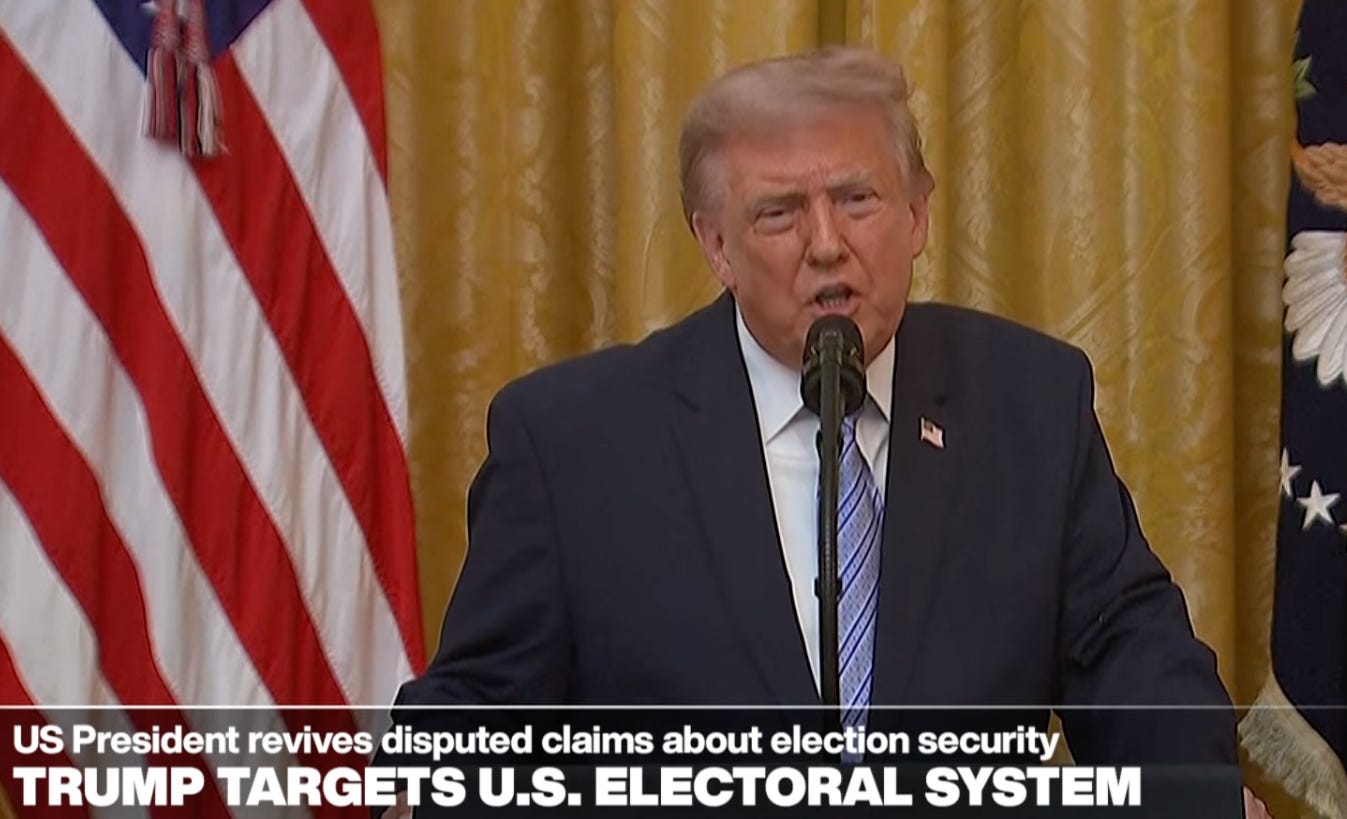
Then came the catastrophe. “Unfortunately, the system we have today falls catastrophically short” of secure elections, Trump announced, before promising documents revealing “shocking vulnerabilities in our election infrastructure.” China, he said, had carried out “the largest compromise of election data in history,” acquiring 220 million American voter files. Intelligence officials had hidden the evidence. Venezuela had developed techniques for manipulating its own elections. Fraudulent registration forms had been discovered in Muskegon, Michigan. Names of ineligible people remained on voter rolls. Each fact or allegation was stripped of context, enlarged beyond what the underlying material supported, and stacked beside the others until the pile looked ominous enough to stand behind a presidential podium.
The trick depended upon repeatedly confusing different things. Foreign governments acquire voter information, much of which is publicly available or commercially obtainable. That is not evidence that they changed votes. Foreign actors conduct influence operations intended to shape opinion, aggravate social conflict, or damage candidates. That is not evidence that they altered tabulations. Venezuela may possess the capability to manipulate elections within Venezuela. That is not evidence that Venezuela manipulated an American presidential election. People submitted fraudulent registration applications in Muskegon, but election officials detected them, no improper ballots were issued, and the FBI later closed the investigation without identifying a criminal violation or national-security threat. Trump presented the case as evidence that the system failed when it was closer to evidence that the safeguards worked.
None of the documents established that a foreign actor changed a vote, altered a count, or determined the outcome of the 2020 election. Trump largely avoided saying explicitly that the new material proved he had won. Instead, he surrounded that old lie with enough ominous language that viewers were meant to arrive at it themselves. He referred to “rigged and stolen” elections, described officials as conspirators, accused the intelligence community of a cover-up, and called the material “brand new and irrefutable,” even as the documents themselves remained under review.
The policy demand arrived at the end, where it had been waiting all along. Congress must pass the SAVE America Act. Voters must produce proof of citizenship and photo identification. Mail voting should be nearly eliminated. States should purge their rolls according to federal findings. The administration would help local jurisdictions “patch” election vulnerabilities before the midterms, despite having gutted or dismantled institutions responsible for helping protect those systems.
This was not an intelligence disclosure that happened to produce a political demand. It was a political demand for which intelligence fragments had been assembled as scenery.
Trump then paused his defense of democracy long enough to threaten the press. ABC and NBC had declined to carry the address live, he complained, because “they know that the system is corrupt” and “they want it to continue.” The networks were not exercising editorial judgment; they were “part of a plot,” he declared. “Their licenses should be revoked.” Having produced no evidence that the broadcasters were concealing election fraud, Trump treated their refusal to televise his accusations as proof that the accusations were true.
The argument was designed to seal itself against contradiction. Carry the speech, and Trump receives an uninterrupted national platform. Decline to carry it, and the refusal proves participation in the conspiracy. Fact-check him, and the fact-checkers become members of the deep state. Ask to inspect the evidence in advance, and the White House withholds it until airtime. No possible journalistic response can disprove the story because every response is converted into another exhibit for the prosecution.
There was also the small technical difficulty that ABC and NBC do not each possess a single national broadcast license that Trump can simply revoke. The FCC licenses individual local stations, not entire networks as though each were a tavern awaiting renewal of its liquor permit. But the legal incoherence was almost beside the point. Trump had openly declared that editorial independence should expose a news organization to government retaliation. The networks declined to lend him their credibility, so he proposed using the state to punish them.
CBS chose differently. It carried most of the speech and then invited Senator Mark Warner, the vice chair of the Senate Intelligence Committee, to provide the context the network had withheld while Trump spoke. Warner did not accept the role assigned to him. “I was embarrassed that the president of the United States went before our whole country, and networks like yours carried this as news,” he told anchor Tony Dokoupil, before describing the address as a rehash of falsehoods and insisting that responsible journalists had an obligation to challenge them.
Dokoupil pushed back. Warner was on the program at that very moment, he noted, providing precisely the analysis, context, and resistance he was demanding. CBS had warned viewers about Trump’s record before joining the address and was now performing the promised fact-check. Warner, in this telling, was complaining about the absence of a fire brigade while standing beside the firefighters.
Warner’s point was that the building had been deliberately set alight on live television. Trump received the flags, the seal, the urgency, the uninterrupted frame, and the emotional authority of a presidential address. The truth received the panel afterward. The falsehood reached viewers as an event; the correction arrived as commentary. CBS treated the cleanup as proof that broadcasting the spill had been responsible journalism.
The president supplied the lies. CBS supplied the transmitter. Then it invited Mark Warner to mop the studio floor and seemed offended when he pointed toward the broken pipe.
Warner also demolished the substance of Trump’s presentation. The intelligence community had already examined the relevant material. It had concluded that foreign powers conducted influence operations but did not change votes or alter the technical process of the 2020 election. Many of the voter files Trump described as a historic Chinese breach were publicly obtainable. The administration had dismantled or weakened several of the very institutions created to defend election systems. Trump’s own officials had reached the conclusion he now pretended had been suppressed from him.
The confrontation revealed the larger risk for American media. Trump’s credibility has deteriorated so badly that every organization carrying him live risks lending him some of its own. The question is no longer simply whether journalists believe the president. It is whether they understand that allowing him to use their platforms as evidence of presidential seriousness can damage their standing once his claims collapse.
The speech also cannot be understood as another isolated eruption over 2020. Ty Cobb, who served as a White House lawyer during Trump’s first term, described it as “all a predicate” for what might follow, an effort, he said, to “season the country for the fact that he is going to violate the law.” Cobb warned that Trump could attempt to interfere with the midterms through federal personnel near polling places, the seizure of ballots or voting equipment, or an emergency declaration used to justify extraordinary action. Those are predictions, not proof that every step has been ordered. But Cobb’s concern was grounded in Trump’s prior conduct, his continuing obsession with 2020, and public suggestions from his allies that federal agents could be stationed around polling locations.
Senator Sheldon Whitehouse reached a similar conclusion, calling the address “the formal kickoff of the campaign” to “interfere politically in the November election.” He disclosed that Democratic senators had already conducted a war-game exercise to model possible attempts to manufacture or taint an election result, including federal agents at heavily Latino polling places and starkly unequal distribution of voting machines. “We’re taking this very, very seriously,” Whitehouse said. The revelation was alarming not because it proved a particular scheme was imminent, but because elected officials no longer regarded such scenarios as fanciful.
The New York Times arrived at the same synthesis from the center of the institutional press. Peter Baker described Trump’s address as an “astonishing spectacle” intended to persuade Americans that elections cannot be trusted whenever Trump or his allies lose. He wrote that the administration’s investigations appear aimed not at following evidence wherever it leads but at searching for facts that can support Trump’s fixed belief that he was cheated. Baker joined the emotional and political halves of the story: the effort to salve the wounded ego of a man who cannot admit defeat and the effort to cast doubt on an election his party may lose.
Trump’s actions make the warnings difficult to dismiss. Loyalty to the lie of 2020 has become a qualification for service. Nominees asked who won the election retreat into saying Joe Biden was “certified,” a bureaucratic safe word technically true enough for a hearing but sufficiently evasive to avoid angering Trump. Election-security institutions have been purged or weakened. Officials who contradicted his claims have been removed. Trump has said he regrets not ordering the National Guard to seize voting machines in swing states after his 2020 defeat, adding only that he doubted the Guard was “sophisticated enough” to have pulled it off. The regret was logistical not moral.
Thursday’s speech established the storyline for what may come next. The election system is already broken. Foreign powers are already inside it. State officials cannot be trusted. Journalists are protecting the fraud. Democrats oppose Trump’s legislation because they intend to cheat. Federal intervention is therefore not interference but rescue.
If Republicans win in November, Trump will claim that his vigilance saved the election. If they lose, the defeat will prove the system remained corrupt despite his warnings. The kayfabe has no ending in which Trump is simply rejected by voters. The hero wins, or the villains steal the match.
That is why the long relitigation of 2020 is not really about 2020 anymore. Trump is not trying to persuade historians to revise an old result. He is preparing supporters to reject a future one. The speech was simultaneously a salve for an old humiliation and a permission slip for a possible intervention.
For all the flags, classified files, shouted accusations, and threats against broadcasters, the spectacle was built around something painfully small. Six years later, Donald Trump still needs an entire country to tell him that he did not lose. The federal government must search its archives, intelligence officials must reinterpret their work, nominees must mutilate the English language, activists must rehearse the storyline, and television networks must surrender prime time because one man cannot emotionally survive the sentence: Joe Biden received more votes.
That private insecurity becomes a public emergency when the wounded man can direct intelligence agencies, prosecutors, regulators, federal police, and military forces toward anyone who refuses to maintain the illusion. No remote diagnosis is necessary. The observable pattern is enough. Trump experiences contradiction as betrayal, defeat as theft, and resistance as proof of conspiracy. The more reality refuses to flatter him, the more enemies his story requires.
Earlier in the week, France 24 searched the empty Reflecting Pool for Trump’s invisible, ever-expanding gash and found only the drain. By Friday morning, its international desk was applying the same ordinary standard to an invisible stolen election. Its correspondent said Trump was “pretending” and “claiming” to possess proof, noted that no altered votes or changed result had been demonstrated, and recognized the performance as preparation for midterms his party may lose. Across the pond, the mystery has largely disappeared. Trump’s election claims are no longer received as allegations awaiting verification. They are recognized as tactics awaiting deployment. The pool was the miniature. November is the project.
36 years ago, Vanity Fair journalist Marie Brenner wrote a fascinating profile of Donald and Ivana Trump after their divorce (September 1990 issue, After the Gold Rush, available online in the archives section of the website). She concluded her 1990 article with the following reflection:
"I thought about the ten years since I had first met Donald Trump. It is fashionable now to say that he was a symbol of the crassness of the 1980s, but Trump became more than a vulgarian...Trump appeared to believe that his money gave him a freedom to set the rules. No one stopped him. His exaggerations and baloney were reported, and people laughed. His bankers showered him with money. City officials almost allowed him to set public policy.….. New York City, like the bankers from the Chase and Manny Hanny, allowed Trump to exist in a universe where all reality had vanished."
Here we are again, with far greater stakes if Trump is allowed to impose his universe where all reality has vanished. Mary and Shanley are on the front lines to ensure reality remains front and center - we are fortunate to be on their team!
The people designing these scripts for him (I cannot believe that trump is capable of doing it himself) are geniuses. The content and timing needed for such manipulation of opinion is not simple. The knowledge and understanding of human thought and comprehension must be deep. The techniques of employing that knowledge to manipulate it are far more complex than I could ever understand.
Thanks for presenting this to us. It is amazing.