


Good morning! If you’re looking for a unifying theme today, it’s this: the rest of the world is no longer asking what America will do; they’re starting to plan for what happens if America doesn’t show up at all.
Let’s start in Europe, where Poland just asked the quiet part out loud. Prime Minister Donald Tusk, leader of one of America’s most loyal NATO allies, is now openly questioning whether the United States would actually honor its defense commitments in the event of a Russian attack.
Poland is a country that spends heavily on defense, sits on NATO’s eastern flank, and has historically treated the U.S. alliance as existential. And now its leader is essentially saying: we’d really like to believe you’ll be there… but we’re not entirely sure anymore.
While Europe is asking whether America would actually show up, Russia is busy testing the answer in real time. Putin has now sent the frigate Admiral Grigorovich through the English Channel escorting Russian vessels, including the Sparta, a cargo ship previously linked to transporting military equipment to Syria. Britain has threatened to crack down on sanctioned “shadow fleet” vessels helping fund Russia’s war machine, but Moscow appears to be treating those threats less like a red line and more like a polite suggestion written in disappearing ink.
That’s the context for Tusk’s warning. Europe is watching Russia probe NATO’s edges, test Britain’s resolve, and flaunt sanctioned ships in one of the world’s most sensitive waterways, while America burns through weapons in Iran and Trump turns alliance management into open-mic night at the apocalypse lounge.
And here’s the part that should make everyone sit up a little straighter: this isn’t just about Trump’s rhetoric anymore.
Even if Trump woke up tomorrow, had a sudden personality transplant, and decided to fully honor NATO commitments, big if, enormous if, Waffle House-at-2am-if, the United States may not actually have the capacity to follow through.
The war with Iran has quietly burned through a staggering share of America’s high-end munitions: over a thousand long-range stealth cruise missiles, more than a thousand Tomahawks, more than a thousand Patriot interceptors, and a similar number of precision strike systems. Weapons you need for a real war with a real adversary.
To keep the Middle East campaign going, the Pentagon has reportedly been pulling resources from Europe and Asia, meaning the very regions we’d need to defend against Russia and China are now less prepared to do exactly that. When Tusk asks whether America would show up, the answer is no longer just political, it may be logistical.
Which brings us to the next problem: even when Trump does show up, he’s increasingly showing up like a guy live-posting from inside a diplomatic incident. Case in point: India. Ahead of a planned visit by Secretary of State Marco Rubio, Trump decided to share a four-page screed from a conservative podcast host referring to countries like India as “hellholes.”
India’s foreign ministry responded with the diplomatic equivalent of “what on earth is wrong with you people,” calling the remarks uninformed, inappropriate, and in poor taste.
This is the world’s largest democracy. A key strategic partner. A country successive administrations have carefully cultivated as a counterweight to China, and Trump is out here signal-boosting racist podcast rants like a guy who just discovered the reply-all button. It’s strategically illiterate in addition to be offensive. When the U.S. needs stable alliances, Trump is actively eroding them, sometimes deliberately, sometimes accidentally, but always loudly.
Back home Paramount Skydance CEO David Ellison hosted a lavish dinner “in celebration of the First Amendment” honoring Trump and members of the press because nothing says free speech like a $110 billion media merger waiting on regulatory approval while executives toast the guy who controls the regulators.
Outside, members of Congress and protesters gathered to call it what it was. Jamie Raskin called it “a lavish oligarch’s dinner for Donald Trump” and said the merger was “crafted to consolidate old and new media in the interests of the MAGA movement and the Donald Trump family.”
Norm Eisen twisted the knife even better, saying the dinner “resembles a celebration of the first amendment the same way a book burning is a celebration of the written word.”
Inside, they were raising glasses to “press freedom.” Outside, people were actually exercising it.
Speaking of things being “handled,” the DOJ Inspector General is finally stepping in to review how the department managed the release of the Epstein files. Which is overdue, considering the DOJ’s version of transparency involved missing its legal deadline, dumping heavily redacted documents weeks late, and somehow managing to expose victims’ personal information while still concealing almost everything else. A real gold medal performance in failing both directions at once.
The IG says the audit will assess the department’s compliance with the Epstein Files Transparency Act, including how DOJ “identified, collected, produced and redacted” the records. It will also scrutinize the “processes for redacting and withholding material,” which is bureaucratic speak for: did you do your job, or did you just hit “publish” at 11:59pm and hope no one noticed the black boxes?
Remember, the law does not allow records to be withheld, delayed, or redacted because they might cause “embarrassment, reputational harm, or political sensitivity” including to “any government official, public figure, or foreign dignitary.” Which makes the black-marker-palooza around powerful people feel like a cover story with formatting issues.
Congressional oversight continues to function like a sitcom subplot. Former Attorney General Pam Bondi was subpoenaed, promptly fired, and then DOJ said the subpoena “no longer obligates” her to testify because, wouldn’t you know it, she doesn’t have the job anymore.
Finally, for a little schadenfreude, though honestly, it’s getting harder to tell where the comedy ends and the concern begins, we have Trump’s ongoing meltdown over his White House ballroom.
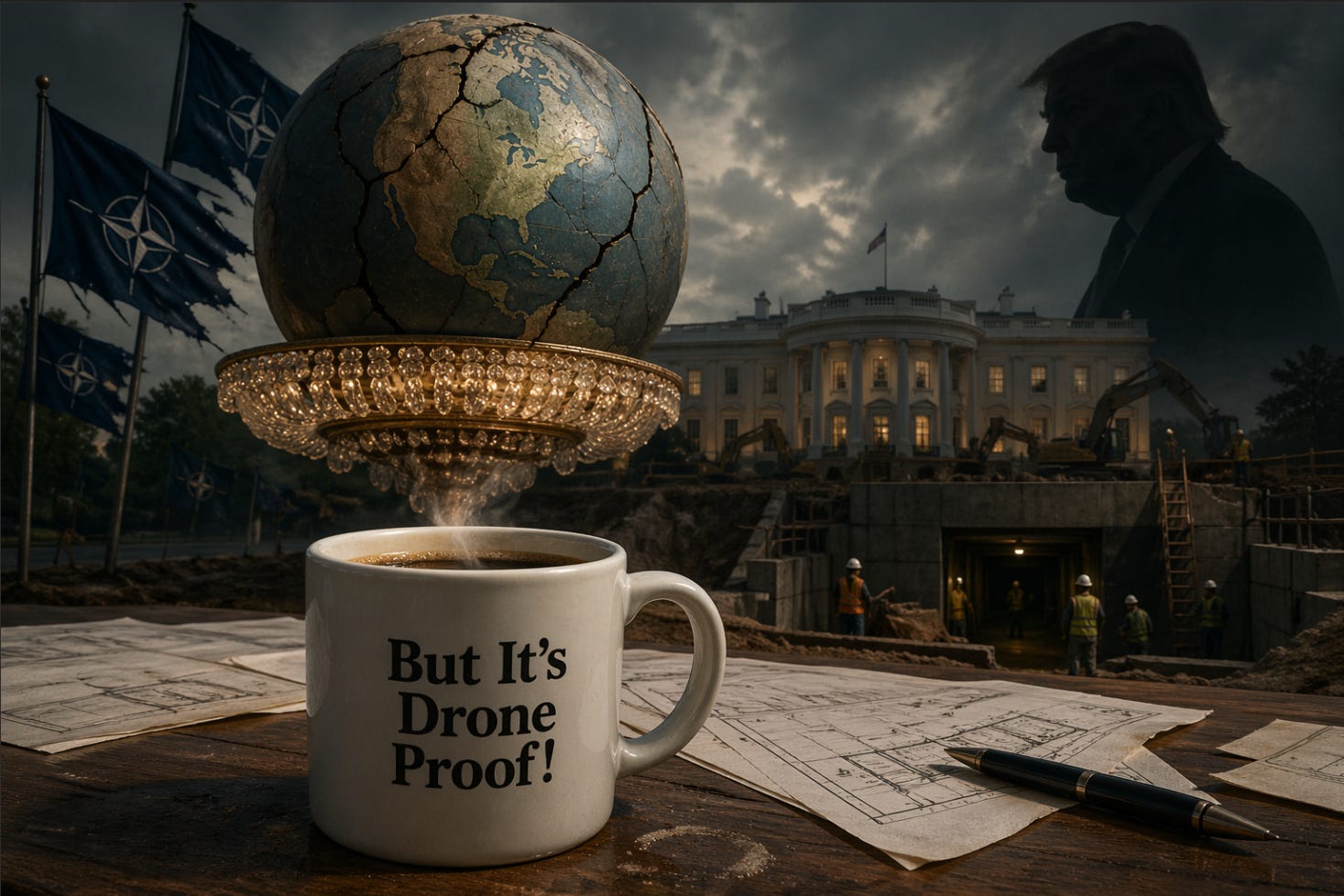
After a federal judge blocked construction, Trump began posting furiously about how the ballroom is not just a ballroom but also, somehow, a critical piece of national security infrastructure. In one post read, Trump reportedly described the project as a “safe and secure large-scale meeting place” with “bomb shelters,” “state-of-the-art hospitals,” “protective missile resistant steel columns,” “drone proof ceilings,” and “ballistic and blast proof glass.”
There you have it, the one thing standing between America and catastrophe is a chandelier. The legal argument, if we’re being generous and calling it that, is that the ballroom and an underground bunker are effectively inseparable. Trump reportedly claimed the “underground portion is wedded to and serves the upper portion,” which is a very fancy way of saying: no bunker without the ballroom, no national security without the canapés.
What makes this more than just absurd is the pattern: inflate a personal vanity project into a national security crisis, attack the courts, flood the zone with nonsense, and hope something sticks.
It’s funny until you remember this is the same person with command authority over the military, the economy, and the nuclear arsenal.
Europe is questioning whether America would defend it. US weapons stockpiles are being drained faster than they can be replaced and key allies are being publicly insulted. Media power is consolidating around political loyalty and the president is arguing that a ballroom is a missile defense system.
This is a credibility crisis, material, moral, and mental, and the world is starting to act accordingly.
What better time to start poking at the edges? Putin is a lot of things but stupid isn’t one of them. Trmp couldn’t have made it easier for Putin….burn through critical weapons’ stockpiles, distract the entire American military establishment with a war of choice and then miss the tiger in the room stealthily pawing at the perimeter.
Depressing, but true: America's support is no longer guaranteed, in any context, really, but especially as regards NATO. It's got to be a frightening question to ask aloud, as Tusk did, but it's actually just rhetorical, because the answer is clear, and obvious: Donald Trump, and thus America as a defensive military (or even diplomatic partner) is not good their word, let along written agreements. Trump seems to draw strength from the chaos. This might work in RE development, and obviously worked in political campaigning (somehow), but when it comes to the boring business of running a nation, maybe reliable and predictable is good?