


Good morning! Thursday has arrived carrying a flamethrower, and the day’s central theme is no longer just Trump’s corruption, cruelty, or compulsive dishonesty; those are baked into the wallpaper. What is becoming harder to ignore now is something darker: his decline appears so obvious that commentators abroad are no longer merely mocking him or rolling their eyes at the latest imperial toddler tantrum. They are openly asking whether he still has the mental capacity to exercise presidential power safely. In one foreign discussion, the panel’s argument is that trying to decode Trump’s strategy has become almost pointless because “trying to deconstruct his mind is completely futile,” and because he now seems to “make a statement and then 10 seconds later… assert the opposite.” One commentator goes so far as to say, “These are not the actions of a sane man,” while another says bluntly that he is “a loony with a lot of power.” In Sydney, the language goes even further, with Trump described as a man in “profound psychological crisis” whose behavior may reflect both deep pathology and cognitive deterioration. You do not have to endorse every diagnosis floated in those conversations to grasp the larger point. The point is that the rest of the world is talking about the President of the United States the way one talks about a man visibly coming apart in public, not a leader in command of events.
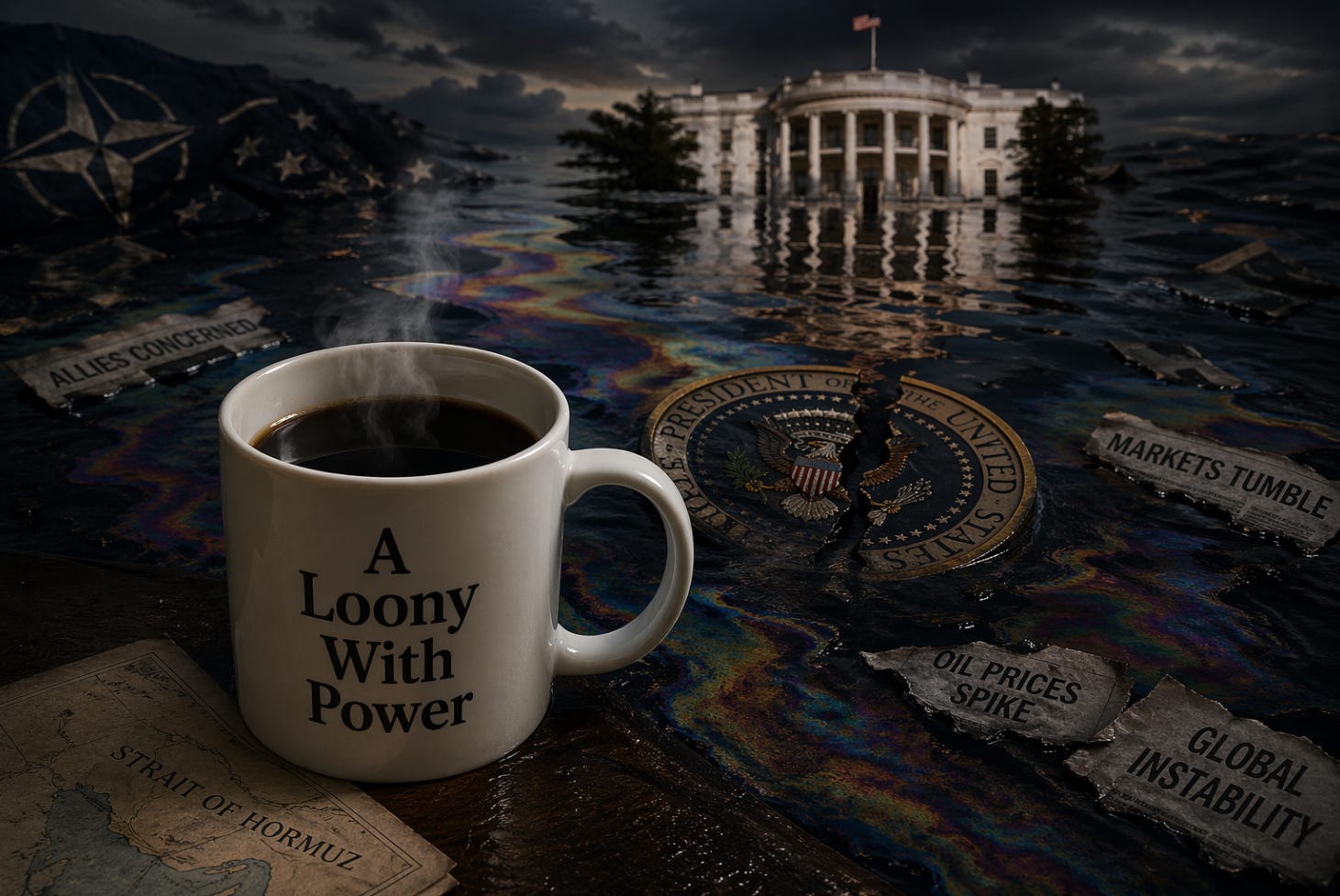
Just to remove any lingering doubt, Trump responded this morning by escalating the Hormuz crisis in exactly the sort of improvisational, dangerous fashion that makes those foreign assessments land so hard. Via Truth Social, he declared he had ordered the U.S. Navy to “shoot and kill” any boat laying mines in the Strait of Hormuz and insisted that “there is to be no hesitation,” while mine-clearing operations would be tripled. The additional reporting makes the recklessness even clearer: even as Trump was threatening lethal force, the White House line was that there is “no time pressure” on negotiations, that the cease-fire is essentially indefinite, and that Washington is waiting for Iran to “figure out who exactly is negotiating.” The guns are live, the timetable is mush, and the strategy appears to be whatever falls out of his mouth or onto Truth Social in the next five minutes. Worse, Congress has already been told that clearing the strait could take “up to six months after the war ends,” meaning the economic pain from this mess may linger long after the latest macho outburst fades from the headlines.
This is not some symbolic puddle fight between two men in speedboats. The Strait of Hormuz normally carries around a fifth of the world’s traded oil and gas, so every threat, seizure, and mine-clearing delay ripples through the global economy. AP reports that Iran’s recent actions in the strait and the U.S. response have already undermined the supposed cease-fire. The blockade remains in place, the cease-fire is effectively open-ended, and the cleanup could drag on for as long as six months after the conflict ends. So this is not a tidy demonstration of strength. It is an indefinite military and economic choke point being managed by a man who treats brinkmanship like live-stream content.
Regional reporting makes the picture worse, not better. Al Jazeera notes that from Tehran’s perspective, the U.S. blockade itself is the original escalation. It punctures the White House fairy tale that Trump is merely policing order against Iranian chaos. No, he is escalating inside an already explosive confrontation and branding his own escalation as stability. The White House line is that there is no firm deadline for negotiations and that Trump alone will decide when enough is enough. We have one man turning a regional war scare into a presidential mood ring, while the rest of the planet gets to enjoy the oil shock.
The New York Times reporting on Iran makes the strategic landscape even more alarming. The death of Ali Khamenei did not usher in some softer or more pliable regime. According to the Times, real power has shifted toward a collective of Revolutionary Guards commanders who now dominate decisions on war, diplomacy, and internal security, while Mojtaba Khamenei appears less like an all-powerful successor than a kind of ceremonial chairman presiding over a hard-line military board. Civilian leaders have reportedly been sidelined, and the generals are driving the closure of the strait, the cease-fire maneuvering, and the negotiations with Washington. While Trump is publicly issuing shoot-to-kill threats and privately insisting there is “no time pressure,” he is facing an adversary whose decision-making is murky, militarized, and deeply suspicious of negotiation itself. Instead of strategic genius, we have a cognitive fog machine colliding with a bunker state.
Because this administration can never resist adding a little amateur operetta to the edge of catastrophe, the Pentagon is also busy devouring itself. Navy Secretary John Phelan was abruptly fired after months of infighting with Pete Hegseth and senior Pentagon figures, according to the New York Times, while the Wall Street Journal adds that the feud revolved around shipbuilding, power struggles, and Phelan’s unusually direct line to Trump. Phelan had championed the so-called “Golden Fleet” and even a proposed “Trump-class” battleship, because even in the middle of a Middle East crisis there is always time for a vanity project that sounds like it was conceived in a casino lounge after three whiskeys and a History Channel binge. The Times says he clashed with Hegseth over management, personnel, and ideology, while the Journal reports that his authority had already been hollowed out from above. So at the exact moment the Navy is central to one of the most dangerous confrontations in the world, Trump’s Pentagon is still operating like a reality show staffed by grievance goblins in dress uniforms.
Across the Atlantic, Europe is beginning to say more plainly what many leaders there have likely feared for months: Trump’s America is no longer acting like a dependable ally. The Guardian reports that Brussels has moved to stall a pipeline deal in Bosnia that would hand a strategic energy project to a little-known Wyoming company fronted by Jesse Binnall and Joe Flynn, both figures tied to Trump’s orbit. The deal is being sold as energy security for Europe, but the reporting suggests something more familiar and more sordid. Transparency International warned that the legislation steering the contract to AAFS without open competition would set a “dangerous precedent,” while the EU’s envoy warned Bosnia that it was “crucial that draft laws are thoroughly coordinated” with Brussels if the country wanted to stay on its European path. Meanwhile, Binnall has called the project a “priority for the Trump administration,” which rather gives the game away. Scratch the paint and there it is again, the sticky residue of Trumpism, where every geopolitical event somehow leads back to whether his friends can get a cut.
That is why James O’Brien’s commentary from Britain lands so sharply. His point is not simply that Trump is offensive or vulgar. It is that he has broken one of the foundational assumptions of modern British foreign policy: that the United States is, however imperfectly, a friend and a reliable ally. As O’Brien puts it, “the United States of America is no longer our friend,” and Britain’s military dependence on Washington is “no longer tenable.” Put that beside the Guardian’s pipeline story and the wider picture clarifies. Europe is starting to understand that under Trump, America behaves less like a democratic anchor and more like a volatile patron power whose ruling circle sees alliances as opportunities for extraction. The special relationship begins to sound much less special when one side is threatening Greenland, bullying allies with tariffs, destabilizing NATO, and letting the president’s political entourage sniff around the Balkans for infrastructure deals like raccoons near an overturned bin.
Back home, the authoritarian instinct is no longer subtle. Harry Litman’s analysis of the indictment against the Southern Poverty Law Center shows how the administration’s method works: take something routine, lawful, and institutionally familiar, then drape it in the language of criminality until the public stops asking whether the underlying theory makes any sense. Litman notes that SPLC used confidential informants to infiltrate extremist groups, a tactic law enforcement itself uses all the time. But the administration is trying to transmute that into a narrative that SPLC was somehow “funding extremism,” which is about as intellectually honest as claiming the FBI bankrolls the mob every time it pays an informant. Litman argues the fraud theory appears weak and the real objective is rhetorical: smear a longtime ideological enemy with a headline dirty enough to do the work before the facts catch up.
In case anyone still thinks that is an isolated stunt, the New York Times reports that the FBI examined whether routine reporting by Times journalist Elizabeth Williamson could somehow be framed as stalking after she wrote about Kash Patel using bureau personnel to provide security and transportation for his girlfriend. According to the Times, agents interviewed the girlfriend, searched databases for information on the reporter, and considered stalking statutes before Justice Department officials reportedly concluded there was no legal basis to proceed. There is the same instinct again, right out in the open: in one case, anti-extremist infiltration gets rebranded as support for extremism; in the other, ordinary First Amendment newsgathering gets floated as a crime because it embarrassed the powerful. The trick is not to prove the critic is criminal, but to wrap them in the vocabulary of criminality and hope the stain spreads faster than the truth.
Here we are with a president whose visible decline is now being discussed abroad in tones once reserved for family interventions is escalating in the Strait of Hormuz with shoot-to-kill rhetoric and no obvious off-ramp. Iran is no less dangerous, only more militarized and more firmly controlled by hard-line generals. Europe is waking up to the fact that Trump’s America is no longer a trustworthy ally but a transactional, predatory power. At home, the machinery of law enforcement is being bent toward intimidation, retaliation, and narrative warfare against critics, journalists, and watchdogs.
This is degeneration. Institutional, strategic, moral, and perhaps personal degeneration becoming so obvious that even the rest of the world has stopped pretending not to notice. The scandal is no longer simply that Trump says outrageous things, fires people on a whim, menaces allies, and targets critics. The scandal is the United States is still expected to function as though this is merely another manic news cycle rather than a government being run around the weakening judgment of a profoundly dangerous man.
Marz and I are still playing catch-up today, and not just on the task list but on lost sleep, frayed nerves, and the general psychic damage of trying to process a presidency that now feels less like governance and more like watching a chandelier sway over a gas leak. Technically, Marz is already fully restored — he is behind me snoring with the serene confidence of a creature who has outsourced all responsibilities and sees no reason to revisit that decision. So I’ll take his example under advisement. Until then, peace be with you all, and may your coffee be stronger than the headlines.
You are absolutely right, Mary. All the reputable newspapers I read in the UK seemed to decide en masse at the beginning of the Iran war that it was time for the editorial kid gloves to come off and for Trump to be denounced as the demented Emperor who has no clothes... I think they had hesitated before because they were afraid of being sued. He is a universal hate figure over here and there is much oppostition to the state visit by the king and queen to the US at the end of the month. The only popular move our mistake-prone prime minister has made lately is to resist the UK being involved as a combatant in the war.
My coffee IS strong and so is my resistance to all this evil sickness. Thank you Mary, and please take care of yourself!!