


The reward for hope doesn’t always arrive as a miracle. Sometimes it looks like an eleven-month-old baby lovingly petting the capybaras attached to his mother’s feet. I love capybaras. They are enormous rodents with tiny ears, magnificent faces and the general demeanor of creatures who have declined to participate in unnecessary conflict. I had capybara keys on my keyboard for years, and I have always wanted pet capybaras of my own, but apparently there are laws against collecting giant South American rodents simply because you believe they would improve the atmosphere of your home.
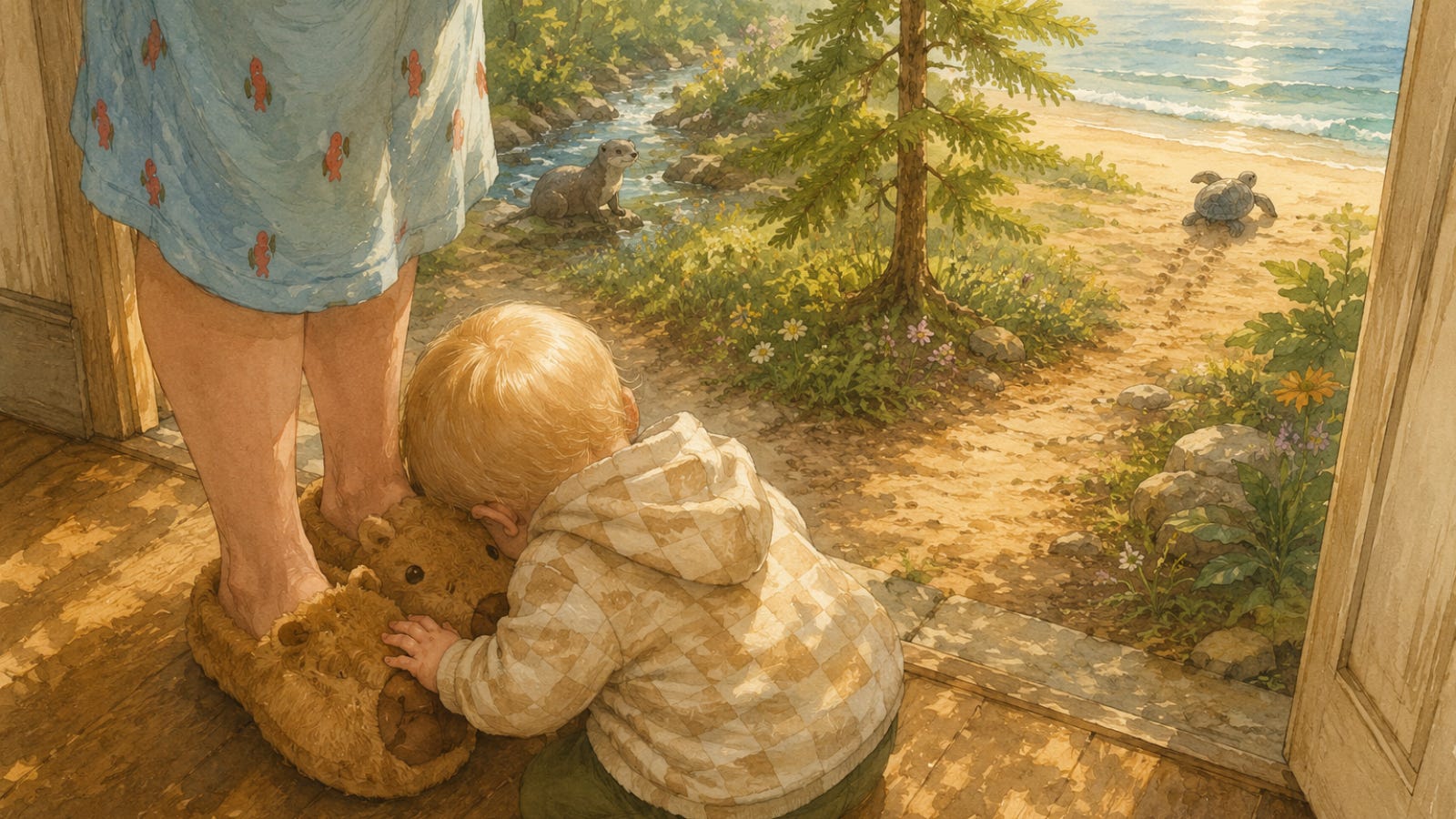
I did, however, get capybara slippers, which have immediately become Ezra’s favorite members of the family. He follows me around the house, pets them and occasionally lowers his head onto one so he can rest against its little capybara face. I am still inside the slipper when this happens, which makes walking difficult, but his happiness is worth the temporary loss of mobility.
A few months ago, our life here felt terribly uncertain. We were facing extraordinary hardship, and there were moments when the future we had imagined on this land seemed as though it might disappear before we had the chance to build it. We didn’t know whether we would get to keep living here, raising our children here, planting trees here or sending my capybara slippers shuffling through this particular kitchen.
Hope didn’t solve those problems through magic. It didn’t remove the fear, complete the paperwork, make the calls or carry us through the hardest days without effort. It did however, keep us from surrendering before the answer arrived. Because we kept going, we got to stay. Hope didn’t hand us some entirely different, perfect life. It allowed us to keep living the imperfect one we already loved.
Every morning, Ezra calls my name from his tiny prison, leaning over the rail of his crib with a smile so enormous that whatever reluctance I felt about joining the waking world is immediately overruled. I’m not sure what I’ll do when he reaches the age when he no longer needs me to retrieve him from his tiny prison every morning. I suppose I’ll sleep longer and look back fondly, which is one of parenthood’s crueler arrangements. We spend years exhausted by the very things we will one day miss with an ache.
He has also started doing this adorably bashful thing where he rubs his ear against his shoulder and looks at you with a half-smile and those beautiful blue eyes. I adore him, probably more than any other human currently shorter than 36 inches.
My daughter remains a firecracker, although beneath the sparks she is terribly soft at heart. She will not dare let you know that too often, but every once in a while she allows you to catch a glimpse, and it is beautiful. The strawberries are still blooming, the tomatoes are edging closer to ripe, and the cucumbers and cucamelons are climbing their little trellises. We finally planted the wildflower she potted at Head Start last year. When I asked where it should go, she looked at me as though the answer should have been perfectly obvious.
“Wildflowers go where the wild things go, Mom,” she said, pointing toward the woods.
So, her wildflower now grows near the trailhead, exactly where the wild things go.
At night, when we read together, I have to remind myself to be patient. It’s late, I’m tired, and my brain is usually overstimulated after a full day of children, construction, work and approximately 40,000 unfinished thoughts colliding inside my skull. When she tries to read at the same time I’m reading because she’s learning how, the overlapping voices can feel unbearably loud to my ADHD brain.
But if I ask her to stop, my heart breaks a little, because she is not interrupting the story. She is trying to enter it. Hope, in that moment, is believing that the noise filling my tired brain is also the sound of her becoming a reader. It’s allowing her the time to stumble over the words because the child struggling to read beside me tonight may become a woman who disappears into books tomorrow.
Love doesn’t always feel peaceful while we are practicing it. Sometimes love is profoundly loud, and sometimes hope is allowing a four-year-old to slowly sound out another word while your nervous system files a formal complaint.
My oldest, my ADHD buddy, has struggles of his own. He is simply not always in the same place as everyone around him, which is okay, and I understand that better than most. Understanding does not magically prevent it from becoming tiresome, overwhelming, infuriating or all three before lunch. Empathy is not an endless reservoir that refills itself while no one is looking. Hope doesn’t require me to pretend those struggles are easy. It asks me to believe that the difficulty we are having today is not the limit of who he can become.
So, I’ll keep doing my best. I’ll share my experiences, teach him what helped me and try to offer him the understanding I needed when I was his age. There will be hard days, repeated conversations and probably a great many missing objects that were definitely in his hand five minutes ago, but we’ll continue finding our way forward together.
We don’t give up on our children because they are unfinished. We remain beside them because they are unfinished, and because we know that somewhere inside every exhausting stage is a person still becoming more extraordinary.
My husband and I have our good days and bad days. Some days we barely speak, while other days feel so perfect that I can’t imagine how we ever become lost from one another. It’s difficult to know which version of us the morning will produce, but we always come back. We rarely go to bed angry, and when the world becomes too heavy, we remind each other why we keep going. He is the architect of my imagination, my safe place to rest and my defender from the darkness.
An interesting fact about me is that I was afraid of the dark until we moved in together, a condition that was probably not helped by my lifelong commitment to watching television programs about serial killers and then acting surprised when every sound in the hallway seemed murderous. Mom knows all about this because I shared her bed for what must have felt like most of her natural life. The poor woman spent years sleeping beside a frightened child who had voluntarily consumed six consecutive hours of forensic television.
My husband made me feel safe enough to sleep in the dark, and my goal is to provide that same safety for him. Hope inside a marriage isn’t the expectation that every day will be perfect. It’s the belief that a quiet day isn’t the final word, that neither of us is reducible to our worst mood, and that we can keep returning to the place where we recognize one another.
Out in the fairy garden, we planted a Dawn redwood, which may be the most appropriate tree we could possibly have chosen for a place built around imagination and hope. Botanists knew the genus from fossils and believed it extinct until Chinese scientists connected living trees in central China to that ancient genus during the 1940s. Science had already placed the Dawn redwood among the vanished things, and there it was, still growing. The tree hadn’t returned from extinction. It had never agreed to be extinct in the first place.
The Dawn redwood is also a deciduous conifer, which means its needles turn bronze and fall away in autumn before returning green in spring. Even its ordinary life contains a lesson about appearances. Bare does not necessarily mean dead, and lost does not always mean gone.
My husband and our oldest have also been adventuring through the woods, where they discovered all kinds of remarkable things, including a Pacific willow we initially believed was approximately eight separate trees. It turns out it is one tree, although it appears to have formed its own small municipal government.
The plants are thriving, the fairy garden is coming into its own and the renovations inside the house are beginning to take shape. Unfortunately, cabinets are apparently being manufactured from rare timber, powdered diamonds and the consolidated retirement accounts of ordinary Americans, because I can’t identify any other reasonable explanation for what they cost.
At this point, buying a table saw and a router appears cheaper than buying cabinets, so I may acquire both, point them toward some lumber and hope for the best.
I am also considering making the countertops from wood slabs. There is a man nearby who sells beautiful local wood for a reasonable price, and while I would prefer that the trees remain trees, he only cuts them when they’re dying or threatening homes and infrastructure. I suspect the project would still find a way to become outrageously expensive, because wood has a remarkable ability to detect optimism and adjust its price accordingly, but it would be beautiful and fun.
If anyone has experience making wood countertops, I would love your advice, particularly if your advice begins somewhere other than, “First, purchase $11,000 worth of specialized equipment.”
This is the life hope preserved for us. It isn’t grand or flawless, and it would look thoroughly ordinary to anyone passing our house. It’s children learning, plants growing, a husband and wife returning to each other, a baby petting capybara slippers and two adults considering whether they can manufacture an entire kitchen with optimism and a router. It is ordinary, and it is everything.
We are finding hope in these little adventures, the tiny victories and the beautiful smiles, but sometimes hope reveals itself in an instant so urgent that an entire street can feel it. On August 19, at approximately 2:10 in the afternoon, a 14-year-old girl was riding an electric bicycle along a road in Qionglai, China, when she collided with an SUV and was pulled beneath it. One of the vehicle’s tires came to rest against her waist.
For a few terrible seconds, she was a child trapped beneath thousands of pounds of metal while an ordinary afternoon continued around her. Shopkeepers were inside their businesses. People were walking home or carrying groceries. Drivers were moving along the road, and everyone had somewhere else to be.
Then someone saw her. Two or three people began shouting that a person was trapped beneath the vehicle, and they ran toward the SUV. They placed their hands against it and tried to lift, but the vehicle didn’t move. It was simply too heavy for them. That could have been the end of their attempt, but instead they shouted again, and more people came.
Nearby merchants abandoned their shops, pedestrians changed direction, a man wearing slippers ran toward the vehicle, and a woman carrying a market basket joined him. Within minutes, somewhere between 10 and 20 strangers had gathered around the SUV. They didn’t stop to ask the girl’s name. They didn’t debate who had caused the accident, whether helping would make them late or whether lifting a vehicle was technically their responsibility. Nobody held a meeting to determine the most efficient allocation of compassion. They saw a child beneath an impossible weight, and they decided the weight would have to move.
Some positioned themselves along the vehicle and lifted together. Others reached beneath it and prepared to pull the girl free. The first few people had not been strong enough, but every new pair of hands changed the equation until the thing none of them could move alone began to rise. The weight stopped belonging to one person, and within minutes, they pulled the girl out. She emerged pale and frightened, with abrasions and fractures, but her vital signs were stable when emergency crews arrived and took her to the hospital.
A witness who watched the rescue said the strangers moved as though they had trained together. They hadn’t. They were shopkeepers, shoppers and people passing through an ordinary afternoon, but when the moment came, they became something coordinated and powerful.
For those few minutes, the girl wasn’t a stranger to them. She was a child who needed to be lifted, and that was enough to make them act like family. There is something profoundly beautiful about what happened on that street, because the rescue didn’t begin with certainty. The first people who tried to lift the SUV failed. Their hope wasn’t based on evidence that they were strong enough. It was based on the conviction that leaving her beneath it was unacceptable.
So, they called for more hands. One person believed the vehicle might move, then another joined, then another, until belief became muscle and muscle became rescue. Perhaps this is how hope works in families and communities more often than we recognize. It doesn’t erase the weight crushing someone, it moves through people until the weight is distributed widely enough to lift.
Sometimes the rescue takes only minutes. Sometimes it requires years, international cooperation and a journey across an ocean. In December 2023, a dog discovered a tiny sea turtle lying nearly lifeless on a beach in Wales. The turtle, later named Rhossi, weighed only two pounds and belonged to one of the most endangered sea turtle species on Earth.
Rhossi is a Kemp’s ridley sea turtle, a species native to the Gulf of Mexico. Powerful currents had apparently swept him across the Atlantic, carrying him approximately 5,000 miles from the waters where he belonged. By the time he reached Wales, the cold had overwhelmed his body.
Sea turtles depend on the temperature around them to regulate their own bodies. When the water becomes too cold, they can become cold-stunned, leaving them weak and unable to swim or function normally. Rhossi had somehow survived the Atlantic only to arrive on a distant beach barely alive.
The Anglesey Sea Zoo took him in and began the long work of rehabilitation. Over nearly two years, the two-pound turtle grew into a 46-pound survivor. His recovery involved veterinarians, conservation organizations and government agencies on both sides of the Atlantic, all cooperating to give one endangered animal a chance to return to the sea.
Earlier this month, Rhossi was transported by helicopter from Wales to London, placed aboard a transatlantic flight and carried to the Houston Zoo, bringing him much closer to his native Gulf of Mexico.
His medical examination revealed lingering pneumonia, so his journey is not yet finished. He will need additional treatment and time before specialists can determine whether he is ready to be released into the wild.
Hope didn’t look at Rhossi’s remarkable growth and declare the work finished. It looked at the scans, acknowledged that he was still sick and stayed beside him. Hope doesn’t require the ending to be complete before it counts. It exists in the dog that found him, the people who refused to leave him on the beach, the caretakers who spent nearly two years helping him grow strong and the international network now working to return him to an ocean he has not seen since he was impossibly small.
Rhossi is slowly finding his way back to the water where he belongs. In New York, people spent half a century making a river safe enough for something else to come home. For roughly 100 years, no river otter had been documented along the Bronx River. The river had once been treated as an open sewer and industrial dumping ground. Factories poured waste into the water, untreated sewage entered the river and people discarded tires, appliances and garbage along its banks. Wildlife disappeared because the river could no longer support it.
Then people began the slow, unglamorous work of bringing it back. Public agencies, conservation organizations and community volunteers removed trash, restored habitat and fought for cleaner water. Residents who had inherited the consequences of generations of neglect spent decades repairing a place they hadn’t destroyed.
In 2007, beavers returned to the river after an absence of more than 200 years. Then, on June 23 of this year, a motion-activated camera captured something almost unbelievable moving through the vegetation beside the water. The Wildlife Conservation Society confirmed that the image showed a North American river otter, the first documented in the Bronx in approximately a century.
One otter doesn’t prove that a permanent population has returned, and scientists are careful not to claim that it does. The animal may have been passing through, searching for food or exploring unfamiliar territory. Hope doesn’t need us to exaggerate what happened.
River otters require clean water, healthy habitat and enough fish to survive. Its presence means the Bronx River has once again become capable of welcoming a creature that couldn’t have lived there before.
The otter isn’t merely a charming animal captured by a camera. It’s a small, whiskered receipt for 50 years of human persistence. The people who restored that river didn’t know exactly what would return or whether they would live to see it. They simply refused to accept that neglect was permanent. Year after year, they kept cleaning, protecting and repairing until the river became alive enough to surprise them.
That’s the kind of hope I want to remember, because we’re often taught to expect hope to arrive as a miracle, sudden and complete. More often, it begins with the stubborn refusal to accept that the way things are is the way they must remain.
Hope is the first person placing their hands against an SUV they can’t lift alone, trusting that more hands will come. It’s treating a two-pound turtle for nearly two years even though the ocean he belongs to is 5,000 miles away. It’s cleaning a river for half a century before an otter finally steps into the frame. It’s planting an ancient tree you may never live long enough to see fully grown. It’s reading beside a tired child, believing in a son through the difficult stages, returning to a marriage after the quiet days and continuing to build a home when the future once felt uncertain.
Tomorrow morning, Ezra will probably yell my name from his tiny prison. I will climb out of bed, put on my capybara slippers and walk toward the crib while two little blue eyes watch me approach. He will smile because I came, just as I always do, and then he will follow those capybaras around the house as though nothing in the world could be more wonderful. It is a tiny, ordinary scene, but there was a time when I didn’t know whether we would get to keep living this life in the place we loved.
Now we do. That’s what hope can do for an ordinary family. It doesn’t promise that life will never become heavy. It keeps us calling for more hands, trying again, returning to one another and believing that the weight can move. It doesn’t always give us a different life. Sometimes it helps us keep the one we love.
Thanks for sharing all the wonderful images of your entire family. Love seeing them explore their world through your eyes…🥰
Your writing is inspiring!!