

Today, my ADHD buddy turns ten, which is a perfectly reasonable number until it belongs to your child, at which point it becomes personally offensive. Time has moved far too quickly, one moment, he was small enough to carry through the world, and now he stands beside me with his own ideas, jokes, struggles, and hard-won wisdom.
I am so proud of him. I am proud of how much he has grown, how deeply he feels, and how many battles he has already fought inside that remarkable brain of his. Watching a child become himself is one of the strangest privileges of parenthood. You want them to grow, you work every day to help them grow, and then they do, which seems, frankly, inconsiderate.
Today is also fair day, an event my children have anticipated with the emotional restraint traditionally associated with a moon landing. My daughter has been talking about it since last year’s fair because, for her, the county fair is not an annual event; but rather, a yearlong spiritual commitment.
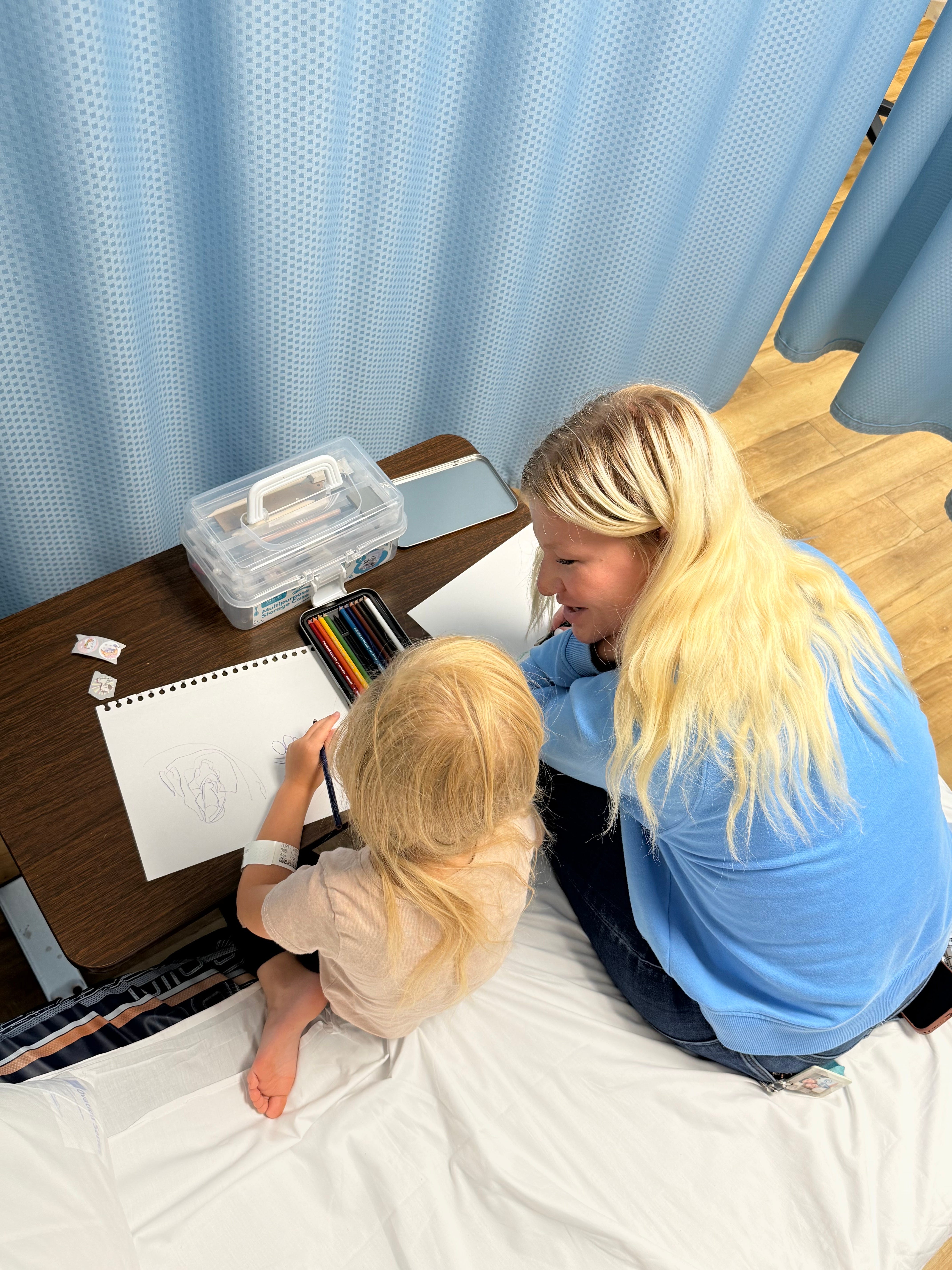
Unfortunately, the day did not unfold the way I hoped when I wrote this morning. My girl did not wake up rejuvenated. We are now at the ER, and the fair she has spent an entire year anticipating is carrying on without us. I am grateful I finished most of this piece before the day revealed itself, because the rest of today belongs entirely to her.
Her health matters more than any fair, of course, but my heart still breaks knowing she is missing the animals, the rides, and something fried that costs more than a respectable lunch. Her dad and I have already agreed that, once she is well, we will locate the nearest and soonest upcoming county fair and travel wherever necessary. We may be exhausted parents operating a small domestic emergency response agency, but we keep our promises.
This morning, I was waiting for the house to wake up, hoping my girl felt better, wondering how my son became ten, and paying close attention to the signs. Unfortunately, the federal government has also become interested in signs, although for entirely different reasons.
The Trump administration has discovered a national emergency at the Smithsonian. Not the aging infrastructure, the condition of the collections, or the possibility that a country dismantling democratic institutions might want to preserve enough evidence for future historians to explain what happened. The emergency is that the National Museum of American History occasionally presents American history as something that actually occurred.
President Donald Trump has ordered signs placed outside the museum warning visitors that some exhibits are inaccurate. Because the Smithsonian operates independently and the president can’t simply march inside and rearrange the past until it compliments him, the White House has settled on the surrounding walkways, which are controlled by the National Park Service.
The signs will direct visitors toward information the administration considers more accurate, an extraordinary proposition from people who have spent years treating documented fact as a personal attack.
A White House report accused the museum of failing to present the country in a manner that is “inspiring, unifying, and worthy.” Apparently, history must now behave like a motivational poster in a dentist’s office. It may contain an eagle, a sunrise, and perhaps a quotation about courage, but it must not mention slavery, dispossession, segregation, labor exploitation, or anything else likely to interrupt the administration’s preferred national mood.
Museum director Anthea Hartig defended the Smithsonian’s standards and told Congress that its work is grounded in scholarship. This was once the ordinary expectation for a history museum; it’s now a controversial insistence that the past should be assembled from evidence rather than presidential self-esteem.
The timing is useful because the warning signs aren’t confined to the museum; they’re everywhere. The United States has expanded its military campaign deeper into Iran, striking bridges, tunnels, communications facilities, water systems, power stations, military bases, and missile production sites. Tens of thousands of civilians have been affected by attacks on infrastructure, while Iran continues striking American bases and ships across the region.
What began as another supposedly controlled military action has acquired the traditional features of a war everyone insisted would remain limited: civilian suffering, dead service members, damaged infrastructure, widening retaliation, and officials explaining that the next escalation is necessary because of the previous one.
The administration has also fired upon a merchant vessel accused of attempting to breach the American blockade. Iran has attacked shipping through the Strait of Hormuz, one of the most important oil passages in the world, helping push fuel prices upward while the president promises that greater force will eventually produce stability. In other words, the war passed the dangerous threshold, turned around, and bombed the bridge behind it.
While Americans absorb the cost of that conflict, Trump has revived his tariffs after the Supreme Court invalidated the previous version. The new duties range from 10 to 12.5 percent and apply to imports from 60 countries, covering nearly all goods entering the United States.
The administration says the tariffs will punish countries that have failed to prevent forced labor. Trading partners dispute the justification, particularly because nations with radically different labor records received remarkably similar penalties.
This is not the old tariff policy, the White House would like everyone to understand. This is an entirely new tariff policy wearing the old policy’s coat, sleeping in its bed, and collecting roughly 60 percent of its former “revenue.”
The legal mechanism has changed, but the cashier remains the same. Tariffs are paid by American importers, who generally pass those costs to businesses and consumers. Shoes, household goods, machinery, electronics, and countless products made with imported components are likely to become more expensive. After years of insisting other countries would pay, the administration has replaced that promise with a forced-labor justification and hoped nobody would examine the receipt.
The Justice Department, meanwhile, withdrew subpoenas targeting three New York Times reporters after a federal judge found that the government had handled the case with the care of someone assembling a chair during a power outage because, with the lights gone, there was apparently nothing better to do. It looked convincing enough in the dark, but the moment someone placed any weight upon it, the entire structure collapsed in a magnificent crash. The Justice Department then dusted itself off and blamed the person who had tried to sit down.
The subpoenas were part of an investigation into sources behind reporting on the $400 million retrofit of the Qatari jet Trump accepted for use as Air Force One. Government lawyers sought records belonging not only to the journalists, but also to one reporter’s mother and two journalists’ spouses.
“That was an error, judge, which we own,” Justice Department attorney Sean Buckley said.
Judge Arun Subramanian noted that department regulations require subpoenas targeting journalists to be used only after other investigative avenues have been exhausted.
“Subpoenas are the last step, not the first step,” he said, concluding that the government had turned the rules “on its head.”
The Justice Department withdrew the subpoenas, then attacked the judge for objecting to its conduct. This has become the administration’s preferred form of accountability: retreat, complain, and announce that the person who noticed the misconduct is the real threat.
Hours later, Trump attended the White House Correspondents’ Association dinner and delivered an hourlong speech filled with insults toward journalists, politicians, and entertainers. It was a celebration of journalism in roughly the same sense that a wrecking ball celebrates architecture.
Outside Washington, the warnings have become harder to convert into signage because many of them are currently on fire. More than 250,000 people have fled wildfires in France and Spain. Some escaped by boat after roads became impassable. France shortened the final stage of the Tour de France so security personnel could be redirected toward the emergency, while firefighters, soldiers, aircraft, and assistance from across Europe were deployed against flames intensified by extreme heat and climate change.
Across the United States, heat is pushing electricity consumption to extraordinary levels. Texas reached a record demand of more than 91,000 megawatts this week. Earlier this month, national electricity output exceeded 100,000 gigawatt-hours in a single week for the first time. Solar power supplied roughly one-third of Texas electricity during peak demand, an inconvenient achievement for politicians who insist renewable energy is an elaborate liberal scam. Apparently, the sun neglected to consult the “King of Coal” before keeping the air conditioners running.
Democratic lawmakers also learned that ICE has referred only one officer for possible discipline after 56 excessive-force complaints filed since Trump returned to office. No discipline has been confirmed. Some agents received abbreviated training, and guidance governing vehicle stops, an issue in recent fatal shootings, is reportedly being communicated verbally rather than established in a formal written policy. That’s another warning sign, although the administration will presumably decline to post it.
Parents learn to watch signs because children depend on us to notice. We listen when a stomach hurts, change plans when a body needs rest, find another fair, and we don’t order the child to become more inspiring, unifying, and worthy before we acknowledge what’s happening. A functioning government should possess at least the situational awareness of two worried parents on fair morning.
War spreading through civilian infrastructure, government efforts to expose journalists’ sources, federal officers operating with minimal oversight, a quarter of a million people fleeing fire, and a government attempting to replace documented history with a more emotionally supportive version are all warnings that I desperately hope lawmakers begin to heed.
The White House is correct about one thing, Americans should pay closer attention to the signs, they’re simply looking in the wrong direction.
P.S. Our subscription rates for new paid subscribers will increase on 08/15/2026. Upgrade before then to lock in our current price of $7/month or $70/year. Existing paid subscribers will keep their current rate. Learn more here:
I hope your daughter starts feeling better soon. In the Midwest, fair season runs most of the summer. Hope you can find one moderately close.
Thank you for another great piece. Hope your daughter feels better soon.