


Any of you who read my Sunday reminder yesterday know my family has been focusing a lot of attention on gardening lately, which means my husband and I have reached the part of adulthood where “just one more YouTube video before bed” has somehow become “here is a 47-minute lecture about soil structure.”
Romance is alive and well, folks. It’s just wearing garden gloves and whispering, “Wait, rewind that part about worm castings.”
For the most part, these late-night video binges have been about earthworms. Earthworms and healthy soil. Earthworms and compost. Earthworms and the underground universe beneath our feet that most of us walk across every day without giving it a second thought. And I have to tell you: earthworms are incredible.
They are soft little miracles. Blind, boneless, lungless, humble little creatures that breathe through their skin and spend their lives turning dead things into the conditions for life. They tunnel through compacted soil, making pathways for water and roots and air. They eat decaying leaves and organic matter and leave behind castings so rich and useful that gardeners talk about them the way some people talk about truffles.
They aren’t glamorous, they don’t have a brand, and they don’t hold press conferences in which they pretend that decomposition was their idea, and everyone is saying nobody has ever decomposed like this before. They simply do the work.
And this is not just garden-person sentimentality talking. The USDA has described earthworms as environmental helpers that play a valuable role in soil health and viability in forests, prairies, gardens, and farmland. They feed on organic material in the soil, including decaying plant matter and roots, and help create the conditions for healthier ground. A 2023 study in Nature Communications estimated that earthworms contribute roughly 6.5 percent of global grain production and 2.3 percent of legume production, equal to more than 140 million metric tons of food each year. So yes, the worms are doing numbers.
Which brings me, naturally, to Donald Trump. I know, I’m sorry. I didn’t want to bring him into the garden either, nobody wants that man near the tomatoes. But being who I am, and born of who I was born from, thanks, Mom, I could not spend hours learning about these small, disregarded creatures while also reading the news and not arrive at the obvious conclusion:
The earthworm is one million times better than the current president of the United States. And before anyone accuses me of being unfair to Donald Trump, let me be clear: I am being unfair to the worms.
Earthworms are often treated like nothing. We step over them on sidewalks after rain. We sell them in plastic tubs for fish bait. We use their name as an insult, even though the average earthworm has done more for civilization than most billionaires and almost every current sitting Republican senator.
An earthworm takes rot and makes soil, Trump takes a functioning institution and makes rot. The worm enriches the commons, Trump sees the commons and immediately begins wondering whether he can put his name on it, charge admission, install gold fixtures, and hand out VIP packages to donors who believe patriotism is best expressed through merchandise. The worm creates air pockets in suffocated ground, Trump creates suffocation in every room he enters.
The worm understands, in whatever ancient wormy way a worm understands anything, that life depends on reciprocity. It receives the dead leaves, the old roots, the scraps and the broken-down matter and the autumn wreckage. Then it gives something back.
Can you imagine? A creature that takes from the world and returns nourishment. How quaint, how pre-MAGA, how clearly not enrolled in the Donald J. Trump School of Extractive Narcissism, where the first lesson is that every public good is a private opportunity, every crisis is a camera angle, every law is a dare, and every patch of American soil is just waiting to be turned into a stage for one man’s birthday party.
Which is not even much of an exaggeration this week. Recent reporting says a lawsuit is seeking to block Trump’s planned UFC event on the White House South Lawn, scheduled for June 14, 2026, Flag Day and Trump’s 80th birthday. The suit alleges misuse of federal property and objects to a temporary steel structure known as “The Claw,” because apparently even authoritarian pageantry now comes with supervillain set design.
The White House lawn, a public symbol, a national space, a place that belongs, at least in theory, to the people. And there he is again, trying to convert the public into the personal, the civic into the commercial, and the people’s house into one more grotesque backdrop for one man’s endless appetite.
A worm would never. A worm has more respect for soil, and this is where the earthworm becomes more than a cute little garden fact. It becomes a political philosophy.
Healthy soil is not made by domination, by spectacle, or by stripping everything down, poisoning what remains, and then standing in the dust yelling that you alone can fix it. Healthy soil is made by relationship.
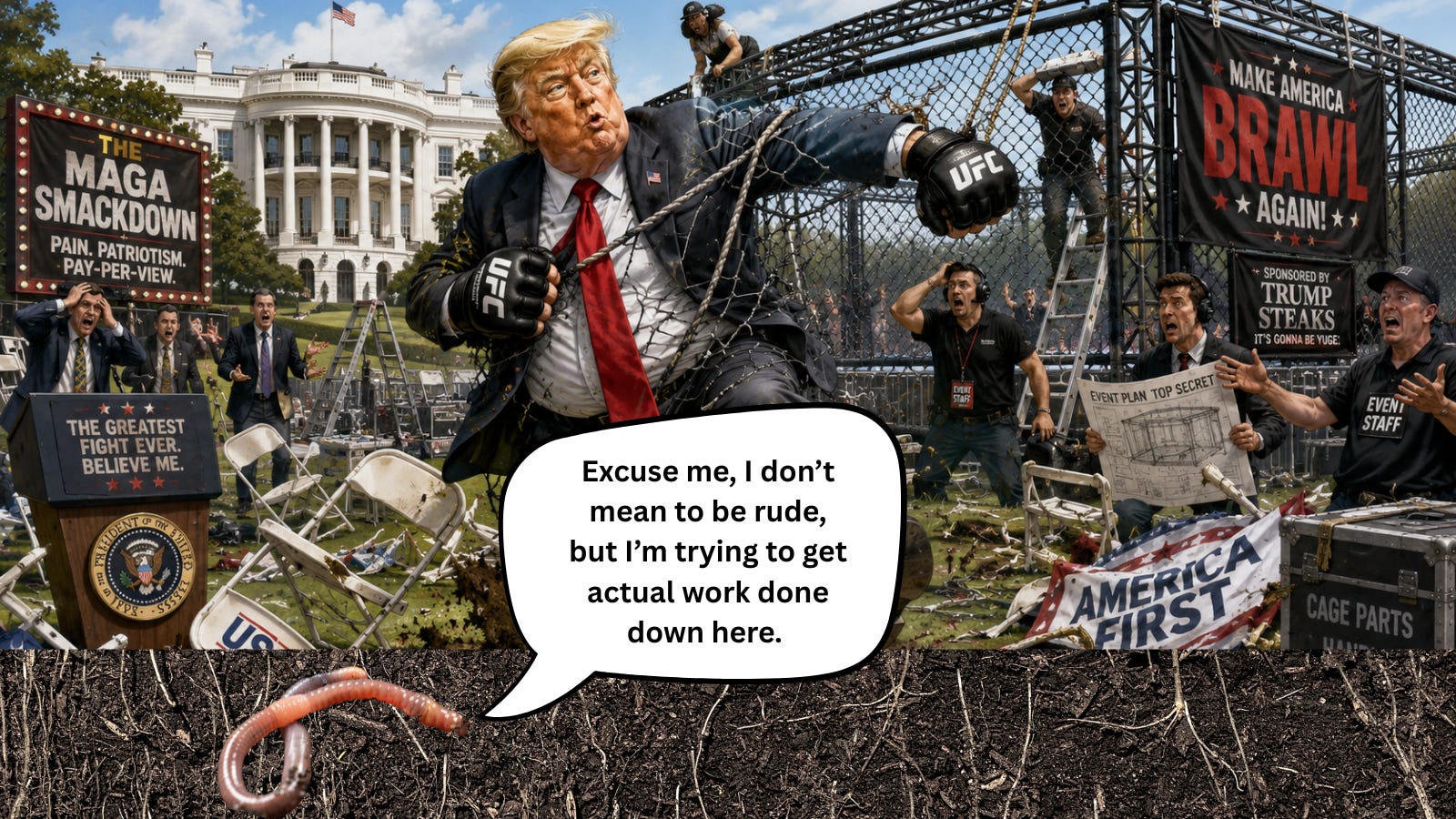
It is made by living systems working together: fungi, bacteria, roots, insects, worms, water, leaves, decay, and time. Nothing in healthy soil gets to be the whole story. Nothing gets to declare itself king of the garden. The tomato needs the microbe, the microbe needs the organic matter, the worm needs the moisture, the roots need the channels and the whole thing works because everything is connected and everything has limits.
This, I think, is part of why learning about soil feels weirdly emotional right now. Because we are living under a politics that hates limits. Limits are the whole point of a democracy. Limits on power, on corruption, and on what one man can do with public property, public money, public trust, public law, and public fear.
Trumpism treats all limits as insults. It sees restraint as weakness, accountability as persecution, expertise as treason, and humility as something that happens to other people, preferably poor people.
Meanwhile, the worm, the lowly worm, has never needed a military parade, a loyalty oath, a commemorative coin, a social media platform, or a federal judge to explain to it that the world doesn’t exist solely for its personal glorification.
The worm knows its job. The worm doesn’t wake up and ask, “How can I make this entire ecosystem about me?” It asks, “Is there a dead leaf nearby?” And honestly, that is leadership.
The more I learn about worms, the more amazed I am by how much of life depends on the uncelebrated. The underground, the quiet, and the labor we don’t clap for because we don’t see it.
We are trained, especially in this country, to look up. Up at towers, at screens, and at powerful men on stages telling us they’re powerful. But the real work of survival is often happening below us. In the dark, the damp, and the places where rot is not denied or branded or weaponized but transformed.
There is something almost heavenly about that. A fallen leaf isn’t the end of the story. The kitchen scraps, the garden clippings, the whole soft collapse of living things into not-living things, all of it, can become food again. All of it can become structure, or the next green shoot pushing up through the dirt. That is the work of the worm.
And in a time when our politics feels like one long argument with decay, I find myself very moved by the idea that decay does not have to be a destination. It can be a beginning, but only if something living is there to do the work.
That is the sustainability piece I keep coming back to. Because for all their quiet power, worms aren’t invincible. Neither is soil, living systems aren’t invincible just because they are ancient.
We have treated soil like dirt, which is to say, like nothing. Something to scrape, pave, poison, compact, sterilize, and demand from. We drench lawns in chemicals to make them look tidy. We bag leaves that could feed the ground. We till and till and till until the soil structure collapses. We build neighborhoods where water runs off instead of soaking in. We buy “solutions” in bottles when the actual solution may be: stop killing the thing trying to help you.
The worms may need our help so they can keep helping us. And the good news is that helping them doesn’t require becoming a soil monk or renouncing society, though frankly, after this week’s news, I understand the appeal. It can be simple. Leave some leaves, add compost, keep soil covered with mulch, disturb the ground less, and avoid pesticides and mystery lawn products that promise a perfect green carpet at the expense of everything alive underneath it. Plant more things, grow cover crops if you have the space, and let the garden be a little less sterile. Let the ground be habitat, not just decor.
And please, don’t dump bait worms into forests or wild places, because even worms can become a problem when humans move them where they don’t belong. I know. It is heartbreaking. We found an organism better than the president and now I have to tell you not to release random ones into the woods like tiny composting vigilantes. But that is the thing about living systems: care requires attention.
It’s not enough to love “nature” in some broad decorative way, we have to learn what helps and what harms. We have to learn the difference between a garden bed and a forest floor, between feeding soil and disrupting an ecosystem, between stewardship and control.
Which, come to think of it, is also the difference between democracy and Trumpism.
Stewardship asks: What does this living system need in order to thrive after I am gone?
Trumpism asks: How can this living system serve me before I burn it down?
Earthworms aren’t sentimental, they’re not inspirational in the way we usually like things to be inspirational, and they aren’t majestic, unless you are the kind of person who has spent too many late nights watching gardening videos and now thinks a worm moving through compost is basically a whale song. I may be that kind of person now.
But earthworms remind us of something we desperately need to remember: the world is held together by small acts of repair. Not by spectacle, domination, or one swollen man insisting that every camera, every institution, every law, every lawn, every flag, every birthday, every war, every grievance, and every square inch of public life belongs to him. The world is held together by what feeds the roots, what opens the compacted places, what takes the mess and makes it useful, and what works in the dark without applause.
So yes, I have become a worm partisan. Put me down officially as pro-earthworm, pro-compost, pro-leaf litter, pro-humus, pro-the tiny, slimy, unphotogenic laborers of the underground republic. Because at least the worm gives something back, at least the worm understands limits, at least the worm knows what to do with rot. And at this point in American history, that puts it far ahead of the president.
Thank you for lightening my day. Filth is what we continue to receive from our administration. Dirt and earthworms and the community of our insects and for that matter the rest of all that lives in our backyards is completely the opposite. Pure, sweet, incredibly beautiful...even when we might at first glance say ewwww! Thank you for reminding me of this.
I love this comparison of the work that earthworms do and the death star destruction. I have long gardened and love earthworms. We have compost bins and we have a special worm bin where stuff like lettuce goes in the top. The worms eat it and we get liquid enriched by worms for use in the garden. Right now it is raining, thankfully, and I am sure the worms are enjoying it. I sure am.