

America is trying to hold a celebration while the floorboards are smoking. There are flags out front, speeches on the television, patriotic napkins somewhere in a warehouse, and the usual official insistence that everything is fine, sturdily built, and operating according to plan. But if you follow the smoke, if you stop listening to the band long enough to hear the alarms under the brass section, you eventually arrive in the same place every national failure goes when it can no longer remain theoretical.
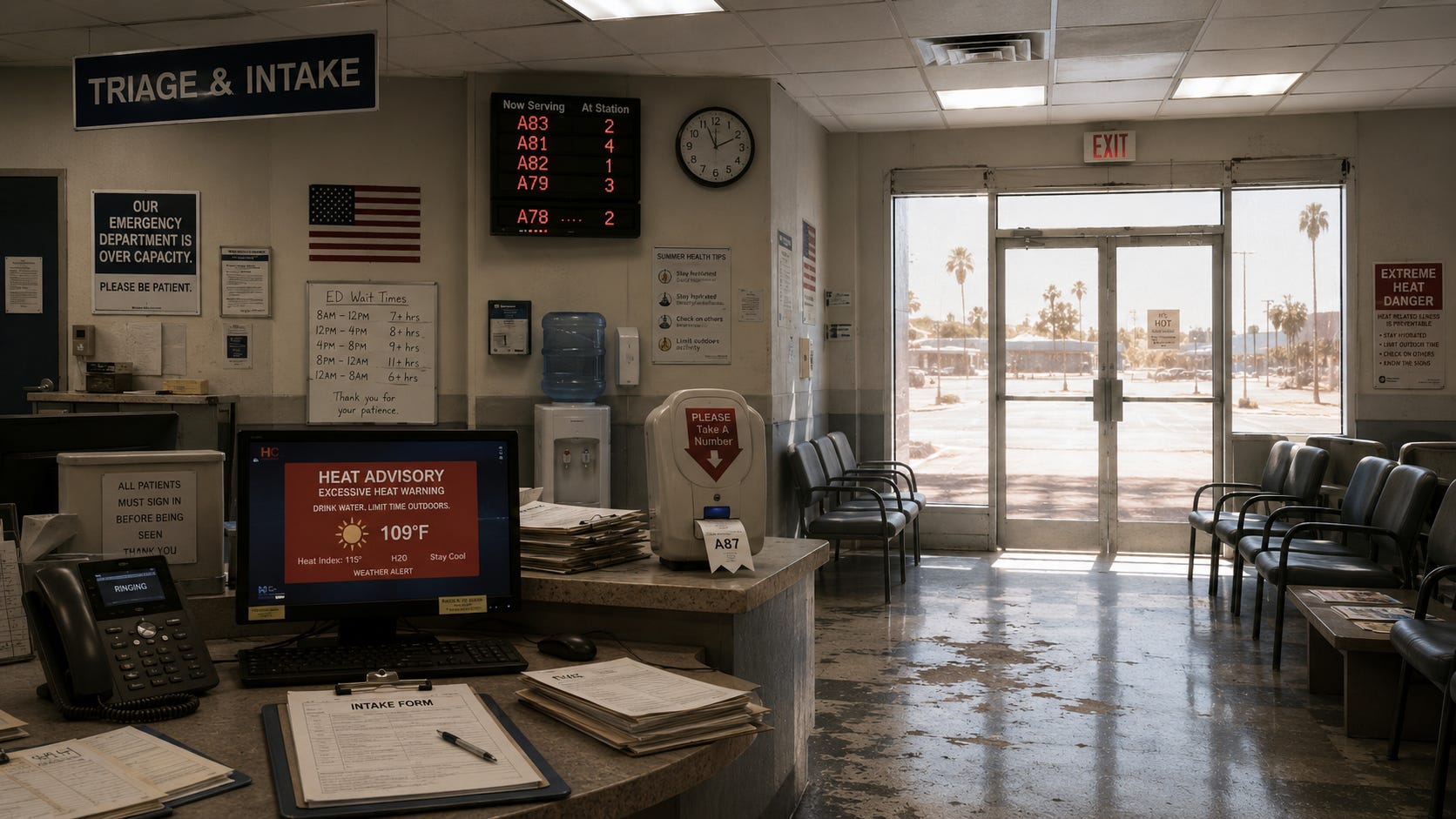
Healthcare. This is the triage desk of the republic, the room where slogans arrive with symptoms, ideology develops a fever, budget cuts start wheezing, climate policy shows up dizzy and dehydrated, vaccine politics walks in coughing, and the person behind the desk is still asking whether everyone has the proper paperwork.
Triage, in theory, is supposed to be a moral clarity machine. The sickest are seen first, need outranks convenience, danger outranks etiquette, and a person’s body makes the case before bureaucracy gets to decorate it. But American healthcare has always had a special gift for taking a simple human crisis and turning it into a scavenger hunt with co-pays. Now the triage desk has become something even stranger. It’s no longer merely deciding who is sickest. It is deciding who is worthy, compliant, ideologically acceptable, who worked enough hours, chose the right plan before the deadline, whose provider feels spiritually comfortable, and whose body can be persuaded to wait until the next enrollment period.
This week, the Trump administration moved religious freedom to the center of federal health policy, with HHS reorganizing its Office for Civil Rights so conscience and religious freedom are elevated within the agency’s enforcement structure. The Guardian reported that the shift is likely to affect reproductive healthcare, LGBTQ+ healthcare, and vaccine policy. Dorit Reiss, a professor at UC Law San Francisco, put it plainly: “They are very much putting religious freedom front and center.” She also warned that this version of religious freedom tends to privilege conservative Christianity and protect discrimination against LGBTQ people.
At the triage desk, this means the first question is no longer simply, “What do you need?” It becomes, “Does your need conflict with someone else’s conscience?” This is a neat little trick, because the patient is still the one bleeding, but the institution gets to faint. Healthcare becomes less a service than a feelings tribunal, one where the person seeking care is asked to wait while everyone else checks the spiritual weather.
Of course, conscience is a serious thing. Nobody needs a lecture on that, but in public healthcare, conscience can’t become the decorative gate around other people’s survival. A person with an ectopic pregnancy doesn’t need a theology symposium. A trans teenager doesn’t need a civil rights office that has wandered into the exam room carrying a clipboard and a suspicious amount of church bulletin energy. A parent trying to vaccinate a child doesn’t need public health policy rewritten as if preventable disease has been patiently waiting for its religious exemption paperwork to clear.
Then comes Medicaid, which is now being escorted to the desk and asked to prove it has been productive enough to deserve a bandage. Twenty-five Democratic-led states and the District of Columbia sued the Trump administration this week over Medicaid work requirement rules, arguing that the exemptions for sick people are too narrow and that the administration has veered from earlier guidance. The new rules require affected Medicaid enrollees to log 80 hours of work or approved activities each month, beginning no later than January 1, 2027.
There is something especially American about making people prove they are not too poor, too sick, too unstable, too rural, too overwhelmed, or too unlucky to navigate the system designed to decide whether they deserve care. The policy is sold as responsibility, which is a beautiful word, one of those words politicians hold up like a clean white towel. But the towel is usually covering a machine. And the machine is built to drop people.
KFF notes that the 2025 reconciliation law requires 44 states, including D.C., to condition Medicaid eligibility for certain adult enrollees on work requirements starting January 1, 2027. States will have to make policy decisions, upgrade systems, educate enrollees, train staff, and build the whole apparatus quickly. That sounds very orderly until you remember that many of the people affected are already living inside the kind of chaos that paperwork doesn’t politely wait for. They are working seasonal jobs, caring for relatives, managing chronic illness, sharing phones, missing mail, moving between addresses, trying to remember passwords, losing shifts, finding rides, and discovering that the online portal has once again decided to become a haunted object. Sometimes cruelty is a maze.
And then, because the country has apparently committed to irony as a governing philosophy, the administration also froze federal funding for New York’s Medicaid Fraud Control Unit, the very kind of unit meant to investigate and prosecute fraud in the Medicaid system. HHS accused the state of not producing enough criminal indictments and convictions, and the funding suspension is supposed to last at least through September 30. New York Attorney General Letitia James said her office has recovered more than $627 million for Medicaid and vowed to fight the decision.
So here we have the fraud portion of the program. Fraud is real, fraud should be investigated, and nobody needs to pretend otherwise. The Justice Department just announced a national healthcare fraud takedown involving 455 defendants, including 90 doctors and other licensed medical professionals, in alleged schemes tied to more than $6.5 billion in false claims. That’s an entire gilded ecosystem of people who looked at Medicare and Medicaid and saw not patients, not public trust, not fragile lives, but a buffet with no adult supervision.
But this is where the triage desk becomes political theater. Real fraud exists, and the administration still manages to use “fraud” as a fog machine. One moment it is charging providers and professionals in massive alleged schemes, which is necessary work. The next moment it is freezing funding for a state fraud unit while Medicaid recipients are being marched toward work verification systems that could knock eligible people out of coverage for administrative reasons. The fraudster in the mansion and the patient who missed a notice should not be starring in the same morality play. Yet somehow, under this kind of politics, everyone near Medicaid gets lit by the same suspicious fluorescent bulb.
Meanwhile, the Affordable Care Act marketplace is having its own quiet emergency, the kind that doesn’t always make good television because it happens at kitchen tables and on laptops and in the long pause after someone sees the premium. KFF estimates that average monthly effectuated ACA marketplace enrollment could fall to about 17.5 million people in 2026, and possibly as low as 16.5 million, down from 22.3 million in 2025. Premium payments from enrollees increased by an average of 58 percent, and average deductibles increased 37 percent to a record $3,786.
People are not simply paying more, they are trading down, choosing higher deductibles, dropping coverage, or making that most American of medical plans, which is hoping the body remains affordable until December. It is coverage in theory, care at a distance, and insurance as a laminated promise with a toll booth in front of it.
And because no modern healthcare story is complete without the wellness-industrial complex arriving in linen pants and carrying a syringe, FDA scientists are now raising concerns about a batch of trendy peptide therapies that Robert F. Kennedy Jr. supports loosening restrictions on. According to NPR reporting, FDA documents flagged limited evidence and potential safety issues for peptides including BPC-157, TB-500, and MOTs-C, even as an FDA panel is expected to consider easing access to them.
This is the other side of the same crumbling room. Traditional public health gets treated as tyranny. Vaccines get recast as coercion. Medicaid recipients get treated as suspects. But trendy injections marketed for recovery, metabolism, and optimization somehow glide toward the velvet rope. The wellness industry has discovered what politics learned long ago, which is that if you say “freedom” with enough confidence, many people will stop asking who profits when the guardrails come down.
Then measles walks into the waiting room. According to the CDC, as of June 25, there have been 2,134 confirmed measles cases in the United States in 2026, with 30 outbreaks reported and 93 percent of confirmed cases associated with outbreaks. Measles is a perfect little indictment because it doesn’t care about vibes. It doesn’t care whether someone feels brave on the internet. It doesn’t care whether a podcast host has discovered a new theory of immunity between mattress ads. Measles is old, fast, and rude. It was supposed to be a warning from the past, not a recurring guest in the future.
And outside, the heat keeps rising. The Midwest and Great Lakes are under dangerous heat, with the National Weather Service warning that heat index values have exceeded 100 degrees in some areas and that people without air conditioning face special risk for heat-related illness. This is where climate becomes unmistakably medical. Extreme heat is not only an environmental story. It is an emergency room story, a pregnancy story, a disability story, a senior-care story, a farmworker story, a utility-bill story, a medication story, a neighborhood story, and a story about whether the country can admit that weather is no longer just background scenery.
At the triage desk, climate arrives sweating through its shirt. Medicaid arrives with a stack of forms. ACA patients arrive holding coverage they can barely afford to use. Public health arrives with measles. LGBTQ patients arrive with their rights suddenly conditional on someone else’s doctrine. Fraud investigators arrive asking why the fire department is being punished for not producing the right kind of smoke. FDA scientists arrive with warnings while the wellness crowd asks whether the warning could be reformatted as a subscription service.
And behind the desk, the republic keeps asking the same question in different costumes. Are you worthy? That’s the sickness at the center of the room. The deeper sickness is the national habit of treating care as something people must morally earn while treating profit, power, and cruelty as administrative inevitabilities.
A humane system would ask who is in danger and move toward them. A broken system asks who can be blamed for needing help. A cruel system asks that question while calling itself reform. Every political abstraction eventually becomes a body in a chair.
This is why healthcare is the triage desk of the republic. It’s where the country’s arguments stop being arguments. It is where budgets, beliefs, court rulings, agency memos, climate denial, anti-government slogans, and campaign talking points finally take a number and sit under fluorescent lights, waiting to be called.
The smoke alarm is working, the patients are here, and the symptoms are visible. The only real question is whether anyone in charge still believes the sickest should be seen first.
Thank you for another great piece of writing.
I triage your writing to "highest value".