


Good morning! To the war-drunk grifters, oligarch media hobbyists, and discount strongmen currently treating the planet like their own private escape room, I hope you eat a little crow.
We begin in the Strait of Hormuz, where Donald Trump has decided that if reality refuses to flatter him, he will simply threaten it harder. Trump posted a snarling declaration that the United States would begin the process of blockading ships trying to enter or leave the strait, framing Iran’s mine threats and toll extortion as “WORLD EXTORTION” and promising that any Iranian who fired on U.S. forces or commercial shipping would be “BLOWN TO HELL,” with America “LOCKED AND LOADED.” The accompanying Fox interview did nothing to calm matters. Instead, Trump doubled down, saying the U.S. was “going to be blockading,” touting an “all in, all out” regime, and making clear that if Iran did not abandon its nuclear ambitions, he was prepared to inflict even more destruction.
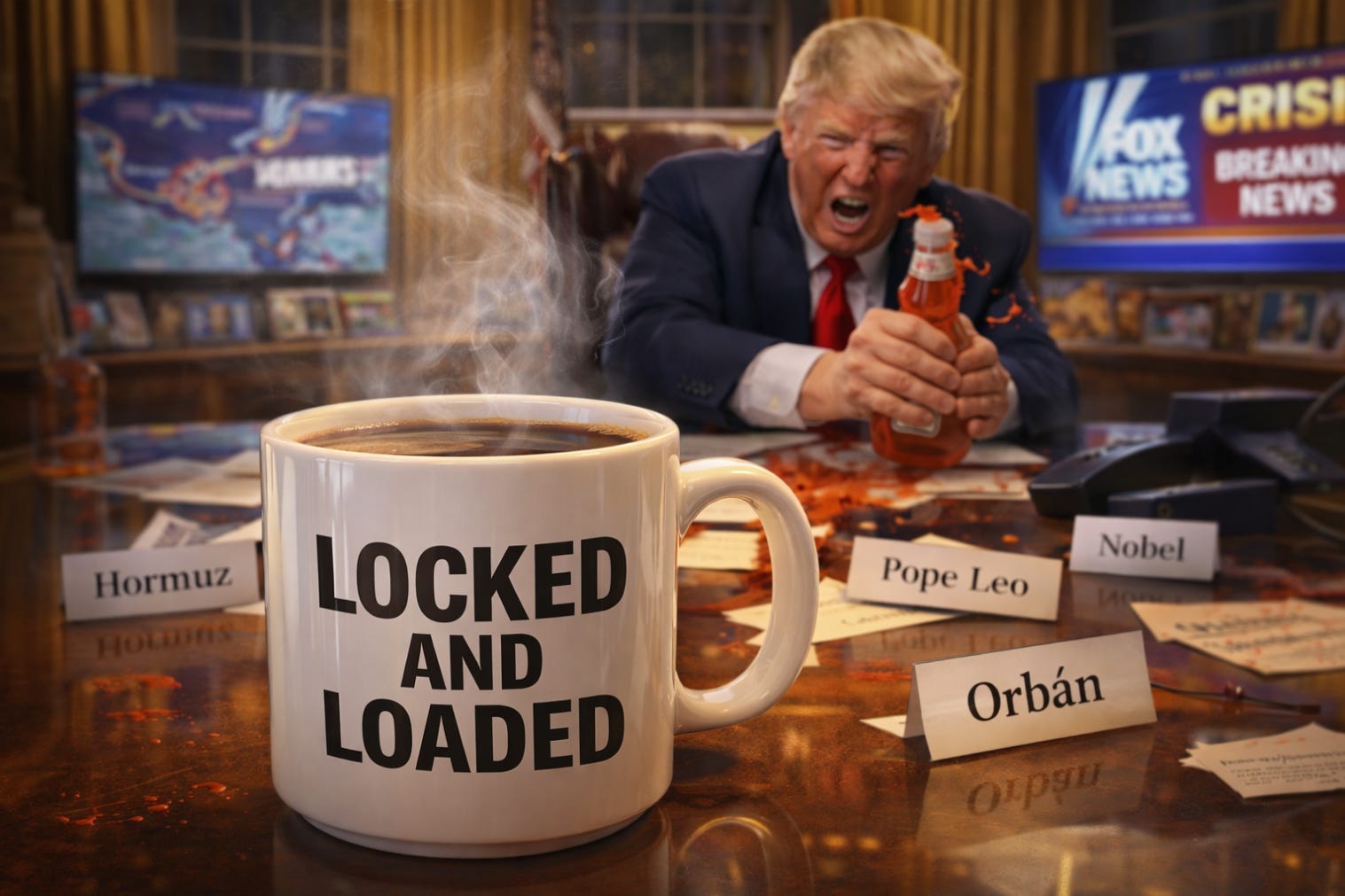
What makes this even more grotesque is how casually Trump discussed civilization-scale violence, as though he were rearranging tee times instead of threatening to blow up bridges, power plants, and whatever else wandered into his line of sight. In the same interview, he defended his earlier threat that “a whole civilization” could die, said he was “fine with it,” and openly vowed that if Iran did not give up its nuclear effort, he would “further destruct Iran.” He also boasted that Iran’s military was essentially gone, bragging that “their Navy is gone,” “their Air Force is gone,” and that the country had “no cards.” He sounds like a man lurching between campaign rally, mafia don, and cable-news call-in guest while holding the machinery of war.
Outside the MAGA terrarium, the view is rather less impressed. France 24’s assessment of the failed talks was blunt: neither side showed much urgency or willingness to compromise, oil prices still hit American consumers whether Trump understands that or not, and none of Washington’s allies are joining this blockade adventure, including Britain, which would prefer a diplomatic path. Their analyst offered what may be the cleanest diagnosis of U.S. leadership at the moment: a White House that tends to “observe its own reality.” That is such a devastatingly polite way of saying the people in charge are governing from inside a hallucination bubble.
Shipping analyst Sal Mercogliano came in with the sort of reality-based explanation that ought to be tattooed on the inside of every cable pundit’s eyelids. His point is that maritime logistics do not care about Trump’s all-caps swagger. You do not answer one illegal chokehold on the strait with another blockade and pretend you have restored order. Mercogliano notes that CENTCOM’s actual clarification is narrower than Trump’s bluster, focusing on traffic to and from Iranian ports rather than shutting the whole strait, which tells you the military itself is already sanding down the president’s social-media theater into something slightly less deranged. Still, he is crystal clear that blockading is a state-of-war act, and that the economic consequences are now hitting because the ships that should be arriving from the Gulf are simply not showing up. The administration planned for bombing runs, not for what happens when actual tankers vanish from the timetable and the global economy notices.
If that were not enough self-inflicted American absurdity for one morning, Pope Leo XIV has now become the latest person Trump assumed he could bully into submission. Instead, Leo responded with the sort of cool, devastating papal side-eye that makes Trump look like a man screaming at stained glass. After Trump attacked him as too liberal, “weak on crime,” and terrible on foreign policy, Leo said he had “no fear of the Trump administration” and then delivered one of the great understated burns of the year when asked about Truth Social: “It’s ironic, the name of the site itself. Say no more.” The Pope later made clear that he had “no intention to debate” Trump because he is “not a politician” and because his message is simply peace. Leo is trying to speak in moral terms about war, domination, and peace. Trump is trying to drag the Pope into a pro-wrestling promo.
The pushback from Catholic leadership was equally blunt. Archbishop Paul Coakley reminded the public that “Pope Leo is not his rival; nor is the Pope a politician.” Which is about as close as the Church comes to saying: sir, this is a cathedral, not a Fox green room. Trump appears incapable of processing moral criticism except as a personal political insult. While Leo speaks from theology, conscience, and actual seriousness, Trump retaliates with grievance, insult, and full-on AI messiah cosplay, posting a lurid image of himself in white robes and a red mantle, laying glowing hands on a stricken man as onlookers gaze up admiringly beneath an American flag, the Statue of Liberty, and bursts of celestial fireworks. It is hard to imagine a more perfect contrast between authority and ego, or between adulthood and whatever flaming circus of narcissism Trump has mistaken for leadership.
Elsewhere in the authoritarian humiliation department, Viktor Orbán has now been booted from power in Hungary, and the American right is left clutching its pearls, campaign brochures, and probably a few half-finished CPAC lanyards. The significance here goes well beyond Budapest. Orbán was the MAGA movement’s favorite European strongman, the poster child for how to hollow out democracy while keeping the branding, and Trump’s people were so invested in saving him that JD Vance reportedly traveled to Hungary during the Iran crisis to campaign for him. Orbán lost anyway. As the Associated Press notes, this is a very public humiliation for Trump and the U.S. right, who treated Orbán as a model for how to bend media, courts, and elections without ever admitting that democracy had become mostly decorative.
The most delicious part: even after sixteen years of packing institutions, bending the rules, and tilting the field, Orbán still got beaten. The AP quotes Steven Levitsky observing that oppositions can win despite a tilted playing field, and Ian Bassin adds the crucial takeaway for Americans: even a guy who rigs the system can be defeated when people unite and turn out against him. That is a warning flare aimed directly at every would-be American autocrat currently doodling executive fantasies in the margins.
The international meaning is just as important. Orbán was Putin’s best friend inside Europe and a major obstacle to aid for Ukraine, so his fall is a setback not only for Trumpism but for the broader pro-authoritarian, anti-Ukraine bloc. Which makes the next bit of symbolism especially rich: a University of Oslo professor has publicly said he nominated Volodymyr Zelenskyy and the Ukrainian people for the 2026 Nobel Peace Prize, a gesture Trump and his little grievance fraternity will absolutely hate. Against that backdrop, the image sharpens beautifully: Orbán, the darling of the illiberal right, loses. Ukraine, the target of that same right’s cynicism, sabotage, and endless bad-faith sneering, continues to stand as the democratic counterexample. It is the sort of contrast that makes the ketchup tremble in the bottle.
If you have been wondering why so much of corporate media feels weirdly flattened, timid, or selectively blind, Al Jazeera’s Listening Post offered a brutal summary. The program argues American media is not merely struggling; it is being concentrated and captured by oligarchs who do not buy outlets to defend democracy, but to defend power. The show cites the extraordinary fact that more than half of traffic to major U.S. news sites last year went to outlets controlled by just seven families or their corporate entities. Instead of a healthy press ecosystem, we have a national information system being slowly turned into a billionaire petting zoo.
Their examples are not subtle. Jeff Bezos is presented as the case study in slow-motion capture: the owner who first “used his fortune to swoop in and rescue” the Washington Post, then later changed course, ordered the editorial board to focus on “personal liberties and free markets,” and presided over what the program describes as a newsroom “bloodbath.” One commentator lands the point perfectly, saying the message sent to the newsroom is that it now has “an audience of two, Jeff Bezos and Donald Trump,” which is not, last I checked, the same thing as the public. Another puts it even more bluntly: “They call it a reset. Looks more like a retreat to me.”
The segment turns to CBS and the Ellison family, portraying their moves as even more openly ideological. The point is not just that rich people own media. It is that, as the program says, these oligarchic owners often have “much larger businesses,” including in some cases “defense contracts, billion-dollar contracts that have nothing to do with news,” so when journalism becomes inconvenient, it is the journalism that gets trimmed. At CBS, the segment says the Ellisons “quickly installed Barry Weiss,” even though she had “exactly zero experience working in television news,” and the result was immediate: “CBS News suddenly look at 60 Minutes as not an independent journalistic bulwark of truth … and suddenly it’s got some fear in favor.” Weiss, we are told, has brought in commentators “virtually all of them conservative, pro-Israel, and pro-Iran war,” while “redrawing the lines of what falls in the 40 yard lines of acceptable debate.” Legacy institutions get remade into something more compliant, more pro-war, and more accommodating of concentrated power. The “observes its own reality” White House does not operate in a vacuum. It is helped along by a media class increasingly owned by people who would rather manage access than confront power.
Finally, one developing Epstein-related subplot is worth watching carefully, but carefully is the key word. Survivor Amanda Ungaro has posted ominous warnings on social media directed at Melania Trump and Pam Bondi, and Allison Gill raised the possibility that those posts may help explain why Melania suddenly chose to drag the Epstein story back into the open with that strange White House statement denying ties and urging hearings. Gill is explicit that there is no confirmation that Ungaro’s posts triggered Melania’s move. Still, the timing is suspicious enough to be notable, especially now that the question hanging over Melania’s statement remains so obvious: why now? Why, when the story had cooled, did the first lady suddenly leap into the spotlight to deny things that had not been dominating headlines that week? It doesn’t prove anything, but it does suggest somebody in that household may know another shoe is wobbling on the ledge.
Marz and I continue our nightly moonbeam vigils and hold you all in our thoughts. Even as Trump’s handlers do their best to shield him from public view, with even his state meeting with the King and Queen of the Kingdom of the Netherlands reportedly closed to the press, the stakes remain as high as ever. A shuttered room does not make the danger disappear; it only makes the evasion more obvious. So this is the moment to keep the pressure squarely on Congress, which still has both the authority and the obligation to rein in Trump’s war before more damage is done. They cannot keep outsourcing their courage while the rest of the world absorbs the shockwaves.
Love and gratitude for your brilliant truth telling courage!
"a national information system being slowly turned into a billionaire petting zoo." Beautiful!