

Good morning! Well, so much for the Nobel Peace Prize tour. The man who once lamented that he hadn’t yet received his Oslo invite has instead managed to trigger the most destabilizing chain reaction in global politics since the oil shocks of the 1970s, and we are three days in.
Let’s take stock of the “peace through strength” strategy currently unfolding. Over the weekend, the United States and Israel launched a joint air campaign that killed Iran’s supreme leader and struck more than a thousand targets. The administration insists this is not Iraq, not endless, not utopian. Defense Secretary Pete Hegseth stood at the Pentagon podium this morning and assured the nation that we didn’t start this war, we are “finishing it.” That’s comforting. It’s always nice when someone declares they’re finishing a war that did not previously involve open combat between the two countries.
Trump, meanwhile, has offered a rotating buffet of endgames. Perhaps Iran’s elite military will lay down their arms and hand power to the people in a spontaneous national kumbaya. Or maybe it will be a Venezuela-style decapitation strike where everyone keeps their job except the guy at the top. Better yet, there maybe, possibly, might be “three very good choices” for leadership already waiting in the wings. Or perhaps the Iranian people will rise up, but not right now, because bombs are falling and they should stay indoors.
It’s less a strategy than a choose-your-own-adventure novel and while Washington improvises its next few chapters, the rest of the world is doing math. Brent crude surged as much as 13% when markets opened. European gas prices spiked nearly 40%. Shipping through the Strait of Hormuz, the narrow artery through which roughly a fifth of the world’s oil flows, has slowed to a standstill. Qatar halted LNG production after strikes near its facilities. Saudi Arabia shut down refinery operations as a precaution. Tankers are stacking up at sea like a geopolitical traffic jam. I’ve written a thorough analysis into the ramifications for the energy sector that will be published here tomorrow.
This is the part that tends to get left out of late-night Truth Social declarations. Military strikes are kinetic. Energy markets are systemic. When you set one off, the other responds automatically. Inflation doesn’t care about bravado, and mortgage rates don’t salute.
While the White House insists this will be “four to five weeks” if necessary, no big deal, we have “tremendous amounts of ammunition stored all over the world,” Europe is quietly making its own adjustments. France just announced a doctrine of “forward deterrence,” offering for the first time to station elements of its nuclear force abroad in Europe. That’s not because Emmanuel Macron woke up nostalgic for the Cold War aesthetic. It’s because European capitals are recalibrating against both Russian aggression and growing doubts about the stability of American security guarantees.
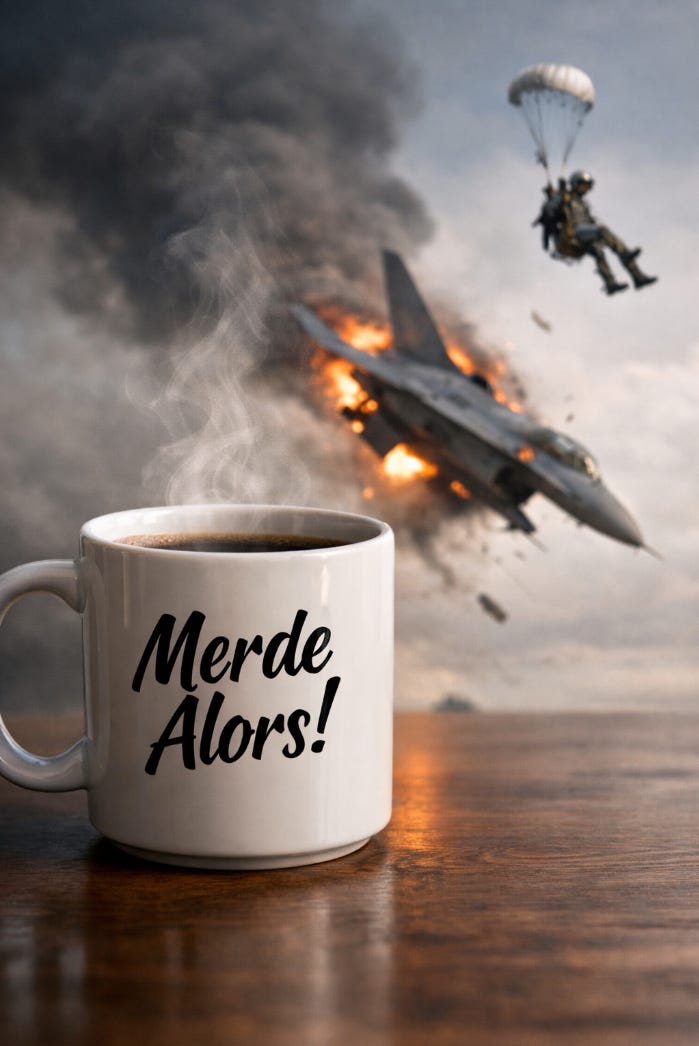
Emmanuel Macron signaled that France is prepared, for the first time, to temporarily station elements of its nuclear force outside French territory. Not permanently and not jointly controlled, and Paris is very clear that the decision button remains French and French alone. But the mere willingness to move warheads abroad, to deepen strategic coordination with Germany, Poland, the Netherlands, Sweden and others, is a tectonic shift.
France has always guarded its nuclear arsenal like a family heirloom. Strategic autonomy is practically a national religion. The fact that Macron is now openly discussing forward deployment tells you something fundamental has changed.
Officially, this is about Russia’s invasion of Ukraine and doubts about long-term American commitment to European security. Unofficially and inevitably, it is also about volatility.
When the United States launches a major war in the Middle East without a clearly articulated end state, European capitals don’t just watch. They hedge.
Forward deterrence is not Europe preparing to start World War III. It is Europe preparing for uncertainty.
Here’s the irony layered on top of irony: a conflict supposedly aimed at restoring stability and deterrence in the Middle East has now prompted a nuclear posture rethink in Europe.
It’s ripple effect. Russia will notice. China will notice. Every intelligence service on earth will notice. When nuclear doctrine begins to move, even subtly, it means strategic confidence is eroding somewhere. That is the real story here.
Congress is scrambling to rediscover the Constitution. Democrats are demanding a war powers vote after the strikes are already underway, always an inspiring display of legislative timing. Republicans are largely unified in public, though cracks are forming within the MAGA coalition that was promised an end to “forever wars,” not a new one. Tucker Carlson is reportedly furious. Some of the loudest “America First” voices are wondering how “no more endless wars” became “Operation Epic Fury.”
The irony is almost too neat. Trump who once warned that a weak leader would “start a war with Iran” because he had “no ability to negotiate” is now presiding over a widening regional war, rising U.S. casualties, and an energy shock that could ripple through global markets for weeks.
Over the weekend, Americans saw him twice. Once at 2:30 in the morning. Then again in a pre-recorded statement acknowledging the first U.S. fatalities. No Oval Office address or comprehensive explanation of objectives, and no detailed articulation of what success looks like. Just fragments, phone calls with handpicked reporters, shifting descriptions of endgames, and a steady insistence that everything is going according to plan.
Three American service members were initially confirmed killed. Then a fourth.
“War is hell,” Defense Secretary Pete Hegseth said at the Pentagon podium, as if reading out a traffic advisory. Trump acknowledged that more casualties are likely. “That’s the way it is,” he shrugged.
Even allies are noticing the improvisation. One foreign correspondent put it bluntly: the American public was not prepared for this war “in any way.” The justifications appear fluid, and the timeline elastic with shifting objectives. Even Senator Lindsey Graham, when asked whether there is a plan for what comes next, essentially responded: it’s not our job to own it.
The central problem appears to be no clearly articulated long-term strategic framework guiding what happens after the bombing.
Is the objective deterrence? Regime collapse? Nuclear rollback? Proxy suppression? Internal uprising? A negotiated settlement after a show of force? A Venezuela-style decapitation? A spontaneous civic awakening under falling bombs? All the above? None of the above?
Unpredictability in nuclear geopolitics is a liability. When end states shift depending on the interview, adversaries assume maximal intent. Markets assume prolonged instability. Allies assume unpredictability. That’s how conflicts widen.
Energy infrastructure is being targeted across the Gulf. Hezbollah has opened a northern front against Israel. Iranian drones have reached as far as a British base in Cyprus. Tanker insurance markets are pulling back, and investors are piling into gold. Airlines are tumbling while defense stocks are soaring. The global system is reacting faster than the White House can refine its messaging.
Through it all, Trump has largely avoided sustained public engagement aside from a Medal of Honor ceremony later today and a handful of selective phone calls he has retreated from public view. For a man who thrives on spectacle, the silence is conspicuous.
There is a pattern here. A belief that decisive force can reset the board quickly, and that boldness substitutes for architecture, or that geopolitical 52-card pickup might somehow arrange itself into a winning hand. When energy chokepoints, alliance structures, nuclear doctrine, domestic political fractures, and regional proxy networks all begin moving at once, the margin for improvisation shrinks rapidly.
Kiss that Nobel Prize goodbye!
“Geopolitical 52 card pickup”
That’s a great visual for the latest mess created by rump.
"A belief that ... geopolitical 52-card pickup might somehow arrange itself into a winning hand" is about as good a description of Trump's foreign policy and his decision to start a war with Iran (prompted by Israel and Saudi Arabia) as there is.