

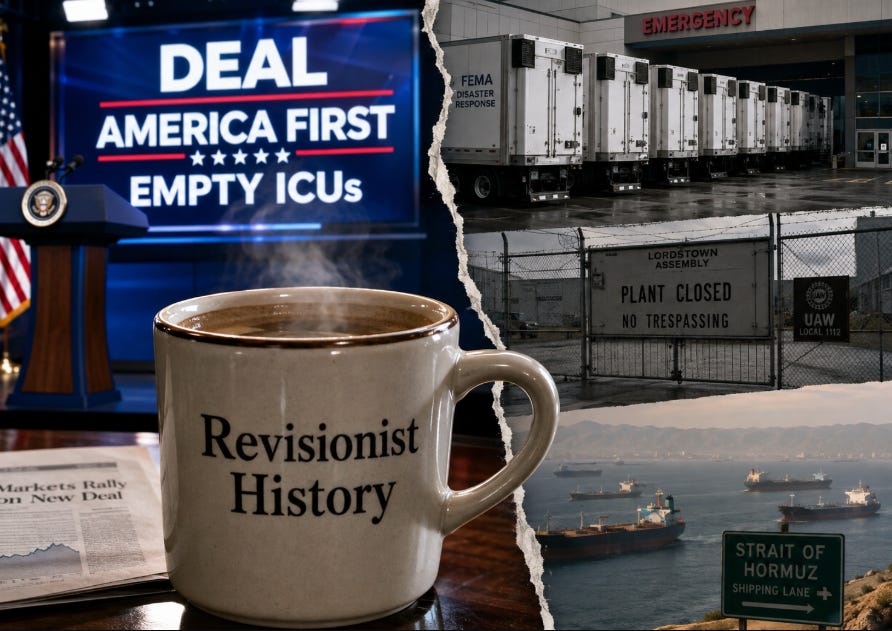
Good morning! Welcome to Monday, when Trump has once again announced a diplomatic breakthrough that the other country involved appears not to have heard about. Pour the coffee, we are negotiating with ourselves again.
Donald Trump announced over the weekend that he had cancelled a planned “massive attack” on Iran after securing the “parameters” of a deal. Negotiations, he said, would begin Monday. An agreement was imminent.
Monday has now arrived, and Iran says there are no negotiations with the United States, no plans to send a delegation and no plans to receive an American one. The talks that are actually taking place are between Iran and Oman over a possible temporary shipping route through the Strait of Hormuz.
Perhaps the American delegation is stuck in traffic, or the Iranians forgot to check Truth Social. Perhaps diplomacy has finally evolved beyond the tiresome historical requirement that both parties know it is occurring.
There may, of course, be indirect messages moving through Pakistan, Qatar or other intermediaries. Governments communicate through back channels all the time. But messages passed through mediators are not the same thing as formal negotiations beginning Monday, and they certainly do not establish the existence of agreed “parameters” for a peace deal.
Trump’s story is that American military might brought Iran scrambling to the negotiating table. The available reporting describes a rather different weekend. Al Jazeera’s Alan Fisher reports that Saudi Arabia’s crown prince and other regional officials made a series of calls urging Washington to rethink its strategy, after which Trump called off the strike. Fisher noted that nobody seems entirely sure what Trump means by the “parameters of a deal,” a phrase that has all the structural integrity of a Mar-a-Lago cocktail napkin.
Iran may have welcomed the cancellation of an American attack. Gulf allies may have pressured Trump to step away from another round of escalation. Oman may be making progress on a maritime arrangement. None of those things means Iran agreed to negotiate with the United States on Monday.
There is an increasingly noticeable rhythm to these announcements. Analyst Negar Mortazavi observed that talk of imminent deals and military pauses has repeatedly arrived just before financial markets reopen after a weekend. The sequence is becoming familiar: threaten an enormous attack, allow oil markets to spend two days contemplating Armageddon, then announce an undefined breakthrough before the opening bell.
No one should confuse that observation with proof of motive. It is, however, a curious pattern for a president who conducts foreign policy as though the Strait of Hormuz were a volatile meme stock.
The Pentagon has signed a new framework agreement with Lockheed Martin and Northrop Grumman to expand production of missile-interceptor components. The Pentagon did not disclose the value. The announcement arrived alongside reports that American weapons stockpiles have been depleted by the wars in Ukraine and Iran.
That does not prove Trump cancelled the attack because the United States is running short of the weapons required to sustain it. It does mean we should resist his preferred account in which an entirely unconstrained military machine stood poised to deliver unprecedented destruction until Iran begged for mercy and handed him a peace deal.
At present, the confirmed accomplishment is that the United States did not launch another attack.
Calling off an attack is not the same as securing peace. Talks between Iran and Oman do not amount to negotiations between Tehran and Washington, and a threat Trump ultimately abandoned does not prove his strategy succeeded. Sometimes a cancelled disaster is simply a cancelled disaster.
The distance between Trump’s slogans and observable reality is even shorter in Eastlake, Ohio, where the last shift at the Conn Selmer brass-instrument factory ended on June 30.
On April 9, Conn Selmer filed a formal WARN notice with the state of Ohio announcing that all 150 workers at the plant would be terminated when the facility closed. The company blamed repeated annual losses and an inability to compete with manufacturers in Asia.
It sounds like the familiar obituary of American manufacturing: foreign competition arrived, losses mounted, and management reluctantly accepted the inevitable. Then John Paulson enters the story, carrying the autopsy report and a shovel.
Paulson is the hedge-fund billionaire, Trump adviser, and major fundraiser who publicly declared in 2024 that America could not allow its producers to close domestic factories and offshore their work. His investment firm owns Steinway Musical Instruments, Conn Selmer’s parent company. Paulson’s company then closed the 61-year-old union factory in Eastlake, moved professional French-horn production to a nonunion plant in Indiana and sent much of the remaining work to China.
“We can’t have American producers closing American factories and offshoring,” Paulson had said.
The company’s stated explanation was that losses forced the move. The union’s account complicates that chronology. Workers said Conn Selmer had already begun building a $21 million manufacturing facility in China in 2024, opened it in 2025 and gradually transferred parts of the Eastlake workload there despite assurances that the new facility would not affect Ohio production.
Whatever the full history of Conn Selmer’s losses, the Chinese replacement was not hastily assembled after the April WARN notice revealed a sudden emergency. The infrastructure required to receive the work was already being built while Paulson was publicly denouncing the very practice his company was preparing to undertake. America First is a customer-facing slogan rather than an internal operating requirement.
Representatives Shontel Brown and Ro Khanna led a congressional letter to the secretaries of commerce and labor on April 9, asking the administration to respond to the closure and the offshoring of highly skilled union jobs. They noted that Eastlake workers had spent more than six decades building the company into the largest American manufacturer of band and orchestral instruments.
Trump did not need a new tariff schedule, an executive order, or another stadium speech about reclaiming America’s industrial destiny. He needed to call one of his own allies and tell him that moving these jobs to China was unacceptable. The call either never came or did not matter.
Trump imposes costs at the border and calls them patriotism, while the billionaires standing beside him preserve their private exits. Workers are expected to absorb the tariffs, believe the speeches and demonstrate national loyalty. Owners remain free to relocate production whenever the spreadsheet points east. It is the toll-booth presidency in miniature. Trump offered the workers a villain while his donor took the factory.
Robert F. Kennedy Jr. is not merely getting the pandemic wrong.
He is constructing a replacement history in which Trump bears no responsibility, Anthony Fauci controlled powers he never possessed, overwhelmed hospitals become empty rooms and the public-health response, not the virus, is remembered as the true catastrophe.
Kennedy delivered this history Sunday during a contentious interview with CNN’s Dana Bash. He said the United States had experienced “the worst outcome of any country in the world” and had “the highest death rate from COVID of any nation on Earth.”
It did not.
Johns Hopkins University’s mortality data placed Peru, Bulgaria, Hungary, Bosnia and Herzegovina, North Macedonia and several other countries above the United States in cumulative reported deaths relative to population. Different reporting systems and definitions complicate international comparisons, but they do not transform Kennedy’s false claim into a true one.
When Bash pointed out that other countries had higher rates, Kennedy performed the familiar maneuver in which a statement remains accurate even after its central assertion has been disproved. He had said America had the highest death rate. Other countries had higher death rates. He nevertheless continued speaking as though the disagreement concerned interpretation rather than the ordinary meaning of the word “highest.”
Kennedy then blamed Fauci for the lockdowns.
Fauci was an adviser. He could recommend, warn and argue. He did not possess the legal authority to close a church, a school, a restaurant or a state. Governors issued those orders under powers held by state governments. Trump was president, Fauci worked inside his administration, and the United States passed 400,000 reported COVID deaths on January 18, 2021, two days before Trump left office.
Kennedy also claimed that intensive-care units were empty “all over the country,” including in New York at the height of the pandemic.
New York City’s hospitals and permanent morgues were so overwhelmed in March 2020 that FEMA sent 85 refrigerated trailers to hold the dead. Hospital workers in protective equipment wheeled bodies into temporary morgues because the existing system could not accommodate them.
Those trucks were not conceptual. They were not the output of a computer model or a disputed public-health projection. They sat outside hospitals containing human remains.
Kennedy is asking the country to accept that the intensive-care units were empty while the morgues overflowed.
The vaccines present another obstacle to the replacement history. Estimates vary according to the time period and model used, as estimates necessarily do, but their lifesaving effect is not seriously in doubt. One analysis estimated that the American vaccination program prevented approximately 1.1 million deaths by November 2021. NIH has cited an estimate of roughly 2.4 million lives saved by March 2022.
That does not mean every pandemic policy was wise. It does not mean officials never made errors, recommendations never changed or authorities never exceeded what hindsight would now consider prudent. Public-health decisions were made during a fast-moving emergency with incomplete information, uneven evidence and enormous consequences.
Those failures deserve examination, but examination is not what Kennedy is doing.
Taken individually, his statements can be presented as errors, exaggerations or the usual debris surrounding a hostile television interview. Taken together, they form a political narrative.
Trump wanted to liberate the country. Fauci prevented him.
Governors disappear from the chain of authority. Trump’s presidency disappears from the chronology. Refrigerated morgue trucks disappear from New York. The vaccines disappear as a lifesaving intervention. The dead remain only as evidence that public health failed.
The virus becomes almost incidental to the story of the pandemic.
A complicated national catastrophe involving federal agencies, governors, hospitals, socioeconomic inequality, chronic illness, political polarization, vaccine refusal, and an erratic president is reduced to the malevolence of one government scientist.
One villain is easier to prosecute than a history.
Regular readers will recognize the shape. This is the maneuver dissected here yesterday: Trump is the hero of the story, never its author. What’s new this morning is the delivery mechanism: MS NOW put a name and a data set to each individual falsehood.
On MS NOW Monday morning, Dr. Omer Awan supplied the factual spine. America did not have the world’s highest per-capita death rate. The intensive-care crisis was real. The morgue trucks were real. Governors ordered lockdowns. Vaccination saved lives.
Financial Times national editor Edward Luce then supplied the blunt verdict, calling Kennedy a “nutjob,” a “quack” and a man who “shouldn’t be local dog catcher,” much less run the Department of Health and Human Services.
The language was satisfying, but Luce’s more consequential point was institutional. Congress hauled Anthony Fauci back for another hearing last week, where he repeatedly invoked the Fifth Amendment, while failing to subject the sitting health secretary to comparable scrutiny about the country’s current measles outbreak or its preparation for the next pandemic. Fauci is retired. Kennedy is exercising power now.
Congress always has time for another séance with the designated demon. Oversight of the man currently running federal public health is apparently more difficult to fit into the schedule.
David French identified the larger danger. America already suffers from an enormous amount of civic ignorance, amplified by sealed media environments in which propaganda about vaccines, government and the medical establishment circulates without meaningful correction. Kennedy, French said, could take the country from “civic ignorance into civic idiocy.”
Civic ignorance is not knowing that Fauci lacked the legal authority to close a school. Civic idiocy is appointing a health secretary who depends upon the public never learning that fact.
The revisionism does important work in the present. If Fauci single-handedly caused the catastrophe, then dismantling the institutions associated with him becomes accountability. If vaccines failed, weakening vaccine policy becomes prudence. If the hospitals were empty, future warnings of overwhelmed medical systems can be dismissed as another attempt to frighten and control the public. If public-health intervention caused more damage than the pathogen, then the next government response should be slower, weaker and easier for political leaders to override.
Memory becomes public-health infrastructure. A society that remembers the last emergency accurately can recognize warning signs, preserve successful tools, and correct genuine failures. A society taught a fabricated history will prepare for the wrong dangers, distrust the people sounding alarms, and repeat mistakes it has reclassified as victories.
Kennedy’s account is more dangerous than an ordinary lie. He is not simply denying what Americans saw. He is assigning new moral roles to everyone involved.
The president who held power becomes the helpless resistance. The man now responsible for preparing the United States for another pandemic becomes the heroic custodian of lessons that never happened.
Kennedy is not trying to understand the last pandemic. He is trying to clear the political ground for mishandling the next one.
Perhaps unrelated: I received a phone call at dinner time last night from my brother, Beebo, who is in the throes of dementia, though loath to admit it. (Understandably.) He reported that he took 'the test' and scored perfectly. Sounded all too familiar to me. The good news is that Beebo lacks access to the nuclear codes.
I found the part about Conn Selmer very interesting. Both those companies originated in my home town of Elkhart, Indiana, once known as the band instrument capital of the world. Many people in Elkhart spent their working lives making musical instruments. Then the competition arrived and gradually Elkhart lost its factories making all sorts of things. Elkhart became the poster child for these kinds of losses. Obama visited Elkhart at least once. Elkhart County is not D friendly. Today I see the same destruction happening caused by billionaires who probably would like to have slave labor. Then we have the fights over data centers including one here in Salem. The governor took the state property off the board, but the data center company still can deal with people who own private parcels, including a company from Indiana.