


What keeps happening now, over and over, is that the White House can still control records, limit disclosure, curate camera angles, and flood the zone with loyalist noise, but it is having a harder and harder time controlling the one thing that matters most: the spectacle of Donald Trump in public for long stretches of time. No one outside his medical team can responsibly diagnose him from clips, transcripts, or cabinet-room wanderings. It is also true that ordinary viewers are not hallucinating when they notice a pattern: the repetition, the drift, the inability to hold a coherent thread, the constant collapse from policy into fixation, grievance, and trivia. The concern is no longer built only from rumor or whispered palace intrigue. It is built from performance.
I give you the Sharpie moment. A president in the middle of a national-security event, with war, NATO, oil chokepoints, and global escalation supposedly on the table, suddenly disappears into a meandering monologue about government pens, expensive pens, bad pens, good pens, Sharpies, how kids were getting thousand-dollar pens, how the pens did not write, how he personally negotiated the superior pen deal, and how all of this somehow reflected his genius as a steward of public money. Trump has always rambled. What felt different here was the texture of the ramble. It was not merely loose; it was compulsive, repetitive, detached from context, and delivered with the same manic insistence as his war talk, as if the fate of the republic and the quality of office supplies were all one uninterrupted stream of presidential consciousness. It is precisely the kind of public degradation that no physician’s letter can fully override once millions of people have seen it with their own eyes.
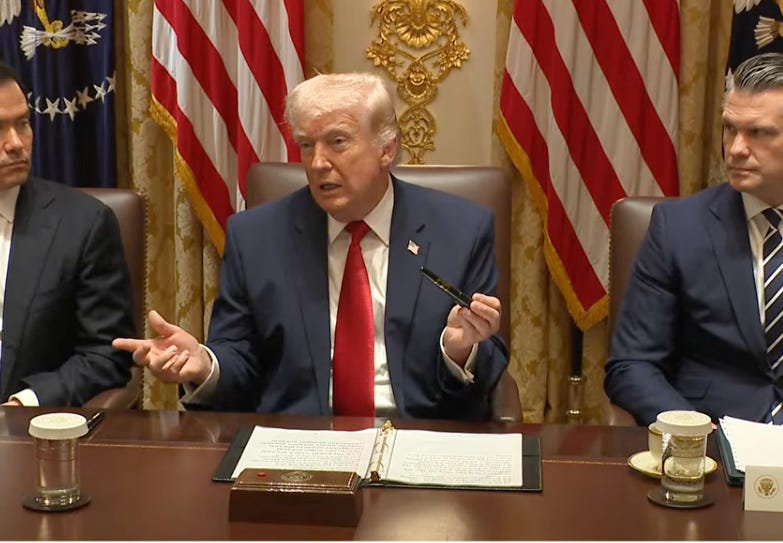
The entire cabinet meeting unfolded like an empire in late-stage delusion trying to produce its own highlight reel before the walls close in. Trump’s basic message on Iran was that everything had been crushed, everyone was begging him for peace, and he might continue bombing anyway because, in his telling, peace is something you establish by acting like the villain in an action movie who has confused terror with leverage. He insisted, “They are begging to work out a deal,” then immediately undercut any notion of restraint by adding, “I don’t know if we’re willing to do that,” and later, even more bluntly, “We have other targets we want to hit before we leave.” That is a man trying to sound both indispensable and unhinged at the same time.
He boasted that Iran’s navy was gone, its air force was gone, its missiles were mostly gone, its leadership was gone, its factories were getting destroyed, and its ability to retaliate was evaporating. “The Air Force is gone,” he declared. “Their antiaircraft and communications capability totally dismantled.” “All of their leadership is gone. The first level is gone and they are all gone.” He called the bombing run “one of the great air raids in history, maybe the greatest,” and bragged that “every single bomb hit its mark and obliterated that place.” It was the usual Trump blend of chest-thumping and cinematic self-mythology, as though war were not a matter of consequences and escalation but a simple branding opportunity for a man who thinks every crisis is improved by louder adjectives.
He described the Iranians in the language of obsession and pathology, as “sick people” and “sinister sick people,” because this administration has now fully substituted cartoon psychology for diplomacy. “Because they did not make a deal and because they are sick people,” he said. “They are sinister sick people.” It is a man reducing an entire geopolitical crisis to a tabloid morality play, flattening strategy into insult because insult is the one instrument he trusts.
Trump framed the whole war as proof that all previous presidents were cowards or fools and that only he had the strength to stop a nuclear nightmare. “Every president for 47 years, every president should’ve done this,” he said. He attacked Obama for having “gave them the Iran nuclear deal, free will toward a nuclear weapon,” bragged, “I terminated the deal,” and warned that if he had not, “you would’ve had a nuclear weapon years ago and it would’ve been used, I guarantee.” But the real problem with that story was captured perfectly in an LBC radio exchange that followed. Host Tom Swarbrick cut straight to the contradiction: if the deal now being floated includes things like reopening Hormuz and renewed monitoring of Iran’s nuclear program, then “these are the things that existed prior to this war.” And then he asked the obvious question: “Are we going back to the things that Donald Trump ripped up like the JCPOA that he got rid of in his first term and we’ve just had to have a war and lots of people die in order to get us back to where we were?” Correspondent Simon Marks agreed, saying that “all sorts of elements in that 15-point plan contain fresh questions about the president’s own credibility.” That is the heart of it. After years of swaggering about destroying Obama’s framework, Trump now appears to be bombing and bluffing his way back toward a worse, bloodier version of the very constraints he once trashed and presenting that as strength instead of catastrophic/kakistrophic, ego-driven stupidity.
Then came the “big present” story, Trump’s bizarre maritime fairy tale about Iran supposedly signaling sincerity by allowing “eight big boats of oil” through Hormuz, then perhaps ten, Pakistani-flagged, gliding nobly through the middle of the strait as though Poseidon himself had signed onto the peace framework. As maritime analyst Sal Mercogliano patiently laid out, the shipping data do not support Trump’s version of events. The monitored traffic over those days showed a much smaller and more muddled set of tanker movements than the cinematic convoy Trump described, and the vessels identified did not line up with his tale of a triumphant flotilla proving that the right people were finally dealing with him. Trump was narrating some trailer in his head, not the actual shipping log. It suggests a president operating on impression, spectacle, and fragments rather than on clean operational understanding. If he cannot reliably describe what happened with a handful of boats in a narrow waterway that has become central to global energy risk, one begins to wonder what exactly he is taking away from these daily briefings besides mood, applause lines, and a few memorable images.
That question looks even uglier in light of what we now know about the administration’s appetite for turning war into content. The White House has been publicly posting Iran-war videos that splice apparent strike footage with clips from movies, sports, cartoons, and video games, defending the practice as a way of “showcasing” military success. Trump himself has publicly posted surveillance-style footage he said showed U.S. strikes on Iran’s Kharg Island. So the public-facing architecture is already there: as a memeified sizzle reel built for engagement, virality, and emotional gratification. Reporting last week said Tulsi Gabbard had explored reshaping Trump’s intelligence briefings into a Fox-style video format tailored to his preferences, complete with maps, graphics, and more visual presentation, though that reporting was disputed by administration officials. Clearly, we cannot prove he is literally being shown daily “snuff films” of bombs hitting targets. The administration has already normalized the packaging of war as entertainment, and it has already been reported that Trump’s information diet may be getting tailored into television-ready visual form because he does not like traditional briefing materials. Once you know that, the “eight big boats” hallucination stops looking random and starts looking like what happens when a president absorbs the montage and mistakes it for mastery.
Even the room itself ratted them out. One of the sharpest observations from the British side came from Simon Marks, LBC’s Washington correspondent, who said this cabinet meeting was dominated by “paid propagandists” from friendly publications and streaming channels, and not by trained reporters doing adversarial work. That description was devastating because it was so clean. This was not a president under pressure from a hostile press corps. It was the safest possible environment, a curated aquarium of obedient microphones, and he still came off as vindictive, erratic, and “all over the map.” If this is how he sounds when surrounded by what amounts to human packing peanuts, one can only imagine how fast the whole thing would come apart in an actual unscripted setting. The loyalist media ecosystem around him is no longer functioning mainly as journalism. It is decorative legitimacy, a ring of familiar faces there to soften reality, frame his outbursts as leadership, and help smuggle propaganda into the bloodstream of everyday coverage.
Even from across the Atlantic, where people have become depressingly used to Trump’s performative vulgarity, the reaction to this meeting was noticeably harsher. Simon Marks opened with the bluntest possible diagnosis: “He was all over the map again today,” and what made that observation sting was that Marks was not talking only about style. He was talking about consequence. Trump’s own words made the point for him. On Iran, Trump insisted, “I’m the opposite of desperate. I don’t care. In fact, we have other targets we want to hit before we leave.” That isn’t even coherent coercion; it is a man announcing that peace remains available, provided he may savor a few more explosions first. Marks rightly treated that as evidence that Trump is “digging in,” not stepping back, and that the so-called peace track is being presented as a backdrop for more threats, rather than a serious offramp.
Marks also zeroed in on the NATO remarks, because this was the truly alarming part of the performance. Trump was no longer merely whining that allies were not carrying their weight. He was openly toying with the idea that if NATO faces a future crisis in Europe, perhaps involving Russian aggression, the United States might no longer feel especially compelled to show up. Trump said it himself: “We’re always going to be there. At least we were. I don’t know about anymore to be honest with you. I have to be honest.” He then complained, “We’re there to protect NATO, to protect them from Russia, but they’re not there to protect us.” Marks understood immediately what that meant. He said Trump was, “for the first time indicating that perhaps if NATO faces a crisis in Europe arising out of Russian aggression, the United States will not necessarily step up to the plate to defend countries including our own.” That is the real scandal buried inside the ranting. Trump framed the Iran conflict as a test of alliance loyalty and decided NATO had failed it. He was treating mutual defense not as a strategic commitment but as a transactional grudge ledger: help me when I want help on my war, or maybe I will remember your hesitation when you need protection from yours. Picture mob-style protection racket geopolitics with presidential seals stamped on top.
The British reaction to that was brutal because it did not simply stop at condemning Trump’s disrespect. Broadcasters and ministers alike heard something deeper in his mockery. When he sneered that British carriers were “toys” compared to America’s, the sting was not just the insult. It was the uneasy recognition that Britain has in fact allowed itself to become fragile enough to be mocked by a bully with some plausible ammunition. It may explain why the overseas reaction has gotten more severe. Europeans are no longer hearing this as another round of Trump being Trump, another one of his boorish little alliance tantrums. They are hearing a man in the Oval Office reframing NATO itself as a loyalty test built around his personal resentments, and they are grasping that the old assumptions about American dependability can no longer be taken for granted. Marks’s genius was to capture the whole thing in one phrase: Trump was all over the map. That was not just about his mental sprawl. It was about the fact that the map itself is starting to warp around his grievances.
Inside the meeting, the supporting cast did what this administration’s supporting cast always does: they translated chaos into hymns. JD Vance spoke as though the Iranian military had already been effectively destroyed and the only thing left was to admire the president’s moral clarity. “The Iranian military is effectively destroyed,” he said, and then cast the whole campaign in apocalyptic terms, warning, “You don’t want the worst people in the world to have a nuclear weapon.” In Vance’s telling, this was not a risky escalation or a dangerous gamble. It was a morally purified exercise in presidential virtue.
Marco Rubio followed by insisting Trump was acting not just for America but for the world and that countries complaining about this ought to be grateful. “The president is not just doing a favor to the United States and our people, but for the world,” he said, before adding, “Countries around the world, even those that are out there complaining about this a little bit, should be grateful that the United States has a president that’s willing to confront a threat like this.” That is the familiar imperial script: bomb first, demand gratitude later.
Steve Witkoff gave the usual “we tried diplomacy first” speech and floated a fifteen-point peace framework while simultaneously reinforcing the narrative that Iran had only itself to blame for not surrendering sooner. He said the Iranians were effectively stalling, that “Jared and I both agreed that the Iranians were there to buy time until a weaker president arrived,” and then announced, “We have… presented a 15-point action list that forms the framework for a peace deal.” It was the standard administration formula: diplomacy was supposedly exhausted, peace is still supposedly available, and the only reason anyone is bleeding is because the other side refused to recognize Trump’s magnificence early enough.
Secretary of Testosterone Pete Hegseth treated the entire event like a casting call for a future cable-news retrospective on manly resolve, ranting about fake news and media betrayal while assuring everyone that this was not another Iraq, this was clean, decisive, glorious American success. “This is not Iraq, this is not purity, this is not chaos. This is success. Pure American success,” he declared. He then turned on the press in the usual Fox-brained style: “Behind every fake news story there’s an F-35 pilot executing a dangerous mission. Get it right.” And because subtlety is dead, he added, “The Department of War will continue negotiating with bombs. War is negotiation by other means.”
Scott Bessent then wandered in to assure the nation that economic strength and military violence are simply twin expressions of Trumpian vitality, because every modern imperial court apparently needs a Treasury secretary willing to explain that war is bullish if you clap hard enough. “National security is, as you always say, economic security,” Bessent told him, and then added, “The United States dollar has reasserted itself as a safe haven asset… because everyone knows, thanks to your efforts, the U.S. economy is in the best position in the world.” In this telling, bombs fall, markets nod, and the Almighty Dollar salutes the commander.
None of them sounded like adults managing risk. They sounded like hype men assigned to narrate the emperor’s cut of the footage. Through all of it, Trump kept drifting. Iran became Venezuela, Venezuela became the border, the border became Chicago, which became DC, which became the Kennedy Center. The Kennedy Center became ceilings, marble, fake gold, and a construction-cost rant about the Federal Reserve. The Federal Reserve became pens, which became proof of his genius. The whole cabinet meeting played like the stream of consciousness of a man who cannot distinguish between national-security priorities and whatever object most recently floated across the surface of his attention. The administration wanted it seen as a projection of command, but what it actually showed was drift, self-absorption, and a staggering inability to separate the enormous from the trivial.
The final and perhaps ugliest layer beneath all of this is the one Matt Randolph points to: the likelihood that Saudi Arabia is the largest beneficiary of this entire mess. Randolph’s argument is not that Saudi Arabia necessarily caused the war or scripted the escalation beat by beat. It is that Riyadh is positioned to profit from it more elegantly than almost anyone else. Saudi Arabia spent years enduring lower prices and maintaining pressure on U.S. shale while preserving its own ability to move quickly when the market snapped tight. Now, with Hormuz unstable, tanker traffic disrupted, and fear embedded in the supply chain, Saudi Arabia finds itself sitting on spare capacity and some of the cheapest production on the planet while U.S. shale producers remain cautious, disciplined, and far less eager than the fantasy-energy crowd imagines to surge output just because prices flirt with triple digits. Recent reporting on the Dallas Fed survey suggests exactly that: most firms are not rushing to overhaul their 2026 production plans despite the war-driven price spike. Meanwhile, Saudi Arabia has already managed to revive more than half its normal export flow using its Red Sea bypass rather than relying exclusively on Hormuz, giving Riyadh flexibility that others simply do not have.
Layer onto that the reporting that Mohammed bin Salman has been privately urging Trump toward a sustained hard line against Iran, describing the conflict as a historic opportunity to weaken or even reshape a rival regime, and the picture gets darker still. This does not prove that MBS is the puppet master, nor that Trump is a marionette whose every move is scripted in Riyadh. It does suggest a deeply disturbing alignment of incentives. Saudi Arabia gets the geopolitical satisfaction of seeing Iran battered and constrained, and it gets the market satisfaction of tighter supply, firmer prices, and an American shale patch too disciplined, too scarred, or too hedged to flood the market in response. In that sense, Randolph is right: Saudi Arabia may emerge as the prime beneficiary because it positioned itself long before the missiles flew and now stands ready to collect while everyone else absorbs the chaos.
There rest of us must bear witness to a White House struggling to hide the visual evidence of decline as the president drifts from global war to pen reviews without noticing the difference.
Secretary of Testosterone is perfect. It doesn't seem to occur to him that all those videos with spliced pop culture stuff appeal to precisely the class that will find their boots on the ground should the draft, being trial ballooned by assorted officials, is actually reinstated. Perhaps he's hoping to get them to volunteer to be the boots. I'm not sure he's clear about the difference between actual macho and performative macho.
"Trump has always rambled. What felt different here was the texture of the ramble. It was not merely loose; it was compulsive, repetitive, detached from context..."
Many psychiatrists are saying Trump is exhibiting all the symptoms of frontal Temporal Dementia and it's only going to get worse:
https://jaywilson1.substack.com/p/its-not-about-the-flowers?r=10sd39