


Good morning! North Carolina started sending mail ballots Friday, which means this is no longer an argument about something that might happen in November. Pieces of paper are moving through the system now, while the Trump administration is simultaneously asking the Supreme Court for permission to impose an entirely new federal screening regime on the way some of those ballots are mailed.
Even under ideal circumstances, this would be concerning.
Earlier this week, a USPS whistleblower warned that the agency was rushing to build Trump’s new mail-ballot screening system on an abbreviated timetable, with requirements still changing and a “zero-percent failure” policy that could cause tens of thousands of ballots to be rejected because of a single bad barcode scan. They are trying to build a mousetrap around the mailbox.
Federal Judge Indira Talwani temporarily blocked the mandatory portions of the rule, finding that USPS appeared to be exercising election authority Congress never gave it and warning of the possibility of widespread disenfranchisement. The Supreme Court had previously allowed the administration to proceed with rulemaking because the earlier lawsuit had been premature, while explicitly noting that whatever final rule emerged would not necessarily be lawful.
Well, the final rule emerged. The challengers challenged it. The judge blocked it.
Thursday the Justice Department went running back to the Supreme Court asking permission to turn it on anyway.
Ballots are already moving.
Control of Congress can turn on a few thousand votes scattered among a handful of districts. Sometimes considerably fewer.
Republicans themselves are behaving as though they understand exactly how precarious November has become.
Politico interviewed more than two dozen Republican candidates, lawmakers and operatives and found a party confronting an unusual problem: vulnerable Republicans desperately need Donald Trump, provided he stays somewhere else.
Some battleground campaigns have told Trump’s political operation they do not want him appearing in their districts, including one Republican campaign in a district Trump carried by double digits in 2024. GOP pollsters have advised some candidates to minimize references to him. One Republican involved in a competitive race put the dilemma with admirable economy: mention him too much and you’re screwed; fall out of his good graces and you’re screwed too.
The preferred campaign arrangement appears to be:
Please send the voters, send the money, do not send Donald Trump.
Unsurprisingly, Donald Trump seems the most enthusiastic about sending Donald Trump.
He told vulnerable Republicans gathered at the White House this week that he intends to spend the final thirty days campaigning heavily, possibly appearing in three dozen competitive races. This came as wonderful news to some candidates and somewhat less wonderful news to campaigns that have already told his people he cannot come.
Republicans cannot simply divorce him. They spent a decade making Trump synonymous with the party. The National Republican Congressional Committee even renamed its prized candidate program from the “Young Guns” to the “MAGA Majority,” requiring Trump’s endorsement before candidates could join.
Now some of those candidates would like to introduce themselves to voters as independent-minded Republicans who occasionally happen to know a fellow named Donald.
As one GOP operative told Politico, that ship sailed long ago.
“Trump is baked into everything.”
Especially the voters.
Trump’s great political talent has always been bringing irregular voters into the electorate, people who turn out for him but do not necessarily turn out for the Republican candidate for Congress when Trump’s name isn’t on the ballot. The RNC is warning candidates that putting too much distance between themselves and the president could cost them 15 to 20 percent of crucial Republican voters.
Vulnerable Republicans need a man many swing voters dislike to motivate voters who may not come without him.
Trump’s MAGA Inc. super PAC had more than $400 million sitting in the bank as of July 31, one of the largest political war chests in American history. Republican leaders have spent months waiting for the cavalry while the horses appear to be grazing.
Trump has deployed little of the money into competitive races, and Republicans are increasingly worried he may never spend much of it on them at all. The Washington Post reports that some GOP officials believe the opportunity to deploy the entire sum effectively is already disappearing as advertising inventory tightens and early voting approaches.
Trump must personally approve the expenditures. People around him have speculated that he may prefer keeping much of the money for maintaining influence over the 2028 succession, legal expenses, post-presidential activities, or other projects.
Republican candidates thought they had accumulated a $400 million party asset. Donald Trump appears to regard it as Donald Trump’s $400 million asset.
Fortunately for Republicans, America has another billionaire. Elon Musk’s America PAC has begun spending in the midterms, reporting about $800,000 across congressional and Senate races, with the largest chunk going to help Ken Paxton against James Talarico in Texas. Musk has already personally put more than $90 million into this election cycle.
His thoughts on the proper racial classification of Jewish people can remain elsewhere on the internet for today. The more relevant fact is that a single private citizen possesses enough wealth to materially alter the financial environment surrounding elections that will determine control of the United States government.
Musk does not have Trump’s turnout machine.
Trump is not sharing much of his money.
Republicans would very much like both.
And even that may not solve the bigger problem, because eventually somebody has to persuade the voters who are already unhappy.
Which brings us to Iran.
Six months after a war Americans were repeatedly told would be short, gasoline remains expensive, diesel has reached an average $5.85 a gallon, and the disruption at the Strait of Hormuz continues to work its way through the global economy. Diesel was about $3.71 before the war began. Every additional dollar shows up not merely at the truck stop but in the cost of moving groceries, packages, building materials, farm products and nearly everything else that travels by truck.
Europe is discovering the same thing from another direction.
European natural-gas storage is only about 65 percent full, the lowest level for this point in the year since records began, while benchmark gas prices have climbed above €75 per megawatt-hour. Much of the problem traces back to constrained liquefied-natural-gas shipments from the Gulf through Hormuz. European buyers who hoped the war would end in time to refill storage cheaply are now competing with Asian buyers for alternative cargoes as winter approaches.
The disruption is spreading well beyond the price of the fuel itself.
Ships trying to avoid the crippled Strait of Hormuz are putting new pressure on alternative routes, including the Panama Canal, just as drought has reduced the canal’s capacity. The result is an increasingly expensive scramble for passage.
One shipping company recently paid a record $5.3 million simply for a priority transit slot through the canal. That was not the normal toll, an important distinction, but an auction price for jumping the queue. Before the Iran war, the median price for one of those auctioned slots was about $55,000.
The war is no longer merely raising the price of the energy moving through Hormuz, but raising the price of moving around Hormuz.
Those costs do not stay aboard the ship. They migrate into freight rates, supply chains and eventually the price of whatever is inside the containers.
This is what a war looks like after it escapes the Pentagon briefing room: higher heating bills, more expensive gasoline, rising freight costs embedded in everything from groceries to construction materials, and eventually inflation that follows voters into the polling booth.
Which may explain why Vice President JD Vance had such a productive afternoon redefining reality Thursday as he temporarily occupied the White House press secretary’s podium vacated by Karoline Leavitt.
Vance has a rather different technique from Leavitt.
Leavitt preferred the cudgel. A reporter would challenge a claim, she would announce that the reporter was lying, and everyone would proceed to the next question.
Vance gives you a seminar. He establishes a premise, supplies several numbers, offers some historical background, throws in a joke, dismisses an inconvenient distinction as pedantry, and emerges several paragraphs later having confidently proved something that wasn’t true when he started.
Thus inflation under Biden became “about 9.5 percent” and essentially the highest in American history. The actual peak was 9.1 percent, the highest since 1981.
Manufacturing reached “historic highs.” It hasn’t.
Trump produced $19 trillion in new investment. He hasn’t.
The Biden administration drained the Strategic Petroleum Reserve when there “wasn’t an international crisis,” except for that small matter of Russia invading Ukraine and disrupting global energy markets.
The sophistication of the delivery does not improve the quality of the information. It merely increases the likelihood nobody notices before the next sentence arrives.
The most revealing performance concerned Iran.
Asked when Americans might finally see $3 gasoline, Vance explained that gas prices are high because Iran continues attacking commercial shipping and that Americans should appreciate the administration’s heroic efforts to prevent something much worse.
Fair enough as an argument.
Later, asked whether the Iran war would be over before the midterms, Vance objected to the terminology.
He “wouldn’t call it a war.”
There is a certain elegance to this.
It isn’t a war when Americans ask why Trump hasn’t ended it.
It is very much a war when Americans ask why gasoline costs so much.
Major combat operations are over despite further U.S. strikes, Iranian control of Hormuz is effectively gone despite shipping remaining far below normal, and there is apparently no active shooting except for the shooting.
The administration seems to have discovered Schrödinger’s War: open the box and Iran is either responsible for every inconvenient price increase or no longer really at war with us, depending upon which answer polls better.
Unfortunately, barrels of oil are stubbornly resistant to rhetoric.
So are voters.
And that brings us back to November.
Republicans are confronting an election in which Trump’s approval has become a liability in some places even as his personal following remains essential to turnout. Candidates need a $400 million political fund controlled by a president who appears reluctant to spend it on them. Elon Musk is beginning to pour some of his own fortune into the gap. The Iran war is raising energy and transportation costs. The vice president is trying to explain all of this away from the briefing-room podium.
And at precisely this moment, the administration is fighting all the way to the Supreme Court for authority to impose a new federal system governing how some mailed ballots are processed.
None of that proves that the Postal Service changes were created because Republicans fear losing the midterms.
We do not need to make a claim the evidence cannot support.
The documented situation is troubling enough.
An administration is trying to change the mechanics of mail voting just before a national election Republicans themselves describe as perilously close. In that environment, a whistleblower warning, a bad barcode, a rejected batch, Musk’s money, Trump’s idle $400 million, four-dollar gasoline and turnout all become part of the same equation.
“Every vote counts” is usually a civic slogan.
This year it may simply be an operational description.
None of this is what strength looks like. The picture is unsettling: an administration racing the calendar to change voting rules before judicial review is complete; a Republican Party unsure whether its own president is an asset or a liability; a six-month-old conflict reclassified according to political convenience; and a vice president requiring an hour and several subordinate clauses to explain away an economy voters can already see for themselves.
But there is another way to look at all of this, and I think it is the more important one. The scramble itself is evidence that November still matters.
For eighteen months, Americans have watched institutions strained, professional expertise discarded, congressional authority diminished, executive power expanded, and international commitments treated as leverage to be spent whenever the president believes somebody else can be made to hurt.
The rest of the world has watched too.
Allies cannot know whether the United States they spent generations relying on is experiencing a temporary rupture or a durable transformation, so they’re doing what governments do under uncertainty: hedging, diversifying, reducing exposure to a partner that might not be reliable tomorrow.
American credibility can’t be restored by asking the world to remember who we used to be. It has to be demonstrated.
An election won’t repair every damaged institution, refill European gas storage, undo a war, or recover trust spent in months that took generations to build. But it remains one of the few mechanisms Americans have to demonstrate that power is conditional, that institutions belong to the public, not whoever currently occupies them, and that constitutional government is a practice, not an inheritance.
That’s the part worth remembering when the rest gets overwhelming.
Dread says watch helplessly. Democracy says pay attention, ask questions, help your neighbors navigate the rules, check your registration, know your deadlines.
The United States has spent generations telling the world its institutions are stronger than any one president. This November, Americans get another chance to prove it, and nobody else can do that for us.
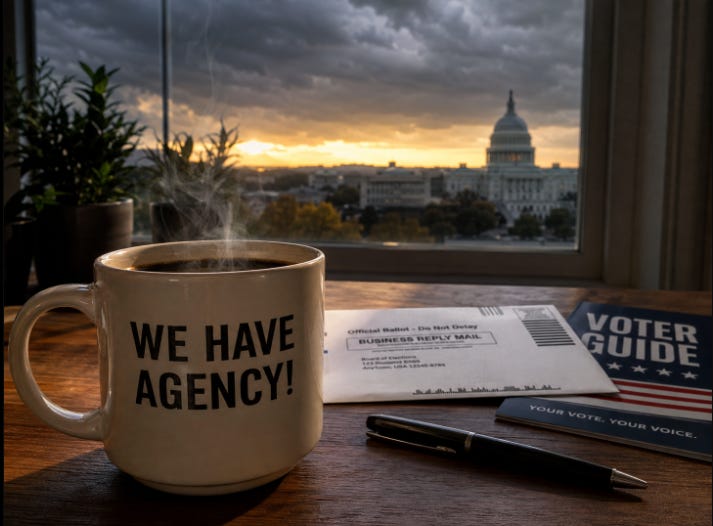
We are not helpless; we do have agency. Vote.
They made their bed. Carefully, pointedly, patiently, accomplishing near all the goals even writing them down in P-2025..”transparency”.
So lie in it.. as well they are,did, and do …the ending is up to you…VOTE EARLY ..VOTE💙
Yes the whistleblower has alleged that the new federal ballot-mail system was rushed, poorly tested, and could wrongly reject batches of mail ballots, but those claims are still allegations, not proven misconduct. Yet.
But Trump is continuing to press ahead by appealing court restrictions and seeking Supreme Court relief, while USPS says it is complying with the current injunctions rather than simply ignoring them. In any case, it's probably too late for 2026.
The bigger concern is 2028: if the federal government gains more operational control over how mailed ballots are processed, close elections could become even more vulnerable to last-minute bullshit changes, litigation, and public distrust—even if courts ultimately stop unlawful measures. And that's plan anyway--just throw a wrench into the gears.
I think this will motivate Dems even more than they already are.