


Good morning! Trump’s preferred domestic governing model remains: take a public institution, slap gold leaf on it, invite wealthy friends, create a revenue stream, call it patriotism, and dare anyone to notice the stench.
Before the domestic ledger, a marker on the weekend, because it deserves its own piece and will get one: the April ceasefire frayed badly over the last forty-eight hours. Israel struck Hezbollah targets in southern Beirut, Iran fired its first missiles at Israel since April, and Israel then struck military targets in western and central Iran, roughly ninety minutes after Trump went on Israel’s Channel 12 to say he didn’t want “an additional attack tonight” and that he was going to call Netanyahu “right now and tell him not to retaliate.” Iranian state TV reported explosions in Tehran, Tabriz, and Isfahan. The president who says “I call the shots” was, by his own timeline, overruled by his partner inside two hours. I’m treating the collapse as a standalone, because the gap between what Trump announced and what happened is the whole story, and it needs the room.
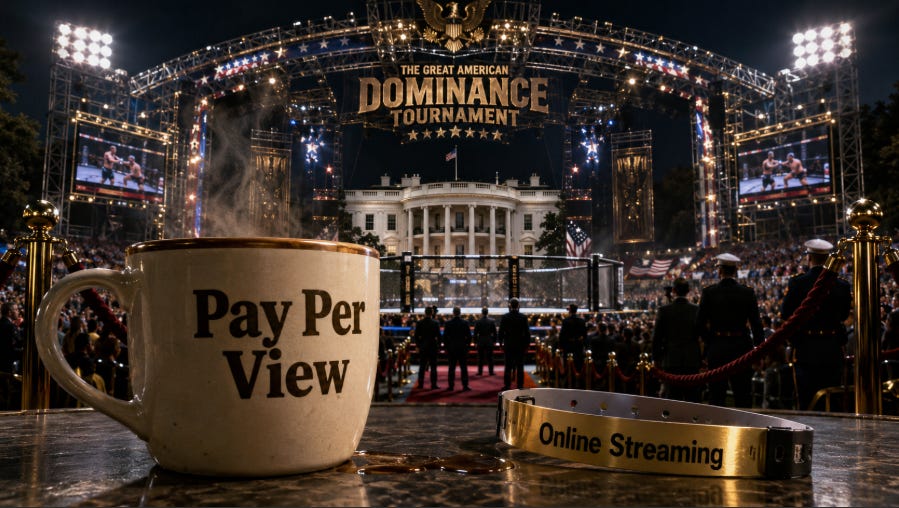
A federal lawsuit now aims to stop the Ultimate Fighting Championship event, billed as UFC Freedom 250, planned for the White House on June 14, Trump’s 80th birthday. The event is being sold as part of America’s 250th anniversary celebrations, because apparently “happy birthday, Mr. President, here is a cage fight on the South Lawn” sounds less banana republic if you staple a tricorne hat to it.
The lawsuit, filed by a political activist and a Vietnam veteran represented by the Public Integrity Project, names the National Park Service and the Department of the Interior, and rests on a deceptively dull hook: Park Service permitting rules bar sporting events on the South Lawn and at the Lincoln Memorial. The conflicts of interest are the color; the permitting violation is the spine. From there the suit argues the event was never authorized by Congress, skipped environmental review, and turns government space into a private, for-profit promotional arena for Trump, Dana White, UFC, and their associated business interests. The South Lawn has been transformed by a 600-ton steel arch.
The Lincoln Memorial is scheduled to host ceremonial weigh-ins. Fighters may make prefight walkouts from the Oval Office. Premium packages were reportedly being sold for $1.5 million each. Paramount Skydance, tied to Larry and David Ellison, is set to collect streaming fees, which means no American can watch this “celebration of America” without first paying for Paramount+. Trump reportedly purchased between $15,000 and $50,000 worth of stock in TKO Group Holdings, UFC’s parent company, in March, disclosed in a May filing, while he was promoting the event.
The White House called the lawsuit “obstructionist” and said the event is no different from other White House-hosted events. Which is true, if by “other White House-hosted events” they mean previous occasions when the president converted the South Lawn into a branded combat-sports venue so his allies could sell seven-figure tickets while fighters did ceremonial weigh-ins at the Lincoln Memorial.
This is what Trumpism has always wanted to do to public space. It turns the people’s house into a set, the monuments into props, the presidency into a sponsorship opportunity, and national memory into a merch table. The 600-ton steel arch is not just a venue feature. It is the thesis statement: the republic, but make it pay-per-view.
Speaking of public institutions repurposed for private power, Scott Pelley’s accusations about CBS and 60 Minutes deserve a very large flashing sign over them.
Pelley, recently fired from 60 Minutes, has accused CBS News chief Bari Weiss of interfering with a segment about the January killing of Minneapolis protester Renee Good by an immigration enforcement officer. In an interview with the New York Times, Pelley said Weiss sent an email before the segment aired requesting changes that, in his telling, would have made protesters look more violent and would have described Good as “driving toward the officer.” Pelley was explicit that he was paraphrasing and did not have the email in front of him.
In a state killing, “driving toward the officer” is not a neutral edit. It is the justification. It is the phrase that turns a person killed by law enforcement into a threat requiring deadly force. Pelley says the video did not support that framing, that the officer was not standing in front of the car, and that Good’s wheels were turned away from him. CBS denies that Weiss was acting with political motivation and says her notes were intended to make the piece stronger, fairer, and more accurate, adding that not everything she raised made the final cut.
Pelley’s accusation is not just about one segment. It lands inside a broader storm at 60 Minutes, where veteran leadership has been replaced, journalists have left amid concerns about editorial independence, and Pelley himself was reportedly fired soon after accusing Weiss of “murdering” the show. Weiss and new executive producer Nick Bilton have talked about modernization, one of those bloodless corporate words that can mean anything from “we need better digital strategy” to “please make the journalism less inconvenient for billionaires and presidents.”
Pelley’s critique, if his account holds, cuts through the fog: if the video does not show Renee Good driving toward the officer, but editorial pressure pushed the show toward language suggesting she did, that is narrative laundering, not to be confused with modernization.
Propaganda does not always arrive in a red hat with a bullhorn. Sometimes it arrives as one suggested phrase: “driving toward the officer.” One phrase that moves the audience from “why did an officer shoot her?” to “maybe he had to.” It is not about whether a show feels more conservative or more centrist or more modern. The issue is not whether 60 Minutes feels more conservative, centrist, or modern. It is whether powerful institutions will defend observable reality when reality conflicts with state violence.
Which brings us to the economy, where Trump’s “golden age” continues to behave suspiciously like a cardboard backdrop printed with the words GOLDEN AGE.
The White House has been celebrating the May jobs report, and on the headline it has a real number to wave. Employers added 172,000 jobs in May, unemployment held at 4.3 percent, and revisions added 93,000 jobs across March and April combined. Taken together, it was the strongest three-month stretch of hiring in more than two years. This is the part worth conceding plainly, because the argument is not that the topline is fake. The argument is that the topline is real and still does not reach the people doing the work.
Underneath it, the picture is less golden. Job growth was concentrated in leisure and hospitality, local government, and health care, not the triumphant return of a 1950s factory economy, unless the 1950s were secretly built on hotel shifts, underpaid caregivers, and municipal payrolls. And wages are losing the race they are supposed to be winning: the most recent real-earnings data, for April, show inflation-adjusted hourly pay falling 0.5 percent, as earnings rose 0.2 percent against a 0.6 percent jump in prices. Workers want paychecks that survive the grocery store. A strong payroll headline does not buy groceries.
Trump is selling a manufacturing renaissance while the manufacturing numbers wander off-script. The Financial Times reported that private factory-construction spending fell to $15.2 billion in April, down about 16 percent since Trump’s second term began, while factory employment dropped by 77,000 jobs over that same window, since the January 2025 inauguration, not last month, when manufacturing actually added a modest 7,000. Eighty-four companies have pledged nearly $1 trillion in manufacturing investment since the term began. Almost none of it is being built. As one manufacturing site-selection executive put it to the FT, announcements are what people say they’re going to do; dollars spent is what’s actually happening. A rendering is not a factory. A press release does not pour concrete.
The rate-cut demand is where the gap gets widest. Trump wants the Federal Reserve to cut rates because lower rates would juice markets, borrowing, and his preferred illusion of prosperity. But Friday’s report pushed the market the other way: yields jumped across the curve, and Fed futures now price in a possible rate hike by year-end, with analysts expecting the Fed to drop its easing bias at the June 17 meeting. Trump is demanding cheap money at the precise moment a strong labor market and tariff-driven inflation have the bond market betting on the opposite. He wants cheap money and good headlines. The data just priced in neither.
Trump’s trip to Wisconsin for a farming-family address sits right in the middle of that contradiction. He took the golden age tour to the heartland while farmers remain exposed to trade-war retaliation, tariff uncertainty, and labor shocks. Farmers are being asked to applaud the same trade-war politics that can close export markets, raise input costs, and make long-term planning impossible. At the same time, his administration has leaned harder into H-2A guest workers even as immigration crackdowns make the system more vulnerable to abuse, and federal oversight has repeatedly found violations in the program, which has ballooned over the past decade. So the same administration that demagogues migrant labor relies on it to keep agriculture functioning.
In his June 5 gaggle en route to Wisconsin, Trump called the jobs report “fantastic,” demanded lower interest rates, claimed markets were wrong to fall on good numbers, and argued that growth is anti-inflationary. He also floated public-private equity stakes in AI companies, dismissed unaffordable NBA Finals tickets by saying people can watch on TV, and attacked Senator Thom Tillis as a “loser” over Todd Blanche’s confirmation.
The Epstein files continue to function like a moral sinkhole under the Justice Department.
Pam Bondi’s House Oversight testimony, as reported through released transcripts, adds another layer to the DOJ shell game. Bondi said Todd Blanche was “in charge” of the department’s entire Epstein files release and that she delegated oversight to him, while also insisting she was not blaming him and praising him as ethical. She acknowledged redaction errors, defended the department’s commitment to transparency, said she was not certain how much Trump knew about Epstein and Ghislaine Maxwell’s crimes before they became public, and said she learned about Maxwell’s prison transfer from news reports. She opposed any Maxwell pardon and said Maxwell should remain in prison for life.
The White House claimed Trump had been “totally exonerated,” which, in this case, means a spokesperson said words while the documents remain unreleased. Democrats are now urging House Oversight Chair James Comer to call Blanche and FBI Director Kash Patel to testify.
The shape of this is familiar: everyone supports transparency; nobody wants to be responsible for the actual release; blame gets delegated sideways; accountability becomes a hallway with too many doors; and Trump’s people declare victory while the public still cannot see the files.
Bondi distancing herself from the release while pointing toward Blanche matters because Trump is moving Blanche upward. The Epstein scandal is no longer just about what is in the files. It is about who controls the release, who manages the redactions, who benefits from delay, and who gets promoted after presiding over the mess. It is accountability theater with a loyalty bonus.
That is the governing pattern: public institutions turned into private stages, evidence pushed toward power’s preferred story, economic headlines stretched over household pain, and accountability treated like a shell game. Trump’s second term keeps insisting it is building a golden age. It is actually building a set and charging admission.
By the way, assume that the UFC match goes ahead: who is geting the $1M or $1.5M entry fee? will those funds pay for the construction and, one hopes, the demolition of the whole set-up so the lawn and gardens can be restored? (Too bad about those old trees....)
And if the match does not go ahead because the courts stop it ... then who pays for the restoration of the terrain?
"...CBS denies that Weiss was acting with political motivation and says her notes were intended to make the piece stronger, fairer, and more accurate, adding that not everything she raised made the final cut...."
And I'm the Queen of Burundi.