


Good morning! After a day off, we return to a news cycle that appears to have been written by a political cartoonist suffering from heat stroke, sleep deprivation, and access to federal procurement documents.
Today’s governing theme is collapse, though collapse may be too dignified a word for some of this. Collapse suggests a structure that once possessed integrity. What we have instead is spectacle failing load-bearing tests.
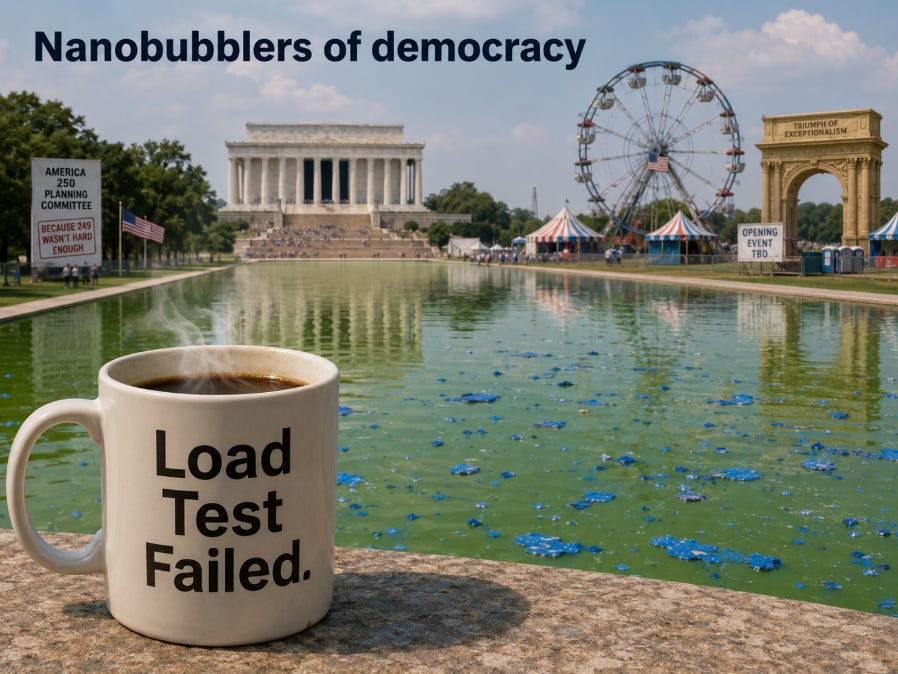
We begin on the National Mall, where the Trump administration has launched the Great American State Fair, a celebration of the country’s 250th anniversary that somehow already feels like a going-out-of-business sale for the republic. The event was supposed to be a grand, nonpartisan celebration of all 50 states. Instead, it appears to have been born as a Trump rally, dressed as a fair, and then left outside in the sun until the frosting separated.
The foreign press, bless them, continues to perform the valuable service of looking directly at Trump’s America from outside the fog machine. British journalist Mikey Smith wandered through the fair and found something less like a national pageant than a supersized conference expo assembled by people who had been told the president likes flags, arches, and things that spin, but not necessarily things that work. There was a Ferris wheel. It had a power failure. There was a miniature version of Trump’s proposed triumphal arch. It was not even decorated all the way around. And there were enough stray booths and odd little exhibits to make the whole thing feel less like a celebration of 250 years of self-government than a trade show for a country being liquidated in sections.
Smith’s best line came when he looked at the nonworking Ferris wheel and then looked, metaphorically, toward the Reflecting Pool. If you knew Donald Trump had anything to do with that Ferris wheel, would you get on it?
This is not an unfair question. At this point, it is a safety protocol.
The Washington Post described the opening as bumpy, with power outages that delayed rides and melted ice cream. Trump had promised “the rally to end all rallies,” which is funny because he is holding another rally on the National Mall about a week and a half later. Even the end of all rallies has a sequel. This is how Trump processes finality. Everything is forever until the next booking.
The original entertainment lineup, you may recall, had a small structural problem: many of the artists reportedly pulled out after deciding they had been dragged into something more politically Trump-shaped than advertised. In the end, as Smith put it, all of them except Vanilla Ice smelled a rat and departed. There are many ways to measure the cultural health of a political movement. “Vanilla Ice remains available” is one of the harsher metrics.
Then there is the Reflecting Pool. The Reflecting Pool is not merely a pool-maintenance story. It is an X-ray of the regime. It is the Trump governing method rendered in algae, no-bid contracts, patriotic paint, hydrogen peroxide, police reports, and a dead duck nobody can definitively explain.
The administration wanted the Lincoln Memorial Reflecting Pool to look special for America’s 250th birthday celebration. Not merely clean. Not merely functional. It had to be Trump clean. Trump beautiful. Trump blue. Specifically, “American flag blue,” because the water in front of the Lincoln Memorial needed to stop reflecting the sky and start reflecting a campaign brochure.
The project was rushed through with no-bid contracts totaling roughly $16 million. Atlantic Industrial Coatings, a Virginia company whose comparable prior work reportedly included a pool at Trump’s Sterling golf club and which had never held a federal contract, received about $14.7 million. Greenwater Services, whose ultimate owner is an investment trust led by Trump donor John J. Cafaro, received about $1.7 million for the nanobubbler purification system. The work was justified under an urgency exemption to meet the July 4 semiquincentennial deadline. The original estimate has already been overrun by about $4 million. Reps. Robert Garcia and Sen. Richard Blumenthal have asked questions, which is the congressional equivalent of walking into a room, smelling smoke, and noticing the curtains have filed for asylum.
The deeper problem is that the administration apparently had the diagnosis and skipped the cure. A 2023 Interior Department report had flagged the pool’s broken pipes and called for new distribution lines so water could be circulated through the treatment plant, filtered, and treated with ozone. In plain English: the system needed plumbing. Instead, the 2026 renovation resealed the basin and painted the floor. The camera-facing part got the treatment. The actual water system appears not to have received the repair it needed.
Then came the perfect Trumpian plot twist. According to New York Times reporting, the temporary nanobubbler machines being used to keep algae under control were removed on June 12 ahead of a promotional event for Trump’s Ultimate Fighting Championship birthday celebration. The machines were bulky. They were fenced off. They needed large generators. They were, in other words, visually inconvenient. And in Trumpworld, visually inconvenient is often treated as a greater emergency than functionally necessary.
The bubblers had to go. The pool looked dark blue that evening. The purification system was reportedly offline for roughly 36 hours. By the time it was reinstalled, algae blooms were already spreading. City tap water contains phosphates, which help protect pipes from corrosion but also feed algae. This means the administration had filled a shallow outdoor basin with algae food, removed the equipment suppressing the algae, staged the photo-op, and then discovered that algae behaves like algae.
Once the water turned green, crews tried pouring hydrogen peroxide into the pool. According to the Times, much of it dissolved before it could reach the larger clumps in the middle. The expensive blue coating began peeling and floating to the surface. Three dead birds turned up, though wildlife specialists have said hydrogen peroxide was an unlikely cause, and the honest frame is not “the chemicals killed the ducks” but “the sequence of decisions made the question harder to answer.”
Then the administration did what this administration does. It blamed vandals.
Trump claimed, without releasing the promised evidence, that “sick people” had taken razors and box cutters to the lining. The Park Service now says in a court filing that some lining was cut with a sharp knife or razor. That may support the existence of some damage, but it does not explain the algae bloom. Nor does it explain the rushed contract process, or the removed bubblers. It does not explain why a pool fixed for the camera instead of the cause immediately became a national symbol of decorative incompetence.
As of late this week, the vandalism theory had reportedly produced seven arrests, seven federal citations, and 18 police reports. One of those arrested was former Olympic canoeist David Hearn, who was held for hours after reaching down to touch an already-detached piece of coating. A 17-year-old was cited for picking up a paint chip. This is the sequence now: government botches maintenance, coating peels, public notices coating peeling, and the public is treated as the likely culprit for interacting with the evidence of the botch.
From across the Atlantic, the foreign press is doing the thing American political journalism sometimes forgets how to do: describing the obvious without first wrapping it in a bipartisan weighted blanket.
Simon Marks captured the Oval Office version of the same pathology this week, as Trump discussed Europe with the tenderness and strategic sophistication of a mob boss reviewing protection payments. Asked about Andy Burnham, the man expected to become Britain’s next prime minister, Trump began with the most honest sentence in his foreign policy repertoire: “I don’t know anything.” He then continued, naturally.
Trump said Burnham was “extremely liberal,” which in Trump’s political taxonomy means somewhere between Bernie Sanders and a recycling bin. He complained that Burnham probably would not “open up the North Sea,” because Trump has apparently been hearing from oil companies desperate to drill in British waters. This was made especially odd by the fact that Burnham has criticized Keir Starmer’s decision not to drill for oil and gas in the North Sea as “economic madness.” But Trump does not require accuracy. Accuracy is a garnish. The meal is dominance.
What Trump truly wants from Europe, he said, is loyalty.
“I just want their loyalty,” Trump said. “We don’t need their money. We don’t need anything. We have the most powerful military in the world by far. But I just want loyalty.”
Then came the line that belongs in the Smithsonian, preferably near a cracked Liberty Bell and a tray of antacids: “Give us a little kiss. We don’t want much. Give me a kiss.”
There it is. The doctrine. Not NATO. Not collective defense. Not democratic alliance. A kiss.
Marks joked that it was a shame Marlon Brando is no longer with us to fill his cheeks with grapes and play Trump in the film version. That is funny because it is exact. Trump’s alliance model is not partnership. It is fealty. Europe must pay more, praise more, drill more, harden borders more, and then lean in for the kiss.
Sitting beside him was NATO Secretary General Mark Rutte, who went into full presentation mode with charts about the “Trump trillion,” praising Trump for forcing Europeans and Canadians to spend more on defense. The spectacle had the energy of a hostage video with laminated graphics: a European leader offering charts to flatter a man who thinks loyalty is measured in tribute and kisses.
The foreign press also caught another important movement this week: the old Democratic center cracking under its own weight.
In New York, Brad Lander defeated incumbent Rep. Dan Goldman in the Democratic primary for the 10th congressional district. Lander, backed by New York City Mayor Zohran Mamdani, was part of a broader leftward sweep in which Democratic socialists and left candidates defeated establishment-friendly contenders. Marks framed it as a political earthquake inside the Democratic Party, a challenge not merely to individual centrists but to the permanent elite machinery: the donor class, the consultants, and the people still trying to sell 1998 as a governing philosophy with updated fonts.
The issue of Israel loomed large. Lander said he would sign on to the Block the Bombs Act and would not vote for additional U.S. military aid to Israel while it violates Palestinian human rights and international law. He also said he intended to stand strongly against antisemitism as a proud Jewish New Yorker, and that defending Palestinian freedom and opposing hatred of Jews are not separate jobs but the same job.
That was the winning message in New York, just days after Hillary Clinton wrote in the Financial Times backing Trump’s vision for the future of Gaza. You could hardly design a cleaner generational contrast if you had a grant from the Department of Symbolism.
The establishment response to collapse is usually to ask everyone to keep clapping for the people who built the stage. New York voters appear to have other plans.
That brings us to the foreign policy portion of today’s collapsing stage set, where Trump’s peace architecture is having the same problem as the Reflecting Pool: the camera angle looked good for about twelve minutes, and then the underlying system announced itself.
The Trump administration got its Israel-Lebanon framework agreement. It got its Washington signing. It got the diplomatic language, the congratulations, the international statements, the little moment when everyone pretends that because a document exists, reality has been edited.
Then Hezbollah rejected the agreement outright.
Hezbollah chief Naim Qassem called the U.S.-brokered framework “humiliating, shameful, and a surrender of sovereignty.” He said it should be replaced by the Iran-U.S. memorandum of understanding. He rejected linking Israeli withdrawal from southern Lebanon to Hezbollah’s disarmament, calling that a “dangerous proposition” crossing “all red lines.” He said Hezbollah would continue armed resistance in the field and would not abandon it.
So, not exactly “peace in our time.” More like “peace in our font.”
Israeli attacks were still being reported in southern Lebanon. Al Jazeera reported a drone strike near Nabatieh al-Fawqa and reports of Israeli forces pushing further north in the Hasbaiyya district. Netanyahu, for his part, is reportedly celebrating the agreement as a victory because Israel appears to get what it wanted: no immediate withdrawal from the so-called security zone, freedom of movement, freedom to attack if necessary, and no hard withdrawal deadline.
If one side is celebrating because it retains operational freedom, and the armed group on the other side is denouncing the deal as surrender and vowing continued resistance, then what Trump has built is not peace. It is a press release with shrapnel attached.
The Iran piece is not exactly stabilizing either. Iran has condemned U.S. strikes on missile, drone, and radar facilities, saying the IRGC responded by targeting U.S. military-linked locations in the region. Bahrain has condemned what it described as an Iranian drone attack on its territory. Qatar, the UAE, and Kuwait have also condemned the alleged attacks. Gaza, naturally, remains under near-daily attack despite the continued use of the word “ceasefire,” which at this point is being asked to carry more moral weight than it can structurally bear.
The Reflecting Pool turned green because the administration removed the equipment keeping it clear for the sake of a cleaner shot. The Middle East framework has a similar problem. The photo-op exists. The functioning system does not. The nanobubblers of diplomacy, enforcement, sequencing, legitimacy, buy-in from armed actors, civilian protection, actual ceasefire compliance, appear to have been carted off before the ceremony.
Before we arrive at Gaza, where the collapse is not merely accidental but architectural, there was one rare flicker of institutional oxygen. A federal judge has ordered the Justice Department to either produce additional unredacted Epstein files or explain why it cannot. Judge Emmet Sullivan handed attorney and independent journalist Katie Phang a significant win in her lawsuit over the Trump administration’s handling of the records, rejecting Acting Attorney General Todd Blanche’s argument that Phang should have used FOIA, which the judge found “does not provide an adequate remedy,” and noting that the Epstein Files Transparency Act was designed to require a broader, less-redacted release than FOIA would. Sullivan found Phang likely to prevail and, in a detail that tells you how hard the department fought on the merits, concluded that Blanche had conceded her core arguments by failing to respond to them substantively. The department missed the judge’s deadline to respond at all; he ordered the release after it lapsed.
The records Phang is after are, by her own filing’s account, about as dark as the files get. She alleges the DOJ redacted the senders and recipients of at least eight email exchanges with Epstein “regarding a ‘torture video’ and sexual activity with young women, including minors.” The order also covers FBI interview records summarizing a woman’s allegation that Trump assaulted her when she was a minor, an allegation that remains uncorroborated, though reporting indicates the FBI found the woman credible and interviewed her four times. Sullivan gave the department until July 2 to produce less-redacted versions or justify each redaction, and to publish a log of every redaction it has made, as the law already required.
The DOJ says it will appeal “with confidence” and maintains it has produced all responsive documents. It also frames the order as asking it to break the law by un-redacting the names of victims who, in the department’s telling, “sadly became co-conspirators.” That is the administration’s standing position on the Epstein files: the redactions protect the vulnerable, not the powerful. The ruling matters because it cuts against the day’s governing instinct. Everywhere else, Trumpworld is building moats, around contractors, loyalists, records, and blame. Here, at least for the moment, a judge is asking for the drawbridge to come down. The administration’s preferred posture is to black out the parts where the powerful get named; this week, a court told it to stop.
That makes the next item even darker, because in Gaza the problem is not merely that the powerful want secrecy after the fact. It is that they appear to be designing immunity before the fact.
The Guardian reports that Trump’s UN-sanctioned Board of Peace, announced earlier this year to oversee Gaza, is planning a sweeping grant of legal immunity for itself, according to a draft resolution obtained by the paper. The draft would extend broad protections to every member of the Board of Peace and its administrative affiliate, the Office of the High Representative, as well as Palestinian technocrats, international military forces, and nonresident contractors lined up to work in Gaza. It defines the legal processes from which they would be immune as “any arrest, detention or legal proceedings in the courts or other entities in Gaza.”
The draft would also allow the organization to obtain public property in Gaza “free of charge.”
The Board of Peace is chaired by Donald Trump. Its seven-member executive board includes Jared Kushner, Steve Witkoff, Susie Wiles, and Marco Rubio. If you are wondering why a body called the Board of Peace includes the president’s son-in-law, congratulations, you are still capable of pattern recognition.
The Board denies that there is any operative resolution or immunity framework of the kind described and says any suggestion that the process is designed to create lawlessness or impunity is wrong. It says all personnel, contractors, and participating entities will follow applicable law and operate under oversight and accountability mechanisms. It reportedly did not explain what those mechanisms would be.
This is the part where the silence does the answering. Six lawyers specializing in U.S. contracting law and international armed conflict reviewed the draft for the Guardian. Their concern is straightforward: if this resolution goes into effect, how would Board officials, soldiers, or contractors be held accountable if there are shootings, accidents, property seizures, personal injury, illness, or death? How would routine disputes over land or business be resolved? Who adjudicates claims when the body creating the claims system is also the body shielding itself?
Noura Erakat, an international law professor at Rutgers, described it as creating a legal system unto itself. Emily Schaeffer Omer-Man said it looked like an attempt to exempt the board and its personnel from accountability for potential legal violations. Omar Shakir of DAWN warned that unilaterally declaring power to seize Palestinian land, property, and buildings without consent, compensation, or redress would echo Israel’s repressive playbook rather than signal an end to genocide, apartheid, and occupation.
This is where the story stops being absurd and becomes cold. The U.S. has been here before. Iraq and Afghanistan were filled with contractors, reconstruction promises, corruption controversies, civilian death, abuse, litigation, and accountability that often arrived years late, if at all. Gaza is not an abstraction. It is a devastated territory full of people who have already endured more than enough experiments conducted by armed men with legal theories. To begin reconstruction by writing immunity into the architecture is not a bureaucratic detail. It is a warning label.
At the Reflecting Pool, the administration allegedly removed the bubblers for the photo-op and blamed vandals when the water turned green. In Gaza, the reported question is darker: before the contractors even arrive, who will be protected if something goes wrong?
That is the day’s theme in one long, ugly sentence: build the spectacle, skip the system, declare the result beautiful, blame the people who notice the failure, and when the stakes rise from peeling paint to occupied land, write the immunity clause first.
The Reflecting Pool was supposed to reflect America.
Unfortunately, it did.
"Marks joked that it was a shame Marlon Brando is no longer with us to fill his cheeks with grapes and play Trump in the film version"
Perfect. Donald Trump has always been that cliched mob boss..."I'm gonna make him an offer he can't refuse"
But now they are refusing.
I always appreciate your attention to the details as well as the facts. That the “Board of Peace” has Kushner, Witkoff, Wiles et al and while the 2027 Budget allocates several billion funding of tax dollars (Source: Snopes research) at Trump’s direction without , it seems, any vehicle of oversight one wonders if tax dollars will build the Gaza resort on the Trump/Kushner wish list.