

There are people who go through life collecting frequent-flyer miles, Donald Trump has historically preferred to collect filings. For years, the most consistent through line in the Trump brand has not been real estate or television or politics. It has been the posture of a man perpetually on the verge of taking decisive legal action, like an uncle at Thanksgiving who keeps standing up from the table to “make a call” and then never actually leaves the room. Lawsuits are part strategy, part hobby, and part performance art. They are the paper version of insisting you are the main character in every disagreement, even the ones you started, even the ones you cannot remember starting, especially the ones in which the other party is a building, an institution, or the concept of math.
Which is why it is so pleasing, in the way a well-timed pratfall is pleasing, that Trump has now settled a lawsuit over music. Not over a contract dispute involving an entire tower. Not over a television deal. Not over some baroque grievance involving a media company, a polling firm, or a federal agency that had the audacity to exist, over a song. Over “Hold On, I’m Coming,” that velvet-rope classic from Sam & Dave, built for dance floors and movie montages and the kind of optimism that arrives with horns.
A settlement, terms undisclosed, and a case dismissed with prejudice. A tidy little ending, like a sitcom episode where the plot gets resolved right before the credits roll and everybody pretends they learned something. The funniest part is not even that the Trump orbit got tangled up in copyright law. The funniest part is the mismatch between the energy Trump likes to project and the reality of how the world works when it is run by people who have invoices and rights and the patience to wait you out.
Because Trump’s public persona is basically a long campaign for the idea that he cannot be stopped, he can only be slowed, and even then only briefly, by incompetent underlings. The brand relies on the expectation that rules will either bend or become irrelevant. That is the whole point of being powerful, you get to treat boundaries like decorative fencing.
Copyright law, on the other hand, is not decorative fencing. It is a parking ticket you cannot talk your way out of. It does not care about your vibes, or your crowd size. It cares, with an almost puritanical focus, about whether you asked, whether you paid, and whether you were told no and did it anyway.
If you want to understand this case emotionally, forget the courthouse for a second and picture the campaign playlist as a kind of retail theft. Not the glamorous kind, not the “Ocean’s Eleven” kind, just the plain kind where someone strolls out with something small because they assume no one is going to stop them. That is how political campaigns sometimes treat music, like it is a communal resource, a public utility, a mood-setting spray bottle you can mist over the crowd. You want triumph, you want swagger, you want nostalgia, and you want the feeling that history is about to break in your favor. You grab a song that already contains those feelings and you let it do the work.
The trouble with “Hold On, I’m Coming” is that it is not neutral. It is not just “good energy.” It is an actual promise of care, it is a song about showing up for someone who is struggling, about closing the distance, and about being dependable, although while I’m sure Trump has used that phrase many times, considering how much time he spent with Jeffrey Epstein, I doubt it was ever as a promise of care. Even if you do not know anything about songwriting credits or publishing rights, you can hear the moral center. The song is built around the idea of support, which makes it an especially odd accessory for an enterprise that often treats loyalty as something you demand, not something you offer.
But campaigns do not pick music because it is morally aligned. They pick it because it hits. And “Hold On, I’m Coming” hits in a way that makes a room feel like it is already winning. It has that Stax punch, the brass, the forward motion, the sense that the future is arriving with good posture. If you are building a rally experience, it is basically jet fuel.
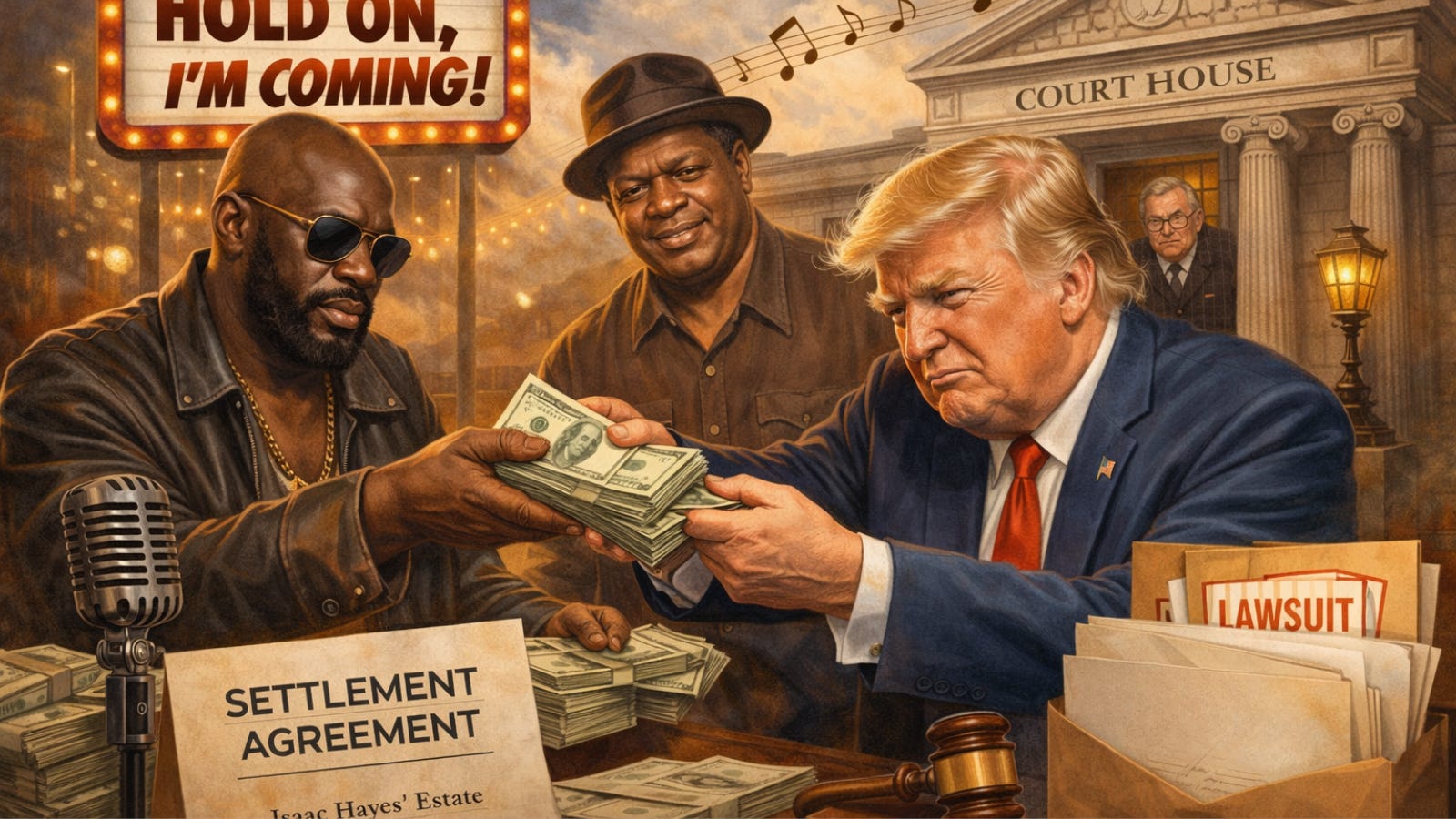
So, the estate of Isaac Hayes, one of the song’s co-writers, sued, alleging the song had been used at Trump events without permission. A judge issued an injunction telling the campaign to stop using it while the case played out. Then, this week, the whole thing ended in a settlement and a dismissal. No big dramatic reveal, no courtroom fireworks for the cameras, just the quiet sound of adults agreeing to stop arguing in public. The most American possible resolution: it is over, but you are not allowed to know what it cost.
What is satisfying here is that it forces a collision between two archetypes. On one side, Trump, whose instinct in conflict is to go louder, to go bigger, to go to war over principle even when the principle is just wounded pride. On the other side, music rights holders, whose entire job is to be boring and relentless, to be the kind of people who can stare at spreadsheets until the universe pays them. Trump thrives on spectacle. Rights holders thrive on documentation. Trump wants the thrill of dominance. Rights holders want the check to clear. In other words, it is a matchup between chaos and paperwork. And on Tuesday, paperwork won.
There is also the title, which really does feel like it was written by a prankish screenwriter with a fondness for irony. “Hold On, I’m Coming.” It is what you say when someone is in trouble and you are rushing to help. It is also what you say when you are stalling, when you are trying to sound like you are arriving any second now even though you are still in the elevator. In the Trump version of the phrase, it becomes almost a legal slogan. Hold on, I’m coming, in the form of another filing. Hold on, I’m coming, in the form of another appeal. Hold on, I’m coming, in the form of insisting that time itself is on your side.
But time is not always on your side, and neither is the music industry. The music industry is built on the idea that art is worth money, and that someone, somewhere, is entitled to that money. It does not care that you only played thirty seconds. It does not care that the crowd cheered. It does not care that you think your use is flattering. It hears a song being used, it looks for permission, and if permission is missing, it starts sharpening pencils.
Which is why this story lands as a kind of corrective comedy. Not a cosmic reversal of fortune, not a grand moral reckoning, just a small reminder that there are still corners of American life where the rules function, and they function in the most humiliating way possible: quietly. No wrestling match, no dramatic takedown, no viral moment. Just a judge, an injunction, a settlement, and a case dismissed with prejudice, which is court-speak for “we are not doing this again.”
And it is worth savoring precisely because it is mundane. It is not about ideology, not about a grand constitutional question, it is about ownership. It is about a thing you do not get to take just because you want the feeling it produces. It is about the unglamorous infrastructure that supports creativity, the part people only remember exists when someone violates it.
In a saner country, this would be a small footnote, a minor legal skirmish in the endless churn of political theater. In our country, it becomes a neat little parable about entitlement meeting the one opponent it cannot intimidate: a system designed to extract payment without caring what you think of it.
Imagine the rally moment again, but this time with the legal subtext audible. The song starts, the crowd perks up, the speakers thump, and somewhere in the background a ghostly voice is whispering, “Do you have the license for this.” That is the true American chorus: not the horns, not the applause, not even the candidate’s voice, but the eternal question of who owns what and who is getting paid.
If you want a moral, it is simple and slightly depressing. Even a cultural anthem can become a prop if enough people decide the energy matters more than the meaning. If you want a punchline, it is simpler. Trump, who has so often treated the court system like a personal stage, walked onto it and discovered that this time he was not the one holding the microphone.
And that is the best kind of irony, the kind that does not require you to strain for it. It is just sitting there, perfectly plain, in the title of the song. Hold on, I’m coming, the invoice is coming too.
But will he pay?
Beautiful analysis! Made me smile, and that's been pretty rare these days.