

Good morning! Moscow called it a Declaration on Peace.
After their summit in Shenzhen, Donald Trump, Vladimir Putin and Xi Jinping issued a four-point statement: reform the United Nations, increase supplies of refined petroleum products, continue talking about nuclear risks, and affirm the immunity of state officials while warning international courts against overreach.
Not a word about Ukraine.
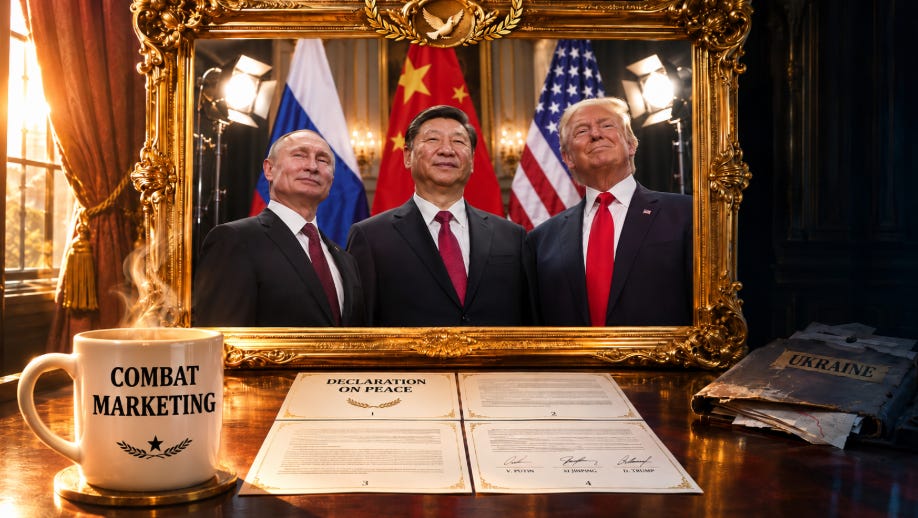
The nuclear provision was hardly groundbreaking. Its central assertion, that a nuclear war cannot be won and must never be fought, came straight from the 1985 Geneva summit declaration issued by Ronald Reagan and Mikhail Gorbachev. Forty-one years later, three presidents had agreed to repeat it without announcing a single nuclear weapons reduction, inspection mechanism or negotiating deadline.
The absence of Ukraine was especially conspicuous. One of the three men at the table has been waging war against the country for nearly five years.
Hours later, Putin held a press conference and offered a rather different interpretation of peace.
Following Ukrainian attacks on the Kerch Strait bridge connecting Russia with occupied Crimea, he ruled out negotiating limited ceasefires covering energy infrastructure or maritime operations. He dismissed European warnings about Russian preparations for a wider war as “nonsense” and advised European leaders to stop their “political diarrhea.”
Then he turned to Yalta.
The 1945 conference, Putin explained, hadn’t really been about dividing the world into spheres of influence. It had simply recognized the realities established by World War II. Today’s conflicts, he suggested, would likewise require recognition of existing realities.
According to Kommersant, Putin said Russia could accept compromises proposed by American negotiators if Ukraine and its European supporters came to recognize those realities. He separately insisted that efforts to move Russia from its territorial demands were pointless.
What, precisely, does Putin perceive as those realities?
Russian forces occupy Ukrainian territory. Moscow has purported to annex Ukrainian regions that remain internationally recognized as part of Ukraine. Putin continues to demand that a settlement accommodate Russian territorial claims that Kyiv rejects.
In Moscow’s telling, territory acquired through military force becomes a fact that other countries must recognize before peace can be negotiated.
A very Putinesque way of interpreting a peace declaration.
Monday, I wrote that the summit would let Putin stand beside the American and Chinese presidents “as though the invasion of Ukraine were merely an unfortunate scheduling complication.” With no agreed agenda, “the picture is the agenda.”
On Thursday, the picture was taken. Kremlin aide Yuri Ushakov had already said the quiet part out loud: the meeting’s “significance and symbolism are hard to overestimate.” Afterward, when a BBC reporter asked whether the summit represented a new world order or merely a pretty picture, Putin insisted it was neither. “This isn’t a picture, it’s serious joint work.”
The trilateral lasted about 80 minutes. The NYT’s Peter Baker noted that no serious advance work had been done to prepare agreements on any of the issues on the table. The original Yalta Conference lasted eight days.
There was one notable clause with a target: the International Criminal Court. Trump raised it himself, calling the ICC one of the “rogue globalist organizations” that he said had strayed beyond its jurisdiction.
None of the three countries is a party to the Rome Statute. Ukraine is. The ICC issued a warrant for Putin in 2023 over the alleged unlawful deportation and transfer of Ukrainian children. The declaration cannot invalidate the warrant or change the court’s jurisdiction. But the three leaders found common ground in criticizing the institution that issued it without agreeing on how to end the war.
Russian state media treated the photograph itself as news. TASS reported that Putin stood to Xi’s right and Trump to his left, describing Putin’s position as the place of honor under diplomatic protocol. Life.ru noticed that in the Kremlin’s footage of a separate photo backdrop, the Russian tricolor occupied the center of the three-flag display.
The Russian media’s own reporting supplied a revealing contrast. On Wednesday, RIA Novosti photographed Trump at Xi’s right, with Putin on the other side of Xi’s wife, Peng Liyuan. Kremlin aide Yuri Ushakov acknowledged that Putin and Trump had been seated at different banquet tables and couldn’t speak over dinner. Xi personally welcomed Trump at the airport with a hug; Putin was received by senior Communist Party official Cai Qi. On Thursday, Putin got the honored position beside Xi, and TASS explained its significance. Channel 5 even noted the previous day’s different arrangement. Monday’s piece said Xi would arrange the furniture. The seating chart had a second edition.
State TV’s Vesti announced that the three leaders would deliver a joint statement afterward. They didn’t appear before reporters to make one. According to the independent outlet Agentstvo, Vesti deleted the announcement minutes before the meeting ended, though not before it was archived. A written declaration followed. TASS presented the four-point document as the “Declaration on Peace” and filled its coverage with Western validation: a Bloomberg-sourced headline about Putin rebuffing attempts to isolate Russia, and a Reuters column on Europe’s “power deficit.” When the Kremlin’s own pool reporter, Pavel Zarubin, asked Foreign Minister Sergei Lavrov whether the talks had succeeded, Lavrov demanded to know why he would ask such a question and ended the exchange.
Even the pleasantries got an upgrade. In the AP video, Trump says, “It’s an honor to be with Vladimir. It’s an honor to be with you, Mr. President. What a job you’ve done,” with “Mr. President” and the praise for Shenzhen addressed to Xi. The AP and Roll Call transcripts agree.
Yet, as Agentstvo reported, the Kremlin’s Russian transcript turns “Vladimir” into “Vladimir Vladimirovich” and adds “Mr. President Putin.” Putin had opened with “the distinguished president of the United States of America, Mr. Trump.” The Kremlin supplied the return courtesy on Trump’s behalf.
Putin’s history lesson needed editing, too. He named Russia, China and the United States as World War II victors who helped establish the UN, leaving out Britain and France, also victors and original permanent Security Council members.
The China that signed the UN Charter in 1945 was the Republic of China. The People’s Republic did not exist until 1949 and assumed China’s UN seat in 1971. The Republic of China now governs Taiwan, which Xi was pressing Trump about in Shenzhen.
Independent Russian-language journalists read the declaration differently. Verstka noted that Ukraine wasn’t mentioned. Echo pointed out that the document named the ICC and refined petroleum products, but not the war. Even pro-Kremlin Ukraina.ru acknowledged “not a word about Ukraine,” then framed Europe’s reaction as fury.
Novaya Gazeta Europe reported that Washington and Moscow pressed a reluctant Beijing to host the meeting, with the Americans pushing hard. Former national security adviser Jake Sullivan said on The Rest Is Politics that Beijing had preferred prepared statements to negotiations. The outlet argued the summit was unlikely to produce much beyond a group photograph.
Washington left a vacuum for Moscow’s version to fill. Putin took questions for more than an hour; Trump held no post-summit press conference. Chinese officials barred Bloomberg reporter Annmarie Hordern from the trilateral after her question about Jensen Huang. White House officials sought her reinstatement, but Beijing refused.
On the flight home, U.S. officials collected the press pool’s phones “for security reasons,” a restriction Fox News correspondent Jacqui Heinrich said had not been imposed after Trump’s May departure from Beijing. No specific explanation was immediately given.
Putin got his seat at the table, though Beijing rationed even that. The photograph showed he was received, not that anyone accepted his terms. The war continues.
The occupation was a reality. The peace was a declaration.
"reform the United Nations, increase supplies of refined petroleum products, continue talking about nuclear risks, and affirm the immunity of state officials while warning international courts against overreach."
In other words: eliminate reasonable opposition, plunder the earth, keep the armed threats alive, and be accountable for nothing. Same-o, same-o...I hope no one expected anything different.
More performative and empty BS