


Good morning! In St. Petersburg, they’ve already painted the picture. Thursday, in Shenzhen, three men will stand for a photograph. In the painting, Putin gets the middle. At the actual summit, Xi Jinping is the host, so Putin may have to move over. Moscow has made no secret of wanting a new Yalta, invoking the 1945 conference at which Roosevelt, Churchill and Stalin negotiated the shape of the postwar world.
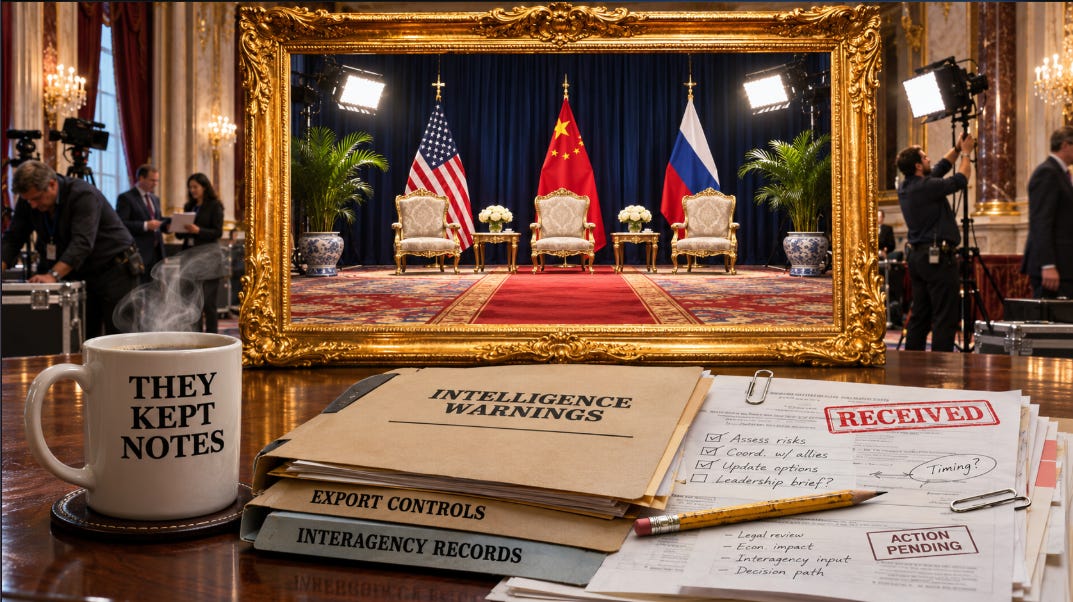
One wrinkle: The Financial Times reports that the three governments chose to meet without an agreed agenda, and an American official told the paper that Trump expects no nuclear arms agreement. A summit without an agreed agenda, or an expected nuclear agreement still produces one thing, and Moscow’s press has been candid about what it is. Kommersant, as translated by the BBC’s Steve Rosenberg, wrote: “Even just a joint photo of the three leaders will speak volumes.”
So the picture is the agenda. Putin gets to stand beside the American and Chinese presidents as though the invasion of Ukraine were merely an unfortunate scheduling complication. Trump collects another first-ever, the kind of achievement that exists the moment it is announced. Xi gets to arrange the furniture.
We should pull the camera back.
Start with the empty chair. Katie Rogers of the New York Times reports that at the big moments of this term, Trump has had a habit of looking up and asking where Jensen is. Jensen Huang, then chief executive of Nvidia, was usually close by. He boarded Air Force One in Alaska for the May trip to Beijing and sat at the head table when Xi came to Washington in September.
He will miss Shenzhen. Huang stepped down last week after revelations of an affair with Alice Huang, no relation, who ran a Singapore-based firm called Megaspeed and whom U.S. intelligence officials believe to be an asset of Beijing. Beijing calls that slander. CNN’s sources add a caution worth keeping: the agencies are not certain she spied on Nvidia, though some officials saw her access as a risk either way.
The affair is the least important part. ABC News’s timeline has the president briefed on the intelligence twice: in the fall of 2025, and again on May 12, by Marco Rubio, aboard the plane Huang was about to join. Trump’s first answer was that he had only just learned of it. By last week it could have been mentioned, he allowed, before adding the most revealing sentence of the whole business: “Certainly, it didn’t make much of an impact on me.”
Take him at his word. A warning that a suspected foreign intelligence asset was close to the man shaping his thinking on China and chips reached the president more than once. Trump says it made little impression. Yet, according to subsequent reporting, he also approved action against suspected chip diversion that never materialized. How those two things fit together is a question worth asking.
He has a philosophy for this. China spies on us and we spy on them, he said in September, which is true, and is also the sort of thing a man says while leaving the door unlocked.
One seat on this week’s flight is taken. Howard Lutnick, the commerce secretary, is expected aboard, according to Semafor. His is the department that Treasury Secretary Scott Bessent publicly blamed on Friday for failing to stop sales of advanced Nvidia technology to Megaspeed. The official whose department is accused of delaying action is flying to the country whose companies, by the Times’s account, got the computing power. Scott Bessent, the Treasury secretary publicly questioning Commerce’s handling of the case, is expected on the trip too. The White House says the president does not expect to raise any of it with Xi.
Lutnick’s defenders can point to the trade truce with Beijing. Commerce has made no new additions to its export blacklist since October 2025, and the administration separately suspended a rule that would extend restrictions to subsidiaries of listed companies. But neither explains why Megaspeed itself wasn’t listed. Commerce disputes the reported confrontation, Megaspeed denies diverting chips, and no criminal charges have been announced against the company. Every one of those points is an argument for an inquiry.Pull back once more, past the tarmac, to the people who are not travelling at all.
Somebody wrote those briefings, followed the trail of chips through Singapore and Malaysia, and assembled the intelligence that went up the chain. Their names are not on the guest list. They are analysts, investigators and career officials, and the reporting indicates that their warnings reached the people responsible for making decisions. The president was briefed more than once.
Julia Curlee knows something about how that process is supposed to work. She spent twenty-five years in national security, served in the CIA’s China Mission Center, briefed Vice President Mike Pence, and worked as a National Security Council director under Biden and during the opening weeks of Trump’s second term. She was there when the administration began dismantling the NSC’s coordinating staff.
In a conversation with Bill Kristol on Sunday, Curlee made a distinction worth dwelling on. The Nvidia affair, she argues, was not an intelligence failure. The intelligence community identified the potential threat and warned the president. What happened afterward was a failure of policy and coordination. She regards the inaction as deliberate, a choice to prioritize something else. That is her assessment, not an established finding about anyone’s motives.
Curlee also explained something more important than assigning blame. In a functioning National Security Council, the intelligence warning is the beginning of the process, not the end. Officials from different agencies meet, argue, weigh the risks and send decisions up the chain. Someone has to determine whether Huang should receive a defensive briefing, whether his access to the president should be restricted, whether existing chip-export licenses should be reviewed, and whether Megaspeed belongs on the Commerce Department’s Entity List.
Those are not simple decisions. Warning Huang about a suspected intelligence operation might also alert Beijing that American intelligence had discovered it. There could be legitimate reasons to preserve surveillance rather than expose it. But somebody should be weighing those competing interests, documenting the choices and ensuring that whatever the president decides is actually carried out.
Curlee says the administration’s purge of the National Security Council damaged precisely that mechanism. The regular meetings that once brought competing agencies together fell away. So did opportunities to force disagreements into the open, establish a record and determine who was responsible for following through. Departments could operate in separate silos, with no clear process for resolving conflicting instructions.
Consider what that means in this case. Axios reports that Trump approved action against suspected chip diversion on three occasions, in May, August and November, but that Commerce officials resisted implementing the proposed restrictions. Commerce disputes important parts of that account. On Friday, Treasury Secretary Scott Bessent publicly confirmed that Treasury, State, Defense and the U.S. Trade Representative’s office had supported blacklisting Megaspeed for months.
If the president approved the restrictions, why weren’t they implemented? Did Commerce persuade him to change his mind? Did officials misunderstand what had been decided? Was there another instruction, delivered somewhere outside the meetings? We don’t know. But these are exactly the questions a functioning national-security process is supposed to resolve.
Curlee has an answer to the next question, too: how do we find out?
Congress doesn’t have to begin by getting Lutnick into a witness chair. Investigators can start several levels below him, with the career officials at Commerce’s Bureau of Industry and Security who handled the licenses, prepared recommendations, attended meetings and documented instructions. Their testimony and records could establish when concerns were raised, which actions were recommended, who made or overruled the decisions, and why the proposed restrictions were never implemented.
Those people may never appear in a presidential photograph. Their records could nevertheless tell us considerably more about what happened than anything said at a summit.
Here is the reveal, and it is less comfortable than a plain charge of incompetence. The United States has capable people. Its intelligence professionals identified a danger, and their warnings reportedly reached the president. Multiple agencies pressed for action. Yet the restrictions they sought were not imposed, and senior administration officials are publicly disputing why.
What arrives in Shenzhen on Thursday is a president who says the intelligence warning made little impression on him, a commerce secretary whose department is under scrutiny, and a national-security controversy the White House says it does not expect to raise with Xi.
Then there’s the man standing on the other side of the photograph.
In September, CNN reported that Russian surveillance satellites likely helped Iran target American forces. Its investigators tracked fourteen Russian satellites passing over Prince Sultan Air Base in Saudi Arabia two days before an Iranian attack that wounded twelve American personnel. American intelligence sources told CNN that Russian satellite data had helped Iran conduct precision strikes. The extent of that assistance has not been publicly established.
Putin will be standing beside Trump on Thursday. Whether Trump intends to ask him about Russia’s reported assistance to Iran is another question.
The people left out of the photograph still have records. Voters took both chambers of Congress away from the president’s party this month, and the inquiries are already taking shape. Huang and Lutnick have been asked to testify before the Senate Banking Committee in December. But Curlee’s practical point is that investigators don’t need to begin at the top. Career officials can provide the documents, recommendations and instructions that explain what happened between the warnings and the decisions.
Oversight is oft described as something done to a government, a punishment or a distraction from the real work. It belongs to the real work. It is how a country discovers whether its warnings were heard and its decisions carried out.
The questions are short. What did the government know? Who decided what? And why didn’t the proposed restrictions follow?
Thursday’s picture will be handsome: flags, handshakes, a caption about history. When it arrives, look at the edges. Then tell your members of Congress you want to hear from the people who were left out of it, because they kept notes.
It might be fun to watch (just kidding) Putin and Xi fight over which country gets to claim the Diaper Don as their asset. Russia has the inside track but Xi is gaining fast. And it hurts me to even think this but it’s true.
Once again Trump validates Putin's belief that Russia is a world superpower. The three leaders are openly illustrating their stance that world domination should be divided into "spheres of influence" with Trump taking North and South America, Putin taking Europe and and maybe the Middle East, and Xi taking Asia, Southeast Asia, and Malaysia. I wondwr who gets Africa, Australia, and Antarctica?