


Donald Trump has responded to his party’s midterm drubbing by discovering that there should be limits on what a president can demolish.
This must be tremendously exciting news for the East Wing, which would have loved to participate in the discussion but is currently unavailable for structural reasons.
On Thursday, November 5, two days after voters handed Republicans a congressional defeat, Trump signed a proclamation designating the Oval Office, Outer Oval Office, and Cabinet Room a national monument. He described the result as a “landmark for the ages” and said the completed legal process would make it “impossible for anybody ever to destroy this incredible space.”
The man who brought demolition equipment to the White House has developed an urgent concern about what might happen if the next occupant has ideas. Apparently, the peaceful transfer of power now requires a separate negotiation over the side tables.
There is something almost touching about this stage of his relationship with democracy. The public has voted, the balance of power is changing, and the president is processing these developments by attempting to give his office the legal status of a protected archaeological site. Future generations may stand behind a velvet rope while a ranger explains that this is where the forty-seventh president struggled to distinguish the country’s property from his own taste. Please keep your children close. The cherubs are historically significant.
Trump has filled the Oval Office with gold accents, figurines, gilded mirrors, and decorative flourishes, including little gold cherubs brought from Mar-a-Lago. It is an extraordinary commitment to making the working office of the presidency look as though Versailles has opened a timeshare desk.
And some of this decorating was reportedly a personal undertaking. According to Maggie Haberman and Jonathan Swan’s book Regime Change, Karoline Leavitt once walked into the Oval Office and found Trump using superglue to attach gold decorations to the marble fireplace mantel. Please picture being the person who has to explain to the next administration that the president has glued things to the national inheritance.
Now he’s seeking federal protection for the room. Apparently, when the tube says permanent, Donald Trump still wants a second opinion from Congress. The East Wing got an excavator. His craft project gets a proclamation. This is a remarkably specific preservation philosophy: everything that existed before he arrived was available for improvement, but future presidents must approach his handiwork with the reverence normally reserved for cave paintings.
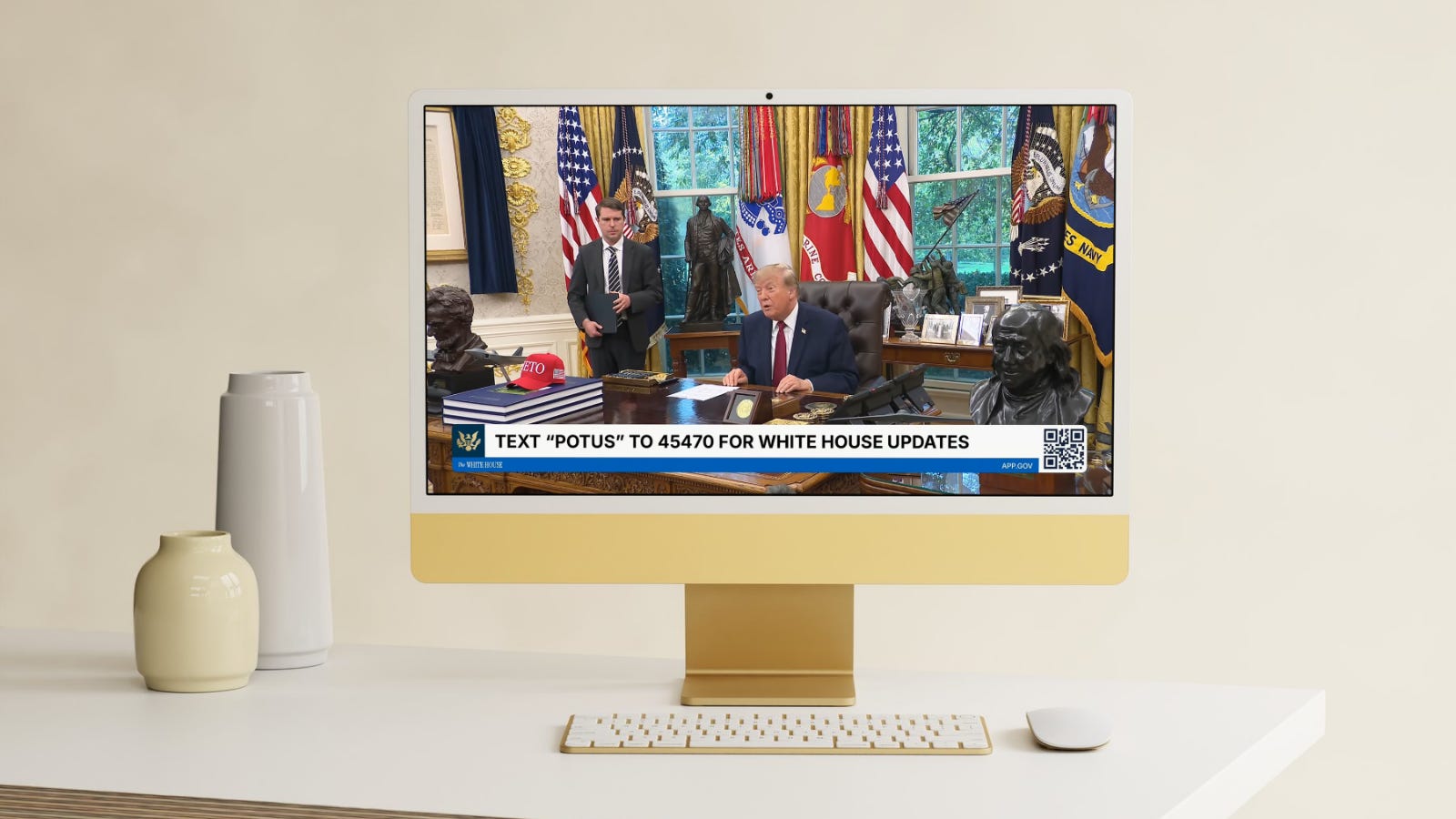
You can understand his anxiety. He has firsthand knowledge of what happens when a president decides the previous arrangement simply will not do. The evidence used to be on the east side of the building.
For accuracy, the East Wing was part of the White House’s National Historic Landmark property, rather than a separately designated national monument. Those are different designations. The White House is also expressly exempt from the usual review requirements of the National Historic Preservation Act. Historic status did not make the East Wing demolition-proof.
That distinction matters. So does the sight of the person responsible for its demolition presenting himself as the last line of defense against somebody else’s renovation. He has effectively arrived at the neighborhood preservation meeting in an excavator and asked whether everyone else has a permit.
The principle seems to be that previous presidents left behind alterations, while Donald Trump has left behind civilization. Their contributions were subject to his judgment. His contributions should be subject to federal protection.
History, apparently, becomes irreplaceable at the precise moment he finishes decorating it. But there is a complication, and it is beautifully located in his own paperwork.
The proclamation expressly preserves a president’s authority to redecorate and choose furnishings. It requires documentation, review, and consideration of alternatives before substantial alteration or demolition. It also preserves Congress’s authority over federal property and the White House’s existing statutory exemptions.
It doesn’t place every gilded object under eternal federal guard. The cherubs should retain counsel. A future president could change the furnishings under the very proclamation Trump signed. The gold accents have not been granted life tenure. Somewhere in the transition paperwork, there remains room for a perfectly lawful box marked Donald’s little things.
Nor does the proclamation establish the congressional approval requirement Trump described in his remarks. The text calls for a preservation process. His announcement supplied the force field.
This is a recurring difficulty with governing by superlative: eventually someone reads the document and discovers that “forever” means there will be a management plan.
Still, the timing gives the whole performance its particular flavor. After an election that reduced his party’s power, he was announcing protections for rooms he had personally redesigned. We can’t know every calculation behind that decision. We can, however, see what he chose to put in front of the cameras.
Democratic government depends on people accepting limits before those limits become personally convenient. Preservation rules are supposed to protect a shared inheritance. Checks on executive power are supposed to restrain whoever holds the office. If a president treats those safeguards as obstacles while pursuing his own plans, then demands their protection when imagining a successor’s, he’s asking for a special category of government service: restraint for everyone who comes after him.
That is a very different understanding of public stewardship from recognizing that the building, the office, and the authority are borrowed. The next president should respect the White House’s history. Trump should have respected it, too. The standard has to survive a change of occupants, even when the incoming occupant has the audacity to prefer fewer decorative angels.
So yes, this is quite a way to accept an election result: discover guardrails, demand permanence, and explain why the people who follow you must be more careful than you were. America has voted. The president has begun securing the furniture. Somebody please tell the East Wing that its application for historic concern has finally been approved.
I suspect a large number of Americans will agree with me that we should reverse every single one of Trump’s tasteless, dysfunctional renovations.
We should:
• remove all Trump’s gilding in the WH, including the resort-style gold signs
• take down the insulting Presidential Walk
• restore the Rose Garden
• rebuild the East Wing exactly as it was
• remove the ballroom entirely or cut it down to a much smaller size
• fix the chronic drainage issues of the Reflecting Pool without making it a gaudy blue
• prohibit construction of the “Triumphal Arch”
• reopen the DC golf course, park, and trails to the public
• replant all the trees that have been cut down
• reopen the Kennedy Center after any essential repairs are completed
• remove flawed gilding from statues
• remove (again) statues honoring Confederates
• restore Smithsonian exhibits altered by Trump
• remove Trump banners and Trump’s name from all federal buildings
• restore the Palm Beach Airport’s original name
• restore all National Parks like Big Bear and Yellowstone to their pre-Trump sizes and public protections
• strengthen legal protections for all national landmarks so no future president can arbitrarily alter or destroy them
Bears Ears is a National Monument. The melon felon reduced the size of Bears Ears from over 1.35 million acres to 121,000 acres. Perhaps we can leave the area the size of a postage stamp in the Oval Office for the creep's legacy.