


For too long, the press treated Donald Trump like a supernatural force rather than a mortal man: impervious to fatigue, immune to consequence, forever yelling at full volume as if rage itself were a renewable energy source. Now, suddenly, the spell is breaking. Not all at once, not so much with a single headline declaring something is wrong, but with a dawning, uneasy realization spreading across newsrooms that the President of the United States looks, sounds, and behaves like a 79-year-old man who is not particularly well, and that pretending otherwise is starting to feel downright dishonest.
A Guardian piece by Moira Donegan is where the curtain first parts. It doesn’t diagnose; it inventories. The sallow tan, the nodding off, the vanishing schedule, the swollen ankles, the mysterious bandaged hand, the MRI nobody can quite explain. It’s a catalog of patterns that institutional journalists have quietly avoided naming for years. Donegan does something deceptively radical: she asks, plainly, “Is Donald Trump OK?” The question lands with weight precisely because it has been treated as unaskable. Even more destabilizing, she ties Trump’s visible physical decline to his political one. As his approval collapses and elite fear dissipates, the myth of invulnerability evaporates. Mortality, once politely ignored, strolls into the press room and takes a seat.
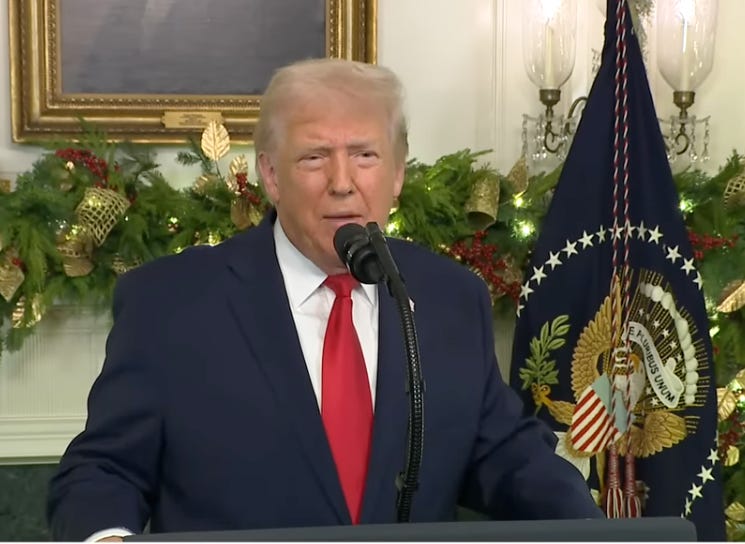
USA Today, of all places, then kicks the door off its hinges. There is no throat-clearing, no faux neutrality, no “critics say.” The headline calls Trump’s prime-time address “crazed” and dares to compare it to Joe Biden’s infamous debate performance, the moment that permanently rewired how the media talks about presidential capacity.
This is the same comparison that once would have earned an editor a frantic call from a standards desk. Now it runs in a mass-market national paper read by airport dads and dentists’ offices. The column doesn’t focus on the lies, those are old news, but on the delivery: the frenetic pace, the shouting, the rage without modulation. This wasn’t a man reassuring a nervous country. This was a street-corner ranter who accidentally wandered into a broadcast booth. And USA Today doesn’t end with a question. It ends with a verdict: the man running the country is not well.
That alone would have felt seismic. But then comes the Daily Beast, which doesn’t raise the temperature so much as explain how the fire alarm failed in the first place. After the cameras shut off, Trump turns to his aides and asks how he did. They tell him he was great, of course. He then explains that the whole thing wasn’t even his idea, his chief of staff made him do it. A primetime address to the nation, the kind historically reserved for wars, assassinations, or existential crises, was apparently deployed as a vibes-based damage-control maneuver because someone’s Vanity Fair profile got a little too honest.
And this may be the most horrifying part of the entire saga. Not the shouting, not the lies, not even the manic speed-run through economic fantasyland, but the banality of the trigger. The speech wasn’t prompted by a national emergency. It wasn’t an attempt to steady markets or respond to catastrophe. It was a glorified tantrum memo, greenlit by a sealed-off court of loyalists who respond to “How did I do?” with automatic praise and no reality check. This is not a system designed to protect the country; it’s a system designed to protect the leader from discomfort.
Queue the Kennedy Center. On the surface, the board’s vote to rename the John F. Kennedy Center for the Performing Arts the “Trump-Kennedy Center” looks like pure vanity, another grotesque branding exercise from a president who has never met a building he didn’t want to autograph. But in context, it reads differently. It reads as urgency.
Here is a sitting president, visibly aging, increasingly erratic, increasingly insulated, moving not to secure policy victories or build durable coalitions, but to weld his name onto a federal memorial while he still can. Not after death, and not through consensus, but right now. Through a handpicked board meeting at a billionaire’s Palm Beach home, complete with loyalty performances, a dissenting member muted on the call, and a declaration of “unanimous” acclaim that collapses under even casual scrutiny.
This all reads like legacy panic. Healthy leaders don’t need to annex national symbols to reassure themselves of permanence. Secure leaders don’t silence objections and call it unity. Leaders focused on the future don’t rush to carve their names into marble while alive. They govern. What Trump is doing instead, across the Kennedy Center, the White House grounds, the renaming schemes and monument fantasies, is turning institutions into emotional stabilizers. The state becomes a mirror, reflecting back the image he needs to see: strong, historic, indispensable.
The Kennedy Center episode doesn’t contradict the health scrutiny story, it completes it. As physical stamina wanes and cognitive tolerance for dissent narrows, the symbolic grabs get bigger, louder, and more desperate. Control of narrative is replaced with control of naming. When reassurance fails, enshrinement begins.
And if the Kennedy Center rename represents legacy panic at the scale of a federal memorial, the West Colonnade plaques show what that panic looks like when it turns inward, petty, and unfiltered.
Until recently, the West Colonnade was visual negative space, a quiet passageway, a 45-second commute between the West Wing and the residence, notable mostly for how unremarkable it was. Now it has been transformed into what can only be described as a presidential burn book. Gold-framed portraits. A gaudy “Presidential Walk of Fame” sign. A mirror Trump proudly showed off on Truth Social. And beneath each president’s image, a plaque etched with Trump’s own judgments, insults, and self-congratulation.
The plaques read less like history than like a late-night grievance spiral rendered in bronze. Joe Biden is declared “by far, the worst President in American History,” accused of humiliation and criminality in the familiar Trumpian cadence of erratic capitalization and personal obsession. Barack Hussein Obama is labeled divisive. Bill Clinton’s legacy is reduced to a punchline about Hillary losing to Trump. Even Ronald Reagan, spared the venom, is ultimately conscripted into praising Trump himself, as though no presidency can be allowed to exist without orbiting his.
Most revealing are Trump’s own entries. His first-term plaque praises Operation Warp Speed and claims he “saved millions of lives,” despite his current alliance with anti-vaccine conspiracists. His second-term plaque boasts of a “magnificent” White House ballroom that does not yet exist, a fantasy etched into metal while the East Wing sits in rubble. Reality, here, is optional. Assertion is permanent.
This is what personalization of power looks like when it sheds even the pretense of governance. History is no longer something to be stewarded or contextualized; it’s something to be annotated, corrected, insulted, and bent into a flattering shape. The White House itself becomes a mood board, an exterior wall repurposed into a running commentary track, updated not by historians but by impulse.
Placed alongside the Kennedy Center vote, the plaques stop being merely grotesque and start being diagnostic. As tolerance for dissent narrows and physical stamina visibly wanes, Trump’s relationship to institutions changes. They are no longer platforms for collective memory or democratic continuity. They are props, mirrors, emotional stabilizers. When reassurance fails, when the press finally begins to ask whether he is OK, the response is not transparency but enshrinement, not policy but permanence, not debate but bronze.
Confident leaders don’t behave this way. This is how leaders behave when time feels close, when control feels fragile, and when the line between legacy and ego collapses entirely.
Taken together, these stories mark a turning point that is both encouraging and deeply depressing. Encouraging because the media are finally doing the job they should have been doing all along: observing, contextualizing, comparing patterns, and refusing to pretend that age, stress, and decline are impolite topics when they apply to the most powerful person on earth. Depressing because it took collapsing poll numbers, elite recalculation, a truly unhinged television performance, and now a full-blown attempt to staple Trump’s name onto a JFK memorial, to make this scrutiny permissible.
There is something almost farcical about realizing that the press could have asked these questions earlier but chose not to, until the emperor not only had no clothes, but was yelling at a camera at 2x speed while quietly arranging to rename national institutions after himself. Yet, here we are, watching respected outlets cautiously, then bluntly, acknowledge what millions of viewers have been seeing in real time: this is not normal, this is not fine, and this is not strength.
Optimism, then, with a side of gallows humor. The media are waking up, but only because the situation has become too absurd to ignore. Is Donald Trump okay? I don’t think so, and even worse, there is no reason to trust the systems around him either.
After his death, Germany removed all monuments to Hitler and removed his name from any buildings where it appeared. Just saying…
Have been so grateful that you (and others on Substack) took on the gruesome task of watching Trump implode last night. Your accounting of course is unique, and also reflects on the sadness of our country’s year long tragedy🙏🙏