

There are some stories that walk into your week with muddy paws, a wagging tail, and absolutely no regard for your emotional stability. This is one of those stories.
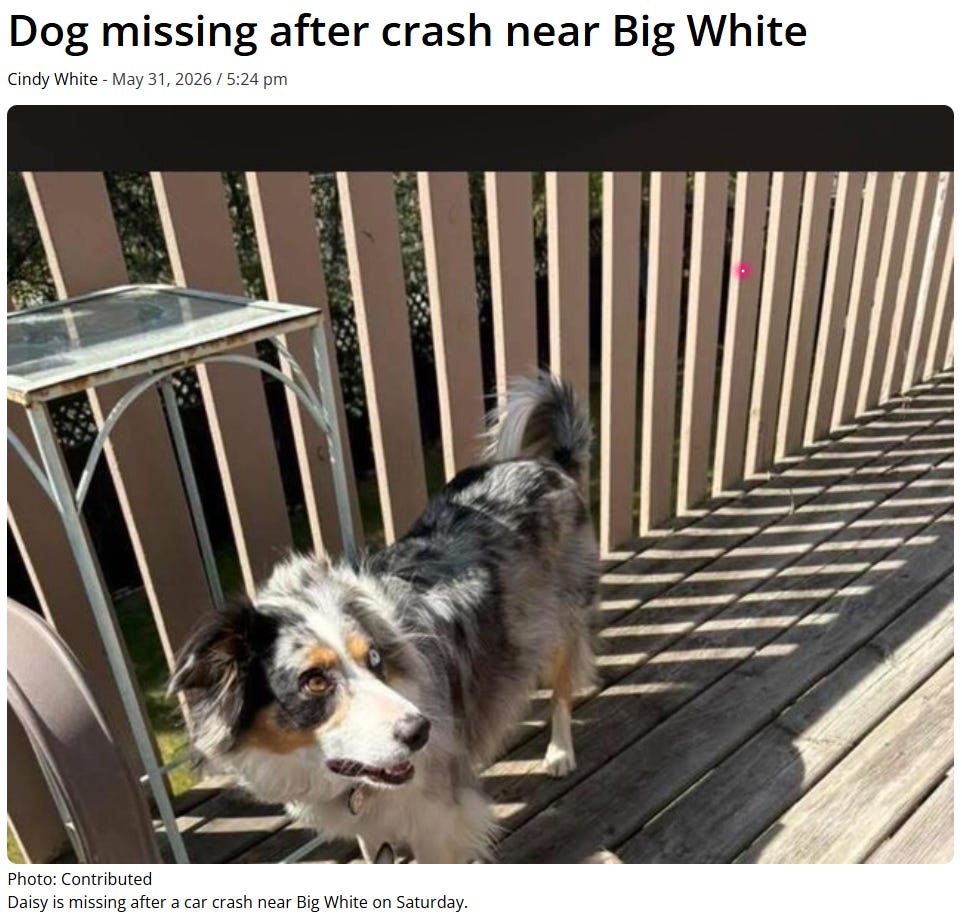
In British Columbia, near Big White, a woman named Dearah Jordan and her husband were in a terrifying rollover crash on a rural highway. Their vehicle flipped, the world went sharp and sideways, and when the terrible motion finally stopped, Dearah realized that Daisy, their three-year-old Australian shepherd, was gone. I don’t think I have to explain to the dog people what that means, but I will anyway, because some truths deserve to be said for everyone to hear. A dog is not just a dog.
A dog is the little soul who follows you from room to room as if your laundry schedule is spiritually significant, the warm body against your leg when the world has asked too much of you, the silent witness to all the things you can’t quite say to another human being, because people ask questions and try to fix things and sometimes look frightened by the size of your grief, but a dog simply stays. A dog says, with the whole soft machinery of their being, I’m here, you’re here, and for this moment that’s enough.
So, when Daisy disappeared into the wilderness after that crash, people understood that the emergency had not ended when the ambulance arrived, because Dearah and her husband had survived, thank God, but part of their family was still out there somewhere.
And then, because humanity is still a strange and beautiful species no matter how often we seem determined to prove otherwise, people started showing up. Friends, family, volunteers, and strangers came. People brought food, satellite communication help, a thermal drone, which I feel is exactly the level of technological seriousness we should all bring to the sacred task of finding someone’s missing dog. A member of Central Okanagan Search and Rescue named Forrest Kellerman heard about Daisy while he was responding to an unrelated rescue call, and even though search and rescue doesn’t officially search for pets, he couldn’t stop thinking about her.
He has Australian shepherds of his own, which explains everything and also possibly qualifies him for sainthood, because there is a specific madness that enters the heart when you know a breed well enough to imagine the little face, the bright eyes, the worry, the loyalty, and the stubborn belief that if everyone would simply calm down and throw a ball, things might still turn out fine.
Forrest went back on his own time and used his training to search logging roads and forested areas around the crash site. He searched for days, his wife, Tracey, searched too. Other people kept searching, they looked in the woods, along the roads, in the places a frightened dog might run, and then they did the thing love so often does, which is check one more place after exhaustion has already made a very compelling argument for stopping.
And there was Daisy. After four days, she had made her way back to the crash site, back to the last place she knew her people had been, and she was found sitting in the passenger seat of one of the vehicles, safe and waiting.
I need us to pause here and appreciate the full holiness and ridiculousness of that image. Daisy, who had survived the crash and the wilderness and several days of being lost, apparently returned to the scene like a tiny, furry prophet of faithfulness, climbed into a vehicle, and waited for the humans to finally catch up with her plan.
This is, of course, devastatingly sweet, but it is also very dog. Dogs are better at faith than we are. They return to the place love last made sense and wait there, even when the woods are dark, even when the days have passed, even when nobody else can see the thread they are following. And then people followed their own thread right back to her.
That is the part I can’t stop thinking about this week. The world is loud, and often it’s so loud with cruelty and people in suits saying things that make you want to go live inside a hollow tree with a kettle and a very judgmental crow. But beneath all that noise, there are still people hearing about a missing dog after a crash and deciding that they can walk the logging roads, use the skills they have, and help carry one terrified family from the worst moment of their life into the next bearable one.
I know something about that right now. On Friday, June 12, we signed the closing documents for our home, a date that will live in my memory as one of the greatest, most merciful, and most hopeful moments of my life. I don’t think I have the words for it, not really, because some kinds of relief are too large to become sentences right away. They just move into your body and sit there glowing.
The children are over the moon. I mean that sincerely and also logistically, because I’m pretty sure at least one of them is vibrating at a frequency only dogs and woodland creatures can hear. They are planning things with the wild confidence of children who believe that a house is not merely a structure, but a kingdom, a laboratory, a strawberry patch, a mud pie establishment, a fairy garden under development, and a place where someone might reasonably ask for a snack every nineteen minutes until the end of time.
Dad and I are exhausted in the specific way of adults who have survived a financial obstacle course designed by a committee of goblins. We have been working our little tushes off, learning about worms, compost, sun requirements, forest landscaping, and how to read an amortized loan schedule without developing a mysterious eye twitch. I cannot claim we are elegant homesteaders yet. At this stage, we are mostly sweaty people standing in the yard saying things like, “Do you think this is enough light for tomatoes?” and “Should compost smell like that?” and “Why does every answer about soil lead to fifteen more questions about worms?” Still, we’re here, and being here feels like a miracle.
Ezra saw his doctor this week, too. His birthmark is more raised than it was at his last appointment, and it is larger now, so his doctor sent in the request for an MRI again, this time with a letter explaining why it matters. He knows we are prepared to pay out of pocket but wants to try one more time for insurance to pay. They are looking for signs of either a tethered cord or syringomyelia, and I would be lying if I said those words don’t make my heart do strange and unpleasant acrobatics inside my chest.
But here is what is also true. With the exception of constipation, Ezra appears to be doing great. He is growing, and developing as expected for his age. He is still very much himself, which is to say he is a small and also somehow huge, beloved force of nature with cheeks that should probably be insured and a family wrapped around him like a quilt.
So, we wait, we worry, we water the tomatoes, and we learn about compost. We make phone calls, sign documents, and we hold terror in one hand and gratitude in the other, because parenthood, as it turns out, is mostly learning to carry both without dropping the baby.
And through all of this, people have shown up for us in ways I will spend the rest of my life trying to understand. Some help is practical, and some help is emotional, and some help seems to arrive through such improbable channels that you begin to suspect the universe has been quietly making arrangements behind your back. There are people who entered our lives through my writing, who were strangers before they became part of the story of our survival, and whose kindness has changed the shape of what was possible for my family.
I won’t name them here, because some acts of goodness are so bright they almost need a little shade around them, but I will say this. Long before I knew one of them, someone gave her hope as a name, as if sending a little flare into the world. And somehow, years later, that hope found its way to my doorstep when I needed it most. I don’t know what to do with that except weep a little, laugh a little, and believe, perhaps more stubbornly than before, that goodness travels farther than we think.
Maybe this is what Daisy’s story is really about, too. Not only the dog who came back, although God bless Daisy and every hair on her loyal little head, but the invisible map love makes in the dark. The way a frightened animal can find her way back to the last place she knew her people had been. The way strangers can find their way to a family in crisis. The way hope can leave one life as a name, a gesture, a kindness, and arrive in another life years later as a rescue.
We spend so much time talking about what breaks us, and to be fair, there is a lot. There are crashes we don’t see coming, diagnoses we dread, and homes we fear losing. There are bills and appointments and forms and waiting lists and children watching our faces for clues about whether the world is safe. But there are also people who keep looking.
There are people who don’t stop at the edge of their official duty. There are people who say, I have a drone, I have food, I have hope, or I have something to give, and I am going to give it. There are people who understand that love sometimes looks like walking through the woods calling the name of a dog you have never met, that a family can be brought back together by the smallest act of stubborn tenderness, and there are people who will help you find your way home.
This week, Daisy made her way back to the crash site and waited in the passenger seat, because some part of her still knew where love had been, my family signed papers that turned a threatened goodbye into a beginning, my baby’s doctor kept fighting for answers, my children looked at this place with the joy of people who get to keep imagining themselves inside it. And this week, even in the middle of everything frightening and unfinished, I am reminded that hope is not always a grand and shining thing descending from the heavens with a choir and a sensible plan.
Sometimes hope is a dog in the passenger seat, a doctor writing one more letter, a child reminding you to water the plants, a stranger becoming a friend, then becoming part of the reason your family gets to stay, or a tired parent squinting at an amortized loan schedule and whispering, with great spiritual conviction, “I have absolutely no idea what this means, but we live here now.”
And sometimes hope is simply this: when the world rolls over, when everything goes sideways, when what you love most disappears into the trees, there are still people who will come looking, people who will not give up, and people who will help bring the lost ones home.
Thank you for your post. I got the literall shivers on a hot Seattle day reading the saga of Daisy and her family and the community of carers!
I'm so glad your family now has your forever home, and that Ezra is thriving even with the scary,unanswered questions.
Keep taking good care.
First, i would echo Don Packer's remark below... he said it perfectly. i would only add that, do not hope, Know. i firmly believe we attract what we send out... as an owner of a border collie, sharper than most people i know, i would have expect her to show back up at the accident with the "jaws of life" and a first aid kit. Dogs are such amazing, wonderful members of one's family. along with the border collie (the brains of the outfit) i have two Leonbergers who are the most loving animals i have ever known... the one would gladly give you his dinner if he thought you needed it more than he. as a species, we could learn much from dogs and cats and for that matter most every other living species... like all your readers we are sending you caring thoughts and you will get through this.