


Donald Trump is trying to pardon himself from history. Not formally, not yet. The Supreme Court has already handed him a kind of preemptive absolution with its grotesque immunity ruling, and if he ever does attempt an actual self-pardon it will be marketed as a brave stand for the Constitution and a fabulous new opportunity for unity. But in practice, he’s already doing it. He is using the pardon power not as an instrument of mercy, but as a solvent poured over every constraint that might one day hold him to account.
In the process, he’s turning the United States into a country that no longer remembers what a crime is, who a victim is, or what the word “law” is supposed to mean.
We should start with the part everyone keeps politely stepping over: the president is a convicted felon and an adjudicated rapist having been found civilly liable for the sexual assault of E Jean Carroll. A jury found him liable for sexual abuse; a federal judge spelled out that this conduct meets the common understanding of rape. Another jury convicted him on 34 felony counts. This is the man now using the power of clemency like a chainsaw. The scandal is not only that such a man holds the office. The scandal is that the political class has decided to treat this as an eccentric little quirk of our era, rather than the structural emergency it is.
A felon president can more easily pardon felon allies. Equally, a rapist president can more comfortably rehabilitate abusers. A man whose own legal record would disqualify him from teaching kindergarten is now defining the nation’s moral and legal boundaries. That degradation at the top is the quiet precondition for everything that follows.
Trump isn’t just granting pardons; he’s granting permission. He told us who he was with his very first one. Back in his earlier incarnation as president, he pardoned Joe Arpaio, the Arizona sheriff convicted of criminal contempt of court. Arpaio wasn’t punished for a paperwork technicality. He was prosecuted, by Trump’s own Justice Department, for defying a federal court order to stop racially profiling Latinos and playing freelance ICE agent. A judge literally told him: you may not detain people just because you believe they “look illegal.” Arpaio’s response was to keep doing it anyway. Trump’s response was to reward him.
That pardon wasn’t just for Arpaio. It was for every cop, every official, every would-be strongman who looked at a court order and saw a suggestion. It was the presidency announcing that some people’s civil rights are negotiable and some court orders are optional. The message was clear: if your racism serves the right politics, you’re safe.
The pattern deepened from there. Blackwater contractors convicted for slaughtering Iraqi civilians, including children, in Nisour Square. Roger Stone, Paul Manafort, Steve Bannon, Michael Flynn, Charles Kushner. A string of Republican members of Congress convicted of corruption. It became a cottage industry, as the Washington Post put it, where the more powerful and well-connected you were, the more likely your name was to end up on a clemency list. Trump’s first term saw 238 people granted clemency; controversial, but almost quaint by what came next.
The second Trump administration has taken what was once a corrupt side hustle and turned it into governing philosophy. In just ten months, Trump has already handed out nearly 2,000 pardons. The vast majority are for the January 6 rioters: Proud Boys, Oath Keepers, violent offenders who beat police officers, smashed windows, hunted lawmakers, and erected a gallows outside the United States Capitol. He didn’t just shorten their sentences. He declared them patriots.
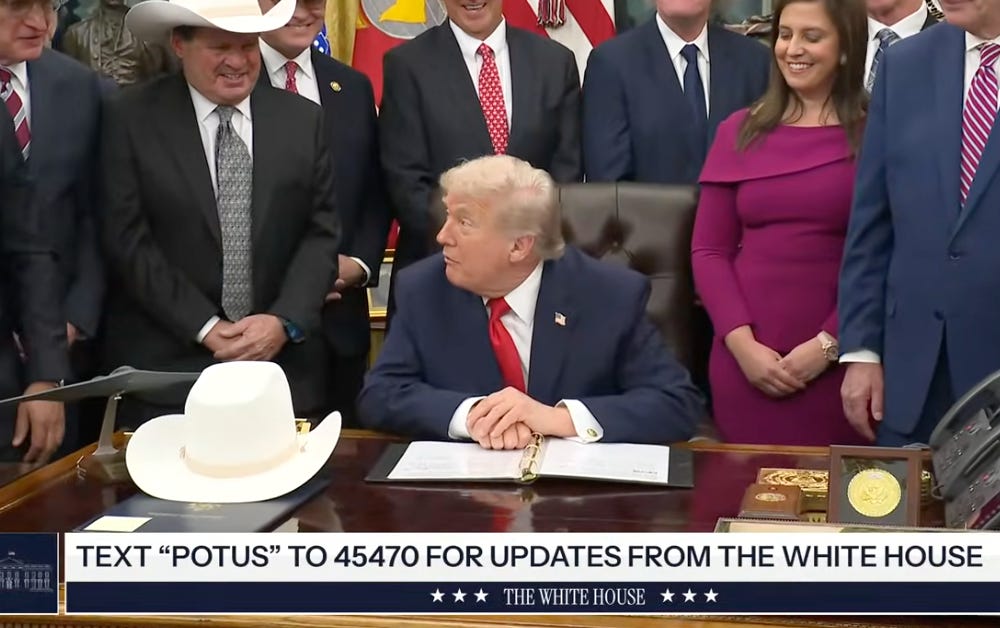
Federal judges, ordered to dismiss cases, have tried to salvage reality by writing their objections into the record. One called the mass clemency a “revisionist myth,” a careful way of saying: the president is trying to rewrite history with his signature. But the damage is done. The men and women who defended the Capitol now wake up in a country that treats their attackers as heroes and their injuries as regrettable but narratively inconvenient.
Victims are figuratively overwritten. George Santos, who in this timeline did eventually graduate from indicted fabulist to convicted fraudster before being scooped up and polished by presidential mercy, is now free to re-enter public life. The constituents he deceived, the donors he exploited, the people whose identities he abused, all of them now watch the man who scammed them stroll back into public life with the blessing of the state.
Or take the January 6 officers themselves, who watched their assailants go free by presidential proclamation. A pardon is supposed to represent a second chance for someone who has paid a debt. Here, it functions as a second assault: the state formally declaring that the violence they endured was not morally disqualifying; it was politically useful.
Even the turkey pardon looks different in this light. While the cameras follow a bewildered bird in a bow tie up to a podium, more than 18,000 human beings sit in a backlog of clemency petitions gathering dust. Fifteen thousand applied this year alone. Their names are public on a Justice Department spreadsheet. They are people serving extreme sentences under draconian laws, people who have aged out of their dangerous years, people whose cases would move any halfway serious review board to tears. Trump’s mercy is not for them.
The old system was deeply imperfect, Rachel Barkow’s “mercy lottery” is not a compliment—but at least it gestured in the direction of principle. There was a career Pardon Attorney, an office that tried, however unevenly, to weigh remorse, rehabilitation, fairness, and justice. Trump fired Liz Oyer when she refused to restore Mel Gibson’s gun rights and replaced her with a loyalist whose guiding doctrine is a hashtag: “No MAGA left behind.” The Justice Department is now effectively out of the clemency business. The White House is the vending machine, and the only accepted payment is proximity.
That’s how you end up with a country where Trump doesn’t just pardon people; he pardons corporations. HDR Global Trading, BitMEX, received a full and unconditional pardon, wiping out a $100 million fine for anti-money-laundering violations. It was legal fiction meeting legal fiction: the presidency forgiving a creature of statute for conduct that harmed actual human beings who will never see a dime. And this wasn’t an isolated act. According to Democratic staff on the House Judiciary Committee, Trump has now forgiven more than $1.3 billion in restitution owed to victims of white-collar crime. A billion here, a billion there, and suddenly justice becomes just another asset class to be written down.
Changpeng Zhao, the founder of Binance, pleaded guilty to running what even the Wall Street Journal, not typically staffed by abolitionists, called a giant money-laundering mill. Binance knowingly allowed money to flow to terrorists, cybercriminals, child abusers, and sanctioned regimes. The company agreed to pay more than $4 billion in penalties. Zhao himself paid $50 million and served four months in a low-security facility where he could, quite literally, take supervised trips to the movies.
By the time Trump pardoned him, Zhao had already walked free. The only real effect of the pardon was to scrub the criminal record, restore Zhao’s eligibility to resume control of his empire, and launder the reputation of a man whose platform facilitated financial pipelines for some of the worst actors on earth.
So why intervene at that point? Why Zhao, out of all the nameless people with impossible sentences and no lobbyist? Because Binance has been quietly scaffolding the Trump family’s new crypto venture, World Liberty Financial. It helped build the plumbing for the USD1 stablecoin. A UAE-linked investment pushed the coin’s capitalization into the billions. Lobbyists close to the Trump sons were hired at eye-watering prices to secure “executive relief.” Binance even began promoting USD1 on its own platform days after the pardon, sending value flowing in precisely the direction Trump’s family needed it to.
The whole story is so on-the-nose it reads like satire: a billionaire money-laundering defendant enriches the president’s children through crypto infrastructure deals and then, surprise, receives a presidential pardon. Even the Wall Street Journal noted that Zhao’s clemency was the most blatant example yet of Trump using public power to reward private enrichment directed toward his own family.
When asked by 60 Minutes why he pardoned Zhao, Trump offered the usual hallucinatory defense: he doesn’t really know Zhao and doesn’t understand crypto, except that it’s “a huge industry.” The White House insisted this means Trump has no “personal relationship” with Zhao, the kind of assertion that suggests a president believes corruption only counts if there are Christmas cards involved.
The point here isn’t mere corruption, but pedagogy. Trump is teaching the financial world that the boundary between criminality and capitalism no longer runs through the law; it runs through him. Help the family enterprise, and your sins become negotiable. Send value upward, and the president will erase the victims downward.
In a system where $1.3 billion in restitution to victims can be vaporized with a signature, what does crime even mean? Who are victims in a world where the president can simply delete their existence? What does justice signify when its price is negotiable and its virtues transferable?
The same pattern animates his supposed compassion for Tina Peters, the former Colorado clerk convicted of tampering with voting machines to feed Mike Lindell’s fantasies. Trump “pardoned” her on Truth Social for the supposed “crime” of demanding honest elections, even though presidents have no power over state convictions. It was a legally meaningless gesture, but he wasn’t aiming at the Colorado Department of Corrections. He was aiming at every local official tempted to meddle with future elections. The message was simple: if you break the law for me, I will bless you, even when the Constitution says I can’t.
George Santos gets permission to grift. Tina Peters gets permission to sabotage democracy. Zhao gets permission to launder. The January 6 rioters get permission to attack the state. The fake-elector crowd even gets a surreal pseudo-pardon proclamation that has no force of law but plenty of symbolic value, an effort to retroactively sanctify the plan to overthrow an election.
Reuters revealed that Trump’s administration is now pressuring the International Criminal Court and its member states to amend the Rome Statute itself so that, once he leaves office in 2029, the court cannot prosecute him, his vice president, his secretary of war, or others for war crimes. Not just “will not”, but cannot. He wants the foundational document of the global war crimes tribunal rewritten to, in essence, carve his name out of the jurisdictional universe.
This is happening against the backdrop of a deadly U.S. campaign of maritime strikes in the Caribbean and Pacific, more than eighty people killed, including a now-infamous double-tap strike that killed two survivors floating in the water. U.S. allies have started backing away: the UK has limited intelligence sharing in the region, France has called the operations violations of international law, the EU and UN have raised legal questions even before the worst details were known. Members of Congress from both parties are demanding the tape.
The ICC can, under its statute, prosecute sitting heads of state. In practice, it often waits until they’re out of office. Trump knows this. Someone close enough to leak to Reuters says the quiet part: there is “growing concern” that in 2029 the court will turn its attention to Trump and his inner circle. That, they say, is “unacceptable,” and they “will not allow it to happen.”
The United States, which never joined the ICC, is now trying to strong-arm its members, our supposed allies, into neutering it. Drop the Afghanistan probe. Drop the Gaza warrants for Netanyahu and Gallant. Drop any potential inquiry into Trump’s strikes. Oh, and while you’re at it, amend your own charter to insert a bespoke immunity clause for our guy. If not, there will be more sanctions, not only on individual judges and prosecutors, but potentially on the court itself.
It is the Arpaio logic scaled up to the global level: court orders are optional, jurisdiction is political, and law is a minor character in a story about power.
Somewhere in all this, Jack Smith is hanging out his shingle with other former federal prosecutors, having once prosecuted crimes at The Hague himself. He spent years in a system designed to hold leaders accountable after they left office. Trump is now trying to dismantle that system preemptively, so that the man Smith once tried to indict cannot be touched by the principles Smith once enforced.
Then, looming over the whole mess, there are the Epstein files. After a rare moment of bipartisan sanity, Trump signed the Epstein Files Transparency Act, requiring the Justice Department to release its Epstein and Maxwell records by December 19, 2025. Survivors, who have been gaslit and stonewalled for years, pushed it over the line. A federal judge has ordered grand jury material unsealed. The promise, on paper, is that the country will finally see who enabled Epstein and how the system protected him.
But survivors and Senate Democrats are not naïve enough to trust this administration’s paper promises. They’ve sent a letter to the DOJ’s Inspector General demanding an audit of the chain of custody: who handled the evidence, when, where, with what authority, and under what pressures. They want to know whether boxes went missing, documents were altered, or names were quietly excised.
They have reasons. A DOJ deputy chief was caught on hidden camera saying, as if he were commenting on the weather, that “they’ll redact every Republican or conservative person in those files.” Ghislaine Maxwell’s transfer to a cushy minimum-security facility, in defiance of Bureau of Prisons policy, raised suspicions of a deal. Internal FBI emails describe the creation of a special redactions team, thousands of overtime hours, nearly a million dollars in one week alone, and a process explicitly focused on identifying any mention of President Trump.
Trumpworld appears to be grooming FBI Deputy Director Dan Bongino as the designated fall guy if anything about the files’ handling blows up. Bongino, a former MAGA talking head who once demanded full disclosure of the very files he’s now overseeing, is being positioned right where the buck is supposed to stop. If the files are mutilated, we are clearly meant to blame “mishandling” rather than malice.
The inspection the survivors are demanding is not a technicality. It is a referendum on whether the United States is still capable of telling the truth about the powerful men who move through its institutions, and about the man who currently sits at the top of them, desperate to ensure that every record of every crime, from Epstein to war crimes to January 6, either disappears or exonerates him.
Layer on top of this Trump’s public defense of Andrew Tate and his quiet, smirking courtship of Tate’s audience. Tate is not just one man with a rap sheet and trafficking allegations; he is a vector, an evangelist for a worldview in which women are property, empathy is for the weak, and domination is the natural prerogative of the successful male. And the connection is not theoretical. As the New York Times reported, Tate has become a formative figure in the Trump family ecosystem itself. Donald Jr. promotes him as a misunderstood masculine icon. Eric echoes his talking points about “feminized society.” And Barron, the child Trump himself keeps insisting is a prodigy of immense consequence, has reportedly been consuming Tate’s content, absorbing the lessons of a man who teaches boys that exploitation is empowerment and cruelty is charisma.
A president with his own history of sexual violence choosing to align with this ethos is part of the same permission structure that allows Trump to pardon violent men, celebrate January 6 assailants, rehabilitate fraudsters, and brush aside allegations of abuse. It is Trump telling a generation of angry young men, including those in his own household, that their worst instincts are not only forgivable, but desirable. That their misogyny is not a problem to overcome, but a credential. That the way to be a man in Trump’s America is to make yourself unaccountable.
In a normal country, a president distances himself from predators. In Trump’s America, he elevates them into role models and pipelines their ideology to his own sons. It is not simply corruption; it is pedagogy.
No authoritarian project is complete without an invented enemy. In Trump’s America, that enemy is “antifa”, not an organization at all, but a tactic and a loose anti-fascist tendency, a label people slap on themselves when they show up to oppose fascists in the street. It has no membership list, no leadership, no headquarters, no uniforms, and no branding beyond the vague proposition that fascism is bad. In other words: the perfect foil for a president who needs a domestic Al Qaeda but can’t find one.
So Trump simply conjured one. He declared antifa a “major terror organization” even though it isn’t an organization. He issued a presidential memo instructing the FBI’s Joint Terrorism Task Forces to investigate and prosecute not just antifascists but adherents of “anti-Americanism,” a category capacious enough to include librarians, sociology majors, anyone who’s ever retweeted AOC, and the entire membership of Amnesty International.
By the time FBI National Security Operations Director Michael Glasheen appeared before the House Homeland Security Committee, the farce had become too large to ignore. Glasheen dutifully repeated the party line that antifa is the “biggest domestic threat.” Then Rep. Bennie Thompson asked the most dangerous question in Washington: “How many members does antifa have? And where are they located?”
Silence. Shuffling papers. The sound of a man realizing, in real time, that he has been dispatched to a national stage to describe the contours of an enemy that exists primarily in presidential imagination and Mar-a-Lago fundraising emails. It had shades of Colin Powell holding up that little vial at the UN, except this time, instead of gesturing toward hypothetical uranium stockpiles and “mushroom clouds,” the administration’s chosen witness couldn’t even conjure a metaphorical vial. He had nothing to hold up. No map, chart, and certainly no roster. Just the political obligation to pretend that a tactic is a terror army.
Pressed again, the FBI official tried: “Well, the investigations are active.” Thompson pressed harder. Glasheen attempted a second escape hatch: “That’s very fluid.” Then, in a moment destined to be studied by political scientists and comedy writers for decades, he added, “The same, no different than Al Qaeda or ISIS.”
And with that sentence, the United States government officially entered its weapons-of-mass-destruction-for-the-domestic-audience era. Except this time the “imminent threat” wasn’t hidden in bunkers or shipped in centrifuges. It was located in the administration’s need for a foil, and in the tragicomic spectacle of an FBI official trying to inflate a handful of black hoodies and anti-fascist slogans into a homegrown jihadist network.
There it was. America, once the country that built the legal architecture for fighting transnational terror networks, now has government officials comparing a loose constellation of Twitter accounts and grad students in black hoodies to global jihadist organizations with logistics pipelines, funding sources, and paramilitary training camps.
The United States has become a cartoon of itself, and the punchline is delivered at congressional hearings. The absurdity would be funny if it weren’t so dangerous. Because beneath Trump’s fixation lies a deeply strategic aim: if you can brand antifascism as terrorism, then you can criminalize dissent; if you can label critics as enemy combatants, you can mobilize counterterrorism tools against them; if you can paint your political opponents as violent extremists, you can justify almost anything.
This is how police states begin: not with a bang, but with bureaucrats sweatily improvising answers about imaginary terror groups before the Homeland Security Committee.
The truth, according to the actual data, is that antifa-linked violence is not only statistically negligible; it is much lower than historical levels of violence carried out by right-wing and jihadist attackers. But Trump doesn’t need facts. He needs a foil, a villain, to validate his own lawlessness. He needs a domestic enemy large enough to justify using the tools of counterterrorism against American citizens.
And conveniently, he needs a distraction from a different kind of domestic extremism,the kind that wore tactical gear, beat police officers, smeared feces in the Capitol Rotunda, and erected a gallows on January 6. That extremism he pardoned, and even celebrated. That extremism is now a recruitment pool for his campaign rallies.
In Trump’s moral algebra, actual terrorists become patriots, while a teenager in Portland holding up a cardboard sign becomes a proto–Osama bin Laden.
Even the inciting incident for Trump’s new obsession, the tragic September 10 killing of Charlie Kirk in Utah, has failed to produce any evidence of organized antifascist conspiracy. Investigators have found no network, no funding, no ideological chain of command, no shadowy figures in dark rooms pulling strings. The alleged shooter carved an ugly phrase on a bullet and acted alone. But Trump’s administration seized upon it as the Reichstag fire they’ve been waiting for, launching a frantic search for nonexistent ties to foreign or domestic groups.
You cannot find what does not exist, but you can waste enormous institutional resources searching for it. And more importantly, you can terrify your base, mobilize your agencies, and justify new forms of repression under the guise of national security.
Again, this is not about antifa, or clemency, or righting wrongs. This is about permission, pure and simple. Permission for Trump’s supporters to see themselves as warriors against an existential threat, and for federal agencies to target political enemies under the banner of counterterrorism. It is permission for the administration to shift public discourse from “Why did you pardon violent insurrectionists?” to “Why aren’t you doing more about the terrorists in Portland?”
When the president cannot explain what crime is, he must create criminals.
When he cannot justify his own lawlessness, he must paint others as the true danger.
When actual extremists are his political constituency, he must fabricate extremism elsewhere.
So the FBI, under pressure from a president who sees fascism as a lifestyle brand and antifascism as sedition, is now trying to build “infrastructure” to track a threat that won’t sit still long enough to be categorized, because the threat is not an organization. It is an idea. In Trump’s America, ideas opposing authoritarianism must themselves be treated as terrorism.
Antifa has no headquarters, but Trump does. From that headquarters, the real threat to democracy is being organized very clearly. At every level, personal, cultural, legal, geopolitical, the pattern holds. Trump does not use the pardon power to correct injustice. He uses it to declare that what was once injustice is now acceptable.
That’s why even the Wall Street Journal, hardly staffed by antifa, has started to sound rattled. They’ve called this a “wild west” of pardons, described the Zhao pardon as a particularly blatant fusion of public power and private enrichment, and catalogued a clemency regime that looks less like mercy and more like a rewards program.
The 18,000 nameless applicants sit, waiting for a system that was never meant to be a donor perk. Hamilton, in Federalist 74, described the pardon power as a “benign prerogative” necessary to soften the criminal code’s “necessary severity,” a way to make sure justice did not wear a face “too sanguinary and cruel.” The whole point was to correct injustice, to blunt the excesses of legislators and prosecutors, not to turn the presidency into a coupon book for the president’s friends.
We are miles away from that now. The criminal code is still severe for the poor, the powerless, the unlucky. But for Trump’s world, for the George Santoses, the Tina Peterses, the Zhao-style billionaires, the violent extremists in tactical gear, justice wears a different face entirely. It smiles, shakes their hand, and hands them a signed document saying: go forth and do likewise.
Trump is teaching a generation that guilt is not about what you did; it’s about whose side you’re on. He’s turning the presidency into a machine that converts criminality into virtue, provided it serves his personal or political interests.
That’s why the stakes here are so much bigger than one bad man with too much power. When a country’s leader is a convicted felon and adjudicated rapist who uses the pardon power to enrich his family, reward co-conspirators, normalize violence, erase victims, bully international courts, invent enemies at home, and potentially tamper with evidence of a global trafficking conspiracy, the crisis isn’t just in the Oval Office. It’s in all of us.
Somewhere along the way, we were told to stop being shocked. To treat each new abuse as just another episode of an endless, exhausting show. To roll our eyes at the latest pardon, the latest fake legal stunt, the latest immunity grab, and to move on. If we accept this as normal, then we have already answered the question the rest of the world has been quietly asking: how far can a democracy fall before it stops being one?
A healthy nation understands that clemency exists to wipe away injustice, not to launder it. A healthy nation understands that a pardon is not a get-out-of-jail-free card for the highest bidder but a last resort for the genuinely wronged. A healthy nation does not allow its head of state to turn mercy into a loyalty program and then call that strength. America is no longer a healthy state.
The good news, if there is any, is that the rot is visible. Survivors are demanding audits. Judges are writing dissents. Journalists are tracing the money. Senators are drafting constitutional amendments to bar self-pardons and corrupt clemency. Legal scholars are proposing independent clemency boards to take mercy out of the hands of prosecutors and courtiers.
But none of that will matter if we don’t recover one simple, endangered idea: that the law is supposed to bind the powerful, too. There are acts so wrong they cannot be rebranded as noble by tweet, proclamation, or pardon seal. That a president who keeps trying to rewrite the definition of crime is telling us, day after day, exactly how guilty he is.
Rather than pardoning “his people”, Trump is indicting his country.
How am I supposed to get a good nights sleep now?!? I should have waited till tomorrow to read this. Keep breathing. Keep breathing. Tomorrow is another day for resistance.
so very true. Thanks for the accurate (and depressing) summary of where we've been and where we are.