


This essay is about what Project 2025 wants women to give up. It wants a country where abortion is harder to access, contraception is easier to restrict, the language of “gender equality,” “reproductive health,” and “reproductive rights” is stripped from federal policy, and support systems that treat women as independent citizens are replaced with policies that privilege what it calls “stable, married, nuclear families” while condemning “subsidizing single-motherhood.” In other words, this is not just a fight about one policy or one election. It is a fight over whether women will be allowed to remain fully autonomous adults, or pushed back toward a social order in which our safety, dignity, and survival are meant to depend more heavily on husbands, fathers, churches, employers, and the state. That is why I am writing this. Because the attack on women’s independence is not only cruel, it is historical vandalism. It asks us to forget what women have done with freedom, and to accept a future built on making us smaller.
Because once you strip away the polished language about family, morality, and social order, the basic complaint underneath this worldview is not hard to hear. Women are too independent. Women have too many choices. Women can leave, delay, refuse, invent, achieve, organize, earn, and live in ways that do not place men at the center of every calculation. Project 2025 says families “comprised of a married mother, father, and their children” are the foundation of a “well-ordered nation and healthy society,” condemns what it calls “subsidizing single-motherhood,” and proposes replacing those policies with ones that support “stable, married, nuclear families.” Elsewhere, the Project 2025 text calls for deleting terms such as “gender equality,” “abortion,” “reproductive health,” and “reproductive rights” from federal rules and programs, and it pushes defining sex under Title IX as biological sex recognized at birth. This is not a blueprint for making women freer. It is a blueprint for making women smaller.
And my response to that, more and more, is not merely outrage. It is disbelief. Don’t you remember what women have already done in this country when given room to breathe?
Don’t you remember Rosie the Riveter, not as a piece of nostalgia on a tote bag, but as a stand-in for millions of women who entered wartime industry when history demanded it? The famous “We Can Do It!” image was part of a wartime effort to recruit women into the workforce, and women filled defense jobs in factories and shipyards across the country. At Richmond’s Kaiser shipyards and elsewhere, women welded, riveted, assembled, and kept the machinery of war moving. America did not lose World War II because women entered the workforce. America depended on them. Apparently the republic can survive global war with women building ships and munitions, but a woman in a modern engineering program is where some men suddenly discover their concerns about social stability.
Don’t you remember the women of NASA and NACA, the mathematicians, engineers, programmers, and team leads whose work powered American flight and the space race? NASA itself now honors the women who served as computers, mathematicians, and engineers from the 1930s through the 1970s, including Katherine Johnson, Dorothy Vaughan, and Mary Jackson. Their calculations, leadership, and technical work were not ornamental. They were foundational. These women were doing some of the most intellectually demanding work in the country while a culture built by lesser imaginations still wanted women to be grateful for the privilege of being underestimated.
And yes, let’s be even more specific. Don’t you remember Margaret Hamilton? She led the Software Engineering Division at MIT’s Instrumentation Laboratory, which developed the onboard flight software for Apollo. NASA credits her as a key contributor to the software effort behind the lunar missions, and she is widely credited with helping popularize the term “software engineering” itself. So when Scott Yenor says, “Every effort must be made not to recruit women into engineering, but rather to recruit and demand more of men who become engineers. Ditto for med school, and the law, and every trade,” what exactly are we supposed to do with Margaret Hamilton? Pretend one of the women who helped write the software logic behind the Moon landing was just a regrettable interruption in the natural order of things? If your social philosophy collapses at the sight of a woman engineer, the delicate thing in the room is not womanhood.
And while we are on the subject of women in science, don’t you remember Pearl Kendrick and Grace Eldering? In the 1930s, working in the Michigan Department of Health laboratory in Grand Rapids, they began the research that led to an effective pertussis vaccine. Their work moved from painstaking local public-health research into mass production and widespread vaccination, helping sharply reduce disease and death. These were not women making themselves useful in some decorative, auxiliary sense. These were women helping save children’s lives. A movement that wants women less educated, less independent, and less present in serious work is not defending civilization. It is spitting in the face of the women who helped keep children alive in it.
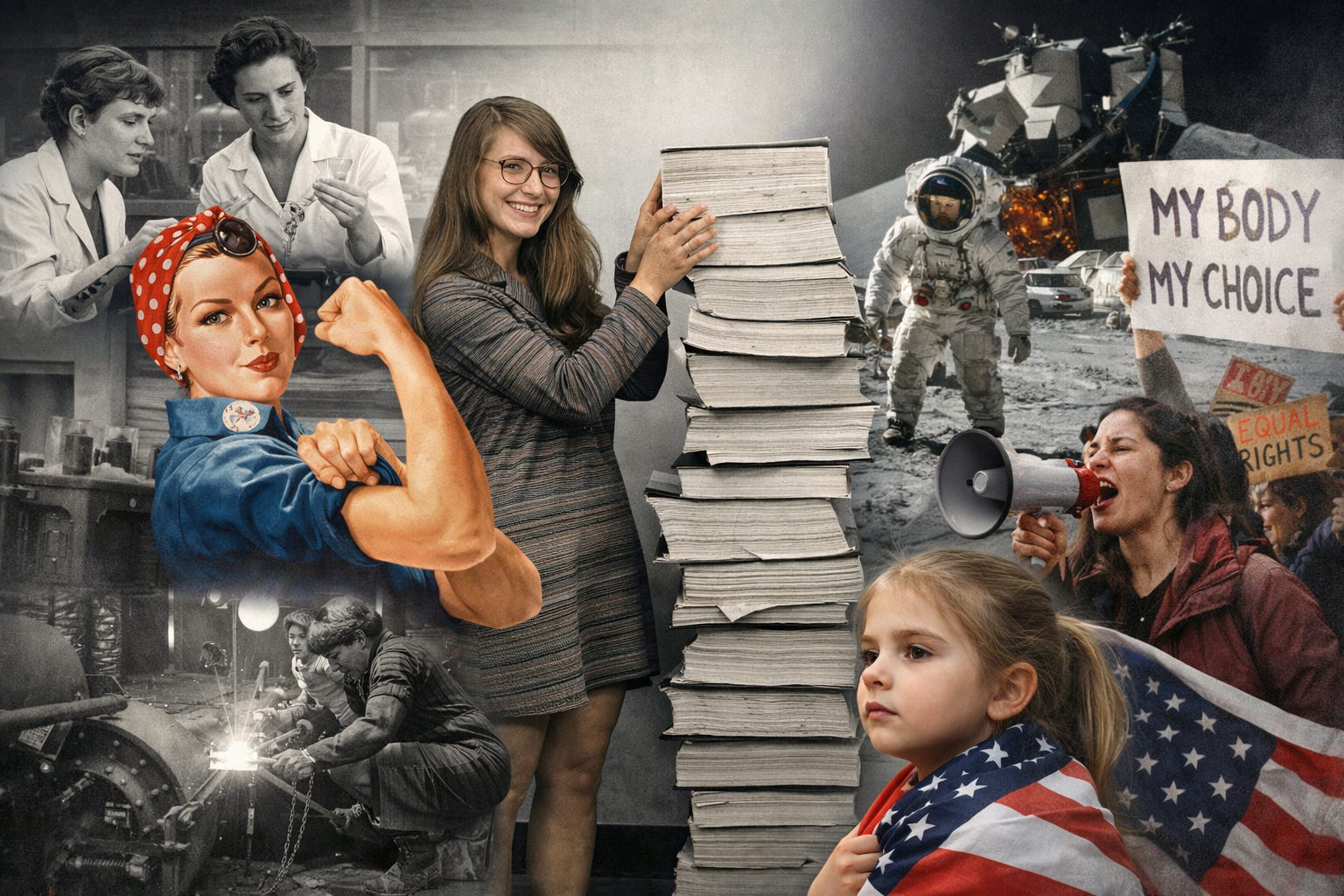
That is why I find the rhetoric of this movement so offensive. It is not only misogynistic. It is embarrassingly ungrateful. It asks women to forget our own inheritance and then asks the rest of the country to call that forgetfulness virtue. It asks us to believe that women’s freedom is somehow in tension with the national good, when the historical record keeps showing the opposite. When women have access to education, to work, to research, to technical training, to law, to medicine, to engineering, and to political life, society does not become weaker. Society becomes more capable, we solve more problems, we build more things, we save more lives, and we widen the circle of who gets to count as fully human.
Which is exactly why men like Scott Yenor sound the way they do. Yenor, who now serves as a director at the Heritage Foundation, has described universities as “the citadels of our gynecocracy,” argued that higher education should be de-emphasized for “family matters,” and said of women in elite achievement, “If every Nobel Prize winner is a man, that’s not a failure. It’s kind of a cause for celebration.” He has also described independent women as “medicated, meddlesome and quarrelsome.” Those are not slips, those are beliefs. They reveal, with unusual honesty, that what agitates this worldview is not female weakness, it is female capability. Weak men do not fear women because women are “useless,” they fear women because they know perfectly well what women can do when we are not trapped.
And that is where the Project 2025 agenda around fertility becomes impossible to ignore. A woman who can control whether and when she becomes pregnant has more leverage over the shape of her life. She has more room to study, more room to earn, more room to leave, more room to refuse humiliation, more room to decide that she would rather build a life on her own terms than accept dependence dressed up as protection. That is why contraception matters, why abortion access matters, why support for single mothers matters, and why childcare matters. These are not side issues orbiting some larger debate about culture, they are the architecture of female freedom. Project 2025’s hostility to reproductive autonomy and its preference for a social order organized around married male provision are not separate matters, they are part of the same design. Dependence is not dignity; it is vulnerability with better branding.
And I want to say this as plainly as I can. Women do not deserve independence because men have graciously decided to permit it. Women deserve independence because we have shown, over and over and over again, what we do with it. We build ships, we write code, and we run calculations. We organize labor, create vaccines, we hold families together, and we fight for the vote. We force open institutions that were never eager to let us in, and we carry more than our share, and then we are told, often by men whose greatest contribution is a podcast microphone and a grievance, that female ambition has become a little too assertive. Forgive me if I do not find that analysis especially weighty.
There is a peculiar smallness to a worldview that sees a free woman and immediately begins thinking about how to reduce her options. It is the politics of the cramped imagination. It cannot imagine society made stronger by women’s agency, so it can only imagine order restored through women’s dependence. It cannot imagine equality as a source of civic power, so it tries to turn equality into a dirty word. It cannot imagine women as fully human citizens, so it keeps reaching for older scripts in which a woman becomes respectable only by orbiting a husband, a father, a church, or a boss. The whole arrangement is sold to us as moral seriousness, but it has all the grandeur of a man hiding your car keys and calling it leadership.
What infuriates me most is that women are expected to accept this with gratitude, or at least with decorum. We are supposed to nod thoughtfully while people call for fewer women in engineering, fewer women delayed by college, fewer women shaped by independence, fewer women able to support themselves outside approved family structures. We are supposed to act as if this is a legitimate philosophical disagreement rather than a naked attempt to narrow women’s lives. We are supposed to overlook the fact that the same movement that romanticizes motherhood is often hostile to the concrete things that make women safer and freer within motherhood, including reproductive choice, economic independence, and support for women raising children without a husband. I am not interested in pretending that any of this is subtle. It is a backlash against women having enough power to say no.
But I do not want to answer it only with disgust. I want to answer it with memory and with love. Love for the women who came before us and did extraordinary things in a world that offered them less. Love for the women who refused to stay small, for the women on the factory floor, in the laboratory, at the drafting table, in the math office, in the code room, in the clinic, and in the union hall. Love for the women whose competence made this country stronger while smug men were still busy constructing theories about why they should be less visible. There is a reason reactionaries spend so much time trying to discipline women’s ambitions. They remember, however dimly, what women are capable of, and that is exactly what frightens them.
So yes, let’s say it clearly. Any man who thinks estrogen is evidence of inferiority is not revealing women’s weakness, he is revealing his own. He is telling you that female freedom makes him feel threatened, that female competence makes him feel displaced, and that female independence makes him aware, perhaps for the first time, that he may not be owed centrality. That is not strength, it is panic in a necktie.
And that is why I refuse the whole project. I refuse the lie that women are more dignified when we are less free, that dependence is safety, and that family values require female submission. I refuse the lie that women’s independence is some elite modern indulgence rather than a proven public good. History remembers better than that, Rosie remembers. Margaret Hamilton, Katherine Johnson, Dorothy Vaughan, Mary Jackson, Pearl Kendrick and Grace Eldering all remember. The country we have is, in part, the country women built when we were allowed to work, think, invent, and act like full human beings.
I have a four-year-old daughter. She is intelligent in ways that feel almost impossible for her age. She is funny, fiery, full of willpower, and full of spirit. I believe, as I am sure so many of you believe about your own daughters and granddaughters, that she has the potential to leave an immense mark on the world. And I will not stand by for a single moment while some draconian man with a small mind tries to shrink her future before she has even had the chance to claim it. The task now is not simply to defend women’s freedom in the abstract. It is to remember what that freedom has already made possible, and to refuse, without apology, the small men who would like us to forget.
So here is the call to action, for women and for the men worthy of standing with us: resist this everywhere. Call your representatives, and pressure your senators. Organize locally, protest publicly, and fund the groups defending reproductive freedom, legal equality, and women’s economic independence. Vote in every election, not just the glamorous ones. Teach your sons that women are not here to be ruled, and teach your daughters that freedom is theirs to keep. Refuse passivity, cynicism, and the comforting lie that someone else will handle this. The people advancing this agenda are organized, determined, and shameless. We will have to be more organized, more determined, and more unafraid. Whatever it takes, we must be willing to do it, because the future of women and girls in this country is too precious to leave in the hands of men who fear what free women can become.
Thank you, Shanley. What infuriates me most is that some women agree with this and have willingly signed on to be Stepford Wives. Outrageous!
Right on, Shanley! As a career Air Force pilot (male) and then a second career airline Captain, I have worked with, and for, lots of women. They are every bit as capable as the men who perform the same jobs (if not more capable). Your examples from history easily support my statement. There is one group of women who are seldom celebrated for their contribution to the World War II cause--the WASPs. The Women's Air Service Pilots deserve a place in history. These women were recruited and trained to fly all types of airplanes in order to ferry the airplanes from the continental U.S. to Europe. The route left Goose Bay, Labrador, then to Greenland, then to Iceland, and finally to bases in England. More than 15,000 planes were delivered on this route, a large number of them flown by the WASPs. The WASPs were not permitted to join the military, thereby getting paid less with no pension or other benefit. The route that they flew was extremely hazardous--no place to land except the refuel stops, no hope of rescue if they had to ditch in the North Atlantic. Despite all the hazards, their record was exemplary. Anyone who thinks Project 2025 is a good idea is obviously not a female--he is also not much of a male, either.