


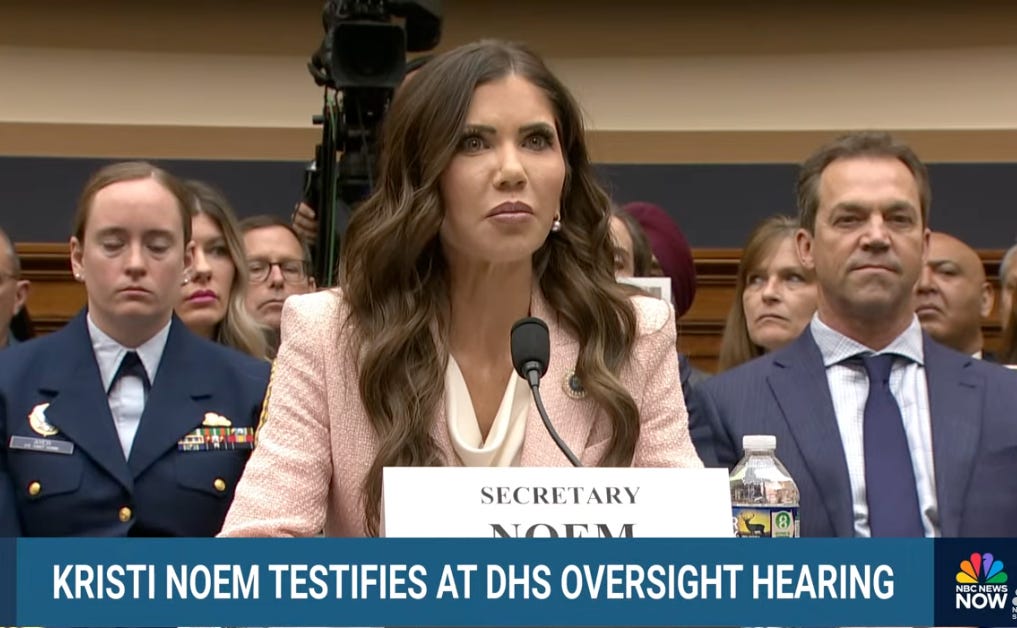
Kristi Noem went to Capitol Hill this week to testify before the Senate Judiciary Committee, and like so many officials before her, she discovered that the most dangerous thing in Washington is not a hostile senator; it’s paperwork.
Senator Richard Blumenthal asked Noem a straightforward question of whether Corey Lewandowski, the former Trump campaign manager turned perennial political barnacle, had any role in approving contracts at the Department of Homeland Security.
Noem’s answer was short and definitive.
“No.”
That would have been the end of it, except for the small complication that DHS apparently keeps records. According to new reporting from ProPublica, internal department documents show Lewandowski personally approved a multimillion-dollar equipment contract last summer. Not only that, but current and former DHS officials told reporters that Lewandowski regularly signs off on major contracts and often serves as the final checkpoint before the paperwork reaches Noem herself. The answer to Blumenthal’s question appears to be less “no” and more “he’s practically sitting on the approval stamp.”
The arrangement is unusual even by Washington standards. Lewandowski is not a traditional government employee. He is classified as a “special government employee,” a designation normally used for outside experts who temporarily lend their expertise to federal agencies. These positions are typically limited in scope and duration, allowing academics, scientists, or industry specialists to contribute without permanently leaving their private-sector jobs.
Lewandowski, however, is not advising NASA about rocket propulsion. He is helping run the Department of Homeland Security, and doing it while technically volunteering.
The official line from DHS is that Lewandowski “does NOT play a role in approving contracts” and receives no government salary or benefits. The implication is that he is simply a public-spirited citizen donating his time for the good of the republic, presumably between campaign consulting gigs and cable news appearances.
The internal process described by ProPublica paints a very different picture. Last year, Noem implemented a new policy consolidating power over DHS spending. Under the rule, every contract above $100,000 must pass through a chain of political appointees before reaching the secretary’s desk. Each official signs or initials a routing sheet that accompanies the contract. According to multiple DHS officials, Lewandowski’s name typically appears at the end of that list, right before Noem’s signature. While DHS insists he has no role in approving contracts, the documents appear to show him approving contracts.
The distinction seems to hinge on a peculiar Washington logic that occasionally appears in testimony: the difference between technically approving something and functionally approving something. If a contract cannot reach the secretary without passing through Lewandowski’s signature, one might reasonably conclude he plays a role in approving it. But bureaucratic semantics have a long history of doing heroic work for officials under oath.
What makes the situation more unsettling is Lewandowski’s status as a special government employee. Unlike full-time federal officials, SGEs face fewer disclosure requirements and can maintain outside income streams. Lewandowski has declined to say whether he is being paid by private companies while serving in this role, or who those companies might be.
That leaves open an awkward possibility: a politically connected operative influencing multimillion-dollar government contracts while the public has no clear visibility into his financial relationships. Even by the standards of modern Washington, that is a curious arrangement.
The problem for Noem is that the paper trail doesn’t stop with contracts. ProPublica notes that Lewandowski’s signature also appears on internal policy routing documents. One such document surfaced during litigation over a decision to roll back protections for Haitian migrants. The approval sheet included several senior DHS officials. Underneath them sat Lewandowski’s name, and beneath that, Noem’s.
This suggests Lewandowski is not merely a friendly adviser offering occasional thoughts over coffee. He appears to be embedded in the department’s decision-making machinery, reviewing spending, weighing in on policy, and signing off on actions affecting millions of people, all while officially occupying a role that DHS describes as essentially voluntary.
Under federal law, knowingly making false statements to Congress is a crime. In practice, prosecutions for misleading testimony are rare, particularly when cabinet officials are involved. Washington has developed a kind of cultural détente around these moments: senators express outrage, agencies issue clarifying statements, and everyone quietly hopes the news cycle moves on before anyone asks too many follow-up questions.
But the broader issue here may be less about a single exchange in a Senate hearing and more about the governing style it reveals.
What ProPublica’s reporting suggests is a model of government where unofficial figures operate inside federal agencies with enormous influence but limited accountability. Titles become flexible. Disclosure rules become optional. And decisions affecting billions of dollars in public spending are filtered through individuals whose formal status remains conveniently ambiguous.
Corey Lewandowski has spent years operating in the gray space between official authority and informal influence. After serving as Donald Trump’s campaign manager in 2016, he remained a trusted adviser even after being pushed out of the formal role. Throughout Trump’s presidency he repeatedly surfaced as an outside confidant with direct access to the president, often influencing decisions despite holding no official government position.
That arrangement drew scrutiny early on. In 2017 Lewandowski helped launch a consulting firm designed to leverage connections to the Trump administration, raising ethics concerns about monetizing political access. Although he stepped away from the venture after criticism, the episode reinforced his reputation as someone comfortable wielding proximity to power without the accountability that normally accompanies public office.
The pattern continued for years. Lewandowski was periodically floated for formal roles inside the administration but never landed one, instead remaining part of Trump’s informal inner circle. That history makes his current role inside the Department of Homeland Security particularly unusual. As a “special government employee,” he faces fewer disclosure requirements than full-time officials, yet internal documents reportedly show him signing off on contracts and policy decisions before they reach Secretary Kristi Noem.
In that sense, Lewandowski’s presence at DHS appears less like a temporary advisory role and more like the latest version of a familiar dynamic: significant political influence exercised through a position that remains technically unofficial.
There seem to be a lot of unelected influential people in this administration. Russell Voight, and Stephen Miller are others that come to mind.
Well this is pretty shocking, and it also makes Noem a pretty proficient liar, what could be the purpose of concealing this and why don't heads ever roll when things like this are revealed?