


Good morning! For several days, American airstrikes on Iran stopped.
After thirteen consecutive nights of bombing, the sudden silence created the faint outline of an off-ramp. Iran initially halted its retaliatory attacks as well. Diplomats talked. People who still possess the dangerous habit of hoping for peace began wondering whether the pause might become something larger.
It did not.
By Saturday, Kuwait’s military said it had detected and destroyed hostile drones targeting several vital facilities in what it described as an Iranian attack. A tanker had been struck by an unknown projectile near Oman. Yemen’s Houthis claimed they had forced eight Saudi ships to change course. Iran’s senior military command warned neighboring countries that continued American action risked consuming the entire region in the “flames of war.”
The lull was the inhalation before the next sentence.
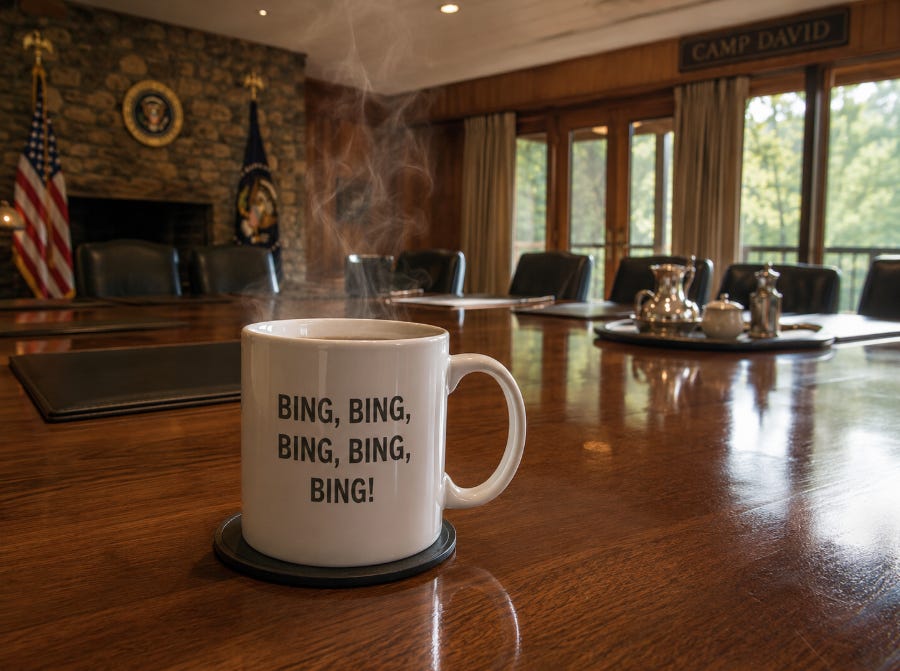
Almost exactly as the region prepared to resume burning, Donald Trump gathered his Cabinet at Camp David to explain the thinking of the man directing the war.
The White House advertised the outing as “a lot of fun and something different for the Cabinet to experience together,” which made it sound as though the secretaries of State, Treasury and War were being taken to summer camp for trust falls and commemorative s’mores.
The actual meeting was the familiar court ceremony, this time with rustic décor.
Camp David sits conveniently along Trump’s route from Washington toward Bedminster, New Jersey. Holding the meeting there gave him an official presidential stop, a historic backdrop, several hours of privacy and a Cabinet photograph before he continued to his golf club.
Trump could borrow the scenery of Eisenhower, Kennedy and Carter without suffering the indignity of spending his weekend in government accommodations. All the prestige of Camp David, none of the staying for dinner.
There may have been a smaller classified discussion about Iran outside the public portion. But Trump’s televised Cabinet meetings are not where decisions are made, anyway. They are where decisions already made, or impulses already indulged, are presented as evidence of presidential genius.
Trump speaks. Cabinet officials take turns explaining why he is courageous, historic, brilliant and responsible for every positive development since the invention of the wheel. Nobody challenges a number, disputes a premise or points out when the emperor has wandered from national security into a story about Walmart, transgender athletes or a senator who failed to appreciate an endorsement.
Trump’s words offer something more revealing than any formal announcement. They provide a nearly hourlong demonstration of the mind deciding whether to widen an already widening war.
It is important to be precise about what fitness means here.
Presidential fitness means being able to distinguish intelligence from grievance, possibility from fact, propaganda from arithmetic, and destruction from strategic success. It means understanding that an enemy can be weakened without being defeated. It means articulating an achievable objective, recognizing consequences beyond the next headline, and tolerating information that does not flatter you.
The Camp David spectacle functions as a fitness examination Trump administered to himself.
He began with the usual greatest hits. America was stronger and more successful than ever. The border was not merely secure; it was the strongest border in American history and perhaps the strongest possessed by any nation in history. Recent illegal crossings were “zero.” The murder rate had experienced the largest decline ever recorded and was now the lowest in the history of the country.
Then came Minnesota.
More than thirty municipal water systems had been hit in what officials described as a coordinated cyberattack. U.S. intelligence agencies assessed that Iran was likely responsible. Federal investigators were also examining whether related attacks had struck water systems across seven states.
The investigation had not produced a final, formal attribution. But Iran was not a theory pulled from the nearest campaign hat. Federal cybersecurity agencies had repeatedly warned that Iranian-affiliated actors were targeting the operational technology used by American water utilities, using tactics resembling those of CyberAv3ngers and other groups tied to the Revolutionary Guard’s cyber command.
This is also the administration that spent the last eighteen months hollowing out the agency responsible for finding those vulnerabilities before hackers do, eliminating CISA’s red team, defunding threat-sharing programs serving small state and local utilities and leaving the agency without a permanent director for the better part of two years.
“I don’t think so,” Trump said of Iran’s involvement. “I blame Minnesota because they are grossly incompetent.”
“I would blame it on Minnesota and the governor, the corrupt governor of Minnesota,” he continued. “They like to say it’s Iran.”
It is entirely reasonable for a president to withhold judgment while attribution remains incomplete. It is not reasonable to decide that a Democratic state probably attacked itself because its governor irritates him.
Trump’s administration degraded the defenses, removed people assigned to identify vulnerabilities and cut services meant to protect small local governments. When the predictable threat arrived, he dismissed the foreign adversary his own agencies considered likely.
Then he pointed at Minnesota and assigned the bill.
The more consequential question is whether any evidence can survive contact with a conclusion Trump finds more emotionally satisfying.
The same stream carried him from Minnesota to inflation, Walmart, Sam’s Club, Giant Eagle, the stock market, factories, tariffs, children’s investment accounts and prescription drugs.
Drug prices, Trump announced, were falling by “400, 500, 600 percent.”
A price cannot fall by 600 percent. A 100 percent reduction brings it to zero. At 600 percent, the pharmacist would have to give you the medication, refund six times its original cost and perhaps hand over the parking lot as a gesture of goodwill.
Trump repeated the impossible claim several times. Nobody corrected him or even shifted uncomfortably enough to register on camera. This Cabinet’s role is not to introduce arithmetic into the proceedings, only to admire the miracle.
Trump then explained that he had personally called foreign governments and forced them to raise the prices their citizens pay for medicine so American prices could fall. According to his telling, leaders who initially refused quickly changed their minds when threatened with tariffs and responded that raising drug prices would be their “great honor.”
Foreign governments did not negotiate these arrangements; the deals were voluntary agreements with drug manufacturers, and health-policy experts have found no corroboration for Trump’s claims about pressuring European leaders.
In Trump’s anecdotes, every foreign leader speaks like a waiter hoping for a larger tip at Mar-a-Lago.
From there, Trump moved to Spain, which he described as being invaded by hundreds of thousands of migrants. Some, he said, had apparently completed a three-mile swim after reading liberal immigration laws and determining they could enter. Unless Republicans won the midterms, America would face something worse.
Ostensibly, this was a Cabinet meeting about governing the United States. It had become a campaign rally built from impossible percentages, imaginary conversations, and migrants conducting comparative statutory research before entering the water.
Then Trump reached Iran.
“You call it a war,” he said. “I call it a military operation.”
This is one of the small linguistic conveniences of the modern presidency. If Congress has not authorized it, the war becomes an operation. When Trump wants credit for winning it, the operation becomes greater than every previous war.
Iran’s Navy had been obliterated. Its Air Force had been obliterated. Its aircraft, radar, air defenses, drone capacity, missile stockpiles, military leadership and manufacturing ability were all gone or nearly gone.
“They have no Navy,” Trump said. “Their Air Force has been obliterated.”
Later, asked whether the military had proposed going big against Iran, Trump objected to the premise.
“We’ve already gone big. What’s big?”
“Everything’s all gone.”
Everything was gone, except the drones Kuwait was intercepting, the missiles still threatening American bases, and the weapons affecting shipping around Oman.
Everything was gone, yet Americans needed to remain on guard, and another round of major strikes might be required.
This remains the central strategic contradiction of the war.
If Iran has already been obliterated, what remains to be achieved? If it can still strike American bases, threaten Kuwait and disrupt maritime traffic, what exactly did obliteration mean?
What condition would end the bombing? Who would verify it? What political order is supposed to emerge from the rubble? What happens if Iran refuses to provide the televised surrender Trump appears to need?
A reporter asked how he planned to achieve a ceasefire.
“We just want to win,” Trump replied.
That was the plan.
“We’re doing very well. We’re trying to be nice, as nice as you can be in a situation like that. They are being decimated.”
Trump again listed everything Iran no longer possessed, then said the United States would continue attacking.
“We’ll be hitting them very hard. At some point they are going to say We just can’t take it anymore.”
The theory is that a weaker party confronted with overwhelming force will eventually accept humiliation and submit. If it does not, the explanation cannot be that the stronger party misunderstood its goals, history or tolerance for suffering. The stronger party simply has not inflicted enough pain.
Hit them hard. If they resist, hit them harder. If they retaliate, the retaliation proves they needed to be hit. If they survive, survival becomes defiance.
This is Trump’s approach to business, lawsuits, political opponents, trading partners, universities, states, journalists and now countries. The world is divided into people who yield and people who have not yet been punished sufficiently.
Former U.S. diplomat Rob Malley described the trap in a conversation with Zeteo. Trump, he argued, operates by one consistent doctrine: if a party will not give in, you hit it harder. The problem is that Iran has drawn the opposite lesson from this war, that restraint does not protect it and only imposing costs restores deterrence.
Trump escalates because Iran will not surrender. Iran retaliates because Trump escalates. Both call it deterrence. Both experience the other’s deterrence as provocation.
Malley calls it a form of globalized guerrilla warfare. The two sides are not measuring victory by the same standard.
For Washington not to lose, it must win. For Tehran to win, it may only have to avoid losing.
Trump’s claims of obliteration sound less convincing with each surviving Iranian drone, because of this asymmetry.
The lull briefly interrupted that cycle. Trump’s Camp David remarks made it sound less like an opening than a prelude.
“They always want to talk, but they break their word so often,” he said. Negotiators could spend seven hours discussing the nuclear issue, Trump complained, only for Iran to emerge and deny nuclear matters had been discussed.
“All they do is make me angry.”
There it was: the emotional state of one man offered as a strategic variable for an entire region.
Diplomacy was evaluated by whether the other party annoyed Donald Trump.
By the time the lull ended, the political story for another American escalation had already been assembled. Trump can say he stopped. Iran responded. He offered peace. Iran chose war. His patience was rewarded with treachery. Whatever he orders next was therefore forced upon him.
The attacks on Kuwait make that argument easier. Kuwait hosts American forces, so an attack on its infrastructure reads as a threat to Americans, not merely Iranian retaliation. The tanker near Oman adds commercial shipping. Houthi pressure on Saudi vessels adds another chokepoint. Iran’s warning about the “flames of war” supplies the apocalyptic quotation for whatever comes next.
Each development provides another paragraph in the case for escalation.
The nuclear issue makes the exercise even more perverse. Trump insists the war is necessary to prevent Iran from obtaining a nuclear weapon. But war may provide Iranian leaders with their strongest argument yet for pursuing one.
Malley said an Iranian leader today would logically be thinking more seriously about a bomb, not that Iran necessarily will build one, but that American policy has made the calculation more rational.
Trump is bombing Iran to prevent it from deciding that only a nuclear weapon can prevent the United States from bombing Iran.
This is what strategic brilliance looks like after enough Cabinet members applaud it.
At one point, while describing American missile defenses intercepting five incoming missiles, Trump supplied his own sound effects.
“Bing, bing, bing, bing, bing.”
The room laughed.
“That would have been a great sound bite,” Trump observed.
Five missiles were fired toward a country where people could have died. American personnel used enormously complex systems to intercept them. The president’s mind moved almost immediately to the entertainment value of the noise he had made while recounting it.
War, weapons, audience response, and personal performance occupied the same mental space.
The story then drifted through 111 missiles allegedly fired toward the aircraft carrier Abraham Lincoln, brilliant operators from MIT and Caltech, Tomahawks, Patriots, cars traveling sixty miles per hour, missiles traveling 8,600 miles per hour, NVIDIA chips and whether China could copy American technology. Trump delivered an entire late-night tour through the presidential showroom.
Trump’s speech repeatedly exposes the absence of any boundary between war as policy and war as content.
A missile defense is significant because “bing, bing, bing” makes a good sound bite. An adversary is destroyed because Trump has declared it destroyed. A negotiation fails because it makes him angry. A cyberattack cannot be Iranian because he dislikes Minnesota’s governor. A price can fall by 600 percent because nobody in the room is permitted to explain percentages.
The Cabinet reinforced the danger.
Hegseth praised Trump’s courage and compared his military buildup with Ronald Reagan’s. Treasury Secretary Scott Bessent invoked Washington, Jefferson, and Hamilton. Robert F. Kennedy Jr. compared Trump’s openness favorably with John F. Kennedy’s. The others rotated through their assigned portions of the liturgy. Trump’s Cabinet is an echo chamber with nameplates.
Camp David once symbolized the slow, frustrating work of diplomacy. Jimmy Carter used the isolation of the retreat to keep Egyptian President Anwar Sadat and Israeli Prime Minister Menachem Begin negotiating when they might otherwise have walked away. Its value was not the scenery. It was that sustained attention, patience, and disciplined mediation could turn a pause into an agreement.
Trump stopped there on his way to Bedminster and used the historic backdrop to announce that Iran had been obliterated, complain that negotiations made him angry, imitate missile interceptions and promise to continue bombing until the weaker country admitted it could endure no more.
By the time Trump reached Bedminster, the photographs were taken and the Cabinet had done its job. By the next day, Kuwait was intercepting Iranian drones, a tanker had been struck near Oman, Saudi shipping was diverting and Tehran was threatening to spread the flames.
The lull had become proof of Trump’s patience, and therefore permission to declare that patience exhausted. Iran could now be both obliterated and intolerably dangerous, while the next escalation was sold as the final blow in a war already declared won.
The most alarming thing about Camp David was not that Trump appeared diminished. It was that he appeared entirely himself.
Grandiose, aggrieved, easily frustrated, captivated by weapons, indifferent to contradiction, and surrounded by people whose professional responsibility has been replaced by the requirement to tell him he is magnificent.
The lull was nothing more than a prelude.
His cabinet knows he is not fit - mentally or physically - they praise him because it gets them what THEY want. Power. Evidently they have no conscience or ethics. Karma will be a bitch.
"strategic contradiction" There you have it, the understatement of the year.