

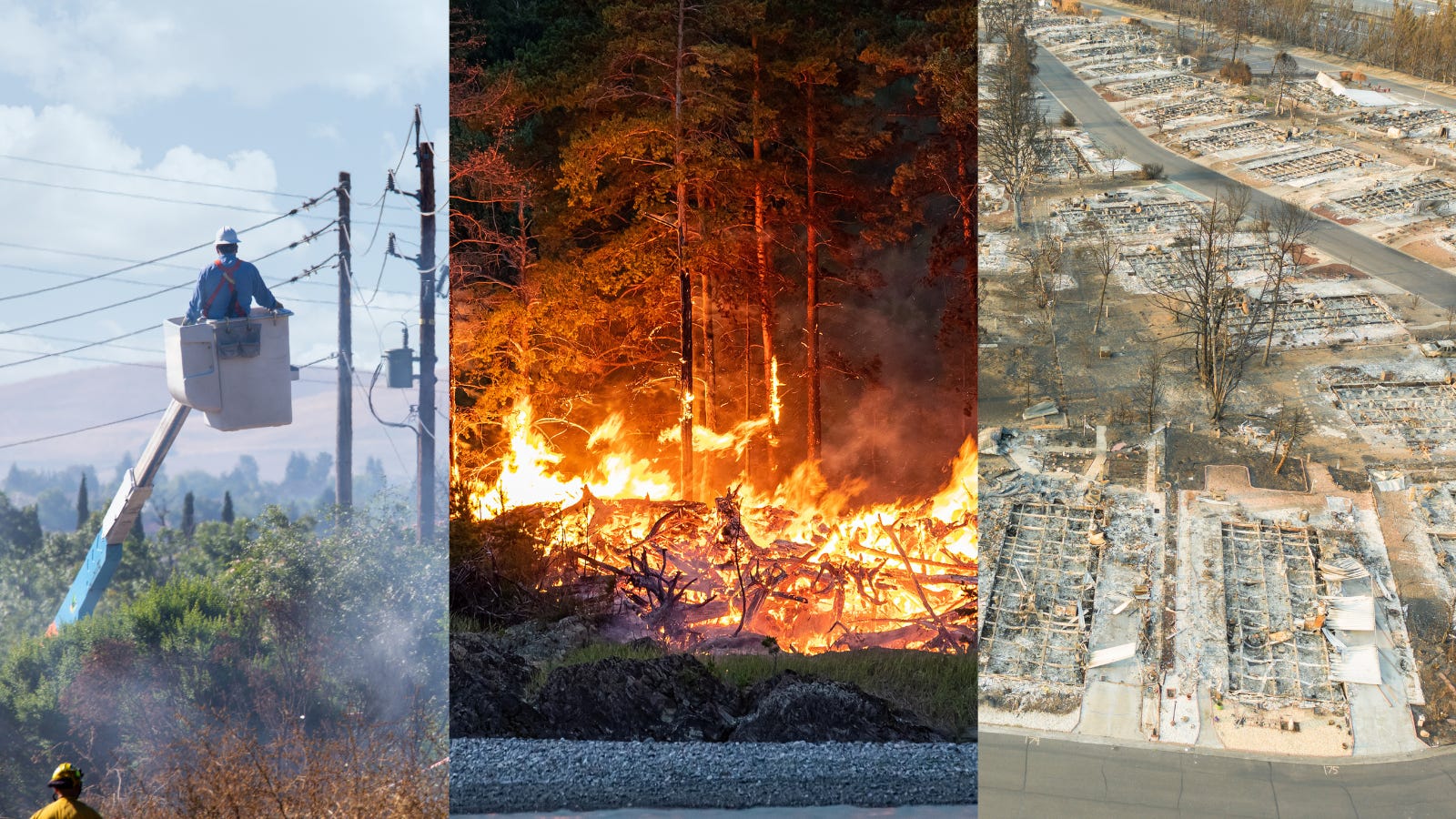
The number $575 million looks clean on paper, crisp, and countable. A settlement you can print in a press release, tuck into an earnings call, and file away as a resolved claim. But the landscapes behind that number are not clean, and the losses are not countable in any honest way. There are the acres of public land that burned, yes, and the suppression invoices, and the restoration plans that will be drafted with careful verbs, “rehabilitate,” “reseed,” “stabilize.” There is also the long, unglamorous aftermath that does not fit neatly into a ledger, the months when the air still feels like a threat, the seasons when people flinch at wind, the particular quiet that follows evacuation, when you return to a neighborhood that no longer sounds like itself.
This is what climate policy feels like in practice. It is not only a debate about emissions and targets, though those matter. It is also a question of who is protected when heat, drought, and wind turn a spark into a wall of flame. It is a question of who pays when a public good becomes a public loss, and it is a question of whether regulation is a living promise or a postmortem. When the Justice Department announced this agreement, it described it as “fair compensation to the American taxpayer for fire-related damages,” as if fairness can be confirmed by a receipt alone.
The PacifiCorp settlement, as reported, resolves federal claims tied to fires in Oregon and Northern California, including the notorious Labor Day fires of 2020 and later disasters in California. The federal government sought recovery for suppression costs and for damage to natural resources on public lands, and the utility agreed to pay. In one sense, this is accountability in motion. In another, it is a reminder that our systems for accountability arrive after the fire has already moved through. They arrive after the helicopters have been grounded, after the last ember has cooled, and after the trauma has set into the nervous system like smoke into fabric.
So, what does it mean to say we need regulation and protection for the people most impacted by these fires? It cannot mean only that we want bigger numbers or tougher press conferences, though those have their place. It has to mean that we are willing to do the slow work that prevents the next catastrophe, and to do it in a way that does not treat vulnerable communities as acceptable collateral.
I keep coming back to the idea of walking, because walking is what we do when we cannot pretend the distance is small. Walking makes you feel the slope, walking forces you to notice who is carrying more weight, walking is a kind of truth-telling. And maybe that is what climate policy needs right now, not a sprint for the headline but a steady march toward a grid and a regulatory system that does not sacrifice the same people over and over.
The people most impacted by wildfire are not only those whose homes burn, though that is devastation enough. They are also the people who live at the edges of forests and grasslands because that is where housing is cheaper. They are the farmworkers and outdoor laborers who work through smoke because missing a day means missing rent. They are the elders and the medically fragile who cannot easily evacuate, or who evacuate and then spiral because displacement is its own health event. They are renters whose losses are rarely made whole, families whose insurance is inadequate or absent, tribal communities whose cultural sites and first foods are not replaceable, towns where a single fire season can break the tax base and the school district and the last remaining clinic. “Wildfires remain a recurring threat to our natural resources, the safety of our communities, and their economic well-being,” one federal official said, and the bluntness of that sentence matters because it refuses to romanticize what fire does.
When we talk about “the grid” in this context, we often speak as if it were an abstract machine. But the grid is an arrangement of decisions, where lines are built, how they are maintained, and whether vegetation management is rigorous or performative. How equipment is set to reclose or trip during wind, whether power is shut off in dangerous conditions, and how that shutoff is planned so it does not become its own crisis. Whether the utility treats risk as something it can manage with a spreadsheet, or as something it has an obligation to reduce even when the reduction is expensive and hard to celebrate.
Utility regulation is supposed to be the place where those decisions are disciplined. The basic promise of the regulated monopoly is a bargain: the public grants an exclusive service territory, and in return the utility provides safe and reliable service under rules that protect the public interest. Wildfire has revealed how fragile that promise can become when climate conditions change faster than infrastructure, and when the incentives tilt toward cheaper short-term choices.
This is where the federal settlement matters beyond its dollar figure. It shows that governments are increasingly willing to pursue recovery for public costs, not just to absorb them as the price of living in a warming West. That has a moral logic, and a fiscal one. Firefighting budgets are not infinite, and restoration is not optional if we want watersheds to function and forests to heal. Federal prosecutors framed this settlement as part of a policy of holding corporations responsible for wildfire damage on federal lands, a sentence that sounds procedural until you remember what it is trying to do, which is to insist that disaster does not erase duty. But a recovery strategy is not a prevention strategy, and a prevention strategy is not a protection strategy, unless it is designed with equity at the center. If we are going to walk our way to regulation and protection, we need to build a path with several stones set firmly in place.
First, we need a standard for safety that is measurable and enforceable. Not “best efforts,” not “continuous improvement,” not the kind of language that sounds responsible while remaining slippery. We need metrics that reflect real risk reduction, and a requirement that utilities demonstrate performance against those metrics, with independent verification. It should be as normal to audit wildfire mitigation as it is to audit finances, because wildfire has become a financial event that begins as a safety event.
Second, we need to sort out cost recovery with honesty. Hardening and modernization should be financed, but not in a way that dumps the burden onto the people least able to carry it. Rate design and assistance programs have to be part of the conversation, not an afterthought, because “resilience” that prices people out of electricity is not resilience. Regulators should scrutinize whether costs are prudently incurred, and they should also require targeted protections like bill relief during disasters, fast reconnection standards, and support for medically necessary power needs when shutoffs occur.
Third, we need public investment that comes with public conditions. Federal dollars aimed at resilience should not just subsidize utilities’ capital plans; they should accelerate the projects that reduce risk for the highest-exposure communities, and they should require transparent reporting so the public can see what improved and where. Grants should reward risk reduction, not just spending, and they should encourage partnerships with tribes, counties, and community organizations who understand the local terrain in a way no statewide plan can fully capture.
Fourth, we need an ethic of preparedness that is not punitive toward the people on the front lines. Shutoffs can prevent ignitions, but they can also endanger people who rely on powered medical devices, disrupt small businesses, and create cascading harms. Regulation should require that shutoffs are last resort, carefully targeted, and paired with real support: backup power for critical facilities, community resilience hubs, clear communication in multiple languages, and planning that does not assume everyone has a car, a credit card, and a second place to go.
Finally, we need to widen the circle of who counts as harmed. Public lands matter, and restoring them matters, but so do the invisible losses in communities that are repeatedly scorched. Policy has to account for displacement, for mental health, for the slow erosion of stability. If a settlement writes a check for the land, regulation must also write a promise for the people.
Walking is not glamorous. It is repetitive. It asks us to put one foot down and then another, in the same direction, even when the horizon looks smoky again. But walking is how movements are built, and how policy becomes protection. It is how you turn a number into a commitment. Ryan Flynn, the President of Pacific Power stated, “This settlement is another significant milestone demonstrating our ongoing commitment to resolve all reasonable claims related to the devastating fires that affected Oregon and California.”
A settlement can be a signal that the era of casual risk is ending. It can also be a temptation to believe that the story is over. Milestones are corporate, but the people living with smoke and displacement don’t experience milestones, they experience seasons, and seasons do not care what we have already paid. The truth is that the story is still burning at the edges, in every dry summer forecast and every windy afternoon. We cannot regulate fire out of existence, and we cannot litigate our way into safety. But we can insist that the systems we have built do not keep choosing the same communities to absorb the shock.
We should take that $575 million and hear, behind it, the sound of feet on a long road. Not the road to punishment, and not the road to forgetting, but the road to a grid that is safer by design, to regulation that is unafraid of clarity, and to protection that reaches first for those who have been asked, for too long, to breathe the smoke and call it normal.
A complex & thorough analysis. How are we to get this underway given the Trump-MAGA aim of fighting every effort to resolve the problem?
I’ll never forget the red sky and ash from the Santiam Canyon fire.