


Not that long ago, historically speaking, when a British monarch visiting Washington was a bit of ceremonial pageantry wrapped around a deeper truth: the alliance was solid, the roles were understood, and everyone knew roughly which century they were operating in.
King Charles III is about to arrive in a very different America. On paper, this is a celebratory visit. A four-day swing through Washington, an address to Congress, part of the build-up to America’s 250th birthday. Usually the kind of thing where you dust off the silverware, quote Churchill, and remind everyone that yes, we saved the world together once or twice. A little nostalgia, a little diplomacy, a little soft power.
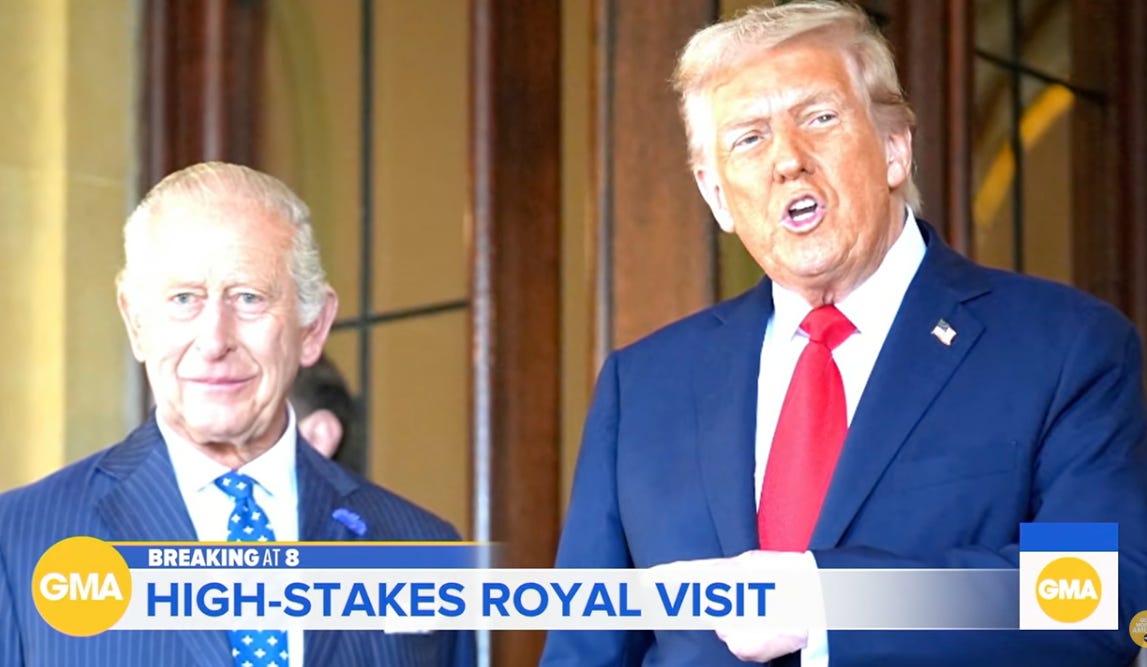
Charles is walking into something closer to a geopolitical escape room, where every door is rigged with a different crisis and the host keeps randomly rearranging the walls. As the King prepares to land, the United States is reportedly considering whether to… withdraw support for British sovereignty over the Falkland Islands. Not hypothetically, but as part of a menu of punitive options against NATO allies who didn’t sign up for Trump’s war of the week. That’s Washington casually picking up one of the UK’s most sensitive territorial issues and shaking it like a snow globe to see what falls out, while simultaneously handing a potential geopolitical windfall to Trump’s ideological ally in Buenos Aires, Javier Milei, who has long championed Argentina’s claim. In one move, Trump manages to punish Britain, reward a political friend, and destabilize a decades-old status quo that previously required actual wars to contest.
It doesn’t stop there. The same leaked Pentagon chatter suggests punishing European allies more broadly, floating ideas like sidelining countries from NATO leadership roles or, in a moment of breathtaking institutional literacy, discussing whether Spain could be kicked out of NATO. It cannot. There is no mechanism. This is the geopolitical equivalent of threatening to uninstall gravity. As one DW correspondent dryly noted, that “might raise some very interesting questions about the level of understanding of how the alliance operates within the Pentagon.”
Across the Atlantic, European leaders are gathering in Cyprus and trying very hard to look like people who are not actively rethinking the entire postwar security architecture. Officially, they’re calm; privately, they are gaming out what happens if the United States doesn’t just drift away from NATO but turns into something more adversarial. As DW put it, the concern is not only that “the US will turn its back on NATO,” but that “the US might turn against a NATO nation.”
The shift didn’t happen in a vacuum. It followed the Greenland episode, where threatening a NATO ally’s territory apparently seemed like a reasonable opening bid. It followed months of berating, tariffs, and erratic policy swings.
Now, just to keep things interesting, there are plans to host a G20 summit at Trump’s own golf club, because why separate statecraft from real estate when you can monetize both, and invite Vladimir Putin as a guest of honor. Not just any controversial guest. A wanted war criminal, welcomed onto American soil, into the bosom of the Trump business empire, while allied leaders are left to decide whether attendance counts as diplomacy, complicity, or simply renting a room at the scene of the moral collapse. As Simon Marks noted, virtually every other country around that table would be obligated to arrest Putin if he set foot on their soil. The United States, conveniently, takes the position that it is not bound by the warrant, which means Trump can turn what should be an international pariah problem into a VIP hospitality package.
So the King arrives to celebrate America’s democratic inheritance while Trump prepares to roll out the red carpet for the man currently trying to destroy Ukraine and fracture Europe. Somewhere in Buckingham Palace, there is undoubtedly a team of people whose job is to turn all of this into a seating chart.
The challenge for Charles is being described, politely, as “threading the needle.” Which is one way of putting it. Another way would be: deliver a speech that affirms democratic values, transatlantic unity, and shared history without sounding like you are directly criticizing the man sitting three feet away who has spent the last week undermining all three.
Queen Elizabeth II managed this trick in 1991 when she addressed Congress, speaking about tolerance, pluralism, and the dangers of force. It was elegant, understated, and effective. It also belonged to a world where those sentiments didn’t immediately read as a subtweet of the sitting president. Charles doesn’t have that luxury. The words haven’t changed, but the audience has.
If there is one consistent insight from the reporting, it’s this: Donald Trump is not capable of silence. He is, as one observer put it, someone who believes that “transmitting is governing” a man who treats constant output as a substitute for actual statecraft.
While the King is attempting to perform a delicate act of diplomatic choreography, the President is likely to be riffing about ballroom seating capacity, criticizing British energy policy, taking swipes at immigration, and, just for good measure, declaring that he is “speaking for the UK” more than Prince Harry. To be fair, this is not how sovereignty is supposed to work. Then again, neither is threatening to hand the Falklands to Argentina mid-state-visit, so here we are.
If all of this sounds like a slow-motion collapse of the transatlantic alliance, that’s because increasingly, people who spent their careers inside that alliance are saying exactly that out loud. General Sir Richard Shirreff, former Deputy Supreme Allied Commander of NATO, not exactly a fringe voice, has gone on record stating that under this administration, America is “no longer an ally” and is not underpinning NATO in any meaningful way.
He’s talking about Article 5, the core promise that an attack on one is an attack on all. Without that commitment, all the firepower in the world is just expensive decoration.
While Europe scrambles to figure out how to “Europeanize” NATO, essentially, how to build a security framework that doesn’t rely on Washington, there’s a quiet, almost tragic irony playing out back in London: the UK already has a defense plan. It just hasn’t been funded or implemented. The house is on fire, and the fire extinguisher is still in the packaging.
Now zoom out one more level, because Charles is not just King of the United Kingdom. He is also King of Canada, and Canada, unlike Europe, has decided to skip the euphemisms.
In a recent exchange, Canadian Prime Minister Mark Carney made it clear that the era of deep integration with the United States is over. Not merely strained or under review. Over.
“Nostalgia isn’t a strategy,” Carney said, in what may be the most polite way anyone has ever announced a geopolitical breakup.
They’re not wrong. The U.S. has imposed tariffs that Canada considers violations of existing trade agreements, reframed negotiations as demands, and treated a long-standing partner more like a problem to be managed than an ally to be consulted. The response from Ottawa is not to beg for a return to the old normal, but to build something new, more independent, more diversified, less reliant.
So let’s take stock of where this leaves the King. He arrives in Washington as the embodiment of continuity, representing a network of relationships that have defined the Western order for decades. The “special relationship,” the Commonwealth, the shared history of war and cooperation and mutual interest.
And he lands in a country where:
– The government is considering undermining British sovereignty over the Falklands to the favor of an Argentinian dictator.
– NATO’s future is being openly questioned from within.
– European allies are quietly planning for a post-American security framework.
– Canada is declaring the old relationship effectively finished.
– And the President cannot be relied upon to get through a state visit without freelancing half a dozen diplomatic incidents.
There is a slogan that has been popping up in American protests lately: “No Kings.” It’s meant as a rejection of authoritarianism, a reminder of the country’s founding principles.
The irony is hard to ignore right now, because the King represents stability, restraint, and institutional continuity. And the President represents… something else entirely.
Charles will likely do what monarchs do. Speak carefully, gesture toward shared values, and avoid direct confrontation. He will, in the language of diplomacy, thread the needle.
King Charles should not be coming. The Brits should have cancelled the visit and made any excuse. By coming here now in the middle of the orange obscenity's illegal war, he is condoning all that is being done both in the Middle East and all the domestic policies that are being carried out here. If he has to come he needs to make clear policy statements about the United Kingdoms soverign position in the world and of the clear and present danger presented by an unstable and erratic United States on the domestic and world stage.
When Mark Rutte (head of NATO) was in Washington to meet with trump a few weeks ago I watched him interviewed on CNN after the meeting and he was FAR too syncophant-ish in his comments. I expected more backbone and much less 'very good meeting, very productive' after all that's gone on. trump has been abundantly clear in showing everyone who and what he is. Pope Leo isn't fawning ... good for him. King Charles is going to be stoic and polite because he is a proper monarch and trump is going to be trump. A wasted trip and trump will read it as being an esteemed president ... no one should give him anything that he can perceive as respect or honour or power. Trip should be cancelled in my opinion. Now if the King was going to candidly drill down on the Epstein Files and Andrew's involvement, that could make for interesting conversation for the fly on the wall.
If Putin is attending the G20, all the rest should cancel and the meeting should be rescheduled in a country where Putin can't go. The authority figures need to be authoritative!!! Stop being polite and politically correct and stop feeding the power-hungry monster with the flavours and tastes of power. Start doing what's right for the 'good guys'!!!