

Good morning! Over the weekend, everyone’s attention snapped to the White House Correspondents’ Dinner shooting, and for once the phrase “unprecedented” actually earns its keep. A gunman made his way into the Washington Hilton, weapons in tow, and opened fire at an event that, this is the part that should make your coffee go cold, had effectively concentrated the upper tier of American leadership into a single basement ballroom. As one analyst put it, you had “the entire line of succession and the president all in a basement ballroom,” a sentence that reads less like a political thriller that ends badly.
it gets worse. The attacker didn’t beat security in some dramatic last-minute breach. He beat it days earlier, simply by booking a room. This wasn’t Ocean’s Eleven. This was Expedia.
As multiple reports now make painfully clear, a more coordinated effort, something less chaotic and more intentional, could have done the unthinkable: wiped out multiple layers of U.S. leadership in a single strike. All of this is happening while the United States is actively entangled in a widening conflict overseas and hosting a royal visit that now looks like a high-stakes episode of “please let nothing else go wrong.”
Which brings us to the second act of this weekend’s slow-motion fever dream: the manifesto and the presidential response. The shooter’s writings are exactly what you’d expect: violent, self-justifying, and deeply disturbed, but the throughline is unmistakable. He describes Trump as a “pedophile, rapist, and traitor,” and frames his actions as some kind of grotesque moral duty. It’s the kind of language that doesn’t just exist in a vacuum; it echoes, distorts, and feeds off the broader political environment. To be clear, I’ve used some of that same language myself in describing Trump.
Then came Trump’s 60 Minutes interview. If you were hoping for a moment of gravity, a president acknowledging the danger, calming tensions, maybe even discouraging the kind of rhetoric that fuels this madness, you must be new here. Instead, we got the full Trumpian fog machine. He explained that assassination attempts happen to “consequential presidents” because “they go after presidents that do things,” before casually seating himself next to Lincoln and McKinley in the presidential hall of martyrdom. He bragged about trillions in investment numbers that appear to have been assembled using a dartboard and a fireworks display. When asked about political violence, he pointed everywhere but inward: Democrats, the press, the internet, the “far-left,” a conspiracy charcuterie board, now available in family size.
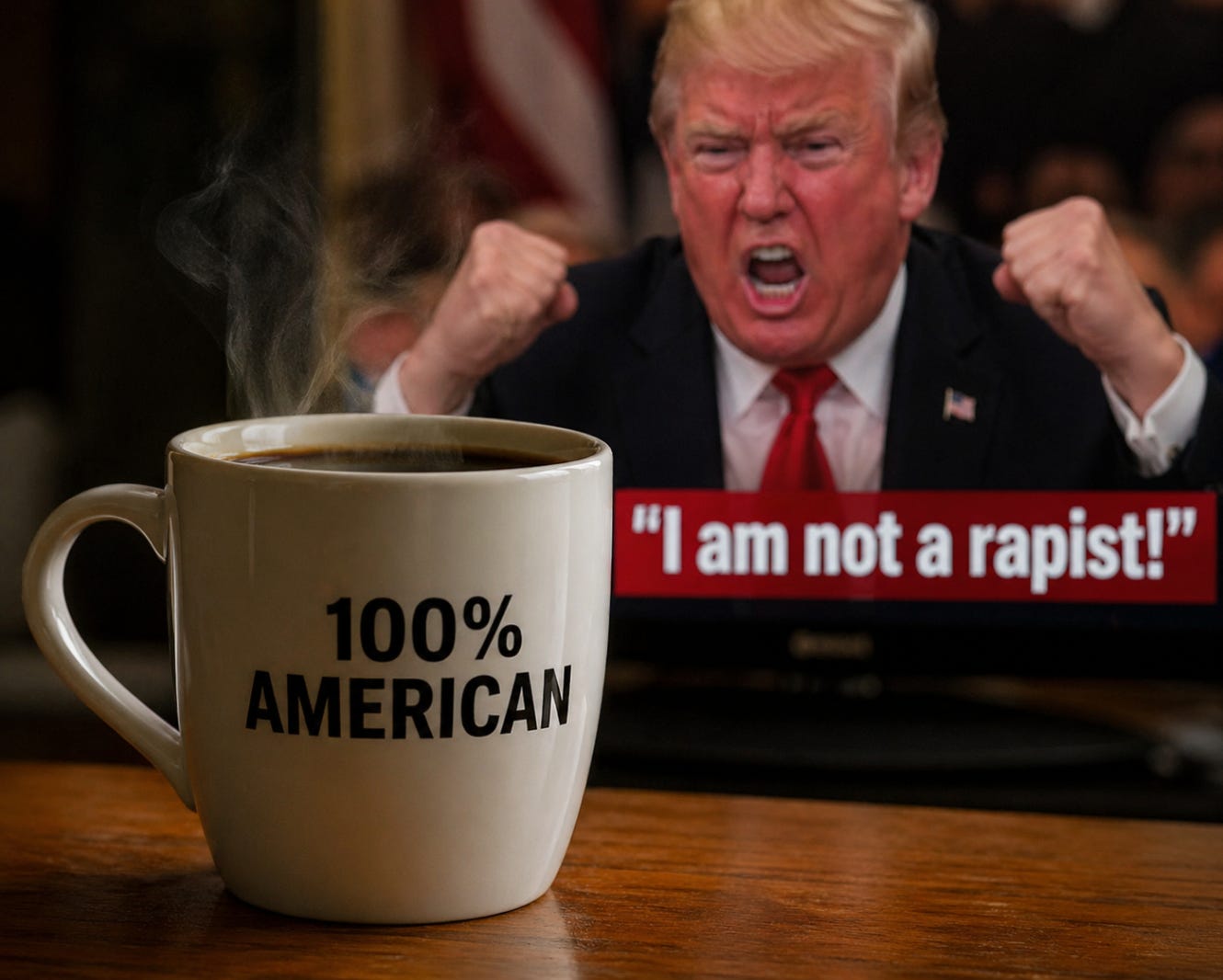
The most combustible moment came when the interviewer read directly from the manifesto, the line accusing him of being a “pedophile, rapist, and traitor.” Trump immediately detonated. “You’re horrible people,” he snapped. “I’m not a rapist. I didn’t rape anybody… I’m not a pedophile.” Cole Allen thankfully missed his intended targets, but he did manage one thing: he got the President of the United States to go on 60 Minutes and angrily deny, on national television, that he is “a rapist” or “a pedophile.” From there, it was a familiar spiral: Epstein deflection, media attacks, lawsuits, “fake news,” and somehow a detour into AI-generated lip-sync conspiracies.
Hovering over all of this is King Charles’ looming visit to the United States, a surreal bit of pageantry arriving at a time when the best-case scenario, as one commentator put it, is simply that nothing happens. No incidents, presidential outbursts, or geopolitical surprises. Just four straight days of everyone behaving like this is a normal country. Good luck!
While Washington is busy arguing over who yelled what at whom, a much bigger and far more dangerous story is unfolding just offstage: the Iran war is stressing the global system in ways that don’t show up in breaking news banners, at least not yet. Economist Steve Keen is sounding the alarm on something most people aren’t even thinking about: fertilizer. Not oil or gas, but fertilizer. Roughly 20% of the world’s fertilizer supply moves through the Strait of Hormuz, and that flow has already been disrupted. Miss that window, miss the planting season, and suddenly this isn’t about prices, it’s about production. Keen’s warning is blunt: food output could drop dramatically, and “there simply won’t be enough food for everyone.”
This is the part of globalization we were never supposed to notice. The part where everything works beautifully, right up until it doesn’t.
Tax campaigner Richard J. Murphy takes that one step further, because even if you assume the system limps along, you still run headfirst into the next problem: allocation.
“We are going to be short of oil… short of food… short of raw materials,” he says. When that happens, markets don’t suddenly develop a conscience. They do exactly what they’re designed to do: sell to the highest bidder and let everyone else fend for themselves.
That’s when you get political decisions about who eats and who doesn’t. And history is not exactly subtle on this point. Bread shortages helped light the fuse of the French Revolution. Food price spikes helped fuel the Arab Spring. Grain and inflation shocks have toppled governments, driven migration, and turned ordinary desperation into mass unrest again and again.
Hunger isn’t just an economic condition; it’s a destabilizing force. When people can’t afford food, when supply becomes unreliable, when the system looks rigged against survival, they don’t sit quietly and wait for the invisible hand to sort it out. They push back.
And if you’re thinking, “Well, at least the U.S. is insulated,” the answer is… kind of, but not really. America produces a lot of its own fertilizer, but it’s still tied into global pricing. Maybe we don’t run out, but farmers pay more, margins shrink, planting decisions tighten, and eventually those costs make their way to your grocery bill.
Which brings us, somehow fittingly, to gold. If you were looking for a perfect metaphor for late-stage capitalism quietly eating its own moral framework, allow me to introduce you to the U.S. Mint, which is apparently taking cartel-linked gold, melting it into respectability, and stamping it with a bald eagle.
A sweeping New York Times investigation found that the U.S. government has been buying gold tied to drug cartels, conflict zones, and environmental destruction, then selling it to investors as “100 percent American,” because nothing says national pride like laundering the proceeds of poisoned rivers and organized crime through a gift-shop version of patriotism.
The gold starts in places like La Mandinga, a cartel-controlled mine in Colombia where workers use mercury to separate gold from mud while paying the Clan del Golfo, a U.S.-designated terrorist organization, for the privilege of destroying the land under its protection. From there, the first magic trick is paperwork: once the gold is logged under Colombia’s loosely regulated small-miner system, it becomes “legal,” even if it was ripped out with industrial equipment, toxic chemicals, and cartel permission slips. As one trader put it bluntly, “If you’re buying from barequeros, you’re buying illegal gold.”
Then the gold travels to U.S. refineries, where it is melted together with other supplies until its origin becomes conveniently philosophical. One refinery executive explained the logic: “As far as they’re concerned, it originated within the U.S.” Which is a very elegant way of saying that if you throw enough dirty gold into a big American pot, the crime essentially evaporates.
From there, the gold can flow into the U.S. Mint, which is legally required to use only newly mined American gold for bullion coins but has spent decades redefining “American” into something more vibes-based than statutory. A 2024 watchdog report found that the Mint stopped even asking suppliers where their gold came from more than 20 years ago, which does feel like a small oversight if your entire product is government-guaranteed purity.
When reporters followed the trail, the blame chain performed exactly as expected: the Mint pointed to suppliers, suppliers pointed to a Texas middleman, and the middleman pointed to a guy in Mexico, after which everyone suddenly discovered a deep commitment to not buying that Colombian gold anymore. Amazing how quickly invisible supply chains become visible once someone shows up holding receipts.
The companion reporting makes the whole thing even more absurd, because the breakdown is not confined to some murky financial back office. At La Mandinga, reporters found cartel miners operating inside the perimeter of a Colombian military base. When the base commander denied it was happening, a reporter walked him five minutes into the forest and showed him the operation in progress, complete with roaring generators, hoses blasting the land into mud, and miners working within earshot of military buildings. “This is inside the base,” the colonel said, apparently learning in real time that the cartel had annexed part of his jurisdiction.
The soldiers tried to shut it down by burning equipment and cutting hoses, but the miners fought back with rocks, machetes, and even gasoline, because on the ground, the authority that mattered was not the state but the cartel collecting the fees.
That is the real story here: a pipeline so obvious that reporters could trace it from a Colombian cartel mine to the U.S. Mint, while every institution along the way insisted it was shocked, shocked, to discover dirty gold in the dirty gold supply chain. With gold now hovering around $5,000 an ounce, wealthy investors are buying it as a hedge against instability, only to help fund the very violence, corruption, and environmental destruction they are trying to escape.
The American Gold Eagle may still come stamped with Lady Liberty and a patriotic guarantee, but behind the shine is a system where cartels dig it up, paperwork cleans it, refineries Americanize it, the Mint blesses it, and investors buy it to feel safe.
Efficient, really. Horrifying, but efficient.
Somewhere in the background, while the headlines argue over shootings and interviews and royal visits, the actual question quietly gets louder: What happens when a system this good at pretending everything is fine runs into a problem it can’t pretend its way out of?
Another important story that was missed due to the "attacker" story was the completely illegal firing of the whole National Sciences board, to be replaced by trumpian loyalists with his militaristic agenda. The board was designed by Congress to be non-partisan, with six year terms so no president could take it over. Trump fired them all anyway with no justification.
Our politics is swiftly descending from ideological to existential. Trump has exploded the flood gates of corruption and lawlessness, allowing an unfettered feeding frenzy of gluttonous greed. While the oligarchs and other assorted puppet masters extract their special favors, Trump plays in his sandbox of imaginary grownup power fantasies. First, he casts his simpleton tariff edict, based on third grade economic logic. Then he builds his own domestic army and quickly demonizes half of the American population as traitors and evil. Now, he descends into playing with soldiers and war.
Lacking any bench strength of expertise in anything, assembling sycophantic courtiers as his governmental cabinet, Trump now faces the perfect storm of tariff consequences, his checkmated deadlock with the Iranians, and his alienation from all of our traditional allies.
Trump does not know what he does not know. His arrogant intransigence and willful dismissals leaves him only able to seek distractions and create deeper delusional reckonings.
The GOP Congress now owns this mess. Reality is crashing down on all the gaslighting and manipulations. It is now time to break the glass in case of fire. We need a Congressional FEMA response to our burning country.