


Good morning! Trump’s day began, as so many of them do, with everyone around him pretending that the obvious thing happening was not happening.
Mark Rutte arrived with charts, numbers, gratitude, and the polished expression of a man who has decided that the best way to move a rhinoceros is to compliment its horn. His task was delicate. He had to tell Trump that NATO still mattered, Europe had actually helped with Iran, Ukraine still needed support, defense production had to expand, and allies were increasing spending, all without triggering the presidential smoke alarm marked “disrespect.”
So Rutte did what diplomats now do in the Trump era. He wrapped the policy in flattery thick enough to survive atmospheric re-entry. Trump was not merely the president. He was “the leader of the free world.” European defense spending was not merely the product of Russia’s war, years of NATO pressure, and the structural reality that Europe finally noticed the house was on fire. It was “the Trump trillion.” American defense jobs were not just procurement consequences. They were proof of Trump’s genius, displayed in chart form, like a hostage note written by McKinsey.
For about eight minutes, it worked. Rutte inserted the actual message: Europe had been there. European bases had supported U.S. operations. Thousands of U.S. flights had taken off from Europe. Germany, Poland, the Baltics, the Nordics, and others were increasing defense spending. Europe was buying U.S. weapons. Ukraine was still being supplied, with Europeans and Canadians paying for much of it. In other words, NATO was not useless, Europe was not freeloading in the cartoonish way Trump prefers, and the alliance still served American power.
One cannot hold back the tide forever, especially when the tide has a microphone and unresolved feelings about Spain.
Once the questions began, Trump went off to the races and then kept racing long after the horses had filed a workplace complaint. He moved from NATO grievances to Spain, the UK, North Sea oil, New York primaries, communists, Erdogan, Turkey and F-35s, Ukraine, mail ballots, the SAVE Act, housing, the Fed, gas prices, the World Cup, the Reflecting Pool, D.C. crime, Memphis, New Orleans, Chicago, Los Angeles, New York, and finally the grand conclusion that the United States is now “the hottest country anywhere in the world.” It was less a press availability than a guided tour through the crawlspace of his mind.
Still, Rutte’s performance mattered. It was not merely sycophancy, though Lord knows there was enough of that to qualify for emergency zoning relief. It was containment. Rutte gave Trump symbolic dominance in exchange for policy continuity. He let Trump feel like NATO had been dragged to the altar by his personal greatness, while quietly making the case that the alliance was still functioning, still useful, and still the platform from which American power operates. This is the grim art of allied diplomacy now: build a golden crib around the tantrum and hope the baby signs the communique.
That same dynamic played out later with Senate Republicans, only without Rutte’s elegance or the charts.
Trump went to the Senate Republican lunch, reportedly talked for more than an hour, and emerged declaring unity. Naturally, his version of unity began with, “I don’t like a few people, but that’s okay.” This is the Trumpian olive branch: a stick with some leaves Scotch-taped to it.
The lunch matters because it produced one of the day’s clearest demonstrations of Trump’s real power over the Republican conference. On Iran, the first impression was that Trump had simply lied when he claimed the Senate had changed its vote. But the actual sequence is more interesting, and more damning. There were two votes. On Tuesday, the Senate passed a non-binding resolution rebuking Trump’s Iran posture, with four Republicans — Bill Cassidy, Susan Collins, Lisa Murkowski, and Rand Paul — crossing over. Trump raged about that vote as “meaningless.” Then, after the lunch blowup, the Senate took up a separate, binding Tim Kaine war-powers resolution. Cassidy voted no. Paul voted present. The measure failed.
So Trump’s account was numerically sloppy and characteristically mashed together, but the core claim was real. Cassidy and Paul moved. The chamber bent.
Cassidy is the key. He had blown up at Trump during lunch, later telling reporters he had lost his temper. Trump reportedly called him a “lunatic,” which in Trump’s emotional taxonomy means someone who has failed to applaud on schedule. Then Cassidy got a private briefing from J.D. Vance and Steve Witkoff, said many of his concerns had been addressed, and by nightfall he was back in the fold. Paul, too, changed posture, saying Trump had asked him to consider the president’s negotiating position. The story is not Republican defiance. It is the theater of defiance followed by same-day capitulation, purchased with a briefing, a White House invitation, and the usual pressure of the cultic weather system.
This is how Trump bends the chamber when the conditions are right. He provokes a rupture, punishes dissent, offers a face-saving rationale, and then treats the return of the dissenter as proof that he was right all along.
The SAVE Act shows the limit of the method. Trump is using the same pressure machine on election law: pass proof-of-citizenship requirements, tighten mail voting, kill the filibuster if necessary, do not recess, do not hide, do not disappoint Daddy. His posts pushed the Senate to keep working and demanded that Republicans terminate the filibuster. Mike Lee amplified the “don’t recess” line. The Senate then recessed anyway, which is a rather elegant Washington translation of “we saw your post and have chosen brunch.”
On Iran, Cassidy folded within a single news cycle. On SAVE, Trump has not yet forced John Thune to destroy Senate procedure. The pressure is the same. The outcomes are not. Iran required Republicans to give Trump room. SAVE requires them to blow up the chamber’s rules for his election agenda. The first was achieved with intimidation and a briefing. The second remains a heavier institutional lift.
The judicial route has just narrowed, making it matter even more. A federal judge permanently blocked Trump’s executive order requiring documentary proof of citizenship to register to vote and imposing new mail-ballot rules. So the fight moves to Congress. Trump cannot simply order the election system he wants into existence. He needs the Senate, and on this question the Senate has not yet fully surrendered. It may, of course. The day is young, and courage in the Republican conference has a shelf life somewhere between cut fruit and unrefrigerated shrimp. But for now, Iran shows the method’s success; SAVE shows its current ceiling.
Iran also produced one of the day’s starkest splits between battlefield boasting and battlefield accountability.
In front of the Fair crowd, Trump declared that Iran had no navy, no air force, no anti-aircraft capacity, no missile launchers, no manufacturing, and that its leadership had been “obliterated.” This was annihilation rhetoric for the grandstands, served hot with fireworks and Lee Greenwood. But in the earlier press exchange, when asked about the Minad school strike, he retreated into fog. He had not seen the report. He did not think it was the United States. There were missiles flying all over the place. Maybe it was this, maybe it was that, better ask Pete.
For the crowd: total control, total destruction, total victory. For the dead children: murk, ambiguity, deniability, and “I don’t think it was us.”
This is the split screen of Trump’s war rhetoric. When the subject is domination, everything is certain. When the subject is responsibility, suddenly the world is complicated.
The Great American State Fair speech was the ceremonial version of the same psychology. It opened with the familiar civic liturgy: 1776, Philadelphia, the Declaration of Independence, creator-endowed rights, life, liberty, the pursuit of happiness. The words were ordinary enough. Any president could have said some version of them. But within minutes, the national birthday had become a personal restoration myth. America had been “dead.” America had been a joke. America had been laughed at. Then Trump returned, and now America is “the hottest country anywhere in the world.”
This phrase is becoming the key to the whole day. He said it in the NATO setting. He said it after the Senate lunch. He said it at the Fair. The United States is not merely strong or prosperous or respected. It is hot. One half expects him to say America has been seen leaving Nobu with a younger economy.
The phrase does real work for him. “Hottest country” means America has been restored because Trump has been restored. It means foreign leaders admire us because they admire him. It means the markets, the military, the border, the monuments, the oil price, the fountains, the World Cup, the fireworks, the Ferris wheel, and possibly the weather all confirm the same story: the country was dead until he personally breathed into its mouth.
The Fair speech then became a scoreboard. Iran. Stock market. Gas prices. Tax cuts. Border. ICE. Crime. Monuments. Drug prices. DEI. School choice. Transgender policy. Gulf of America. Mount McKinley. White House ballroom. Triumphal arch. National Garden of American Heroes. Patriot Games. Grand Prix around the Capitol. The semiquincentennial was not a commemoration of the republic. It was a product launch for Trump’s imperial theme park.
Even gas prices were drafted into the toll-booth state. In the Rutte availability, Trump said oil prices had fallen so much that gasoline should be around $2.25, and announced a DOJ investigation into Exxon, Shell, BP, and others for possible gouging. In the post-lunch gaggle, oil breaking $70 became proof of his Iran success. At the Fair, lower gas prices became another exhibit in the national restoration museum. The method is familiar: declare the price that ought to exist, then aim prosecutorial power at the firms that have not delivered it quickly enough. Adam Smith, meet Todd Blanche.
Venezuela offers the foreign-policy version of the same toll booth.
Trump boasted at the Fair that “in one hour, Venezuela was finished,” referring to the U.S. raid that extracted Maduro. But the record complicates that victory lap. The raid may have been brilliantly executed as a raid, but U.S. forces withdrew, Maduro’s officials remained in place, and Delcy Rodríguez and the existing Chavista apparatus continued to run the country. CSIS’s judgment, a military victory with no viable endgame, is basically the caption under the photo Trump is trying to sell as Mission Accomplished II: This Time With More Bronzer.
Then came Trump’s earthquake post about Venezuela, calling the country our “new and great friends” and saying U.S. agencies were ready to help. On the surface, that looks like contradiction. Yesterday’s defeated enemy is today’s friend. But the deeper structure is darker. It is not that there are two Venezuelas in Trump’s mind. It is that there is one Venezuela whose head of state was removed while the governing apparatus remained useful. The same regime can be narrated as conquered when Trump wants credit and as friendly when Trump wants aid diplomacy. Break the head, keep the booth, collect compliance, call it liberation. Sort of a toll-booth regime change.
At home, the day’s strangest recurring object was the Reflecting Pool, which has now become Trump’s own Rosebud, except wetter and somehow more litigated.
In the press availability, he went on and on about the pool: razors, rubber lining, acid on the grass, thugs, sick people, vandalism, 350-foot gashes, beautiful surfaces, federal statutes, ten years in jail, no shortcuts. At the Fair, he returned to it again, describing the pool as vandalized but already beautiful, soon to be restored. In Trump’s telling, the Reflecting Pool is proof of his builder identity. He fixes what others let decay. He restores beauty. His enemies slash at it with knives because they hate order, patriotism, and perhaps properly maintained water features.
Then Chris Murphy walked onto the Senate floor and flipped the object.
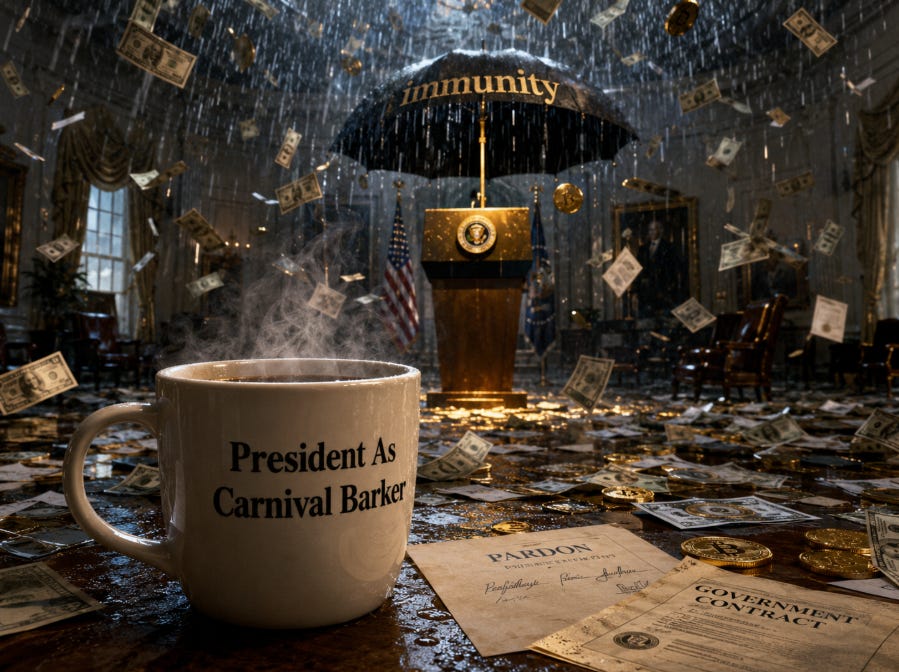
Murphy delivered a long indictment of what he called “500 days of corruption,” arguing that Trump’s scandals are not isolated events but a system. Crypto conflicts. Donor-requested regulatory reversals. Pardons for connected criminals. No-bid contracts. Benefits to Trump family investments. Wartime market trading. Ballroom and fountain contracts. Then Murphy put the theory plainly: “This is not a disconnected series of scandals. This is a system.”
His central argument was normalization by saturation. As Murphy framed it, Trump’s goal is to engage in “so much corruption, so much self-enrichment” and hand out “so many favors to his friends, his family, and his political allies” that it becomes “the pitter-patter of rain.” Normal. Constant. Never-ending. A leak in the roof of the republic, except everyone is told the wet carpet is just patriotism.
In Murphy’s version, the Reflecting Pool is not a symbol of civic restoration. It is another exhibit in the patronage economy: a no-bid contract, inflated costs, Trump friends, public money, and the familiar conversion of government into favor-bank. One object, two narratives. Trump the restorer. Trump the contractor-in-chief. The marble gleams either way; the invoice is the question.
Murphy’s speech deserves its own treatment later, because it was not just a list of scandals. It was a theory of regime corruption. Trump, Murphy argued, is not hiding the corruption. He is flooding the zone with it. He is betting that if there is a new outrage every few days, the public will stop distinguishing scandal from background noise. In normal times, Murphy said, any one of these stories might dominate the news or end a career. In Trump’s Washington, it barely cracks the surface before the next absurdity rolls in wearing a flag pin and asking for a no-bid contract.
Murphy’s closing warning was the real point: once corruption becomes normal, it becomes permanent. That is the danger of the weather machine. Not that every drop shocks you. That eventually, you stop noticing it is raining indoors.
That is the day in miniature. Rutte flattered Trump in order to keep NATO attached to the dock. Senate Republicans staged resistance, then partly folded. Trump turned a messy Iran vote into a real dominance win, but could not yet force the same surrender on the SAVE Act. At the Fair, he converted America’s 250th birthday into a restoration myth starring himself as builder, warrior, redeemer, city planner, price regulator, and part-time fireworks sommelier. Venezuela was both conquered and befriended. The Reflecting Pool was both sacred restoration project and alleged corruption exhibit. And over everything, Trump repeated the refrain: the country was dead, now it is hot, and every institution is expected to line up and confirm the miracle.
The method is not simple chaos. It is pressure, spectacle, and rebranding. Defiance becomes capitulation. War becomes negotiation leverage. Aid becomes proof of friendship with a government you just decapitated. Public works become personal monuments. Corruption becomes weather. And democracy, if nobody keeps pointing at the machinery, becomes just another booth at the fair.
Marz and I are taking a personal day tomorrow, so there will be no morning roundup. The circus, tragically, will continue without us for twenty-four hours. Try not to let anyone privatize the Ferris wheel, invade a country, rename a body of water, or sell pardons out of a commemorative tent while we’re gone.
"The genius of the Reflecting Pool scandal, if one can call it genius without insulting algae, is that it compresses an entire Style of Governance into one ridiculous image.
First, choose appearance over function, then rush the job for the photo op, then announce success before the work survives contact with weather, then, when the thing fails, invent an enemy. And finally, repeat the enemy’s name until the base can no longer tell the difference between evidence and volume. After that comes the enforcement phase...
-SH
I certainly don't believe we are the "hottest" country on earth, but I know Americans are dying from this Administration's heat.