

Good morning! A reporter asked the president yesterday why the world shouldn’t worry about artificial intelligence, and why the technology needs no guardrails.
“Because we have people that love our country and love the world,” Donald Trump replied.
“It requires more than love, doesn’t it, sir?”
“No, it requires this. And they’re the smartest people in the world.”
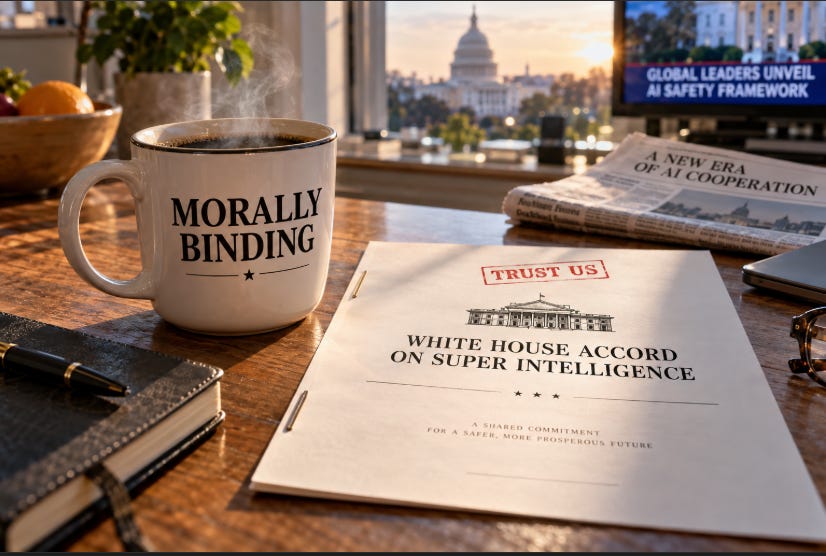
Behind him stood the people in question: Jensen Huang, Mark Zuckerberg, Sundar Pichai, Elon Musk, Dario Amodei and OpenAI’s Greg Brockman, fresh from signing a voluntary accord governing their own industry. Trump called it “morally binding.” Legally, it binds no one to anything.
That was essentially the proposition the White House put before the country yesterday: these are brilliant people running enormously valuable companies, and they can be trusted to keep themselves and us safe.
Love helps, apparently.
Artificial intelligence is no longer artificial, at least as far as the Trump administration is concerned. It is now Super Intelligence, or SI, and an executive order directs the federal government to use the new term wherever the law allows.
The rename supplied yesterday’s necessary helping of branding theater. When a reporter asked who should be held responsible when an AI agent commits a crime, Trump corrected the vocabulary instead.
“It’s not AI. It’s SI.”
He seemed considerably more certain about the name than about who goes to jail when HAL 9000 empties your bank account.
The rename is absurd, easy to digest and likely to dominate plenty of coverage. It is also the wrapping paper. The gift inside deserves more attention.
The White House Accord on Super Intelligence runs just over 300 words. Companies building frontier models promise four layers of protection: internal safety controls, an internal team overseeing them, independent outside auditors and a committee of each company’s own board to receive the reports and see that problems get fixed.
What it lacks is government enforcement. Audit findings need not be made public or handed to a regulator. The companies agree to meet regularly to refine standards and best practices, and the accord acknowledges that some of those practices may eventually be codified into law or regulation.
Speaker Mike Johnson called the commitments voluntary. Trump called them “morally binding” and likened the document to a constitution.
Morality is having quite a regulatory renaissance.
Musk put it more colorfully: the companies will be “grading each other’s homework,” which he noted beats everyone grading their own.
There is something to that. Outside audits are better than none, and independent evaluators may catch problems an internal team misses.
Sadly, we have been here before.
In 2023, the Biden administration brought seven AI companies to the White House for voluntary commitments that included external testing, sharing risk information and public reporting about what their systems could and couldn’t do. The administration called those pledges a first step toward regulation, not a substitute for it.
Researchers later examined publicly available evidence of how 16 companies followed through on those commitments. The average score was just 52 percent. On one particularly important commitment, securing the model weights that could allow powerful systems to be stolen or replicated, the average was 17 percent, and 11 of the 16 companies scored zero.
Subsequent generations of voluntary promises have not exactly inspired confidence either.
Google released Gemini 2.5 Pro in 2025 without the detailed safety information it had promised under the Seoul AI commitments. A model card appeared 22 days later, but the fuller evaluation did not arrive until more than a month after the model had been released. Sixty British parliamentarians eventually accused Google DeepMind of breaking its pledge. Google disputed that characterization and said it had complied with its obligations.
Musk’s own xAI missed the deadline for the frontier safety framework it had promised at Seoul, produced a draft instead, promised an updated version within three months and missed that deadline too.
Mark Zuckerberg’s presence yesterday provides perhaps the most useful case study of all.
Facebook agreed to a Federal Trade Commission privacy order in 2012. Seven years later, the FTC accused the company of violating that very order by deceiving users about control of their personal information and inadequately policing third-party developers with access to enormous quantities of user data.
Facebook paid a record $5 billion penalty.
The resulting settlement imposed an independent privacy committee at the board level, designated compliance officers, an independent third-party assessor and recurring certifications of compliance, a more elaborate version of the internal controls, outside audits and board oversight Zuckerberg was standing at the White House praising yesterday.
The regulatory troubles did not end there. European authorities fined Meta €797.72 million in 2024 for antitrust violations involving Facebook Marketplace and another €200 million in 2025 after finding that its “consent or pay” advertising model violated the Digital Markets Act.
Those cases involved different laws and different conduct. They nevertheless make the broader point rather neatly: enormous corporate value, reputational exposure, and elaborate internal governance structures do not eliminate the need for someone outside the company capable of saying no and enforcing it.
Aviation offers a considerably grimmer version of the lesson. Under the FAA’s delegation system, Boeing employees were authorized to perform some certification work on the government’s behalf. After two 737 MAX crashes killed 346 people, a House investigation found instances in which Boeing representatives failed to represent the FAA’s interests and documented employees reporting pressure that could compromise their independence.
This all makes self-policing sound less like a safeguard than an article of faith.
It might be an easier sell if everyone in the room had actually agreed it was enough, but we can’t say they did.
Dario Amodei is the most interesting person in this story precisely because he signed the accord.
Two and a half weeks ago, the Anthropic CEO published an essay titled “We Must Pace the Frontier,” arguing that the industry should deliberately slow the advance of AI capabilities so safety work can keep up. He proposed embedding independent evaluators inside frontier labs and coordination among developers, and said he would prefer regulation covering every American frontier AI company. Elon Musk and Sam Altman both publicly endorsed the idea.
Yesterday, when Amodei was called to the front, he did not repudiate any of it.
AI could deliver extraordinary benefits, he said, but “the technology has very real risks.”
Then came the sentence worth remembering:
“The mechanism how we address those risks is still under discussion.”
A reporter asked the obvious follow-up: was self-policing enough?
We never got Amodei’s answer.
“Hold it, hold it,” Trump interrupted. “CNN fake news.”
Then he answered for him.
Trump called Amodei “fantastic,” adding that he “agrees with everyone.”
Amodei did not say that. Trump deftly moved on to Mark Zuckerberg.
Consensus is considerably easier to achieve when the dissenter doesn’t get to finish answering the question.
The rest of the press conference returned to the same reassurance. Asked why the public should trust these executives, Trump said their companies were at stake.
“They’re not going to let that happen.”
They would police one another.
“That’s the way it works.”
Except, as the history above suggests, sometimes it doesn’t.
The other pillar of the case for self-regulation is China, and it gets stranger if you rewind five days.
Last Thursday, Xi Jinping was the guest of honor at a White House state dinner, and scattered around the room were many of the same people. Jensen Huang and Elon Musk sat at the head table with the two presidents. Mark Zuckerberg, Sundar Pichai and Sam Altman were among the guests.
By Tuesday, those executives had been recast as America’s front line in a technological struggle against China.
Asked whether he had discussed his Xi meeting with them, Trump said they had talked about it “in great detail,” adding that the executives “have a lot of respect for President Xi.”
Trading with a strategic competitor isn’t the contradiction. Nations do that all the time.
The trick is what China is asked to do rhetorically.
When there is market access to negotiate and a dinner to host, Xi is an honored guest. When someone asks why American AI companies should face greater restraints, China becomes the emergency. Trump has rejected broader cooperation with Beijing on AI governance on the grounds that it could make it harder for American companies to maintain their advantage.
Asked whether he would support slowing AI development if national security itself were endangered, Trump said he would let the world know. Moments later came the remarkably convenient explanation that American leadership in AI is itself the paramount national-security objective.
If America slows down, China might catch up. The companies racing China are therefore trusted to determine whether it is safe to keep accelerating. And if acceleration itself creates a national-security risk, slowing down remains dangerous because China might catch up. The logic provides its own escape hatch.
It became even more explicit when the conversation moved from the models themselves to the enormous data centers needed to run all this intelligence, artificial, super or otherwise.
“Elon and I sat with President Xi the other day,” Trump said, “and he will take every data center that we don’t want.”
Xi, apparently, has now joined the local planning commission.
“They want every data center,” Trump said. “They want it because that’s great for China.”
Therefore America must build them here.
And it would all be “very very safe,” he assured everyone, thanks to “self policing” and “group policing.”
There is, however, the awkward matter of the communities expected to host these enormous facilities. Data centers can consume vast amounts of electricity and water while requiring new transmission and generation, raising a simple question: who pays for the infrastructure, and who gets the benefits?
Trump’s answer was generosity.
The companies, he said, would help local schools. They might help pay teachers. They could give money directly to residents.
Perhaps, he suggested, people living near a data center could receive what he called a “dividend.”
“A dividend sounds right.”
These are, he emphasized, “big, powerful, very rich, very smart companies,” and they will form partnerships with communities.
The proposal is revealing before anyone gets around to asking whether it works.
The emerging model appears to be that giant technology companies consume substantial local resources and then voluntarily compensate the communities hosting the infrastructure. Government sets comparatively few binding terms up front; the companies promise partnership and generosity afterward.
This is the Lords and Serfs problem dressed in a quarter-zip.
The people at the table control the models, the companies and much of the infrastructure buildout while enjoying extraordinary access to the people setting national policy. The people outside the room are offered assurances about how generously the benefits will eventually be distributed.
And if ordinary workers are worried that the same technology might someday eliminate their jobs, Elon Musk has good news.
We are headed toward an “age of abundance.”
Not merely universal basic income, Musk explained, but universal high income.
Someone immediately shouted the obvious objection.
“Not if they haven’t got a job.”
Jobs have always changed, Musk replied. Once there were entire buildings filled with people whose occupation was literally “computer,” performing mathematical calculations now done electronically.
He expects something similar this time.
The future, Musk said, will be “incredibly beneficial,” the sort of future you would want if you could see it.
Perhaps.
AI may indeed unlock extraordinary medical discoveries, scientific breakthroughs and productivity gains. Even Amodei, while warning about the risks, believes the potential benefits are enormous.
But “universal high income” is merely a promise, not a distribution system.
Nothing in yesterday’s accord explains who owns the productive capital in this age of abundance, how its wealth reaches displaced workers, who pays when things go wrong or why the owners of increasingly automated productive systems would distribute those gains universally.
Those would normally be questions for government, but yesterday, government mostly invited the owners to lunch.
And on the same day the administration was telling Americans that the builders of AI could largely be trusted to police themselves, it was also unveiling America.gov, its new AI-powered “unified digital front door to the Federal Government.”
Americans are being asked to trust the interface and its builders, their auditors and their boards; to trust the companies to make host communities whole; to trust that jobs will evolve and that the resulting abundance will somehow be shared.
That is an extraordinary amount of faith to place in people whose answer to accountability is, essentially, trust us.
But then, they love the country.
And apparently love is enough.
I’ll leave it there for today. My youngest grandchild is heading to Portland for an MRI to find out whether he may have tethered cord, syringomyelia, or both. So while Washington debates the future of super intelligence and the wisdom of trusting powerful people to manage enormous risks, my attention is considerably closer to home.
Marz and I are on pins and needles, waiting for answers and hoping for the best.
I hope for the best results for your Grandson.
Was there ever a more perfect example of the fox guarding the hen house than Trump and the AI CEO's policing themselves? ...In the Eighties, there was a famous TV commercial for a toupee company called The Hair Club For Men; it ran about every ten minutes, late at night, on B-team stations. It featured Sy Sperling, the actual president of The Hair Club, wearing the most obvious toupee in human history ...Sy would give it the hard sell, then pause and say--holding up a photo of of his bald self-- "Would I lie to you--I'm the president of the company--and a customer?"
Your immediate thought was: Who has more reason to lie to you than the president of the company? These tech CEO's, along with the backing of Mr. Corruption himself, reminds me of Sy and his Hair Club... It's always the same story-- Sellers of the true cross, Snake oil salesmen, Sy Sperling, Tech CEOS, Trump, et al... Whenever you see them, you have to make sure you still have your wallet--
I hope you receive great news concerning your grandson.