


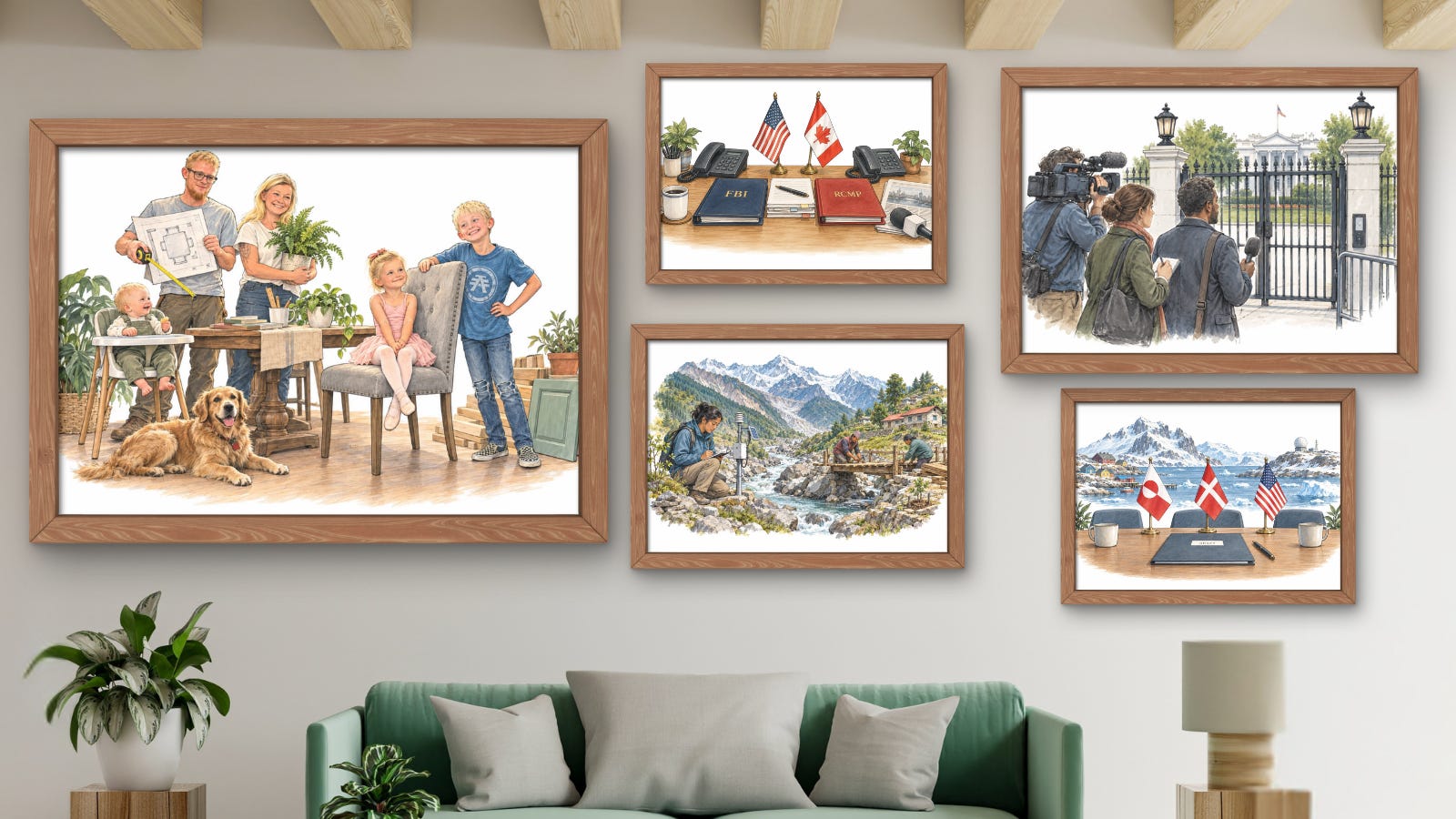
Greenland, Denmark, and the United States are preparing to sign a new security agreement, with parliamentary procedures still to follow before it takes effect. The announcement puts several questions back in the news: who has access, what that access permits, and how the people who live there are represented in the arrangement.
At our house, questions of access are currently concentrated around a gray dining chair, although before we get to that particular negotiation, we need to discuss the apparently extravagant ambition of having a deck and a kitchen sink. We’re still working on building the deck, which is a lot, and expensive, but we want to do it right. We want this place to feel like us, and we also need to be wise about how we spend our money, because the bank account has consistently refused to participate in my vision.
My husband is generally the one who agonizes over these things, while my ADHD brain simply reacts to whatever is directly in front of it. This is why we have so many plants with no homes, because apparently seeing a plant, liking a plant, and bringing a plant home are three stages of a process that my brain considers complete. Where the plant will live is a problem for a future version of me, who would probably appreciate being consulted.
My husband plans, thinks, and prepares, and although I envy that ability sometimes, I mostly feel lucky to share a life with someone who makes room for the way my mind works. He helps carry the practical details so I can flow a little, which is a lovely thing to have in a marriage, even when the flow leads directly into another nursery.
We have so many big plans, and realistically, nowhere near enough money to complete all of them on the schedule I have developed in my head. Everything I price seems determined to remind me of this, especially kitchen cabinets. Ours have an immense amount of water damage from a longstanding leak that we fixed after moving in, but stopping the leak unfortunately did not persuade the wood to return to its original condition.
The kitchen sink needs replacing too, and I find it absolutely horrendous that someone can look at a sink and decide that $1,000 is a reasonable amount of money to charge for it. At that price, I would like it to wash the dishes, put them away, and gently ask whether I have had enough water today. Then there are the hardwood floors, which could be beautiful with enough work, although apparently the work also expects to be paid for.
Meanwhile, the children have opened a new front in their ongoing sibling negotiations, and this one concerns the gray chair. The gray chair is the tallest chair, which means it goes to my daughter because she is the shortest person trying to eat dinner at the table. I have explained this arrangement enough times that I feel qualified to teach a small course on it, but her older brother continues attempting to acquire the chair whenever the opportunity presents itself.
Perhaps the chair has qualities I have failed to appreciate, or perhaps announcing that something cannot be his has transformed an ordinary piece of furniture into the most desirable object in the house. He is ten, and he is still learning how to manage the large feelings that arrive in a relatively small body, while I am learning that dinner apparently requires a seating agreement and someone to supervise its implementation.
All of which has made the words agreement, access, and ownership unusually prominent in my day, and brings us back to Greenland. According to ABC News, Trump described the agreement as giving the United States permanent control over Greenland’s security. A State Department official described permanent access, military basing, and overflight rights, along with restrictions on sensitive investments by American adversaries. Trump also said the United States would begin developing a larger military presence there. Those are the administration’s descriptions of the arrangement, and the detailed terms will matter in determining how it operates.
The statement from Denmark and Greenland says the three governments expect to sign at the coming United Nations General Assembly. Danish Prime Minister Mette Frederiksen said the agreement recognizes the Kingdom of Denmark’s sovereignty and territorial integrity, along with Greenlanders’ right to self-determination. Greenland’s leader, Jens-Frederik Nielsen, said it recognizes Greenland’s interests and role in international cooperation. Their announcement describes a security agreement, with national parliamentary procedures required before it enters into force.
The United States already has a substantial defense arrangement dating to 1951 and operates Pituffik Space Base, which helps monitor potential missile threats over the Arctic. ABC reports that it remains unclear whether the new agreement will amend or supplement that existing pact. The next details to watch are the agreement’s text, its approval process, and the scope of any new deployments. Military access and sovereignty are separate questions, and the announcements so far do not establish a transfer of ownership.
There is also an update on the White House media ban: journalists from CNN, MS NOW, and Politico reported being denied entry on Saturday after Trump announced restrictions on Friday. ABC directly observed a CNN reporter and photographer being turned away. Trump cited objections to the outlets’ coverage, while the organizations said they would defend their reporting and First Amendment rights. For more on the media ban, check out Mom’s piece from earlier today.
A separate report concerns a dispute over CBC’s language guidelines and cooperation between American and Canadian police. According to New York Times reporting, as summarized by TheWrap, some FBI cooperation with the Royal Canadian Mounted Police was temporarily interrupted after Director Kash Patel objected to CBC’s guidance on using the terms terrorism and terrorist when describing September 11. Meetings were reportedly canceled, but the interruption did not encompass all FBI cooperation, and other American agencies continued sharing intelligence. It reportedly ended around September 11, so this is newly reported past conduct rather than evidence of a current cutoff.
CBC, which is editorially independent of Canada’s government, changed its guidance on August 28 to permit describing the attacks as terrorism without attribution. The broadcaster told TheWrap it made that decision independently and had not been contacted by the FBI or American government about its guidance. The FBI declined to comment to TheWrap, and the interruption’s exact duration and operational consequences remain unclear in that account.
Finally, new research from Nepal examines what happens when a disaster exceeds the protections a community has built. World Weather Attribution published its analysis on September 17, examining the August 26 rock-and-ice collapse that became a destructive flood. Researchers describe geological weaknesses interacting with warming, thawing ice, and water movement, while explicitly stating that they didn’t determine whether this particular collapse would’ve happened without human-caused climate change.
The study also explains that Nepal’s warning systems have saved lives in more predictable floods, including downstream during this disaster, but the speed and scale of this event exceeded what existing systems could manage in the hardest-hit areas. Its findings include a need for better monitoring, communication, and support for recovery, while acknowledging that even improved preparation has limits. The human consequences extend beyond the initial flood to the difficult work of restoring homes, services, and livelihoods.
Reading about families rebuilding after that kind of loss gives the word home a weight that no renovation estimate can quite capture. Our projects are about making a place we already have more comfortable, more functional, and more ours, and there is a great deal of good fortune tucked inside that sentence.
For now, our deck remains a work in progress, the plants remain optimistic about their housing applications, and the gray chair remains the subject of negotiations that I expect to reopen at dinner. My husband will keep thinking through the practical details, and I will keep imagining what this place can become, while we try to make those two approaches meet somewhere the budget can tolerate.
That’s the life happening alongside the headlines, and it’s why I keep returning to the details of what people are building, what they are trying to protect, and what happens after an announcement becomes part of somebody’s ordinary day.
A restack does more than you might think! If you value The Homefront Report, please consider becoming a paid subscriber or sharing it with someone who might enjoy reading along. Your support helps Mom and me keep this newsletter going, and we are grateful to have you here.
If you’d like to chip in on our family’s projects, plants, and everyday adventures, you can leave a little extra love here.
26 years later the siding AND battens are nearing completion..It’s truly a hobby, perfecting as the money provides , from scratch meant felling the trees, milling the lumber and slow methodical improvements , the crisis currently -the pneumatic finish nailer 15 + years old groaned and gave up - but west and north sides are completed, shelves back up and what’s “right in front of me” ( that talent adding distractive normalcy gave me a real laugh!!!) …another ADHD cleans up the mess..gratefully. I’m so excited to realize this ‘shack’easier to heat . These improvements ARE incredible feats of accomplishment. We do it ourselves ,with occasional nashings and wailings, learning degrees of difficulty. Bravo , you two got gall! I know!
When we sit at the table …giving thanks…and gaze about…it’s amazing. Enjoy🫶