


Good morning! What caught my attention yesterday was not simply that Donald Trump announced on Truth Social CNN, MS NOW and Politico were no longer welcome at the White House, but how directly Trump himself connected the press to November.
We can’t know precisely what’s in the president’s head or, this morning, happening inside the gates at Camp David, to know whether he is nervous about the midterms. But we do know November is occupying his public rhetoric.
During Friday’s Oval Office announcement on prescription drug pricing, Trump said the new Medicaid program alone “should win us the midterms.” Then came the grievance attached to the accomplishment: “It won’t because the press doesn’t report it.”
The problem, as Trump described it, was that the press was depriving him of political credit for something he believed voters should reward in November.
Later in the same appearance, when a reporter asked about the $500 rebates the administration says it will send to some unsubsidized Obamacare customers, Trump pivoted almost immediately to his much larger political promise: $5,000 for American adults “if the Republicans win.”
So there it was in one afternoon: healthcare savings, November, $5,000 checks and complaints that the press refuses to tell Americans how well things are going.
Now there are three fewer news organizations invited to tell them. Saturday morning, this was no longer just another all-caps Truth Social declaration awaiting its eventual collision with reality. MS NOW correspondent Akayla Gardner arrived at the White House entrance and discovered her credential had been disabled. CNN correspondent Betsy Klein encountered the same thing. Politico’s Cheyenne Haslett was also denied entry. AP reports that journalists from all three organizations were turned away after Trump’s Friday announcement.
The timing has a certain civics-textbook quality to it.
We are now in Constitution Week, Thursday was Constitution Day, marking the anniversary of the signing of the Constitution on September 17, 1787.
This morning, the First Amendment had acquired a badge reader.
Trump’s explanation makes the constitutional issue considerably more interesting than the usual presidential complaint about “fake news.” Asked Friday why he was doing this, he complained about what he called “cumulative stories” over the previous two years. He said the organizations “purposely write negative news” because they want to diminish Republicans and his administration.
Later, he put it even more plainly:
“There’s something wrong with a country that can allow people to write purposely negative stories.”
He added that the outlets could still write them; he simply did not have to allow them into “the people’s house.”
And when somebody finally asked precisely how far the ban was supposed to extend, Trump answered that it should go “as far as you can.” He said the organizations could return if they “straighten themselves out.”
“Fake news” generally means journalism alleged to be false.
“Purposely negative” means journalism the subject does not like.
Those are not remotely the same thing.
There is another problem with appointing the president as the referee of what counts as “fake.” During Trump’s first term, The Washington Post Fact Checker catalogued 30,573 false or misleading claims from him, an average of about 21 a day, with nearly half coming during his final year in office. That tally does not establish that every misstatement was an intentional lie, but it does establish a rather substantial record of claims that did not survive contact with the facts.
Friday supplied a wonderfully timely little demonstration of the problem. Asked about the Russian businessman who paid for two nights of Donald Trump Jr.’s wedding festivities, Trump said his son had paid him back. Then, moments later, he recalled Don Jr. telling him, “I’m paying it back, Dad.” ABC News asked the White House and Trump Organization for evidence that repayment actually occurred. None had been provided by the time the story was published.
Somewhere between “paid” and “paying” there may be a receipt. A presidential assertion is not evidence merely because the president asserted it. Journalism’s job is to ask for the receipt.
Which makes “fake news” an especially slippery standard when Trump himself gets to define it. The problem is not merely hypocrisy. It is that he is trying to make presidential approval the test of factual legitimacy. Reporting can be accurate and still be negative. A president can make a false claim and still call the correction “fake.” Once government access depends on which version the president prefers, truth has been replaced by permission.
The White House Correspondents’ Association made that distinction Friday night, noting that constitutional protection of the press does not depend on whether a president likes a publication’s reporting or the questions its journalists ask. The Reporters Committee for Freedom of the Press called the action “textbook viewpoint discrimination.” Those are the organizations’ legal characterizations, and litigation seems inevitable.
The White House does have discretion over small, restricted presidential spaces. But that is not the same thing as a blanket power to exclude credentialed journalists from established press facilities because the president dislikes their coverage. The D.C. Circuit has long recognized that once the White House opens press facilities to bona fide journalists, access cannot simply be denied arbitrarily or because of what they report.
Which brings us to Politico, because Trump has provided a wonderfully tidy example of why irritating journalists insist on checking nouns.
He keeps describing roughly $8 million in federal payments to Politico as an illegal Biden-era subsidy intended to keep the publication alive. It wasn’t. Federal agencies were buying subscriptions and access to Politico Pro, a professional policy-tracking service. The transactions were contracts, not grants or subsidies, and federal agencies bought Politico subscriptions during Trump’s first term too.
“Maybe Washington shouldn’t be spending this much on premium news subscriptions” is a perfectly reasonable argument.
“Joe Biden secretly paid Politico $8 million to keep it alive” is a different story.
That is where Judge J. Michael Luttig belongs in this story.
Luttig, the conservative former federal appellate judge who advised Mike Pence in 2021 that the Constitution required him to count the electoral votes, spent Constitution Day talking about a different constitutional provision and a different potential confrontation.
Luttig has been warning about Trump’s calls for Republicans to “take over the voting” and “nationalize the voting.” His legal point is straightforward even if his larger warning about January is more speculative: the Constitution does not give the president authority to administer federal elections merely because the president wants it. States run elections under constitutional rules subject to congressional authority. Presidential desire does not manufacture a new constitutional power.
From there Luttig goes somewhere much darker, and we should be precise about what he is saying.
He has laid out a hypothesis, not reported an established Republican plan, about what could happen when the new House organizes on January 3, 2027. Article I, Section 5 gives each chamber authority to judge the elections, returns, and qualifications of its members. Luttig worries that the process could be manipulated at the seemingly mundane level of the House clerk’s roll of members-elect, potentially triggering an enormous constitutional fight over whether duly certified representatives could be kept from participating in organization of the new Congress.
I would not report Luttig’s feared scenario as something Mike Johnson has decided to do. But there is a reason the machinery does not feel quite as academic as it otherwise might.
Remember Adelita Grijalva.
Grijalva won the special election for Arizona’s 7th District on September 23 last year. She then waited 50 days before Speaker Johnson administered her oath. Johnson said the delay resulted from the government shutdown and the House being out of regular session. Democrats argued that he was delaying her because Grijalva had promised to sign the discharge petition forcing a vote on the Epstein files. Johnson denied the accusation. His explanation drew additional scrutiny because Republican special-election winners had previously been sworn in during pro forma sessions.
When Grijalva was finally sworn in on November 12, she immediately became the 218th signature needed for the Epstein discharge petition.
It proves demonstrates how procedures that sound boring enough to cure insomnia, administering an oath, preparing a roll, scheduling a session, can determine whether hundreds of thousands of Americans have a functioning representative and whether Congress has the votes to act.
Those boring mechanisms become fascinating very quickly when somebody discovers they can be used as a lever.
And all of this is unfolding against an increasingly loud midterm soundtrack.
Friday’s healthcare announcement was supposed to be about Medicaid drug prices. Trump turned it into a prediction that the policy should win the midterms, a complaint that the press would deny him credit, and another promise of $5,000 if Republicans prevail.
Earlier in the week, he posted that the 2024 Butler assassination attempt had been “all a Democrat Plot” designed to remove him from the election. He said new information had been found but provided no public evidence connecting Democrats to Thomas Matthew Crooks.
On the same day, Trump’s own FBI director, Kash Patel, testified that investigators had examined data from roughly 27 devices looking for domestic and foreign connections and found no evidence Crooks had been communicating with anyone other than his parents.
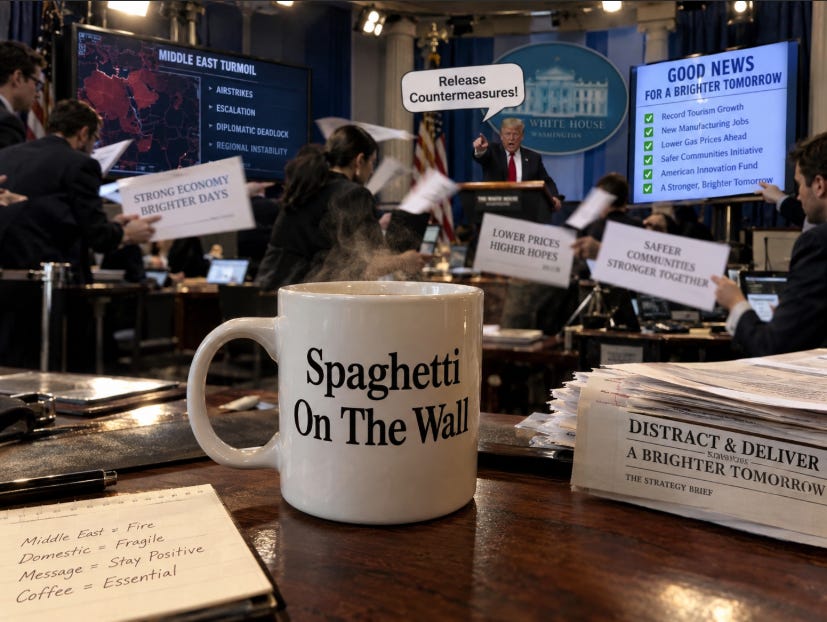
There is a lot of spaghetti being hurled at the wall.
Healthcare savings. $500 rebates. A conditional $5,000 payment. Butler recast as a Democratic plot. Crime. Immigration. Iran. Bad economic news attributed elsewhere, good economic news held aloft as proof of success, and unfavorable journalism described as evidence that the press is conspiring to deny the administration its due.
At least for now, the ketchup remains safely on the dining-room table.
The Middle East is hanging over all of this as well. At Friday’s event Trump acknowledged that Americans would have to pay “some extra gas” because of the Iran war while insisting the conflict would end soon and gasoline prices would fall afterward. Whatever political credit the White House hopes to extract from drug prices, rebate checks or other domestic announcements is competing with a war whose economic and geopolitical consequences are considerably harder to fit on a campaign placard.
Today Trump is at Camp David.
The public schedule gives us only “Executive Time,” closed press. We do not know whether advisers are there talking about November, Iran, Xi Jinping, or anything else. We do know that Trump went there after a MAGA Inc. meeting and dinner Friday evening, and that he has no public appearance scheduled today.
It would be easy to fill that silence with speculation. I’m more interested in what he has already shown us in public.
My read is that Donald Trump is on his heels.
That is not a prediction about who will win in November. It is my reading of how he is behaving as November approaches. He is reaching for good news, attaching electoral significance to policy announcements, promising cash if Republicans win, recasting criticism as persecution and now trying to decide which reporters are allowed through the White House gate.
And being on your heels cuts two ways.
It can expose pressure points. Trump is repeatedly telling us what bothers him: bad economic news, the political costs of the war, unfavorable coverage, the possibility that voters will not give him credit for the things he believes are going well.
But Friday showed the other side of that equation. Pressure does not necessarily produce restraint. Trump complained that the coverage was negative. He said the outlets should “straighten themselves out.” By Saturday morning, their credentials no longer opened the gate. The ban itself is now part of the story.
We do not need to know what Donald Trump is saying behind closed doors at Camp David to see the tension in front of us. A president who keeps invoking November is simultaneously encountering courts, journalists, political opponents and constitutional limits that do not disappear because he objects to them.
That is the vulnerability I see, and also the danger in it. The more pressure he feels, the more consequential his response to that pressure becomes.
Two days after Constitution Day, perhaps the useful lesson is not merely that the Constitution places limits on presidential power. It is that those limits matter most when a president is pushing against them.
The First Amendment promises the rest of us that Trump’s dissatisfaction with the coverage is not supposed to decide who gets to report the news.
Mary, can you address that Medicare Part D premiums are going to skyrocket in January. Mine will increase three fold. I am not sure many.people are aware. Thank you!
"Trump’s explanation makes the constitutional issue considerably more interesting than the usual presidential complaint about “fake news.”
The only "fake news" coming out of Washington is coming out of Trump himself.