


Today, the federal government spent the morning trying to make voting by mail more complicated while states spent the morning racing into court to stop it, which feels about right for a country where we have apparently decided that every functioning system is simply an unfinished renovation project.
A federal judge in Boston dissolved the remaining nationwide injunction blocking the Trump administration’s mail-voting restrictions, meaning the new rules can move forward for now as the legal fight continues. The order would prevent the Postal Service from delivering mail ballots from voters who don’t appear on citizenship lists generated by federal agencies, and election officials are being asked to contemplate implementing major changes just weeks before ballots begin moving through the system. Oregon Attorney General Dan Rayfield filed a new challenge today alongside other states, arguing that the administration is intruding on authority the Constitution gives states to run their own elections. In Oregon, where we have managed to conduct statewide elections by mail for more than two decades without requiring the White House to inspect the envelopes, officials are understandably unimpressed.
To be quite frank, I don’t know where we are today either. It’s been nothing but chaos around here for weeks, and I think we may finally have reached the point where the household itself is gently suggesting that perhaps we stop trying to solve every problem at once. My husband is spent. I don’t know that he has one more ounce of emotional energy available for my problems, the kids’ problems, the house problems or whichever construction problem I have recently wandered into holding a tape measure and an unreasonable amount of optimism. Maybe I pushed him too hard to hurry up and renovate the upstairs because the kids were driving me crazy. Maybe instead of trying to solve the problem by giving them more space, I should have started by establishing better boundaries in the space we already have.
This is one of those parenting revelations that is incredibly obvious approximately five minutes after you have purchased the lumber. When I spend so much time working, I feel guilty about the kids. I worry that I’m not giving them enough of myself, even though I spend more time with them now than I have through most of their lives. That guilt makes me reluctant to tell them they can’t interrupt me while I’m working, because some part of me believes that if I am physically here, I should also be perpetually available.
Maybe some of that comes from my own childhood. I remember being grateful that my mom worked from home and that I could come to her when I needed her, and I want my children to have that same feeling. I want home to be the place where Mom is accessible, where questions can be asked and problems can be brought and somebody is there.
But accessibility and total availability may not actually be the same thing. I have ADHD, I can’t reasonably expect myself to maintain sustained focus while somebody asks me where the scissors are, somebody else needs a snack, somebody has discovered an injustice involving a sibling, another person can’t locate a water bottle that is directly in front of them, and somewhere in the distance a child has begun yelling my name for reasons that will almost certainly turn out not to involve blood.
Focus time is for them, and the work is for them too. If I want this career to succeed, if I want to help build financial stability for this family and create the opportunities I spend so much time imagining for them, then sometimes loving my children has to look like telling them that Mom needs an uninterrupted hour. Nobody really explains this part when you imagine having children.
You picture the enriching childhood, the structured home, the financial stability, the traditions, the family dinners, the vacations, the garden, the crafts and the warm memories, and then one day you discover that producing all of those things requires approximately thirty-seven simultaneous jobs and somebody is always asking whether they can have a popsicle.
Then there’s marriage, because somewhere inside the elaborate logistical operation known as raising a family you are also supposed to maintain a healthy relationship with another adult. Sometimes by the end of the day I don’t want one more snack request, one more drink request, one more question or one more person requiring anything from my body or brain. I want to lie perfectly still in a vegetative state and become one with my own thoughts for a little while. Except I haven’t seen my husband all day, and I miss him.
So even the silence I crave becomes complicated by the fact that I also want to sit beside the person I love. We are always racing against the clock, trying to find enough time for each other, for the kids, for work, for projects, for cleaning, for the garden, for the house and for the apparently full-time administrative position of designing a structured family life. Maybe I’ll make sense of the mess eventually, but right now I think I need to stop and remember why we’re fighting so hard in the first place.
I don’t work this hard because I’m trying to build some grand life for myself. I do it because I want to build something wonderful for my children and their future. I don’t agonize over how I spend my time because I’m worried about whether my personal enrichment quota has been met. I agonize over it because there are people I love deeply, and somehow there never seem to be enough hours to make every one of them feel as important as they are. Lord knows that if I lived alone, I would probably be building racetracks out of aluminum cans I collected and designing unnecessarily elaborate plant landscapes across every available surface. That would not be better.
I bought slippers for the kids recently. My oldest wanted sharks, because apparently the correct footwear for relaxing at home should also look capable of removing a toe. My daughter, because of course she did, wanted capybaras to match Mommy. That alone melted me a little, but last night she finished the job.
She took off her slippers before bed and announced, in the adorable little sing-song voice she uses for most of her life now, “Gotta take off my slippers to get in bed, and I’ll put them by the door.”
I told her she could put them beside her bed instead, because then when she woke up in the morning she could slide her feet straight into her cozy slippers, just like Mommy does.
“I’m gonna do that too!”
Some time passed, and eventually she wandered into my room to lie in my bed with me, as is the custom in our house. She arrived fully prepared with the stuffed bunny she always sleeps with, her water bottle and her capybara slippers, which she carefully placed beside mine so that when we woke up together, we could put on our matching slippers. It was such a tiny thing. There was no grand family experience involved, no finished upstairs bedroom, no expensive outing, no perfectly scheduled enrichment activity and no evidence whatsoever that I had successfully optimized her childhood.
She just wanted her slippers next to mine. Without any effort at all, she made me feel warm and important, like something I had done mattered to her, and reminded me that there’s nothing in the world that compares to being loved in those tiny, ordinary ways. That’s why being alone wouldn’t be better.
So maybe things are chaos here, and for the first time in a while I don’t know exactly what our next steps are. I do know that we can’t keep behaving as though there is no tomorrow, because every evening tomorrow arrives anyway and brings another list with it. I want to stop barreling down the runway at full speed long enough to recognize that my children don’t actually care whether they have brand-new bedrooms or independent nations in their upstairs hideaway. They care about their time. They want to make plaster stepping stones, paint landscapes across canvases, learn about the ecosystem in our woods, check the tomatoes and the cucamelons and the strawberries, and live in the strange little world we’ve built together. They want to feel important, and rightfully so, because I’m not nearly as much a gift to them as they are to me.
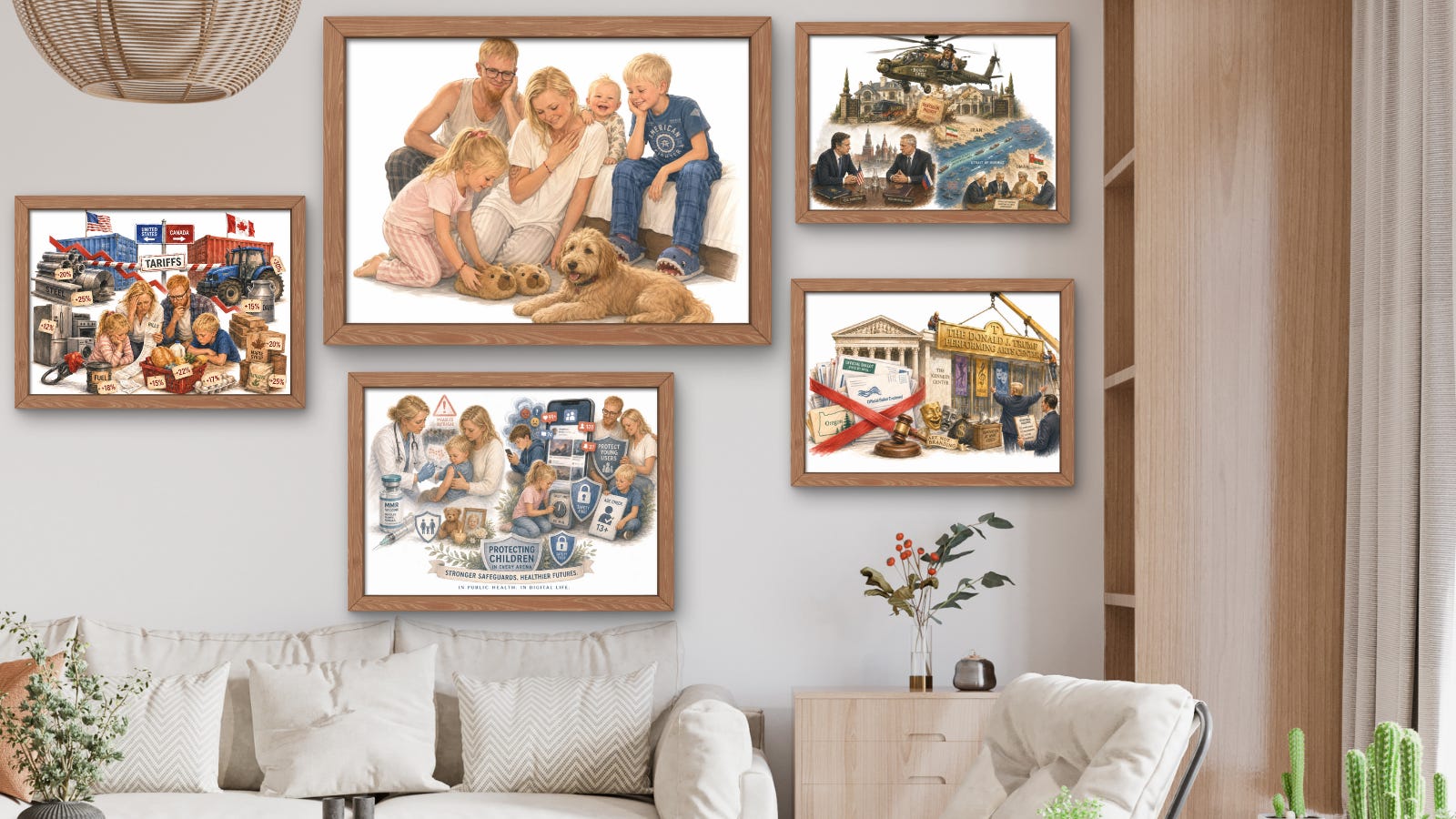
Unfortunately, this revelation about slowing down has not yet reached Washington. The United States and Canada are now exchanging tariffs of up to 50 percent on billions of dollars in goods after trade negotiations collapsed, with Canada preparing retaliatory duties on about $20 billion worth of American steel, dairy products, appliances, farm equipment and other goods beginning September 8. Ontario Premier Doug Ford has threatened further retaliation involving electricity and critical minerals, and Trump responded to this extremely serious economic dispute by floating the idea of renaming Lake Ontario “Lake America,” because apparently diplomacy now comes with the same naming conventions as a suburban water park.
There is a real-world problem underneath the performance, because Americans and Canadians don’t conduct $880 billion in annual trade purely for recreational purposes. Supply chains cross that border constantly, American farmers depend on Canadian fertilizer, Midwestern refineries rely on Canadian oil and manufacturers on both sides build products together, which means tariffs have a nasty habit of eventually finding their way out of presidential social-media posts and into somebody’s household budget.
That matters especially today because new Commerce Department numbers show the U.S. economy grew at an annual rate of just 1.5 percent in the second quarter, down from 2.1 percent in the first, even while consumer spending rose at a healthy 3.4 percent pace. The Fed’s preferred inflation measure remained at 3.7 percent year over year in July, well above its 2 percent target. The economy is not collapsing, but families are still doing a remarkable amount of the carrying while prices remain elevated, and starting an avoidable trade war with the country next door isn’t generally regarded as a traditional cost-of-living strategy.
Then there’s the Kennedy Center, which continues its determined effort to become the most expensive argument over a man wanting his name on something. Justice Department attorneys are now arguing that unless Trump is allowed to receive prominent recognition for renovations to the Kennedy Center, donors may withdraw support, the building could continue deteriorating and eventually it might have to be torn down. The Trump-aligned board has proposed adding language to the building identifying it as renovated and restored by Trump, along with other possible Trump-related naming, after an earlier attempt to put his name on the center was stopped in court. A federal judge is expected to hear arguments Thursday.
This is an institution created as a living memorial to John F. Kennedy, but apparently we have reached the sponsorship portion of American history where national monuments may require the architectural equivalent of “this segment brought to you by.”
There’s something strange about insisting that donors will abandon a cultural institution unless the sitting president’s name appears on it when attendance and artist participation have already suffered during his takeover of the center, but perhaps there’s an advanced fundraising principle here that I failed to learn in my years of grant writing.
The healthcare news is much harder to laugh at. Pennsylvania has reported the first two measles-related deaths in the United States this year, both involving unvaccinated residents of Lancaster County. The country has now recorded five measles-associated deaths over the past two years, more than the combined number reported during the previous three decades, while 2,777 cases have been recorded this year and the United States is experiencing its worst measles year since 1991.
There isn’t a joke worth making there, because measles was declared eliminated from continuous domestic spread in the United States in 2000, and we are now preparing for international health officials to determine whether the country has lost that status.
Vaccination rates have fallen below the level generally needed to prevent outbreaks, while doctors have repeatedly warned that the Trump administration’s changes to childhood vaccine policy and messaging from Health Secretary Robert F. Kennedy Jr. are creating more confusion around vaccines at exactly the moment when clarity matters most.
While the government is reconsidering how children should be protected from diseases we once largely controlled, states have decided they would also like technology companies to reconsider how children are treated online. Meta agreed today to pay up to $17 billion and adopt stronger protections for young users on Facebook and Instagram, settling claims brought by nearly every state over allegations that the platforms used features designed to capture and hold children’s attention in ways that harmed their mental health. The agreement includes a two-hour daily limit by default for users under 18, restrictions on overnight access and school-day notifications, stronger age-assurance measures, hidden like counts and other protections, with money from the settlement also directed toward programs for children and teens.
It has apparently taken years of litigation, nearly every state in the country and a settlement that can be measured in tens of billions of dollars to arrive at the revolutionary principle that children might benefit when corporations are not financially rewarded for keeping them staring at a screen for as long as humanly possible.
And because no American news day is complete without at least one story that sounds like somebody accidentally shuffled together three unrelated newspaper sections, The Washington Post reports that days before Army Chief of Staff Gen. Randy George was abruptly fired, another senior general advised him to abandon an investigation into an unauthorized Apache helicopter flyby at Kid Rock’s Tennessee estate. According to people familiar with the matter, Gen. Chris LaNeve told George that Defense Secretary Pete Hegseth didn’t want the investigation to continue. There’s no evidence establishing that the investigation caused George’s firing, but the sequence is now raising questions, particularly because LaNeve is currently serving as acting Army chief of staff and has not yet been formally nominated for the permanent job amid concerns that he lacks sufficient support on the Senate Armed Services Committee. I would like to remind everyone that these are Apache helicopters, the United States Army and Kid Rock’s house, because sometimes the facts need no additional assistance from me.
Abroad, CIA Director John Ratcliffe made a rare trip to Moscow on Tuesday for meetings with Russian intelligence officials, a visit so routine that the Kremlin confirmed it, Trump called it “semi-routine,” and Ukraine says Washington asked it to temporarily suspend strikes near Moscow, St. Petersburg and some northern regions while the American delegation was there. The substance of those meetings remains secret, but they come as negotiations over Ukraine have largely stalled and Russia continues balancing its relationship with Iran against other regional interests.
At the same time, Iran and Oman say they have reached an understanding on a temporary framework for commercial shipping through the Strait of Hormuz, which remains largely shut nearly six months into the Iran war. Iran says military vessels wouldn’t be allowed through under the proposed arrangement, while commercial traffic would move through designated Iranian and Omani waters, with talks on a more permanent system expected over the next 30 to 60 days. Trump said this afternoon that the war will continue “for as long as necessary” and that there is “no specific timetable” for restarting peace negotiations, even as the two countries work on a mechanism to reopen commercial traffic through one of the world’s most important shipping lanes.
So that’s where we are today. Countries are fighting over tariffs, courts are fighting over ballots, lawyers are fighting over whether a performing arts center can survive without Donald Trump’s name attached to it, public-health officials are fighting a disease we once pushed to the margins, states are fighting technology companies over what they did to children, and somewhere inside the Pentagon there are apparently questions to answer about a helicopter visiting Kid Rock. We’re still remembering Dolly Parton too, because some people deserve to linger in our thoughts longer than the news cycle allows.
Around here, I think I’m learning something less dramatic but possibly more useful, which is that not every problem requires immediate acceleration. Sometimes the upstairs, the project, or the email can wait. Sometimes a child needs to hear that Mom is working right now, and sometimes Mom needs to hear that the work will still be there after she goes outside to inspect the strawberries.
There will always be another deadline, another bill, another room that needs renovating and another crisis competing for our attention, but there won’t always be a little girl carefully placing her capybara slippers beside mine because she wants to wake up and put them on together. Maybe the point was never to build the perfect life fast enough, maybe it’s to notice that we’re already living it.
Shanley, you and your mom are national treasures. I love how you ended your essay. The awful current events were also discussed, because they should be. WTAH is wrong with people?
Elizabeth Fenlon you are absolutely right, Shanley and Mary are absolutely national treasures, and sometimes they are the brightest part of my day!!!!